Bulgaria Wood Pellets Market Top 5 Importing Countries and Market Competition (HHI) Analysis
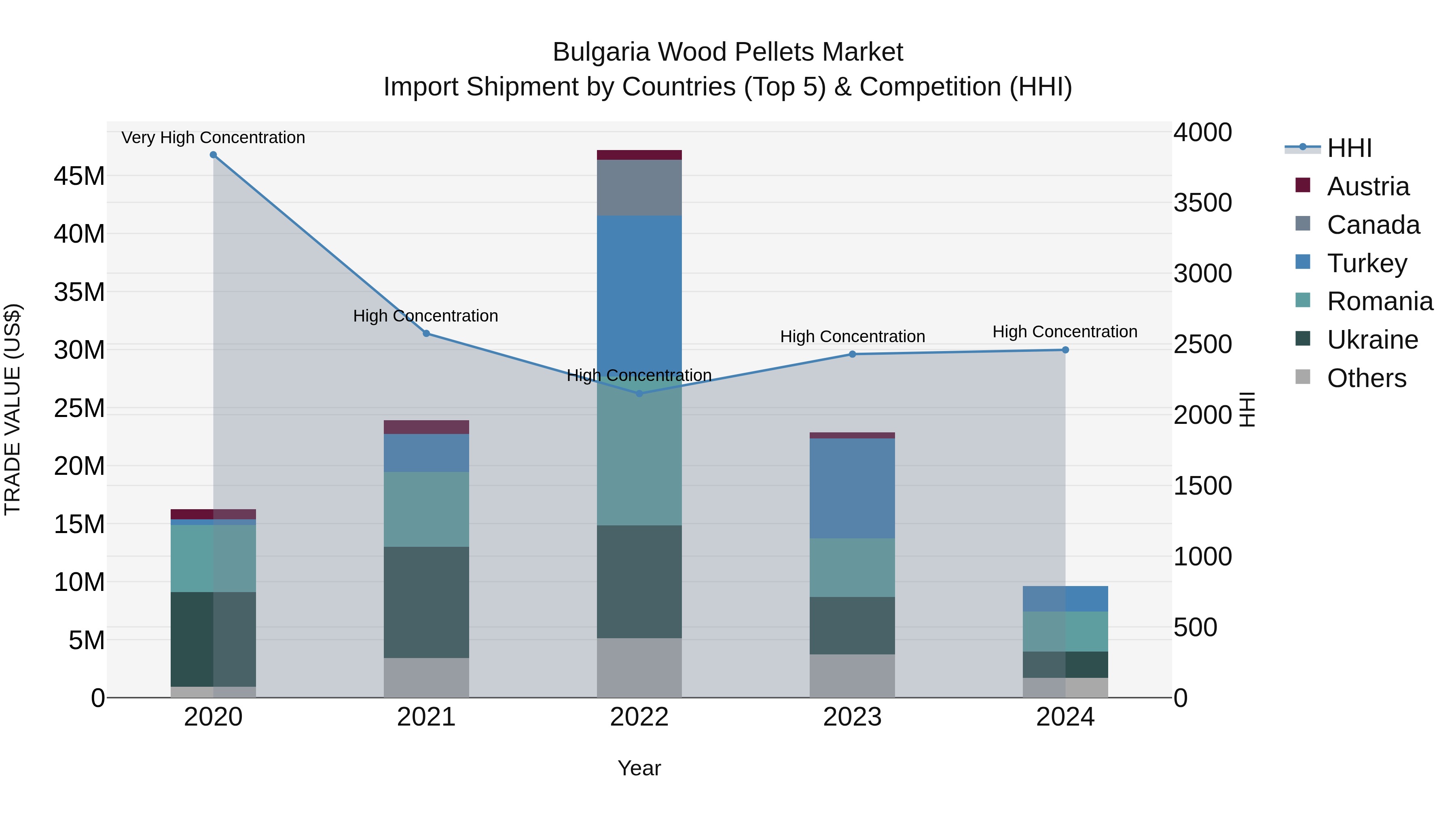
Despite a decline in the growth rate of Bulgaria`s wood pellets import shipments in 2024, the Market Top 5 Importing Countries and Market Competition (HHI) Analysis continues to show a high level of concentration, with top exporters being Romania, Ukraine, Turkey, Italy, and Serbia. The negative CAGR from 2020 to 2024 suggests a challenging Market Top 5 Importing Countries and Market Competition (HHI) Analysis environment, while the steep decline in growth rate from 2023 to 2024 indicates a potential shift in dynamics. Stakeholders in the wood pellets industry should closely monitor these trends and adapt their strategies to navigate the evolving Market Top 5 Importing Countries and Market Competition (HHI) Analysis landscape.
Bulgaria Wood Pellets Market Overview
The wood pellets market in Bulgaria is gaining traction as a renewable energy source for heating and power generation. Wood pellets are favored for their efficiency, low emissions, and sustainability compared to traditional fossil fuels. The market is driven by increasing energy costs, environmental regulations promoting renewable energy, and advancements in pellet production technology. However, challenges include the need for consistent pellet quality and the impact of raw material availability on production costs.
Drivers of the market
The wood pellets market in Bulgaria is influenced by the increasing emphasis on renewable energy sources. Wood pellets are gaining popularity as a sustainable and cost-effective alternative to traditional fossil fuels for heating and power generation. Government incentives and policies promoting the use of bioenergy and reducing greenhouse gas emissions support market growth. The rise in residential and industrial applications of wood pellets, coupled with advancements in pellet production technology, further drives demand.
Challenges of the market
The wood pellets market in Bulgaria faces challenges related to raw material sourcing and market competition. Securing a stable supply of quality wood for pellet production can be difficult, particularly with fluctuating prices and availability. Additionally, the market is highly competitive, with numerous players vying for market share. Regulatory changes related to renewable energy standards and environmental policies can also impact market dynamics, requiring producers to adapt to new requirements.
Government Policy of the market
The wood pellets market benefits from Bulgaria`s policies that encourage renewable energy sources and sustainable biomass use. Government support includes subsidies and incentives for the production and use of wood pellets as a renewable energy source. There are regulations in place to ensure that wood pellets meet environmental standards, contributing to the country`s goals of reducing carbon emissions. The government also promotes research and development in pellet production technologies to improve efficiency and sustainability.
Key Highlights of the Report:
- Bulgaria Wood Pellets Market Outlook
- Market Size of Bulgaria Wood Pellets Market, 2024
- Forecast of Bulgaria Wood Pellets Market, 2031
- Historical Data and Forecast of Bulgaria Wood Pellets Revenues & Volume for the Period 2021-2031
- Bulgaria Wood Pellets Market Trend Evolution
- Bulgaria Wood Pellets Market Drivers and Challenges
- Bulgaria Wood Pellets Price Trends
- Bulgaria Wood Pellets Porter`s Five Forces
- Bulgaria Wood Pellets Industry Life Cycle
- Historical Data and Forecast of Bulgaria Wood Pellets Market Revenues & Volume By Types for the Period 2021-2031
- Historical Data and Forecast of Bulgaria Wood Pellets Market Revenues & Volume By Hardwood for the Period 2021-2031
- Historical Data and Forecast of Bulgaria Wood Pellets Market Revenues & Volume By Softwood for the Period 2021-2031
- Historical Data and Forecast of Bulgaria Wood Pellets Market Revenues & Volume By Applications for the Period 2021-2031
- Historical Data and Forecast of Bulgaria Wood Pellets Market Revenues & Volume By Power Plants for the Period 2021-2031
- Historical Data and Forecast of Bulgaria Wood Pellets Market Revenues & Volume By Residential Heating for the Period 2021-2031
- Historical Data and Forecast of Bulgaria Wood Pellets Market Revenues & Volume By Commercial Heating for the Period 2021-2031
- Historical Data and Forecast of Bulgaria Wood Pellets Market Revenues & Volume By Combined Heat and Power (CHP) for the Period 2021-2031
- Bulgaria Wood Pellets Import Export Trade Statistics
- Market Opportunity Assessment By Types
- Market Opportunity Assessment By Applications
- Bulgaria Wood Pellets Top Companies Market Share
- Bulgaria Wood Pellets Competitive Benchmarking By Technical and Operational Parameters
- Bulgaria Wood Pellets Company Profiles
- Bulgaria Wood Pellets Key Strategic Recommendations






































