Burkina Faso Calcium Hypochlorite Market Size Growth Rate
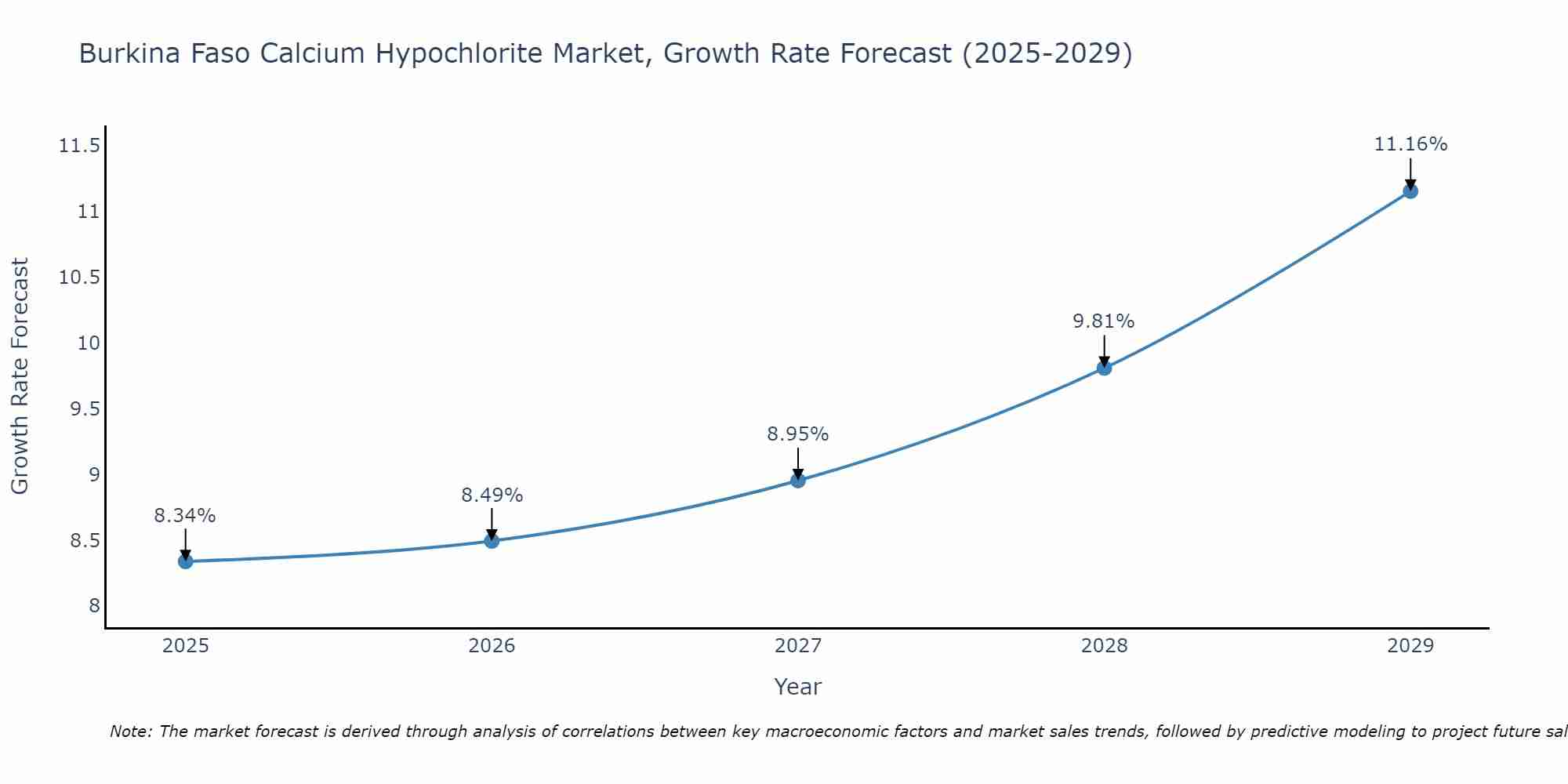
The Burkina Faso Calcium Hypochlorite Market is likely to experience consistent growth rate gains over the period 2025 to 2029. The growth rate starts at 8.34% in 2025 and reaches 11.16% by 2029.
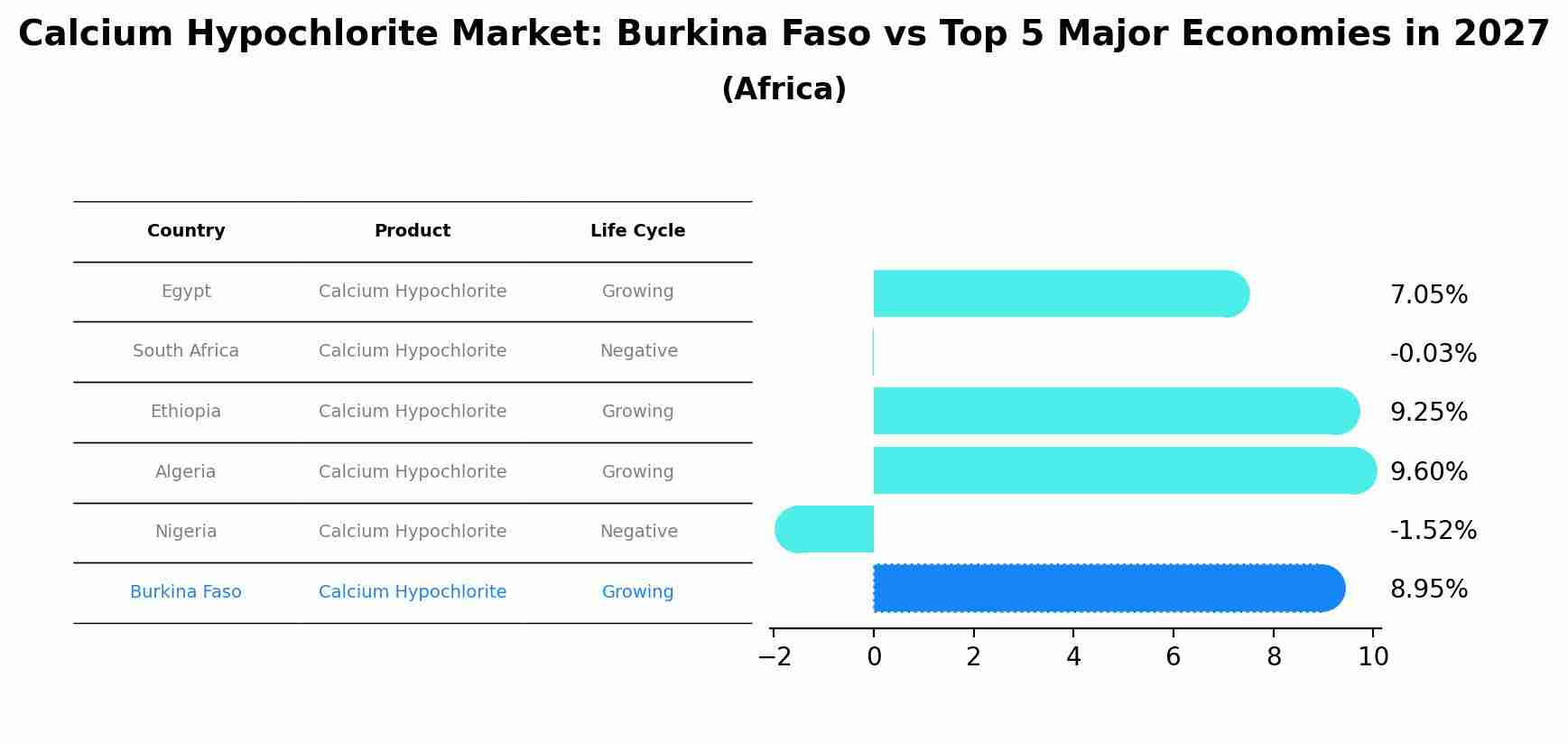
Calcium Hypochlorite Market: Burkina Faso vs Top 5 Major Economies in 2027 (Africa)
The Calcium Hypochlorite market in Burkina Faso is projected to grow at a growing growth rate of 8.95% by 2027, highlighting the country's increasing focus on advanced technologies within the Africa region, where Egypt holds the dominant position, followed closely by South Africa, Ethiopia, Algeria and Nigeria, shaping overall regional demand.
Burkina Faso Calcium Hypochlorite Market Overview
Calcium hypochlorite, used mainly for water treatment and sanitation, has a market influenced by public health needs and water quality regulations. The Burkina Faso market faces challenges including logistical issues related to distribution in remote areas and the need for proper storage facilities due to the chemical`s reactive nature. Furthermore, market growth may be hindered by competition from alternative water treatment chemicals and the cost of importing the product. Enhancing local production and improving distribution infrastructure could help address these challenges.
Drivers of the market
Calcium hypochlorite, widely used as a disinfectant and bleaching agent, sees increasing demand in Burkina Faso due to its applications in water treatment and sanitation. The market is driven by the need for effective water purification solutions to address public health concerns and ensure safe drinking water. Additionally, calcium hypochlorite is used in the textile and paper industries for bleaching processes. The expansion of municipal water treatment facilities, coupled with growing industrial activities and the need for improved sanitation, fuels the demand for calcium hypochlorite in Burkina Faso.
Challenges of the market
The calcium hypochlorite market in Burkina Faso encounters challenges such as limited local production capabilities and reliance on imports for its supply. There are also concerns regarding the safe handling and storage of this chemical due to its reactive nature. The market must navigate regulatory requirements and safety standards, which can affect operational costs and market growth.
Government Policy of the market
The calcium hypochlorite market in Burkina Faso is subject to stringent regulations due to the chemical`s use in water purification and sanitation. Government policies focus on ensuring the safe handling, storage, and application of calcium hypochlorite to prevent accidents and environmental contamination. There are specific guidelines for the distribution and use of this chemical, which include quality standards and safety protocols. The government also monitors the import and export of calcium hypochlorite to ensure that it complies with international safety standards.
Key Highlights of the Report:
- Burkina Faso Calcium Hypochlorite Market Outlook
- Market Size of Burkina Faso Calcium Hypochlorite Market, 2024
- Forecast of Burkina Faso Calcium Hypochlorite Market, 2031
- Historical Data and Forecast of Burkina Faso Calcium Hypochlorite Revenues & Volume for the Period 2021-2031
- Burkina Faso Calcium Hypochlorite Market Trend Evolution
- Burkina Faso Calcium Hypochlorite Market Drivers and Challenges
- Burkina Faso Calcium Hypochlorite Price Trends
- Burkina Faso Calcium Hypochlorite Porter`s Five Forces
- Burkina Faso Calcium Hypochlorite Industry Life Cycle
- Historical Data and Forecast of Burkina Faso Calcium Hypochlorite Market Revenues & Volume By Form for the Period 2021-2031
- Historical Data and Forecast of Burkina Faso Calcium Hypochlorite Market Revenues & Volume By Powder for the Period 2021-2031
- Historical Data and Forecast of Burkina Faso Calcium Hypochlorite Market Revenues & Volume By Pellet for the Period 2021-2031
- Historical Data and Forecast of Burkina Faso Calcium Hypochlorite Market Revenues & Volume By Granule for the Period 2021-2031
- Historical Data and Forecast of Burkina Faso Calcium Hypochlorite Market Revenues & Volume By Application for the Period 2021-2031
- Historical Data and Forecast of Burkina Faso Calcium Hypochlorite Market Revenues & Volume By House Cleaners And Detergents for the Period 2021-2031
- Historical Data and Forecast of Burkina Faso Calcium Hypochlorite Market Revenues & Volume By Agrochemicals for the Period 2021-2031
- Historical Data and Forecast of Burkina Faso Calcium Hypochlorite Market Revenues & Volume By Water Treatment for the Period 2021-2031
- Historical Data and Forecast of Burkina Faso Calcium Hypochlorite Market Revenues & Volume By Pulp And Paper for the Period 2021-2031
- Historical Data and Forecast of Burkina Faso Calcium Hypochlorite Market Revenues & Volume By Food And Beverage for the Period 2021-2031
- Historical Data and Forecast of Burkina Faso Calcium Hypochlorite Market Revenues & Volume By Others for the Period 2021-2031
- Burkina Faso Calcium Hypochlorite Import Export Trade Statistics
- Market Opportunity Assessment By Form
- Market Opportunity Assessment By Application
- Burkina Faso Calcium Hypochlorite Top Companies Market Share
- Burkina Faso Calcium Hypochlorite Competitive Benchmarking By Technical and Operational Parameters
- Burkina Faso Calcium Hypochlorite Company Profiles
- Burkina Faso Calcium Hypochlorite Key Strategic Recommendations






































