Burkina Faso Chillers Market Top 5 Importing Countries and Market Competition (HHI) Analysis
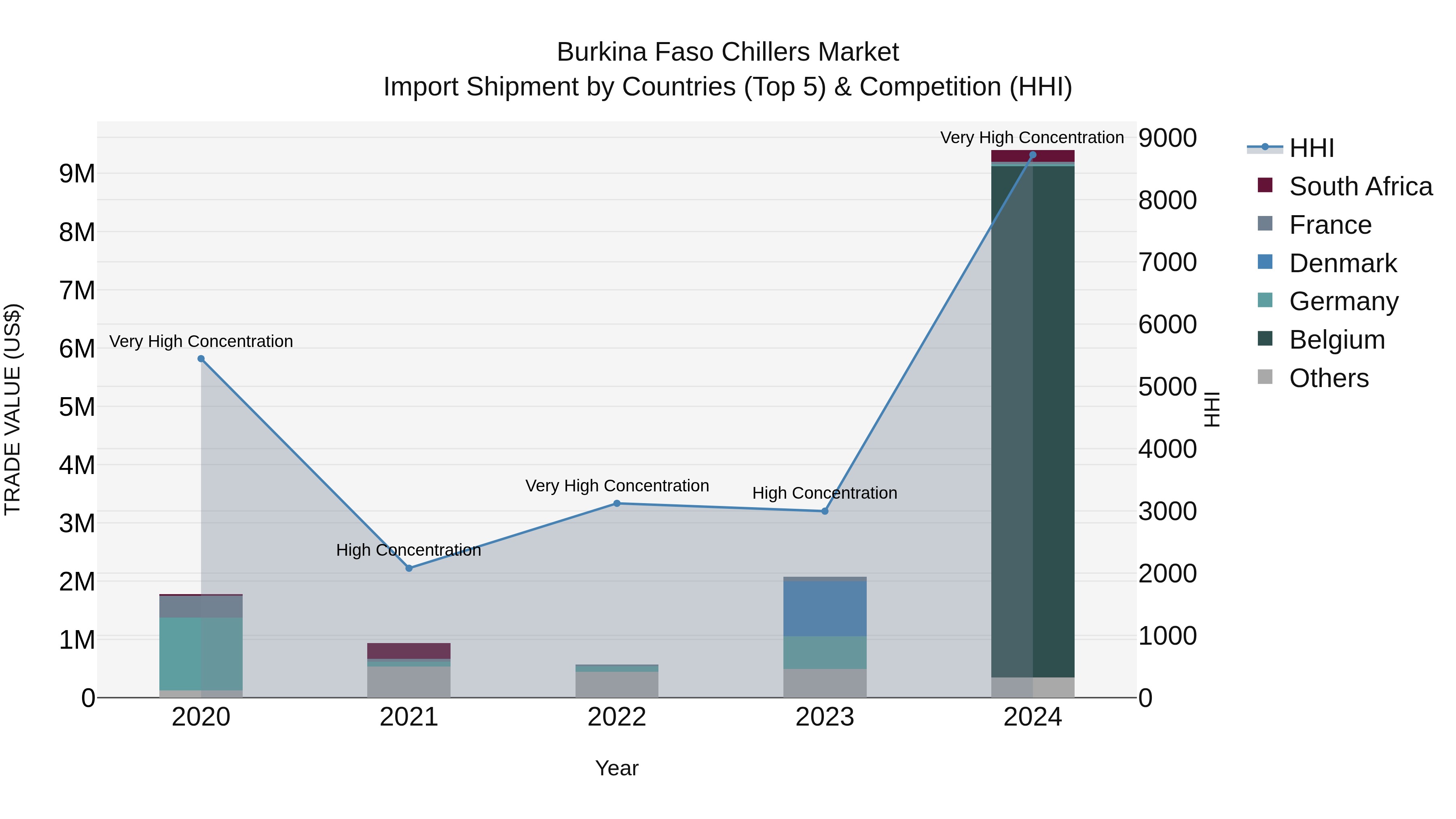
Burkina Faso`s chiller import market in 2024 continues to be dominated by a few key players, with Belgium, South Africa, Tunisia, Turkey, and China leading the pack. The high Herfindahl-Hirschman Index (HHI) signifies a concentrated market landscape. The impressive compound annual growth rate (CAGR) of 51.71% from 2020 to 2024 highlights the sector`s rapid expansion. The exceptional growth rate of 353.21% from 2023 to 2024 suggests a significant surge in demand for chillers in Burkina Faso, presenting opportunities for both local and international suppliers.
Burkina Faso Chillers Market Overview
The chillers market in Burkina Faso is driven by the expanding construction sector, particularly in commercial and industrial buildings that require air conditioning and refrigeration systems. The growing need for temperature control in food processing, pharmaceuticals, and manufacturing industries also contributes to market growth. However, the market faces challenges such as high initial investment costs, energy efficiency concerns, and the lack of skilled technicians for installation and maintenance. The reliance on imported equipment further complicates market dynamics.
Drivers of the market
The chillers market in Burkina Faso is driven by the increasing demand for cooling solutions across various sectors, including agriculture, manufacturing, and commercial establishments. The growth of the food and beverage industry, along with the expansion of retail and hospitality sectors, is boosting the demand for chillers. Additionally, the rising temperatures and need for efficient temperature control in industrial processes are contributing to market growth. Technological advancements in chiller systems and energy-efficient solutions are also playing a significant role in driving the market.
Challenges of the market
The chillers market in Burkina Faso faces challenges related to the country`s hot climate and unreliable electricity supply, which are critical for the operation of chillers. The high initial cost of purchasing and installing chillers is a barrier for many businesses, especially small and medium-sized enterprises. Additionally, there is a lack of skilled technicians to maintain and repair chillers, leading to frequent breakdowns and reduced operational efficiency. The market is also constrained by limited availability of parts and after-sales services, which can prolong downtime and increase operational costs.
Government Policy of the market
In Burkina Faso, the government has implemented energy efficiency policies that impact the chillers market. Regulations require chillers to meet specific energy performance standards to reduce overall energy consumption and minimize environmental impact. The government is also offering tax incentives and subsidies for businesses that invest in energy-efficient chillers, aligning with the country`s commitment to sustainable development. These policies are designed to encourage the adoption of newer, more efficient technologies in the refrigeration and cooling sectors.
Key Highlights of the Report:
- Burkina Faso Chillers Market Outlook
- Market Size of Burkina Faso Chillers Market, 2024
- Forecast of Burkina Faso Chillers Market, 2031
- Historical Data and Forecast of Burkina Faso Chillers Revenues & Volume for the Period 2021-2031
- Burkina Faso Chillers Market Trend Evolution
- Burkina Faso Chillers Market Drivers and Challenges
- Burkina Faso Chillers Price Trends
- Burkina Faso Chillers Porter`s Five Forces
- Burkina Faso Chillers Industry Life Cycle
- Historical Data and Forecast of Burkina Faso Chillers Market Revenues & Volume By Type for the Period 2021-2031
- Historical Data and Forecast of Burkina Faso Chillers Market Revenues & Volume By Scroll for the Period 2021-2031
- Historical Data and Forecast of Burkina Faso Chillers Market Revenues & Volume By Screw for the Period 2021-2031
- Historical Data and Forecast of Burkina Faso Chillers Market Revenues & Volume By Centrifugal for the Period 2021-2031
- Historical Data and Forecast of Burkina Faso Chillers Market Revenues & Volume By Reciprocating for the Period 2021-2031
- Historical Data and Forecast of Burkina Faso Chillers Market Revenues & Volume By Absorption for the Period 2021-2031
- Historical Data and Forecast of Burkina Faso Chillers Market Revenues & Volume By End Use Industry for the Period 2021-2031
- Historical Data and Forecast of Burkina Faso Chillers Market Revenues & Volume By Plastic for the Period 2021-2031
- Historical Data and Forecast of Burkina Faso Chillers Market Revenues & Volume By Chemical & Petrochemical for the Period 2021-2031
- Historical Data and Forecast of Burkina Faso Chillers Market Revenues & Volume By Rubber for the Period 2021-2031
- Historical Data and Forecast of Burkina Faso Chillers Market Revenues & Volume By Food & Beverage for the Period 2021-2031
- Historical Data and Forecast of Burkina Faso Chillers Market Revenues & Volume By Medical & Pharmaceutical for the Period 2021-2031
- Historical Data and Forecast of Burkina Faso Chillers Market Revenues & Volume By Capacity for the Period 2021-2031
- Historical Data and Forecast of Burkina Faso Chillers Market Revenues & Volume By >17.5 kW for the Period 2021-2031
- Historical Data and Forecast of Burkina Faso Chillers Market Revenues & Volume By 17.6-50 kW for the Period 2021-2031
- Historical Data and Forecast of Burkina Faso Chillers Market Revenues & Volume By 51-100 kW for the Period 2021-2031
- Historical Data and Forecast of Burkina Faso Chillers Market Revenues & Volume By 101-200 kW for the Period 2021-2031
- Historical Data and Forecast of Burkina Faso Chillers Market Revenues & Volume By 201-350 kW for the Period 2021-2031
- Historical Data and Forecast of Burkina Faso Chillers Market Revenues & Volume By 351-500 kW for the Period 2021-2031
- Historical Data and Forecast of Burkina Faso Chillers Market Revenues & Volume By 501-700 kW for the Period 2021-2031
- Historical Data and Forecast of Burkina Faso Chillers Market Revenues & Volume By 701-900 kW for the Period 2021-2031
- Burkina Faso Chillers Import Export Trade Statistics
- Market Opportunity Assessment By Type
- Market Opportunity Assessment By End Use Industry
- Market Opportunity Assessment By Capacity
- Burkina Faso Chillers Top Companies Market Share
- Burkina Faso Chillers Competitive Benchmarking By Technical and Operational Parameters
- Burkina Faso Chillers Company Profiles
- Burkina Faso Chillers Key Strategic Recommendations






































