Burkina Faso Diesel Exhaust Fluid Market Top 5 Importing Countries and Market Competition (HHI) Analysis
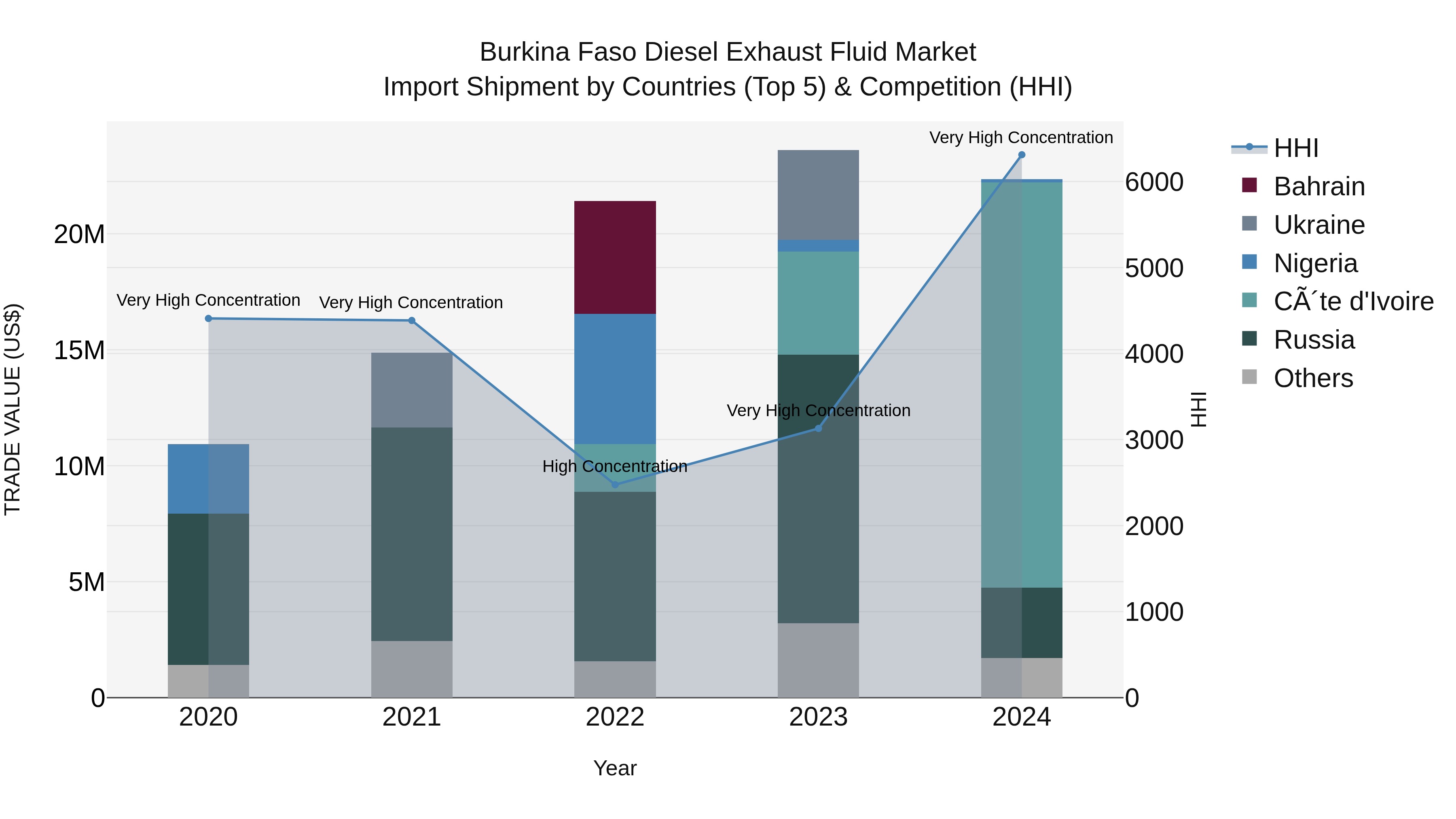
In 2024, Burkina Faso continued to rely on imports of diesel exhaust fluid, with the top exporting countries being Côte d`Ivoire, Russia, Ghana, Finland, and Morocco. Despite the high Herfindahl-Hirschman Index indicating market concentration, the industry experienced a strong compound annual growth rate of 19.58% from 2020 to 2024. However, there was a slight decline in growth rate from 2023 to 2024 at -5.28%. This data suggests a stable market with key players dominating the import landscape in Burkina Faso.
Burkina Faso Diesel Exhaust Fluid Market Overview
The Diesel Exhaust Fluid Market in Burkina Faso is gaining momentum as regulations on emissions become stricter. Diesel exhaust fluid is used in selective catalytic reduction systems to reduce harmful emissions from diesel engines. As environmental awareness and regulatory compliance increase, the market for diesel exhaust fluid is expected to grow.
Drivers of the market
The diesel exhaust fluid market in Burkina Faso is driven by the increasing adoption of emissions control technologies in diesel engines. Diesel exhaust fluid is essential for reducing harmful emissions from diesel vehicles, and its usage is rising due to the implementation of stricter environmental regulations. The growing awareness of environmental protection, along with the increasing demand for cleaner and more sustainable diesel engines, is contributing to the growth of the diesel exhaust fluid market in the country.
Challenges of the market
The diesel exhaust fluid market in Burkina Faso faces challenges due to the limited availability of high-quality fluid products and the high cost of importing them. The market is also constrained by the lack of local production facilities and the limited awareness about the importance of diesel exhaust fluid in reducing emissions. Additionally, the low level of regulation and enforcement of emissions standards further limits the markets growth.
Government Policy of the market
To reduce emissions and improve air quality, the government promotes the use of diesel exhaust fluid. Policies focus on encouraging the adoption of this technology to meet emissions standards and enhance diesel engine performance. The government provides support for local production and ensures compliance with environmental regulations.
Key Highlights of the Report:
- Burkina Faso Diesel Exhaust Fluid Market Outlook
- Market Size of Burkina Faso Diesel Exhaust Fluid Market, 2024
- Forecast of Burkina Faso Diesel Exhaust Fluid Market, 2031
- Historical Data and Forecast of Burkina Faso Diesel Exhaust Fluid Revenues & Volume for the Period 2021-2031
- Burkina Faso Diesel Exhaust Fluid Market Trend Evolution
- Burkina Faso Diesel Exhaust Fluid Market Drivers and Challenges
- Burkina Faso Diesel Exhaust Fluid Price Trends
- Burkina Faso Diesel Exhaust Fluid Porter`s Five Forces
- Burkina Faso Diesel Exhaust Fluid Industry Life Cycle
- Historical Data and Forecast of Burkina Faso Diesel Exhaust Fluid Market Revenues & Volume By Component for the Period 2021-2031
- Historical Data and Forecast of Burkina Faso Diesel Exhaust Fluid Market Revenues & Volume By SCR Catalysts for the Period 2021-2031
- Historical Data and Forecast of Burkina Faso Diesel Exhaust Fluid Market Revenues & Volume By DEF Tanks for the Period 2021-2031
- Historical Data and Forecast of Burkina Faso Diesel Exhaust Fluid Market Revenues & Volume By Injectors for the Period 2021-2031
- Historical Data and Forecast of Burkina Faso Diesel Exhaust Fluid Market Revenues & Volume By Supply Modules for the Period 2021-2031
- Historical Data and Forecast of Burkina Faso Diesel Exhaust Fluid Market Revenues & Volume By Sensors for the Period 2021-2031
- Historical Data and Forecast of Burkina Faso Diesel Exhaust Fluid Market Revenues & Volume By Supply Mode for the Period 2021-2031
- Historical Data and Forecast of Burkina Faso Diesel Exhaust Fluid Market Revenues & Volume By Cans for the Period 2021-2031
- Historical Data and Forecast of Burkina Faso Diesel Exhaust Fluid Market Revenues & Volume By IBCs for the Period 2021-2031
- Historical Data and Forecast of Burkina Faso Diesel Exhaust Fluid Market Revenues & Volume By Bulk & Pumps for the Period 2021-2031
- Burkina Faso Diesel Exhaust Fluid Import Export Trade Statistics
- Market Opportunity Assessment By Component
- Market Opportunity Assessment By Supply Mode
- Burkina Faso Diesel Exhaust Fluid Top Companies Market Share
- Burkina Faso Diesel Exhaust Fluid Competitive Benchmarking By Technical and Operational Parameters
- Burkina Faso Diesel Exhaust Fluid Company Profiles
- Burkina Faso Diesel Exhaust Fluid Key Strategic Recommendations






































