Burkina Faso Fruit Pulp Market Top 5 Importing Countries and Market Competition (HHI) Analysis
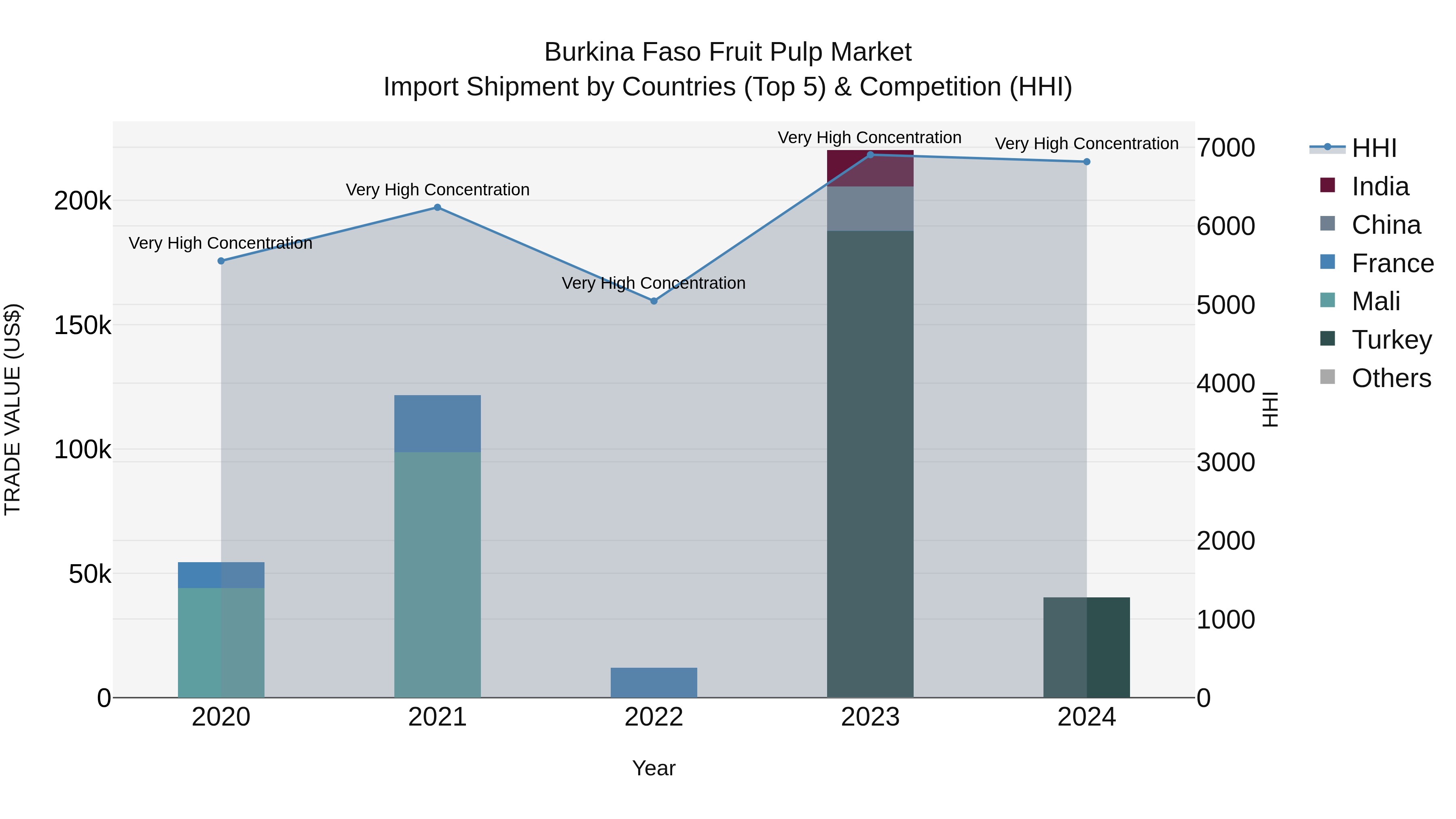
Burkina Faso`s fruit pulp import market in 2024 continued to be dominated by top exporters including Turkey, China, India, Mali, and France. The high Herfindahl-Hirschman Index (HHI) indicates a concentrated market. However, the industry experienced a significant decline with a negative Compound Annual Growth Rate (CAGR) of -7.28% from 2020 to 2024. The growth rate plummeted further in 2024 by -81.68%, reflecting challenges in the market. Stakeholders should closely monitor these trends and adapt strategies to navigate the changing landscape effectively.
Burkina Faso Fruit Pulp Market Overview
The fruit pulp market in Burkina Faso is expanding as the demand for processed and packaged foods increases. Fruit pulp is widely used in the production of juices, beverages, and confectionery products. The market is supported by the countrys agricultural sector, which produces a variety of fruits suitable for pulping. However, the market faces challenges related to processing technology and supply chain management.
Drivers of the market
The fruit pulp market in Burkina Faso is driven by the growing demand for processed fruit products in the food and beverage industry. As consumers seek convenient and nutritious food options, there is an increasing demand for fruit pulp, which is used in the production of juices, smoothies, jams, and other products. Additionally, the expansion of the export market for Burkina Faso`s tropical fruits is contributing to the market growth as fruit pulp is a key ingredient in various international food products.
Challenges of the market
Challenges in the fruit pulp market include limited cold storage facilities and fluctuations in fruit supply. There is also a need for modern processing equipment and effective distribution channels to reach consumers.
Government Policy of the market
Burkina Fasos government promotes the fruit pulp market by encouraging the production and use of high-quality fruit pulp in the food and beverage industry. Policies focus on supporting local fruit processing operations and ensuring the quality and safety of fruit pulp products. The government provides incentives for industry development and ensures compliance with food safety regulations.
Key Highlights of the Report:
- Burkina Faso Fruit Pulp Market Outlook
- Market Size of Burkina Faso Fruit Pulp Market, 2024
- Forecast of Burkina Faso Fruit Pulp Market, 2031
- Historical Data and Forecast of Burkina Faso Fruit Pulp Revenues & Volume for the Period 2021-2031
- Burkina Faso Fruit Pulp Market Trend Evolution
- Burkina Faso Fruit Pulp Market Drivers and Challenges
- Burkina Faso Fruit Pulp Price Trends
- Burkina Faso Fruit Pulp Porter`s Five Forces
- Burkina Faso Fruit Pulp Industry Life Cycle
- Historical Data and Forecast of Burkina Faso Fruit Pulp Market Revenues & Volume By Fruit Type for the Period 2021-2031
- Historical Data and Forecast of Burkina Faso Fruit Pulp Market Revenues & Volume By Mango for the Period 2021-2031
- Historical Data and Forecast of Burkina Faso Fruit Pulp Market Revenues & Volume By Strawberry for the Period 2021-2031
- Historical Data and Forecast of Burkina Faso Fruit Pulp Market Revenues & Volume By Apple for the Period 2021-2031
- Historical Data and Forecast of Burkina Faso Fruit Pulp Market Revenues & Volume By Guava for the Period 2021-2031
- Historical Data and Forecast of Burkina Faso Fruit Pulp Market Revenues & Volume By Berries for the Period 2021-2031
- Historical Data and Forecast of Burkina Faso Fruit Pulp Market Revenues & Volume By Citrus Fruits for the Period 2021-2031
- Historical Data and Forecast of Burkina Faso Fruit Pulp Market Revenues & Volume By Others for the Period 2021-2031
- Historical Data and Forecast of Burkina Faso Fruit Pulp Market Revenues & Volume By Form for the Period 2021-2031
- Historical Data and Forecast of Burkina Faso Fruit Pulp Market Revenues & Volume By Liquid for the Period 2021-2031
- Historical Data and Forecast of Burkina Faso Fruit Pulp Market Revenues & Volume By Powder for the Period 2021-2031
- Historical Data and Forecast of Burkina Faso Fruit Pulp Market Revenues & Volume By Application for the Period 2021-2031
- Historical Data and Forecast of Burkina Faso Fruit Pulp Market Revenues & Volume By Food and Beverages for the Period 2021-2031
- Historical Data and Forecast of Burkina Faso Fruit Pulp Market Revenues & Volume By Distribution for the Period 2021-2031
- Historical Data and Forecast of Burkina Faso Fruit Pulp Market Revenues & Volume By E-Commerce for the Period 2021-2031
- Historical Data and Forecast of Burkina Faso Fruit Pulp Market Revenues & Volume By Convenience Stores for the Period 2021-2031
- Historical Data and Forecast of Burkina Faso Fruit Pulp Market Revenues & Volume By Supermarkets/Hypermarkets for the Period 2021-2031
- Historical Data and Forecast of Burkina Faso Fruit Pulp Market Revenues & Volume By Specialty Stores for the Period 2021-2031
- Historical Data and Forecast of Burkina Faso Fruit Pulp Market Revenues & Volume By Others for the Period 2021-2031
- Burkina Faso Fruit Pulp Import Export Trade Statistics
- Market Opportunity Assessment By Fruit Type
- Market Opportunity Assessment By Form
- Market Opportunity Assessment By Application
- Market Opportunity Assessment By Distribution
- Burkina Faso Fruit Pulp Top Companies Market Share
- Burkina Faso Fruit Pulp Competitive Benchmarking By Technical and Operational Parameters
- Burkina Faso Fruit Pulp Company Profiles
- Burkina Faso Fruit Pulp Key Strategic Recommendations






































