Burundi Aluminium Market Growth Rate Analysis (2025 - 2031)
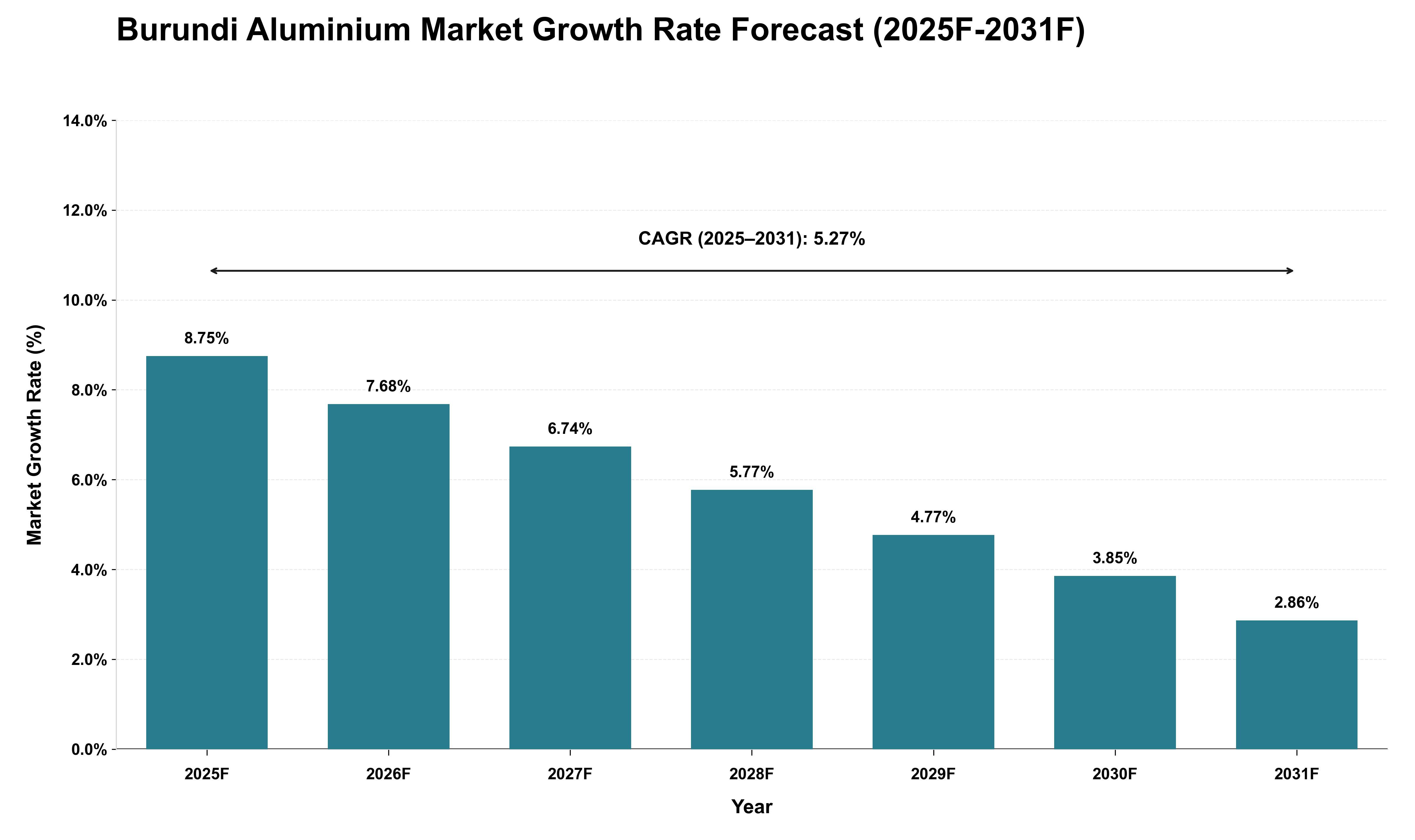
The Burundi aluminium market will experience a robust growth trajectory driven by increasing industrialization and infrastructure development, projected to expand at a CAGR of 5.27% from 2025 to 2031. The initial surge in growth rates, peaking at 8.75% in 2025, will be fueled by heightened demand for lightweight materials in construction and transportation sectors, alongside rising import dependencies as local production capacity struggles to meet burgeoning needs. As the forecast period progresses, growth rates will gradually decline, reflecting typical cyclical trends where initial exuberance gives way to more tempered expansion; for instance, the rate is expected to drop to 2.86% by 2031. This deceleration may also be influenced by global aluminium price fluctuations and supply chain dynamics that could impact import costs and availability, necessitating strategic adjustments within the competitive landscape of the market.
Key Highlights of the Report:
- Burundi Aluminium Market Outlook
- Market Size of Burundi Aluminium Market, 2024
- Forecast of Burundi Aluminium Market, 2031
- Historical Data and Forecast of Burundi Aluminium Revenues & Volume for the Period 2021-2031
- Burundi Aluminium Market Trend Evolution
- Burundi Aluminium Market Drivers and Challenges
- Burundi Aluminium Price Trends
- Burundi Aluminium Porter`s Five Forces
- Burundi Aluminium Industry Life Cycle
- Historical Data and Forecast of Burundi Aluminium Market Revenues & Volume By End-Use for the Period 2021-2031
- Historical Data and Forecast of Burundi Aluminium Market Revenues & Volume By Construction for the Period 2021-2031
- Historical Data and Forecast of Burundi Aluminium Market Revenues & Volume By Transportation for the Period 2021-2031
- Historical Data and Forecast of Burundi Aluminium Market Revenues & Volume By Packaging for the Period 2021-2031
- Historical Data and Forecast of Burundi Aluminium Market Revenues & Volume By Electrical for the Period 2021-2031
- Historical Data and Forecast of Burundi Aluminium Market Revenues & Volume By Consumer Durables for the Period 2021-2031
- Historical Data and Forecast of Burundi Aluminium Market Revenues & Volume By Machinery & Equipment for the Period 2021-2031
- Historical Data and Forecast of Burundi Aluminium Market Revenues & Volume By Others for the Period 2021-2031
- Burundi Aluminium Import Export Trade Statistics
- Market Opportunity Assessment By End-Use
- Burundi Aluminium Top Companies Market Share
- Burundi Aluminium Competitive Benchmarking By Technical and Operational Parameters
- Burundi Aluminium Company Profiles
- Burundi Aluminium Key Strategic Recommendations






































