Burundi Processed Food Market Size Growth Rate
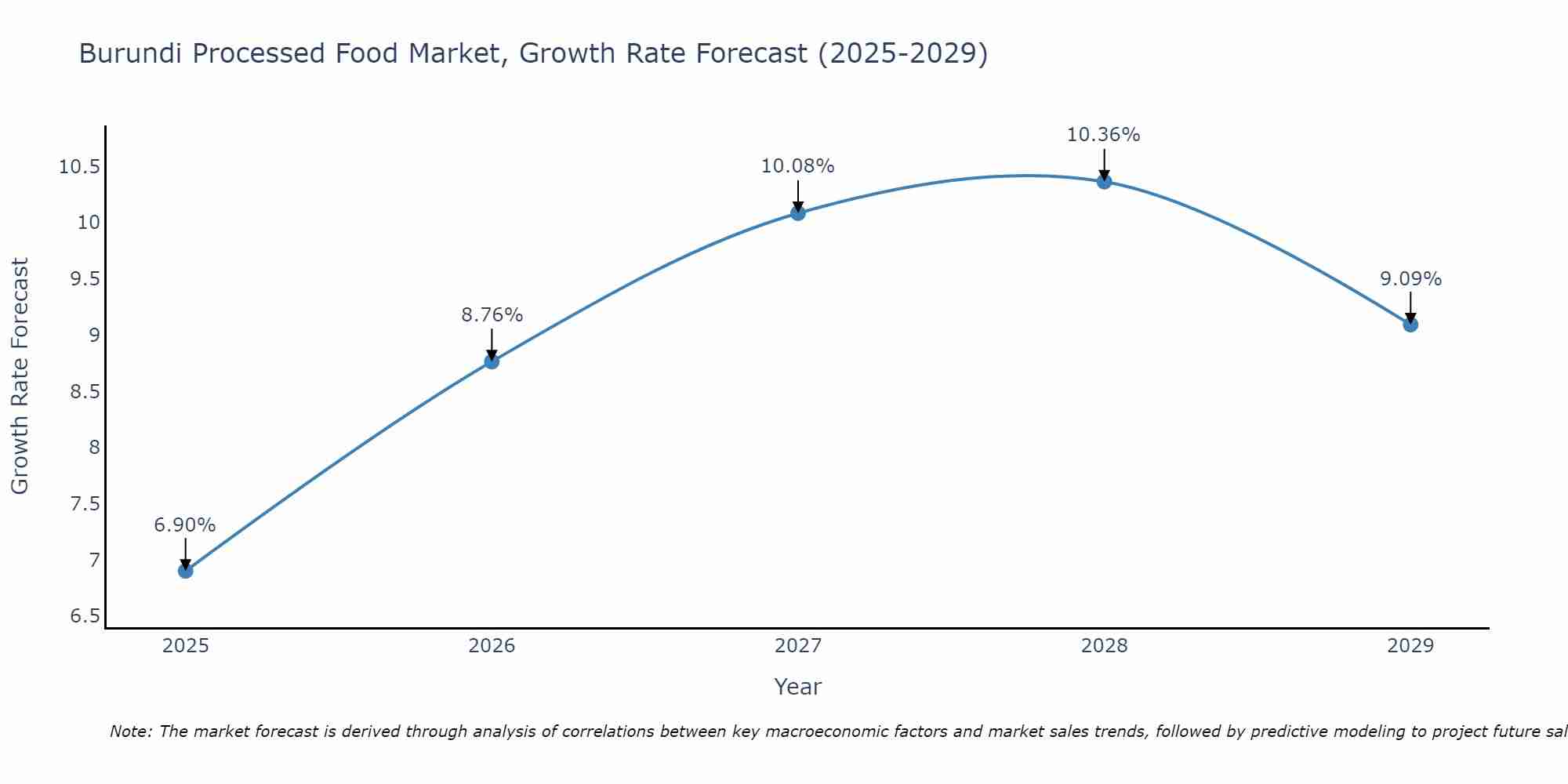
The Burundi Processed Food Market is projected to witness mixed growth rate patterns during 2025 to 2029. Growth accelerates to 10.36% in 2028, following an initial rate of 6.90%, before easing to 9.09% at the end of the period.
Processed Food Market: Burundi vs Top 5 Major Economies in 2027 (Africa)
By 2027, the Processed Food market in Burundi is anticipated to reach a growth rate of 10.08%, as part of an increasingly competitive Africa region, where Egypt remains at the forefront, supported by South Africa, Ethiopia, Algeria and Nigeria, driving innovations and market adoption across sectors.

Burundi Processed Food Market Overview
The Processed Food market in Burundi is growing as processed food products are used in various applications including ready-to-eat meals, snacks, and packaged foods. The market is driven by increasing consumer demand for convenient and long-lasting food products. Advances in food processing technologies and changing consumer preferences towards convenient food options also influence market trends. As the need for processed and packaged food products rises, the processed food market in Burundi is expected to expand.
Drivers of the market
The Processed Food market in Burundi is shaped by the growing consumer demand for convenient and ready-to-eat food products. Processed foods offer extended shelf life and ease of preparation, catering to the fast-paced lifestyle of modern consumers. The growth of the food and beverage industry, coupled with increasing urbanization and changing dietary preferences, drives market expansion. Additionally, advancements in food processing technologies and rising investments in product development contribute to market growth.
Challenges of the market
The Processed Food market in Burundi encounters difficulties including high import costs and limited local production capabilities. The absence of local suppliers and distributors impacts market accessibility. Market growth is further constrained by fluctuating demand and competition from alternative processed food products.
Government Policy of the market
The government supports the processed food market by offering financial incentives for local manufacturers and reducing import duties on processed food products. Policies aim to enhance food security and support the growth of the food processing industry.
Key Highlights of the Report:
- Burundi Processed Food Market Outlook
- Market Size of Burundi Processed Food Market, 2024
- Forecast of Burundi Processed Food Market, 2031
- Historical Data and Forecast of Burundi Processed Food Revenues & Volume for the Period 2021-2031
- Burundi Processed Food Market Trend Evolution
- Burundi Processed Food Market Drivers and Challenges
- Burundi Processed Food Price Trends
- Burundi Processed Food Porter`s Five Forces
- Burundi Processed Food Industry Life Cycle
- Historical Data and Forecast of Burundi Processed Food Market Revenues & Volume By Process for the Period 2021-2031
- Historical Data and Forecast of Burundi Processed Food Market Revenues & Volume By Minimally for the Period 2021-2031
- Historical Data and Forecast of Burundi Processed Food Market Revenues & Volume By Highly for the Period 2021-2031
- Historical Data and Forecast of Burundi Processed Food Market Revenues & Volume By Product type for the Period 2021-2031
- Historical Data and Forecast of Burundi Processed Food Market Revenues & Volume By Plant based for the Period 2021-2031
- Historical Data and Forecast of Burundi Processed Food Market Revenues & Volume By Fruits for the Period 2021-2031
- Historical Data and Forecast of Burundi Processed Food Market Revenues & Volume By Vegetables for the Period 2021-2031
- Historical Data and Forecast of Burundi Processed Food Market Revenues & Volume By Legumes for the Period 2021-2031
- Historical Data and Forecast of Burundi Processed Food Market Revenues & Volume By Extracted foods for the Period 2021-2031
- Historical Data and Forecast of Burundi Processed Food Market Revenues & Volume By Others for the Period 2021-2031
- Historical Data and Forecast of Burundi Processed Food Market Revenues & Volume By Animal based for the Period 2021-2031
- Historical Data and Forecast of Burundi Processed Food Market Revenues & Volume By Milk for the Period 2021-2031
- Historical Data and Forecast of Burundi Processed Food Market Revenues & Volume By Application for the Period 2021-2031
- Historical Data and Forecast of Burundi Processed Food Market Revenues & Volume By Baked foods for the Period 2021-2031
- Historical Data and Forecast of Burundi Processed Food Market Revenues & Volume By Baby food for the Period 2021-2031
- Historical Data and Forecast of Burundi Processed Food Market Revenues & Volume By Breakfast Cereal for the Period 2021-2031
- Historical Data and Forecast of Burundi Processed Food Market Revenues & Volume By Biscuits for the Period 2021-2031
- Historical Data and Forecast of Burundi Processed Food Market Revenues & Volume By Cheese for the Period 2021-2031
- Historical Data and Forecast of Burundi Processed Food Market Revenues & Volume By Chocolate confectionary for the Period 2021-2031
- Historical Data and Forecast of Burundi Processed Food Market Revenues & Volume By Ice creams for the Period 2021-2031
- Historical Data and Forecast of Burundi Processed Food Market Revenues & Volume By Instant Noodles for the Period 2021-2031
- Burundi Processed Food Import Export Trade Statistics
- Market Opportunity Assessment By Process
- Market Opportunity Assessment By Product type
- Market Opportunity Assessment By Application
- Burundi Processed Food Top Companies Market Share
- Burundi Processed Food Competitive Benchmarking By Technical and Operational Parameters
- Burundi Processed Food Company Profiles
- Burundi Processed Food Key Strategic Recommendations






































