Cambodia Aerosol Market Size, Share & Growth Rate
The Cambodia Aerosol Market was estimated at USD 444 Million in 2025 and is projected to reach USD 608 Million by 2032, growing at a CAGR of 4.6% from 2026 to 2032. This upward trajectory is propelled by a surge in consumer demand for convenient aerosol products, particularly within the personal care and household segments. As disposable incomes rise and urbanization accelerates, Cambodians increasingly prefer easy-to-use aerosol formats, enhancing the market's growth prospects.
Cambodia Aerosol Market Year-wise Growth Rate and Key Drivers
This graph highlights how the Cambodia Aerosol Market has steadily grown over the years, supported by major growth factors.
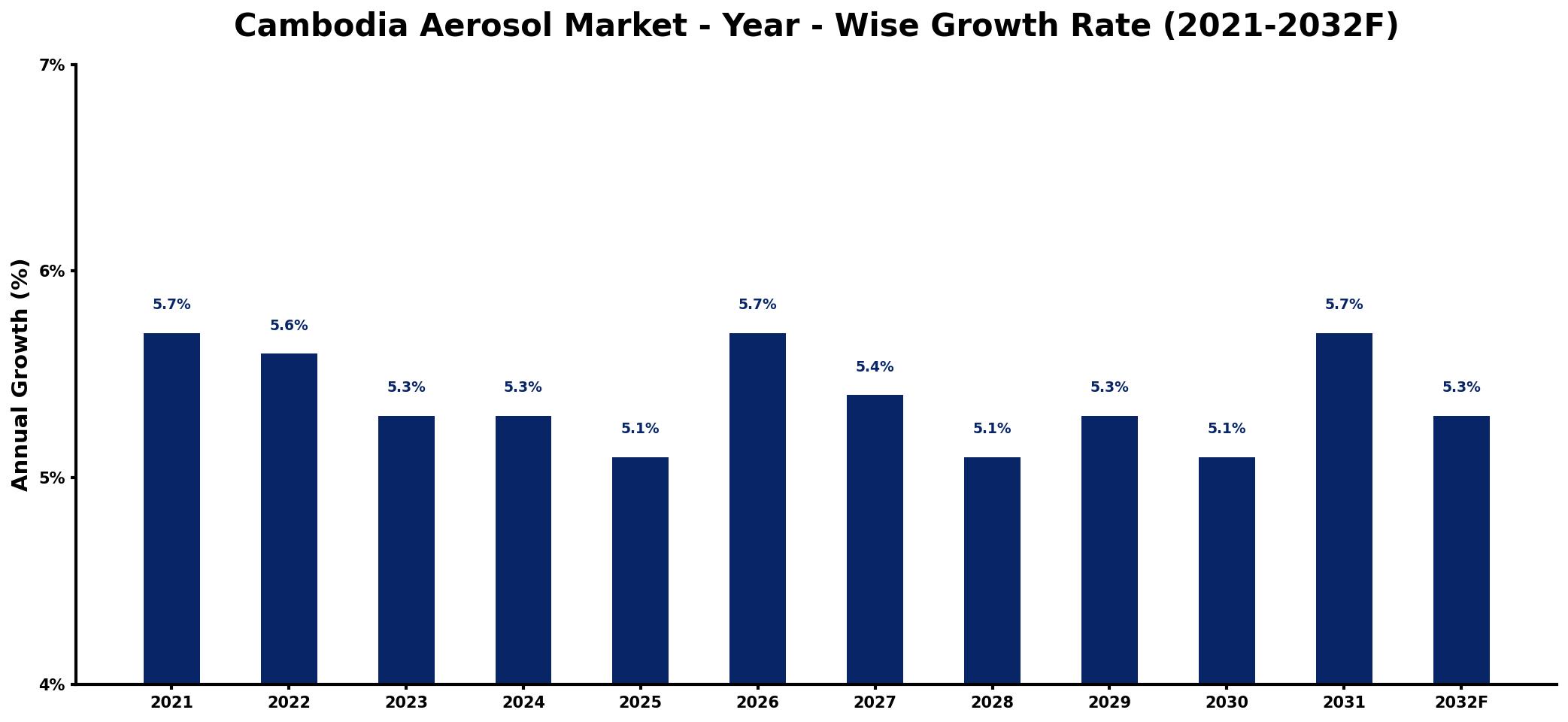
The table below presents the year‑wise growth rates along with the key drivers influencing the market
| Year | Growth Rate | Major Drivers |
| 2021 | 5.7% | Rising consumer health awareness |
| 2022 | 5.6% | Increased urbanization and lifestyle changes |
| 2023 | 5.3% | Growing popularity of convenience products |
| 2024 | 5.3% | Expansion of retail distribution channels |
| 2025 | 5.1% | Investments in eco-friendly technologies |
| 2026 | 5.7% | Surge in personal care demand |
| 2027 | 5.4% | Emerging trends in home care |
| 2028 | 5.1% | Boost in outdoor recreational activities |
| 2029 | 5.3% | Growth in e-commerce sales channels |
| 2030 | 5.1% | Increasing focus on sustainability practices |
| 2031 | 5.7% | Development of innovative packaging solutions |
| 2032 | 5.3% | Rising disposable income levels |
Note: Market size estimations and growth projections presented in this report are based on 6Wresearch's proprietary forecasting methodology, utilizing the latest available industry data, government publications, and primary research inputs.
Cambodia Aerosol Market Synopsis
The strongest force shaping the Cambodia aerosol market is the rapid increase in consumer demand for convenience. With lifestyle changes becoming more pronounced among urban populations, the demand for effective, time-saving products in spray formats has surged, driving innovation and market entry.
In addition to convenience, the market is witnessing a notable shift towards eco-friendly formulations. As consumers become more environmentally conscious, brands are compelled to innovate, introducing sustainable practices and packaging while adhering to stringent regulations aimed at product safety and environmental impact.
Cambodia Aerosol Market Key Takeaways
- The market is poised for significant growth, driven by increasing demand across personal care and household segments.
- Urbanization and higher disposable incomes are key factors influencing consumer preferences for aerosol products.
- Eco-friendliness and product safety are becoming essential considerations for brands in the aerosol sector.
- Innovation in product formulations is crucial, addressing specific consumer needs such as sanitizers and insect repellents.
- The market landscape is competitive, with both local and international entities striving to capture market share.
Evaluation of Restraints in Cambodia Aerosol Market
Despite its promising growth, the Cambodia aerosol market faces several restraints that can hinder its progress. Regulatory hurdles surrounding product registration and compliance pose significant challenges for new entrants. Moreover, the logistical issues related to Cambodia's developing infrastructure can complicate distribution efforts, ultimately impacting product availability in remote areas. Furthermore, intense competition among numerous domestic and international brands creates a crowded marketplace where distinguishing ones offerings becomes increasingly difficult.
Cambodia Aerosol Market Trends
Several trends are currently shaping the Cambodia aerosol market, with a clear emphasis on convenience and eco-friendliness. Consumers are gravitating towards sprayable products due to their ease of use, resulting in a heightened demand for personal care items such as deodorants and household cleaning solutions. Additionally, the market is witnessing an innovative shift towards sustainable aerosol products, as brands explore greener alternatives to traditional chemicals. Enhanced awareness surrounding health and hygiene, particularly in the wake of the COVID-19 pandemic, is also propelling the demand for disinfectants and sanitizers, further diversifying market offerings.
Cambodia Aerosol Market Opportunities
The Cambodia aerosol market offers myriad investment opportunities, particularly in light of the evolving consumer landscape. As urban populations expand, the demand for user-friendly aerosol products continues to rise, creating openings for both local and foreign investors. Collaborations with domestic manufacturers can facilitate the introduction of novel product lines tailored to local preferences. Furthermore, innovation in product formulations, targeting specific consumer needs, presents a significant growth avenue. The market's trajectory suggests a vibrant future filled with diversification and expansion opportunities for savvy investors.
Government Initiatives in the Cambodia Aerosol Market
Government policies in Cambodia are increasingly focused on fostering environmental sustainability and ensuring consumer safety within the aerosol market. The Ministry of Environment has implemented regulations aimed at controlling harmful chemical usage in aerosol products, promoting eco-friendly practices. Additionally, the Ministry of Commerce oversees stringent quality standards and safety protocols, ensuring that products sold adhere to necessary guidelines. These policies reflect a balanced approach, aiming to stimulate market growth while prioritizing environmental protection and consumer well-being.
Future Insights of the Cambodia Aerosol Market
Looking ahead to 2026-2032, the Cambodia aerosol market is expected to continue its upward trajectory, bolstered by factors such as ongoing urbanization, rising disposable incomes, and an escalating preference for convenient product formats. The demand for aerosol products across personal care, household cleaning, and automotive sectors will further drive market growth. With an increasing focus on hygiene in light of recent global health concerns, the demand for aerosol sanitizers and disinfectants is projected to surge. Consequently, innovation in product offerings, along with a commitment to eco-friendliness, will be pivotal in shaping the future of this burgeoning market.
Cambodia Aerosol Market Latest Developments (2025 - 2026)
In the recent months, the Cambodia aerosol market has witnessed a flurry of activity as companies focus on aligning their offerings with growing consumer demands. There has been an uptick in product launches featuring eco-friendly formulations, reflecting a response to increasing environmental awareness among consumers. Additionally, marketing strategies have evolved, with a stronger emphasis on digital platforms to reach urban audiences effectively. The competitive landscape continues to adapt, with firms exploring partnerships to enhance distribution channels and maximize market presence.
Cambodia Aerosol Market - Key Attractiveness of the Report
- 10 Years of Market Numbers
- Historical Data Starting from 2022 to 2025
- Base Year: 2025
- Forecast Data until 2032
- Key Performance Indicators Impacting the Market
- Major Upcoming Developments and Projects
Key Highlights of the Report:
- Cambodia Aerosol Market Outlook
- Market Size of Cambodia Aerosol Market, 2025
- Forecast of Cambodia Aerosol Market, 2032
- Historical Data and Forecast of Cambodia Aerosol Revenues & Volume for the Period 2022-2032F
- Cambodia Aerosol Market Trend Evolution
- Cambodia Aerosol Market Drivers and Challenges
- Cambodia Aerosol Price Trends
- Cambodia Aerosol Porter's Five Forces
- Cambodia Aerosol Industry Life Cycle
- Historical Data and Forecast of Cambodia Aerosol Market Revenues & Volume By Material for the Period 2022-2032F
- Historical Data and Forecast of Cambodia Aerosol Market Revenues & Volume By Steel for the Period 2022-2032F
- Historical Data and Forecast of Cambodia Aerosol Market Revenues & Volume By Aluminum for the Period 2022-2032F
- Historical Data and Forecast of Cambodia Aerosol Market Revenues & Volume By Others for the Period 2022-2032F
- Historical Data and Forecast of Cambodia Aerosol Market Revenues & Volume By Type for the Period 2022-2032F
- Historical Data and Forecast of Cambodia Aerosol Market Revenues & Volume By Bag-In-Valve for the Period 2022-2032F
- Historical Data and Forecast of Cambodia Aerosol Market Revenues & Volume By Standard for the Period 2022-2032F
- Historical Data and Forecast of Cambodia Aerosol Market Revenues & Volume By Application for the Period 2022-2032F
- Historical Data and Forecast of Cambodia Aerosol Market Revenues & Volume By Personal Care for the Period 2022-2032F
- Historical Data and Forecast of Cambodia Aerosol Market Revenues & Volume By Household for the Period 2022-2032F
- Historical Data and Forecast of Cambodia Aerosol Market Revenues & Volume By Automotive & Industrial for the Period 2022-2032F
- Historical Data and Forecast of Cambodia Aerosol Market Revenues & Volume By Food for the Period 2022-2032F
- Historical Data and Forecast of Cambodia Aerosol Market Revenues & Volume By Paints for the Period 2022-2032F
- Historical Data and Forecast of Cambodia Aerosol Market Revenues & Volume By Medical for the Period 2022-2032F
- Historical Data and Forecast of Cambodia Aerosol Market Revenues & Volume By Others for the Period 2022-2032F
- Cambodia Aerosol Import Export Trade Statistics
- Market Opportunity Assessment By Material
- Market Opportunity Assessment By Type
- Market Opportunity Assessment By Application
- Cambodia Aerosol Top Companies Market Share
- Cambodia Aerosol Competitive Benchmarking By Technical and Operational Parameters
- Cambodia Aerosol Company Profiles
- Cambodia Aerosol Key Strategic Recommendations






































