Cambodia BBQ Charcoal Market Size, Share & Growth Rate
The Cambodia BBQ Charcoal Market was estimated at USD 369 Million in 2025 and is projected to reach USD 501 Million by 2032, growing at a CAGR of 4.5% from 2026 to 2032. This upward trajectory is propelled by the deep-rooted cultural affinity for outdoor grilling, which remains a cherished pastime among Cambodians. Additionally, the burgeoning tourism sector is significantly boosting demand for high-quality BBQ experiences, driving the market towards a sustainable future.
Cambodia BBQ Charcoal Market Year-wise Growth Rate and Key Drivers
This graph highlights how the Cambodia BBQ Charcoal Market has steadily grown over the years, supported by major growth factors.
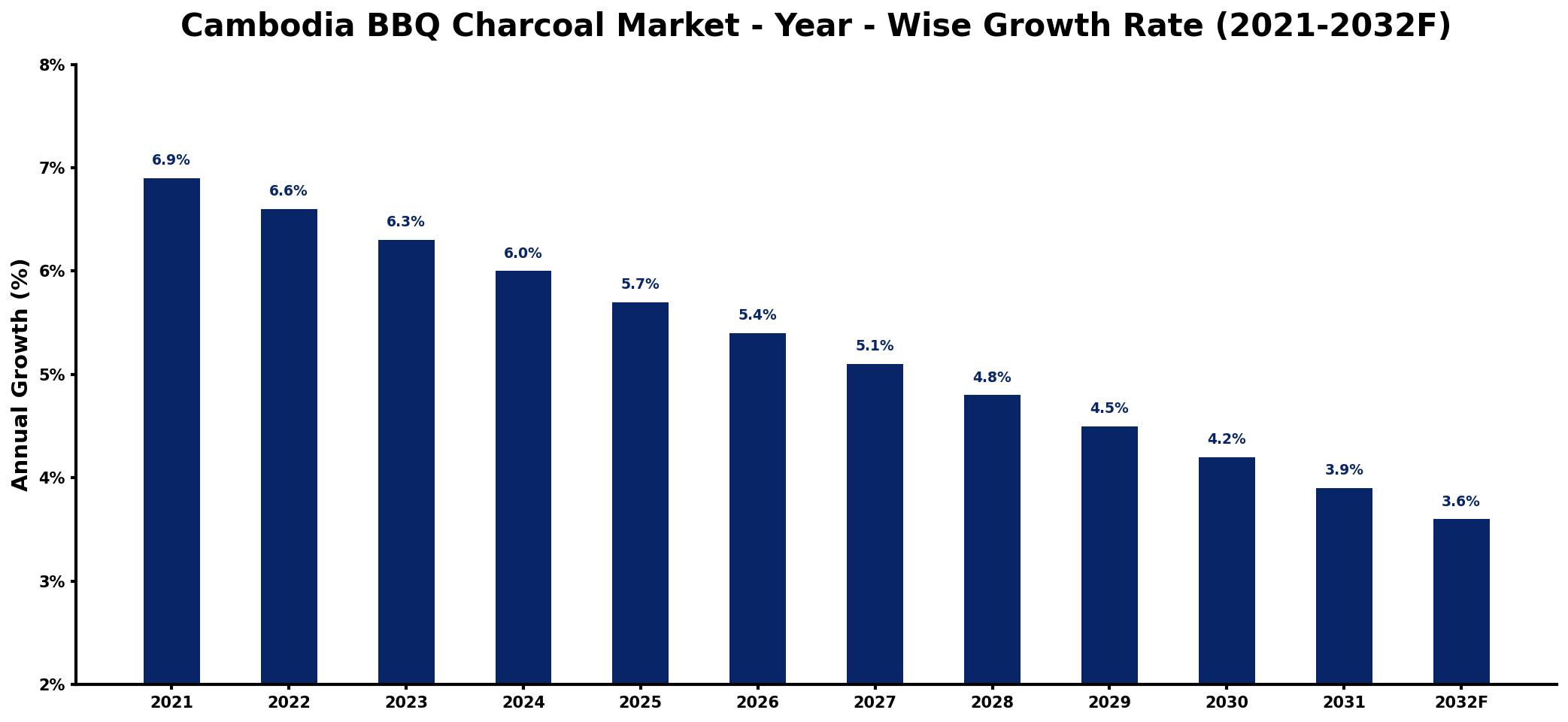
The table below presents the year‑wise growth rates along with the key drivers influencing the market
| Year | Growth Rate | Major Drivers |
| 2021 | 6.9% | Rising outdoor cooking popularity |
| 2022 | 6.6% | Increased investment in tourism |
| 2023 | 6.3% | Growth in restaurant establishments |
| 2024 | 6.0% | Expansion of local events |
| 2025 | 5.7% | Surge in home gatherings |
| 2026 | 5.4% | Higher disposable income levels |
| 2027 | 5.1% | Emerging culinary trends adoption |
| 2028 | 4.8% | Increased social media influence |
| 2029 | 4.5% | increased domestic production output |
| 2030 | 4.2% | Development of recreational spaces |
| 2031 | 3.9% | Strengthening community engagement initiatives |
| 2032 | 3.6% | Diversification of cooking methods |
Note: Market size estimations and growth projections presented in this report are based on 6Wresearch's proprietary forecasting methodology, utilizing the latest available industry data, government publications, and primary research inputs.
Cambodia BBQ Charcoal Market Synopsis
Recently, the Cambodia BBQ charcoal market has witnessed robust growth, bolstered by a combination of local demand and increasing tourist interest. However, as the market evolves, a shift towards premium, sustainably sourced charcoal is anticipated, indicating a growing awareness of environmental impacts and consumer preferences for high-quality grilling materials.
Looking ahead, while the market shows promising signs of growth, it must navigate challenges related to sustainable production practices and competition from alternative fuels. The drive towards environmentally friendly solutions will likely shape market developments in the coming years, creating a more conscious consumer base.
Cambodia BBQ Charcoal Market Key Takeaways
- Strong cultural affinity for outdoor cooking drives BBQ charcoal demand.
- Tourism is a significant growth factor, enhancing the appeal of Cambodian culinary experiences.
- Emerging preferences for sustainable and premium charcoal options are reshaping market dynamics.
- Government regulations are promoting eco-friendly practices within charcoal production.
- Challenges surrounding deforestation necessitate investment in sustainable sourcing strategies.
Evaluation of Restraints in Cambodia BBQ Charcoal Market
The Cambodia BBQ charcoal market faces several substantial restraints that can hinder its growth trajectory. Chief among these are environmental concerns tied to traditional charcoal production methods, which often involve deforestation and contribute to air pollution. The shift toward sustainable practices necessitates significant investments, particularly in eco-friendly manufacturing technologies. Additionally, local producers are under pressure from competition with cheaper, imported alternatives that can undermine their market position.
Cambodia BBQ Charcoal Market Trends
A notable trend in the Cambodia BBQ charcoal market is the increasing consumer demand for natural and premium charcoal varieties, such as those derived from coconut shells and fruitwoods. This shift reflects a broader trend toward high-quality culinary experiences and environmentally responsible choices. Furthermore, social media and food tourism are fueling interest in authentic Cambodian barbecue, driving innovation and variety in charcoal products available on the market.
Cambodia BBQ Charcoal Market Opportunities
Opportunities for growth in the Cambodia BBQ charcoal market lie primarily in the expansion of sustainable sourcing and production practices. By investing in eco-friendly technologies and methods, producers can capture a market segment that values sustainability alongside quality. Additionally, targeting the burgeoning tourism industry with premium product offerings presents a lucrative avenue for growth, as both local and international consumers increasingly seek authentic, high-quality grilling experiences.
Government Initiatives in the Cambodia BBQ Charcoal Market
The Cambodian government has recognized the importance of sustainable forestry practices and has implemented regulations aimed at mitigating the environmental impact of charcoal production. These initiatives include encouraging eco-friendly manufacturing processes and supporting local producers in transitioning to sustainable sourcing. By promoting these standards, the government seeks to balance economic growth with environmental responsibility in the BBQ charcoal market.
Future Insights of the Cambodia BBQ Charcoal Market
As we look toward 2026-2032, the Cambodia BBQ charcoal market is poised for significant transformation. The drive for sustainability will likely gain momentum, with both producers and consumers prioritizing eco-friendly practices. This transition could foster innovation in product offerings, leading to a broader range of high-quality, premium charcoal options. Moreover, as tourism continues to flourish, the market will benefit from increased demand, presenting a unique opportunity for local businesses to cater to both residents and visitors alike.
Cambodia BBQ Charcoal Market Latest Developments (2025 - 2026)
Recent developments in the Cambodia BBQ charcoal market indicate a growing focus on sustainable practices among producers. Increased collaborations within the industry aim to address environmental concerns while enhancing product quality. Additionally, efforts to engage with tourists through specialized BBQ experiences are gaining traction, reflecting a dynamic shift in consumer preferences towards authentic culinary encounters.
Cambodia BBQ Charcoal Market - Key Attractiveness of the Report
- 10 Years of Market Numbers
- Historical Data Starting from 2022 to 2025
- Base Year: 2025
- Forecast Data until 2032
- Key Performance Indicators Impacting the Market
- Major Upcoming Developments and Projects
Key Highlights of the Report:
- Cambodia BBQ Charcoal Market Outlook
- Market Size of Cambodia BBQ Charcoal Market, 2025
- Forecast of Cambodia BBQ Charcoal Market, 2032
- Historical Data and Forecast of Cambodia BBQ Charcoal Revenues & Volume for the Period 2022-2032F
- Cambodia BBQ Charcoal Market Trend Evolution
- Cambodia BBQ Charcoal Market Drivers and Challenges
- Cambodia BBQ Charcoal Price Trends
- Cambodia BBQ Charcoal Porter's Five Forces
- Cambodia BBQ Charcoal Industry Life Cycle
- Historical Data and Forecast of Cambodia BBQ Charcoal Market Revenues & Volume By Form for the Period 2022-2032F
- Historical Data and Forecast of Cambodia BBQ Charcoal Market Revenues & Volume By Briquettes BBQ Charcoal for the Period 2022-2032F
- Historical Data and Forecast of Cambodia BBQ Charcoal Market Revenues & Volume By Lump Wood BBQ Charcoal for the Period 2022-2032F
- Historical Data and Forecast of Cambodia BBQ Charcoal Market Revenues & Volume By Sales Channel for the Period 2022-2032F
- Historical Data and Forecast of Cambodia BBQ Charcoal Market Revenues & Volume By Direct BBQ Charcoal Sales for the Period 2022-2032F
- Historical Data and Forecast of Cambodia BBQ Charcoal Market Revenues & Volume By Retail BBQ Charcoal Sales for the Period 2022-2032F
- Historical Data and Forecast of Cambodia BBQ Charcoal Market Revenues & Volume By End User for the Period 2022-2032F
- Historical Data and Forecast of Cambodia BBQ Charcoal Market Revenues & Volume By BBQ Charcoal for Hotels, Restaurants and Catering (HoReCa) for the Period 2022-2032F
- Historical Data and Forecast of Cambodia BBQ Charcoal Market Revenues & Volume By BBQ Charcoal for Households for the Period 2022-2032F
- Historical Data and Forecast of Cambodia BBQ Charcoal Market Revenues & Volume By Source for the Period 2022-2032F
- Historical Data and Forecast of Cambodia BBQ Charcoal Market Revenues & Volume By BBQ Charcoal made from Agricultural Waste for the Period 2022-2032F
- Historical Data and Forecast of Cambodia BBQ Charcoal Market Revenues & Volume By BBQ Charcoal made from Coconut Shells for the Period 2022-2032F
- Historical Data and Forecast of Cambodia BBQ Charcoal Market Revenues & Volume By BBQ Charcoal made from Nutshells for the Period 2022-2032F
- Historical Data and Forecast of Cambodia BBQ Charcoal Market Revenues & Volume By BBQ Charcoal made from Hardwood for the Period 2022-2032F
- Historical Data and Forecast of Cambodia BBQ Charcoal Market Revenues & Volume By BBQ Charcoal made from Bamboo for the Period 2022-2032F
- Cambodia BBQ Charcoal Import Export Trade Statistics
- Market Opportunity Assessment By Form
- Market Opportunity Assessment By Sales Channel
- Market Opportunity Assessment By End User
- Market Opportunity Assessment By Source
- Cambodia BBQ Charcoal Top Companies Market Share
- Cambodia BBQ Charcoal Competitive Benchmarking By Technical and Operational Parameters
- Cambodia BBQ Charcoal Company Profiles
- Cambodia BBQ Charcoal Key Strategic Recommendations






































