Cambodia Cameras Market Summary
The cambodia cameras market was estimated at USD 499 Million in 2025 and is projected to reach USD 677 Million by 2032, growing at a CAGR of 5.1% from 2026 to 2032.
Cambodia Cameras Market Year-wise Growth Rate and Key Drivers
This graph highlights how the Cambodia Cameras Market has steadily grown over the past five years, supported by major growth factors.
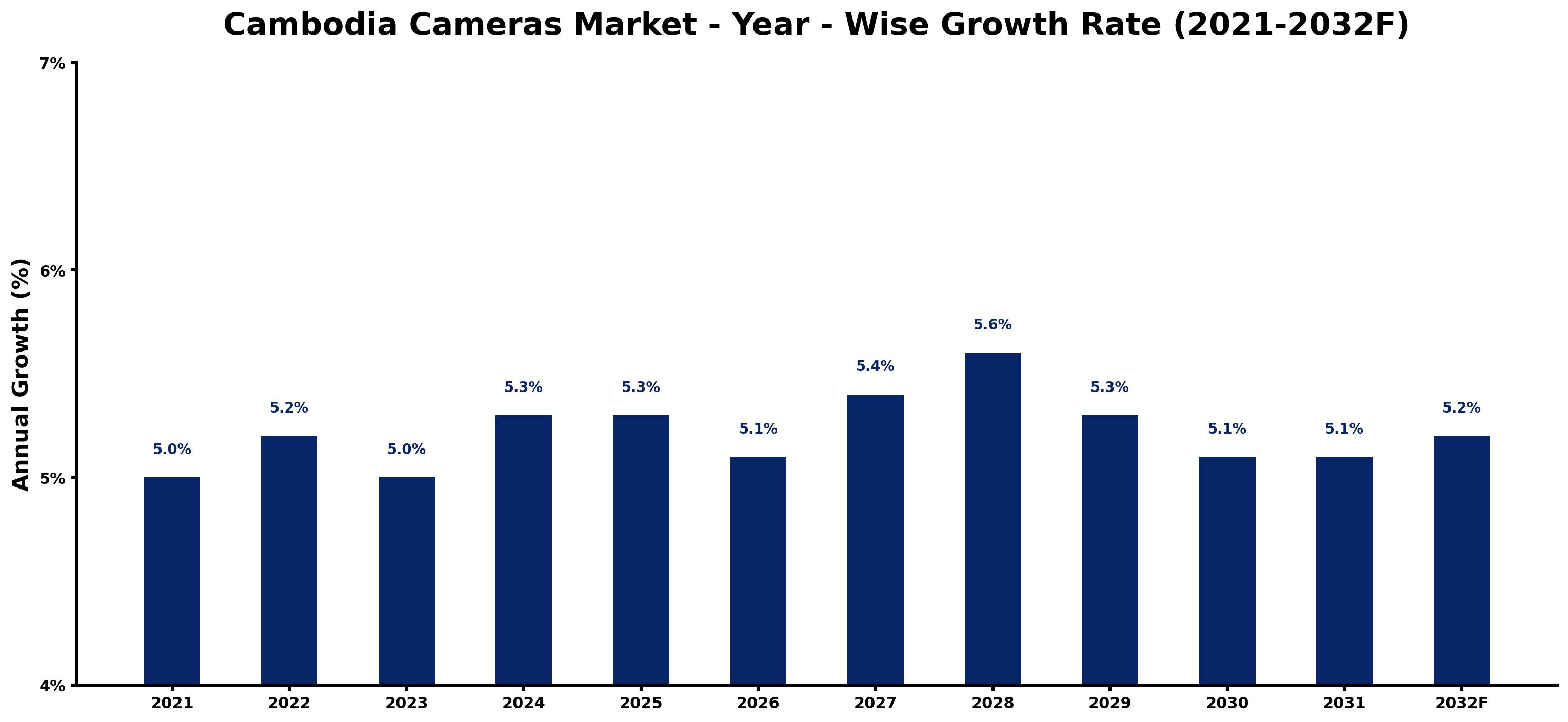
The table below presents the year wise growth rates along with the key drivers influencing the market
| Year | Growth Rate | Major Drivers |
| 2021 | 5.0% | Cambodia's tourism sector gradually rebounds, leading to increased camera purchases by travelers. |
| 2022 | 5.2% | Local retailers expand camera selections, catering to diverse consumer preferences and needs. |
| 2023 | 5.0% | Social media influencers promote photography, boosting interest in quality cameras among youth. |
| 2024 | 5.3% | E-commerce platforms flourish, simplifying access to a wide range of camera brands. |
| 2025 | 5.3% | Photography workshops gain popularity, encouraging more individuals to invest in better equipment. |
| 2026 | 5.1% | Emerging local brands introduce affordable camera options, energizing competition in the market. |
| 2027 | 5.4% | Smartphone camera technology plateauing drives consumers to seek superior standalone cameras. |
| 2028 | 5.6% | Sustainable tourism trends elevate demand for eco-friendly camera accessories and packaging. |
| 2029 | 5.3% | Urbanization in Phnom Penh creates new opportunities for event photography and client services. |
| 2030 | 5.1% | Collaborations between tech firms enhance camera features, making them more appealing to users. |
| 2031 | 5.1% | Consumer spending increases as disposable incomes rise, benefiting mid-range and premium camera segments. |
| 2032 | 5.2% | Content creation and remote work trends solidify the necessity for high-quality imaging equipment. |
Note - Market size estimations and growth projections presented in this report are based on 6Wresearch's advanced forecasting approach, validated with industry datasets as of June 2026.
Cambodia Cameras Market Synopsis
The Cambodia Cameras Market is projected to reach 5.1% and witness significant growth during the forecast period (2026-2032). This growth is primarily driven by the rising interest in photography and videography among consumers, particularly within the younger demographic. Digital cameras, encompassing DSLRs, mirrorless cameras, and compact point-and-shoot devices, dominate this evolving market landscape. The increasing demand for high-quality images, fueled by the proliferation of social media platforms for personal and professional use, significantly propels the adoption of advanced camera technology. Additionally, the burgeoning culture of content creation on platforms like YouTube and Instagram is further stimulating camera sales across Cambodia.
Cambodia Cameras Market Growth Drivers
Several factors are contributing to the growth of the Cambodia Cameras Market. Firstly, there is an escalating consumer base that values high-quality imaging for both personal use and professional endeavors. The quest for aesthetically pleasing social media posts drives the demand for better camera options. Secondly, technological advancements in camera design and functionality appeal to both amateur photographers and professionals, particularly the shift towards mirrorless cameras, known for their compact form and superior performance. Additionally, the rising popularity of vlogging has created a niche for portable cameras, which are essential for content creators who seek convenience without compromising quality. Finally, an increasing number of online retail platforms and e-commerce growth provides consumers with greater accessibility to a diverse range of camera products.
Cambodia Cameras Market Trends and Opportunities
The Cambodia Cameras Market is poised to capitalize on several emerging trends. Foremost among these is the shift towards mirrorless camera systems, driven by their lightweight design and advanced imaging capabilities. Consumers are increasingly gravitating towards such innovations, balancing functionality with portability. Moreover, action cameras are witnessing heightened interest, particularly among adventure enthusiasts and vloggers, owing to their resilience and ease of use in dynamic environments. While smartphone cameras continue to dominate the entry-level market, there is a discernible trend of consumers looking to upgrade to dedicated cameras for enhanced image quality. The proliferation of social media has further accentuated the demand for cameras equipped with Wi-Fi and Bluetooth capabilities, facilitating seamless content sharing. Collectively, these trends indicate a broadening of product offerings within the Cambodia Cameras Market, catering to diverse consumer preferences.
Cambodia Cameras Market Challenges and Restraints
Despite the promising outlook, the Cambodia Cameras Market faces several challenges. One significant hurdle is the low disposable income levels among a large portion of the population, limiting their purchasing power for premium camera products. Furthermore, the prevalence of counterfeit camera items undermines consumer trust and poses risks to brand reputation. Additionally, limited awareness regarding the advantages of investing in quality cameras continues to hinder market penetration. The lack of robust infrastructure, including internet connectivity and access to photography training resources, further exacerbates these challenges. Finally, the rapid improvement of smartphone camera technology shapes competitive dynamics, as many consumers opt for their phones over standalone cameras. Addressing these challenges necessitates focused strategies that prioritize education about camera benefits and the introduction of affordable product lines.
Cambodia Cameras Market Investment Opportunities
The Cambodia Cameras Market presents a myriad of investment opportunities that capitalize on the growing interest in photography and videography. With the thriving social media landscape and the emergence of influencer culture, there is a sustained demand for high-quality cameras and accessories. Potential avenues for investment include establishing retail stores that specialize in camera sales and accessories, as well as developing online platforms dedicated to camera sales. Camera rental services could also be a lucrative venture, catering to tourists and local consumers alike. Moreover, offering photography workshops and training sessions aligns with the increasing interest in the art of photography and could serve as a profitable business model. Collaborating with tourism agencies to provide specialized photography services for visitors exploring Cambodia's rich heritage and scenic landscapes further enhances the investment landscape.
Cambodia Cameras Market Government Investment and Initiatives
Government initiatives significantly shape the Cambodia Cameras Market through various policies. Import regulations and tariffs targeting specific camera types aim to bolster local manufacturing while simultaneously protecting domestic industries from foreign competition. The Cambodian government encourages foreign investments in camera technology and production facilities, offering incentives such as tax breaks and subsidies to attract global players in the market. Furthermore, the establishment of regulations stipulating safety and quality standards for cameras sold within the country ensures consumer protection and enhances the overall credibility of the market. These initiatives signal a commitment to not only promoting competitive market dynamics but also safeguarding consumer interests amid evolving technological landscapes.
Cambodia Cameras Market Latest Developments (May 2025 - June 2026)
Recent developments within the Cambodia Cameras Market from May 2025 to June 2026 indicate a growing shift towards enhanced digital engagement. Several retailers have increased their focus on e-commerce platforms, recognizing the changing consumer preferences towards online shopping. Additionally, brands are investing significantly in marketing strategies that emphasize digital content creation to appeal to younger audiences. The rise of short-form video content on social media has spurred camera manufacturers to innovate and tailor products that cater specifically to content creators. Furthermore, collaborative efforts between educational institutions and photography experts have emerged, aiming to offer training programs that can equip aspiring photographers with necessary skills. This collaborative environment fosters a supportive ecosystem conducive to market growth and development.
Cambodia Cameras Market - Key Attractiveness of the Report
- 10 Years of Market Numbers
- Historical Data Starting from 2022 to 2025
- Base Year: 2025
- Forecast Data until 2032
- Key Performance Indicators Impacting the Market
- Major Upcoming Developments and Projects
Key Highlights of the Report:
- Cambodia Cameras Market Outlook
- Market Size of Cambodia Cameras Market, 2025
- Forecast of Cambodia Cameras Market, 2032F
- Historical Data and Forecast of Cambodia Cameras Revenues & Volume for the Period 2022-2032F
- Cambodia Cameras Market Trend Evolution
- Cambodia Cameras Market Drivers and Challenges
- Cambodia Cameras Price Trends
- Cambodia Cameras Porter's Five Forces
- Cambodia Cameras Industry Life Cycle
- Historical Data and Forecast of Cambodia Cameras Market Revenues & Volume By Product Type for the Period 2022-2032F
- Historical Data and Forecast of Cambodia Cameras Market Revenues & Volume By Built-in Lens Camera for the Period 2022-2032F
- Historical Data and Forecast of Cambodia Cameras Market Revenues & Volume By Interchangeable Lens Camera for the Period 2022-2032F
- Historical Data and Forecast of Cambodia Cameras Market Revenues & Volume By DSLR for the Period 2022-2032F
- Historical Data and Forecast of Cambodia Cameras Market Revenues & Volume By Non-reflex for the Period 2022-2032F
- Historical Data and Forecast of Cambodia Cameras Market Revenues & Volume By Application for the Period 2022-2032F
- Historical Data and Forecast of Cambodia Cameras Market Revenues & Volume By Commercial for the Period 2022-2032F
- Historical Data and Forecast of Cambodia Cameras Market Revenues & Volume By Residential for the Period 2022-2032F
- Historical Data and Forecast of Cambodia Cameras Market Revenues & Volume By Distribution Channel for the Period 2022-2032F
- Historical Data and Forecast of Cambodia Cameras Market Revenues & Volume By Online for the Period 2022-2032F
- Historical Data and Forecast of Cambodia Cameras Market Revenues & Volume By Offline for the Period 2022-2032F
- Cambodia Cameras Import Export Trade Statistics
- Market Opportunity Assessment By Product Type
- Market Opportunity Assessment By Application
- Market Opportunity Assessment By Distribution Channel
- Cambodia Cameras Top Companies Market Share
- Cambodia Cameras Competitive Benchmarking By Technical and Operational Parameters
- Cambodia Cameras Company Profiles
- Cambodia Cameras Key Strategic Recommendations






































