Cambodia Cloud ERP Market Size & Growth Rate (2026-2032)
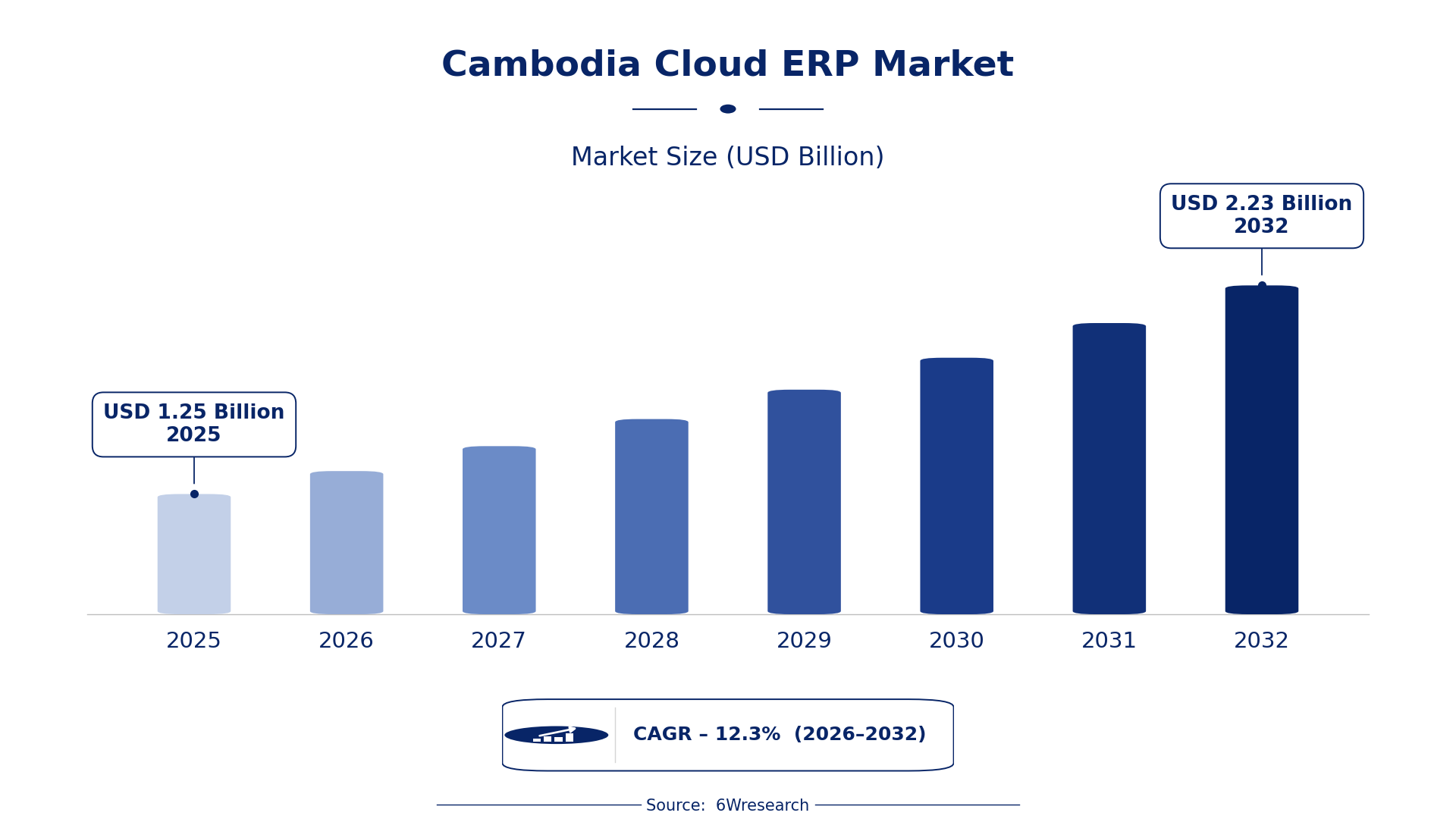
The Cambodia Cloud ERP Market was estimated at USD 1255 Million in 2025 and is projected to reach USD 2235 Million by 2032, growing at a CAGR of 12.3% from 2026 to 2032.
Cambodia Cloud ERP Market Synopsis
The driving force behind the Cambodia Cloud ERP market is the rapid adoption of digital technologies by enterprises. Companies are increasingly recognizing the need for improved operational efficiency and agility, prompting a shift toward cloud-based ERP solutions that offer scalability and cost-effectiveness.
As businesses in Cambodia embrace these solutions, the benefits of real-time data access and enhanced collaboration are becoming apparent. This transformation is not just a trend but a critical component of competitive strategy for organizations aiming to thrive in a dynamic market environment.
Cambodia Cloud ERP Market Year-wise Growth Rate and Key Drivers
This graph illustrates the annual growth rates of the Cambodia Cloud ERP Market from 2021 to 2032, highlighting a steady upward trajectory and projected expansion over the forecast period.
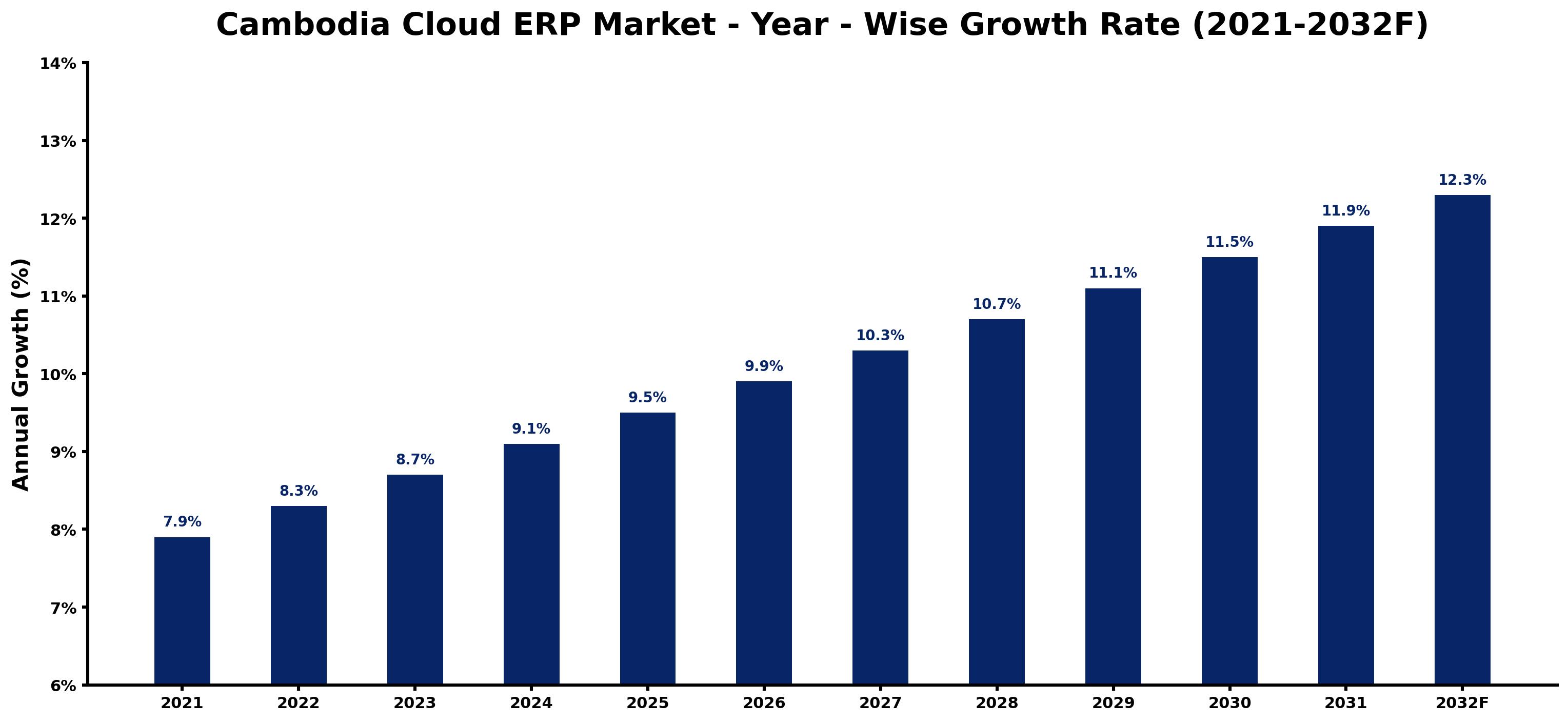
The table below presents the year‑wise growth rates along with the key drivers influencing the market
| Year | Growth Rate | Major Drivers |
| 2021 | 7.9% | Increased digital transformation initiatives by Cambodian businesses. |
| 2022 | 8.3% | Government push for smart cloud solutions in education sector. |
| 2023 | 8.7% | Young population driving mobile-first cloud adoption trends. |
| 2024 | 9.1% | Enhanced local internet infrastructure supporting ERP implementations. |
| 2025 | 9.5% | Growing trend of cashless payments encouraging digital software. |
| 2026 | 9.9% | Local enterprises seeking improved supply chain management tools. |
| 2027 | 10.3% | Tax incentives for businesses adopting technology innovations. |
| 2028 | 10.7% | Rising investment in start-ups fostering cloud software demand. |
| 2029 | 11.1% | Increased remote work culture necessitating cloud ERP solutions. |
| 2030 | 11.5% | Government partnerships with tech firms boosting cloud services. |
| 2031 | 11.9% | Robust growth of e-commerce influencing ERP system importance. |
| 2032 | 12.3% | Strong focus on digital skills training from local universities. |
Note: Market size estimations and growth projections presented in this report are based on 6Wresearch's proprietary forecasting methodology, utilizing the latest available industry data, government publications, and primary research inputs.
Cambodia Cloud ERP Market Key Takeaways
Below are some of the specific key takeaways from the market, including:
- Strong growth driven by increased digital technology adoption across various sectors.
- Cloud ERP solutions are favored for their flexibility and cost-effectiveness.
- Real-time data access is enhancing decision-making capabilities for businesses.
- Government initiatives are supporting the digital transformation agenda in Cambodia.
- Small and medium-sized enterprises (SMEs) are beginning to explore cloud solutions despite challenges.
Evaluation of Restraints in Cambodia Cloud ERP Market
Despite the optimistic outlook, the Cambodia Cloud ERP market faces notable restraints. A key issue is the limited understanding of cloud-based ERP benefits among many businesses, particularly SMEs. Concerns regarding data security, customization, and unreliable internet connectivity often deter these enterprises from fully embracing cloud solutions. This gap in knowledge can stall broader market adoption, limiting the potential for growth in the sector.
Cambodia Cloud ERP Market Trends
The Cambodia Cloud ERP market is witnessing several important trends. One prominent trend is the integration of advanced technologies, such as artificial intelligence and machine learning, into ERP systems. These technologies enhance automation and predictive analytics, enabling businesses to make informed decisions more efficiently.
Another trend is the increasing focus on user experience and customization. Vendors are now offering more adaptable solutions that cater to specific industry needs, allowing businesses to tailor functionalities to their unique requirements. This shift towards personalization is making cloud ERP solutions more appealing to diverse sectors.
Cambodia Cloud ERP Market Opportunities
Significant growth opportunities exist in the Cambodia Cloud ERP market, particularly among SMEs. As more companies recognize the advantages of cloud ERP, there’s a growing demand for tailored solutions that meet specific operational needs. Additionally, partnerships between local firms and global tech companies could facilitate knowledge transfer and infrastructure development, further stimulating market growth.
Government Initiatives in the Cambodia Cloud ERP Market
The Cambodian government is actively promoting digital transformation to enhance economic competitiveness. Policies aimed at improving digital infrastructure and attracting foreign investment are vital for the growth of the Cloud ERP market. These initiatives reflect a commitment to fostering an environment conducive to technological advancement and enterprise innovation.
- A national digital infrastructure upgrade programme that began in 2023 aims to enhance internet connectivity across urban and rural areas.
- Current initiatives include a public-private partnership focused on providing training for local businesses on digital tools and cloud solutions.
- A regulatory framework introduced in 2024 promotes transparency and data protection for cloud-based services.
- Planned initiatives include a comprehensive digital economy strategy expected to launch by 2026, aimed at accelerating cloud technology adoption.
Future Insights of the Cambodia Cloud ERP Market
Looking ahead to 2026-2032, the Cambodia Cloud ERP market is likely to expand significantly as more organizations transition to cloud-based systems. The emphasis on digital transformation will drive demand for ERP solutions that provide comprehensive data analytics and real-time reporting capabilities. As technology evolves, businesses will seek solutions that not only streamline operations but also foster innovation and growth.
Cambodia Cloud ERP Market Latest Developments
In the past year, the Cambodia Cloud ERP market has seen an uptick in activity, driven by both local and international players looking to capitalize on emerging opportunities. Companies are increasingly launching tailored solutions that cater to specific industry needs, addressing gaps in the market.
- A major technology vendor launched a new cloud ERP suite in early 2025, targeting the manufacturing sector with enhanced features for production management.
- An ongoing initiative aims to integrate AI capabilities into existing ERP platforms, enhancing predictive analytics for businesses, which started in late 2024.
- A partnership between a local provider and an international tech firm was announced in Q1 2025 to develop a customized ERP solution for SMEs, focusing on ease of use and affordability.
- Upcoming in mid-2026, a series of workshops and training programs will be rolled out to educate SMEs on cloud ERP benefits and implementation strategies.
Cambodia Cloud ERP Market - Key Attractiveness of the Report
- 10 Years of Market Numbers
- Historical Data Starting from 2022 to 2025
- Base Year: 2025
- Forecast Data until 2032
- Key Performance Indicators Impacting the Market
- Major Upcoming Developments and Projects
Key Highlights of the Report:
- Cambodia Cloud ERP Market Outlook
- Market Size of Cambodia Cloud ERP Market, 2025
- Forecast of Cambodia Cloud ERP Market, 2032
- Historical Data and Forecast of Cambodia Cloud ERP Revenues & Volume for the Period 2022-2032F
- Cambodia Cloud ERP Market Trend Evolution
- Cambodia Cloud ERP Market Drivers and Challenges
- Cambodia Cloud ERP Price Trends
- Cambodia Cloud ERP Porter's Five Forces
- Cambodia Cloud ERP Industry Life Cycle
- Historical Data and Forecast of Cambodia Cloud ERP Market Revenues & Volume By Component for the Period 2022-2032F
- Historical Data and Forecast of Cambodia Cloud ERP Market Revenues & Volume By Solution for the Period 2022-2032F
- Historical Data and Forecast of Cambodia Cloud ERP Market Revenues & Volume By Services for the Period 2022-2032F
- Historical Data and Forecast of Cambodia Cloud ERP Market Revenues & Volume By Vertical for the Period 2022-2032F
- Historical Data and Forecast of Cambodia Cloud ERP Market Revenues & Volume By BFSI for the Period 2022-2032F
- Historical Data and Forecast of Cambodia Cloud ERP Market Revenues & Volume By Manufacturing for the Period 2022-2032F
- Historical Data and Forecast of Cambodia Cloud ERP Market Revenues & Volume By IT and Telecom for the Period 2022-2032F
- Historical Data and Forecast of Cambodia Cloud ERP Market Revenues & Volume By Business Function for the Period 2022-2032F
- Historical Data and Forecast of Cambodia Cloud ERP Market Revenues & Volume By Accounting and Finance for the Period 2022-2032F
- Historical Data and Forecast of Cambodia Cloud ERP Market Revenues & Volume By Sales and Marketing for the Period 2022-2032F
- Historical Data and Forecast of Cambodia Cloud ERP Market Revenues & Volume By Inventory and Order Management for the Period 2022-2032F
- Historical Data and Forecast of Cambodia Cloud ERP Market Revenues & Volume By Organization Size for the Period 2022-2032F
- Historical Data and Forecast of Cambodia Cloud ERP Market Revenues & Volume By SMEs for the Period 2022-2032F
- Historical Data and Forecast of Cambodia Cloud ERP Market Revenues & Volume By Large Enterprises for the Period 2022-2032F
- Cambodia Cloud ERP Import Export Trade Statistics
- Market Opportunity Assessment By Component
- Market Opportunity Assessment By Vertical
- Market Opportunity Assessment By Business Function
- Market Opportunity Assessment By Organization Size
- Cambodia Cloud ERP Top Companies Market Share
- Cambodia Cloud ERP Competitive Benchmarking By Technical and Operational Parameters
- Cambodia Cloud ERP Company Profiles
- Cambodia Cloud ERP Key Strategic Recommendations






































