Cambodia Connector Market: Import Trend Analysis
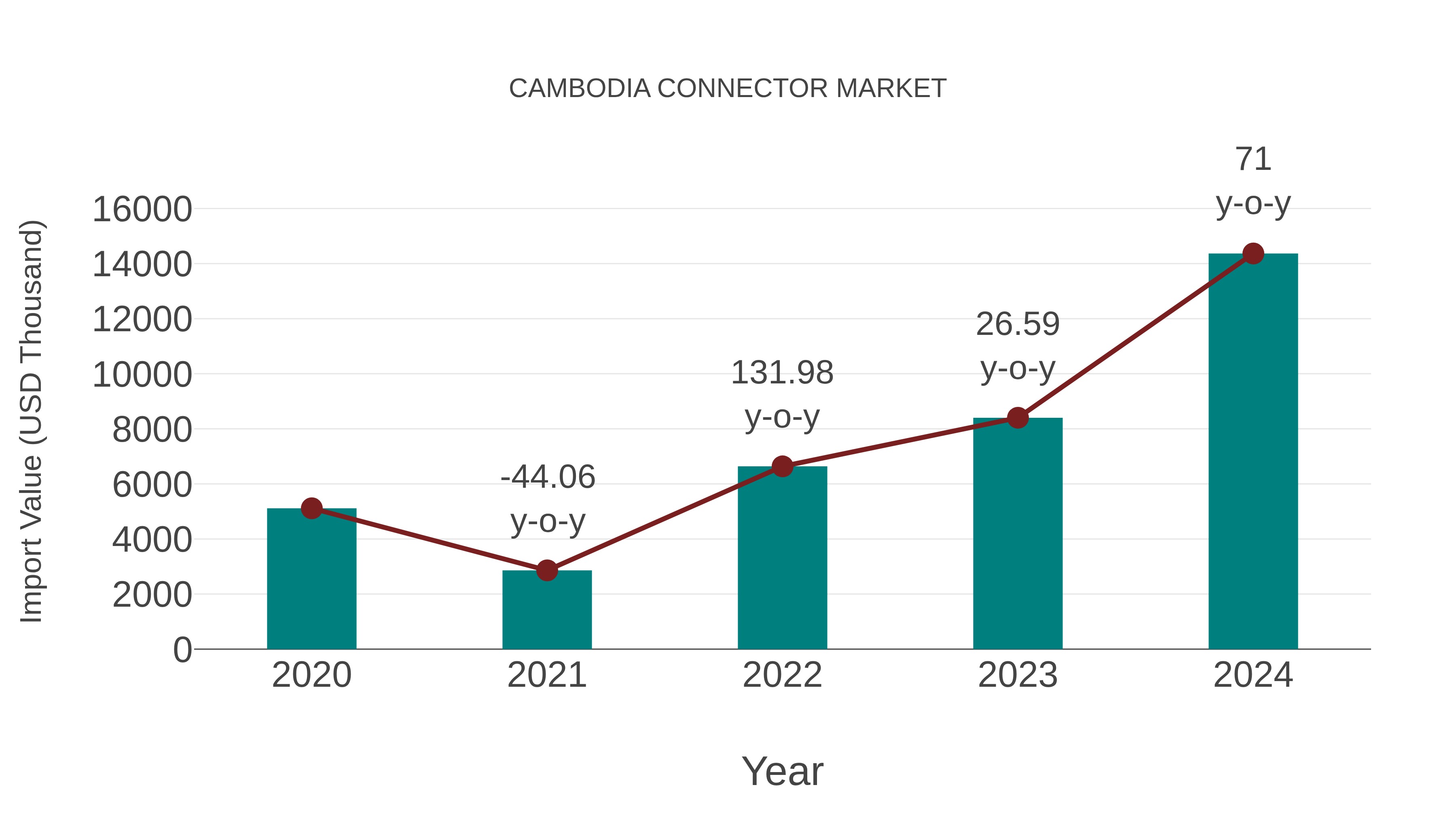
In the Cambodia connector market, the import trend demonstrated significant growth from 2023 to 2024, with a growth rate of 71.0%. The compound annual growth rate (CAGR) for the period 2020-2024 stood at 29.46%. This surge can be attributed to a notable demand shift towards advanced technological solutions in the market, driving import momentum and indicating market stability during the period analyzed.
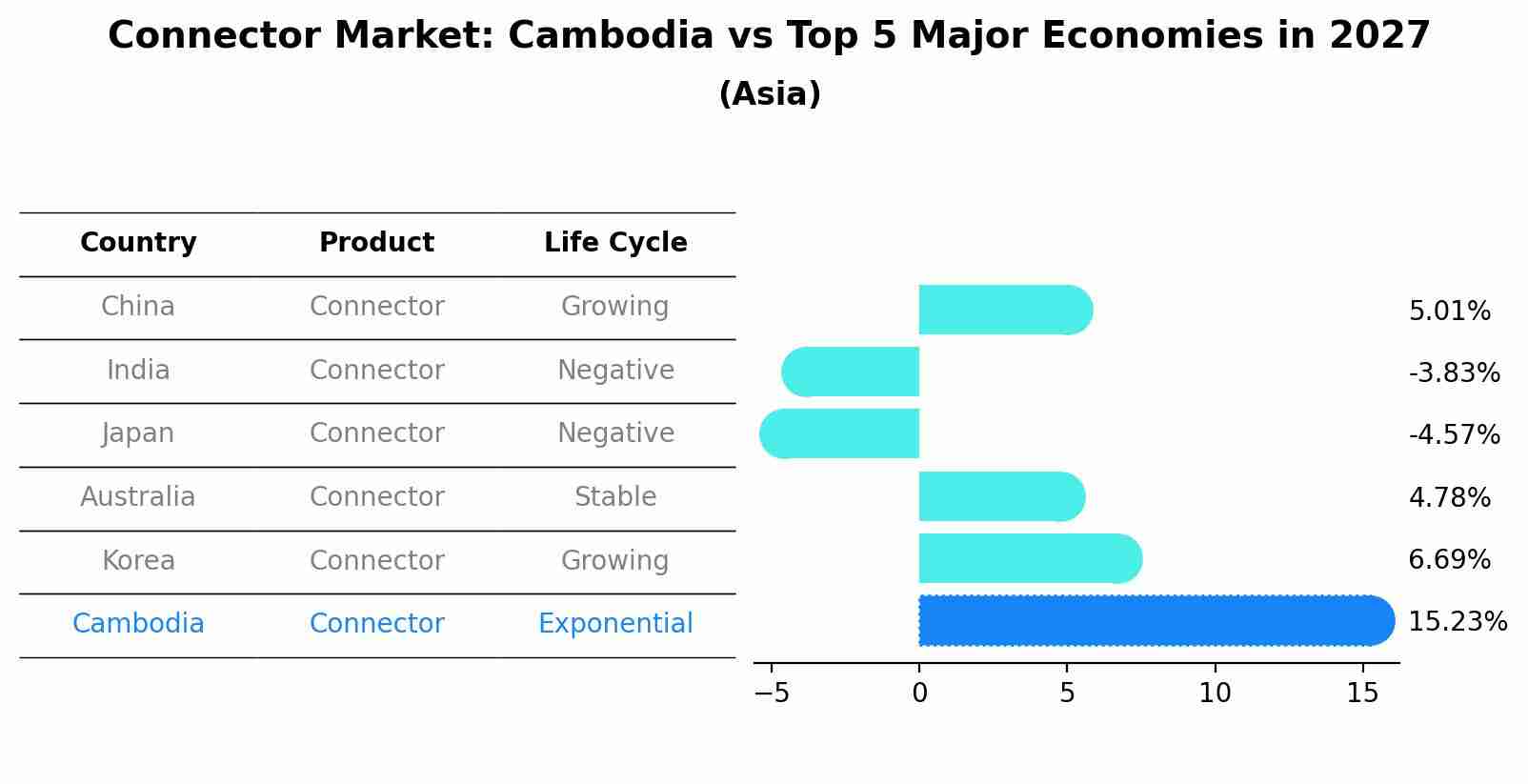
Connector Market: Cambodia vs Top 5 Major Economies in 2027 (Asia)
In the Asia region, the Connector market in Cambodia is projected to expand at a exponential growth rate of 15.23% by 2027. The largest economy is China, followed by India, Japan, Australia and South Korea.
Cambodia Connector Market Overview
With the rapid expansion of the electronics and telecommunications sectors in Cambodia, the connector market is witnessing significant growth. Connectors play a crucial role in ensuring reliable connectivity in various electronic devices, communication networks, and industrial equipment, driving demand from diverse end-user industries.
Drivers of the market
The connector market in Cambodia is driven by the expansion of the electronics industry, increasing demand for consumer electronics, automotive electronics, and telecommunications equipment. Factors such as miniaturization of devices, advancements in connector technology, and growing investments in infrastructure development contribute to market growth by creating demand for high-performance and reliable connectors.
Challenges of the market
The connector market in Cambodia faces challenges such as competition from cheaper imports, limited domestic manufacturing capabilities, and the need for quality assurance and certification. The market may also encounter difficulties in meeting the diverse needs of various industries, including automotive, electronics, and telecommunications. Additionally, fluctuations in raw material prices and currency exchange rates could impact market dynamics.
Government Policy of the market
In the connector market, Cambodia is witnessing increased demand driven by the growing electronics industry and the expansion of telecommunications networks. Government initiatives aimed at promoting foreign investment and supporting the manufacturing sector are driving market growth. Moreover, the adoption of advanced technologies such as 5G and IoT is spurring the demand for high-performance connectors in the country.
Key Highlights of the Report:
- Cambodia Connector Market Outlook
- Market Size of Cambodia Connector Market, 2025
- Forecast of Cambodia Connector Market, 2032
- Historical Data and Forecast of Cambodia Connector Revenues & Volume for the Period 2022-2032F
- Cambodia Connector Market Trend Evolution
- Cambodia Connector Market Drivers and Challenges
- Cambodia Connector Price Trends
- Cambodia Connector Porter's Five Forces
- Cambodia Connector Industry Life Cycle
- Historical Data and Forecast of Cambodia Connector Market Revenues & Volume By Product for the Period 2022-2032F
- Historical Data and Forecast of Cambodia Connector Market Revenues & Volume By PCB Connectors for the Period 2022-2032F
- Historical Data and Forecast of Cambodia Connector Market Revenues & Volume By IO Connectors for the Period 2022-2032F
- Historical Data and Forecast of Cambodia Connector Market Revenues & Volume By Circular Connectors for the Period 2022-2032F
- Historical Data and Forecast of Cambodia Connector Market Revenues & Volume By Fiber Optic Connectors for the Period 2022-2032F
- Historical Data and Forecast of Cambodia Connector Market Revenues & Volume By RF Coaxial Connectors for the Period 2022-2032F
- Historical Data and Forecast of Cambodia Connector Market Revenues & Volume By Others for the Period 2022-2032F
- Historical Data and Forecast of Cambodia Connector Market Revenues & Volume By End Use for the Period 2022-2032F
- Historical Data and Forecast of Cambodia Connector Market Revenues & Volume By Telecom for the Period 2022-2032F
- Historical Data and Forecast of Cambodia Connector Market Revenues & Volume By Transportation for the Period 2022-2032F
- Historical Data and Forecast of Cambodia Connector Market Revenues & Volume By Automotive for the Period 2022-2032F
- Historical Data and Forecast of Cambodia Connector Market Revenues & Volume By Industrial for the Period 2022-2032F
- Historical Data and Forecast of Cambodia Connector Market Revenues & Volume By Computer & Peripherals for the Period 2022-2032F
- Historical Data and Forecast of Cambodia Connector Market Revenues & Volume By Others for the Period 2022-2032F
- Cambodia Connector Import Export Trade Statistics
- Market Opportunity Assessment By Product
- Market Opportunity Assessment By End Use
- Cambodia Connector Top Companies Market Share
- Cambodia Connector Competitive Benchmarking By Technical and Operational Parameters
- Cambodia Connector Company Profiles
- Cambodia Connector Key Strategic Recommendations






































