Cambodia Data Classification Market Size & Growth Rate (2026-2032)
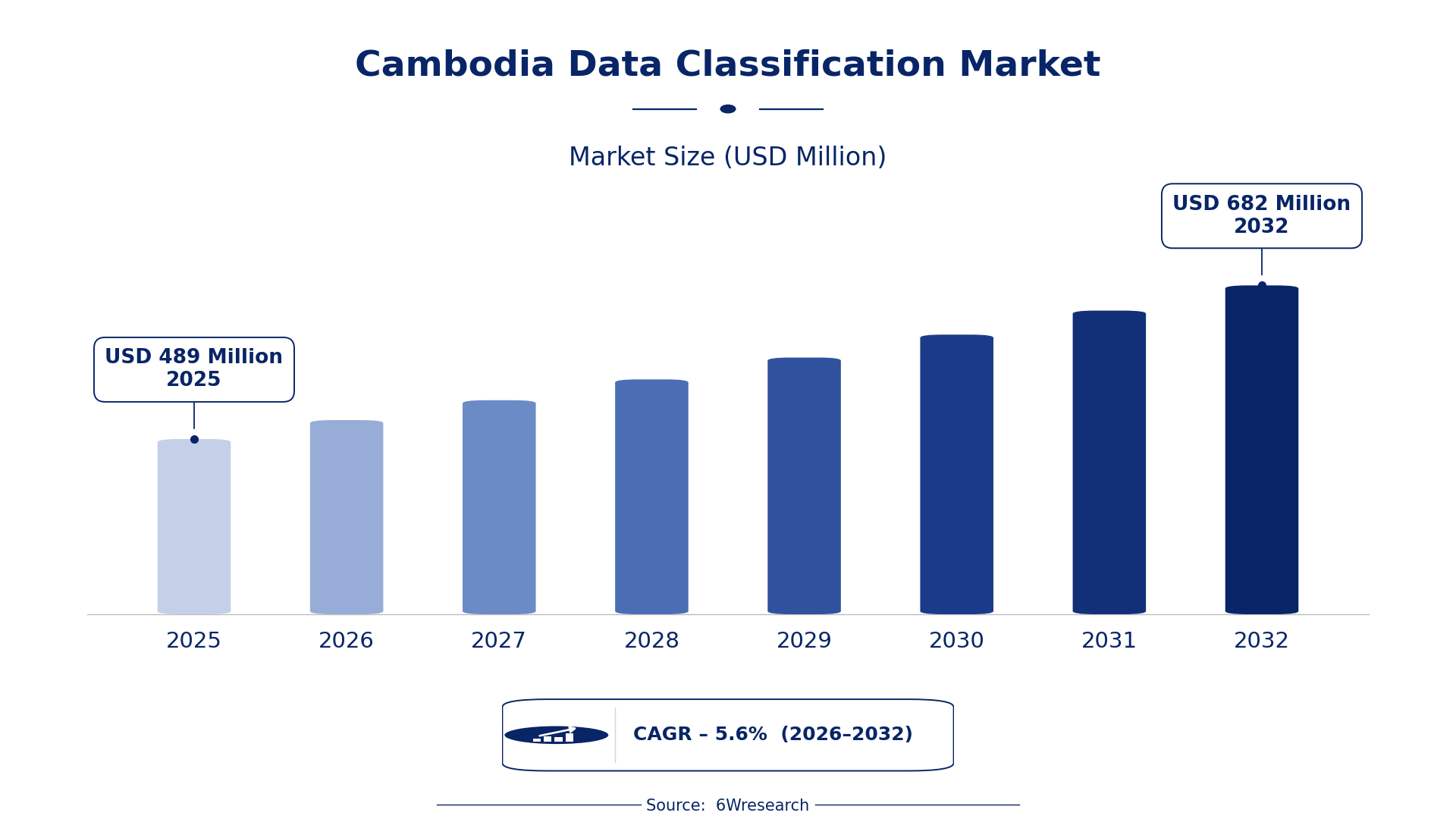
The Cambodia Data Classification Market was estimated at USD 489 Million in 2025 and is projected to reach USD 682 Million by 2032, growing at a CAGR of 5.6% from 2026 to 2032.
Cambodia Data Classification Market Synopsis
The urgency for effective data classification has never been more pronounced in Cambodia. As businesses increasingly digitalize operations, the necessity to categorize information accurately is paramount for ensuring compliance and enhancing data security.
Organizations are now more aware of their responsibilities under regulations like the General Data Protection Regulation (GDPR). This awareness, coupled with the rise in cyber threats, has accelerated the demand for sophisticated data classification tools and methodologies.
Cambodia Data Classification Market Year-wise Growth Rate and Key Drivers
This graph illustrates the annual growth rates of the Cambodia Data Classification Market from 2021 to 2032, highlighting a steady upward trajectory and projected expansion over the forecast period.
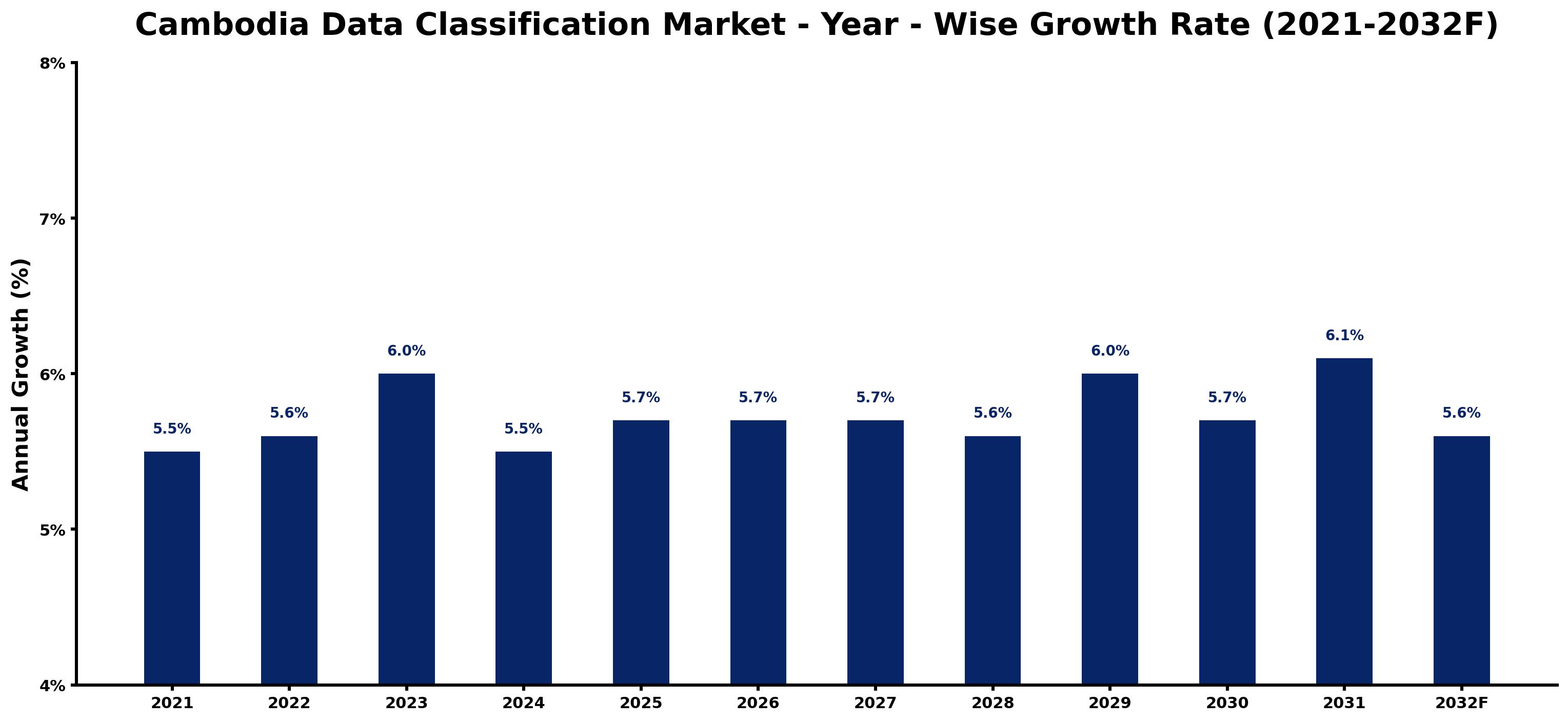
The table below presents the year‑wise growth rates along with the key drivers influencing the market
| Year | Growth Rate | Major Drivers |
| 2021 | 5.5% | Introduction of Cambodia's Personal Data Protection Act. |
| 2022 | 5.6% | Increased investments in cybersecurity infrastructure by local companies. |
| 2023 | 6.0% | Rising concerns over data privacy among Cambodian consumers. |
| 2024 | 5.5% | Government initiatives promoting digital economy and data governance. |
| 2025 | 5.7% | Non-government organizations pushing for better data handling practices. |
| 2026 | 5.7% | Partnerships between tech firms and universities for data literacy. |
| 2027 | 5.7% | Growing number of startups focusing on data analytics solutions. |
| 2028 | 5.6% | Awareness campaigns on data protection boosting market engagement. |
| 2029 | 6.0% | Emerging demand for data classification in e-commerce sectors. |
| 2030 | 5.7% | International businesses requiring compliance with data protection norms. |
| 2031 | 6.1% | Government-funded training programs on data management skills. |
| 2032 | 5.6% | Local enterprises enhancing data strategies for competitive advantage. |
Note: Market size estimations and growth projections presented in this report are based on 6Wresearch's proprietary forecasting methodology, utilizing the latest available industry data, government publications, and primary research inputs.
Cambodia Data Classification Market Key Takeaways
Below are some of the specific key takeaways from the market, including:
- Growing awareness of data security is propelling the need for classification solutions.
- Cambodia's digital transformation is influencing data management practices.
- The government is playing a critical role in shaping data classification standards.
- Language and cultural barriers present unique challenges in data classification efforts.
- Automation tools are becoming increasingly essential for efficient data handling.
Evaluation of Restraints in Cambodia Data Classification Market
The Cambodia Data Classification Market faces real limitations stemming from both infrastructural and cultural factors. A significant challenge is the absence of standardized practices for data classification, which hinders effective implementation. Organizations often struggle to find tools that accommodate the diverse linguistic and cultural landscape of Cambodia. This lack of alignment can lead to inconsistent data management efforts, ultimately compromising security and compliance. As the market matures, overcoming these obstacles will be crucial to realizing its full potential.
Cambodia Data Classification Market Trends
The current trends in the Cambodia Data Classification Market indicate a shift towards automated solutions. Organizations are increasingly adopting software that utilizes machine learning for data categorization, reducing human error and improving efficiency. on top of that, there’s a noticeable emphasis on mobile accessibility in data management tools, reflecting the increasing use of smartphones in business operations. These technological advancements are streamlining processes and making data classification more efficient.
Cambodia Data Classification Market Opportunities
As Cambodia continues to embrace digital transformation, numerous opportunities are emerging within the data classification space. Companies that develop localized solutions can cater to the unique needs of Cambodian businesses, tapping into a less saturated market. Additionally, partnerships with government agencies can facilitate the creation of compliant data classification systems. Investing in training and education programs for employees on best practices for data classification is another area ripe for development.
Government Initiatives in the Cambodia Data Classification Market
The Cambodian government recognizes the critical importance of data classification as a component of effective data management and protection. Recent policy developments are fostering a more structured approach to data security across various sectors. This proactive posture is essential as organizations navigate the challenges associated with compliance and security.
- A regulatory framework requiring data classification based on sensitivity was introduced in early 2025.
- A national initiative focusing on enhancing awareness of data classification best practices is currently underway.
- Plans for a public-private partnership aimed at creating resources for automated data classification tools are slated for 2026.
- The government has established a data management task force to streamline compliance measures in 2024.
- Training programs on data classification for public sector employees have been launched and are ongoing.
Future Insights of the Cambodia Data Classification Market
Looking ahead to 2026-2032, the Cambodia Data Classification Market is expected to grow substantially as regulatory requirements tighten. Companies that adapt quickly to these evolving regulations will have a competitive advantage. on top of that, the integration of advanced technologies such as AI and machine learning will redefine data classification, making it more efficient and reliable. Organizations that prioritize these advancements will likely see improved operational efficiency and compliance outcomes.
Cambodia Data Classification Market Latest Developments
Over the past year, the Cambodia Data Classification Market has experienced significant activity, marked by heightened awareness and the introduction of new initiatives. Organizations are investing more in data classification solutions as the market matures and regulatory pressures increase.
- A new data classification tool was launched in Q3 2025 by a leading technology vendor, aimed at local businesses.
- An initiative to provide public sector employees with training on data classification has been ongoing since mid-2025.
- A major technology provider is currently expanding its operations in Cambodia to address rising demand for data management solutions, expected to complete by late 2025.
- A partnership between local universities and tech companies focused on developing new data classification curricula was established in early 2025.
- A planned national campaign to raise awareness about data security is set to launch in early 2026.
Cambodia Data Classification Market - Key Attractiveness of the Report
- 10 Years of Market Numbers
- Historical Data Starting from 2022 to 2025
- Base Year: 2025
- Forecast Data until 2032
- Key Performance Indicators Impacting the Market
- Major Upcoming Developments and Projects
Key Highlights of the Report:
- Cambodia Data Classification Market Outlook
- Market Size of Cambodia Data Classification Market, 2025
- Forecast of Cambodia Data Classification Market, 2032
- Historical Data and Forecast of Cambodia Data Classification Revenues & Volume for the Period 2022-2032F
- Cambodia Data Classification Market Trend Evolution
- Cambodia Data Classification Market Drivers and Challenges
- Cambodia Data Classification Price Trends
- Cambodia Data Classification Porter's Five Forces
- Cambodia Data Classification Industry Life Cycle
- Historical Data and Forecast of Cambodia Data Classification Market Revenues & Volume By Component for the Period 2022-2032F
- Historical Data and Forecast of Cambodia Data Classification Market Revenues & Volume By Solutions (Standalone and Integrated) for the Period 2022-2032F
- Historical Data and Forecast of Cambodia Data Classification Market Revenues & Volume By Services for the Period 2022-2032F
- Historical Data and Forecast of Cambodia Data Classification Market Revenues & Volume By Application for the Period 2022-2032F
- Historical Data and Forecast of Cambodia Data Classification Market Revenues & Volume By Access Control for the Period 2022-2032F
- Historical Data and Forecast of Cambodia Data Classification Market Revenues & Volume By GRC for the Period 2022-2032F
- Historical Data and Forecast of Cambodia Data Classification Market Revenues & Volume By Web for the Period 2022-2032F
- Historical Data and Forecast of Cambodia Data Classification Market Revenues & Volume By Mobile & Email Protection for the Period 2022-2032F
- Historical Data and Forecast of Cambodia Data Classification Market Revenues & Volume By Centralized Management for the Period 2022-2032F
- Historical Data and Forecast of Cambodia Data Classification Market Revenues & Volume By Methodology for the Period 2022-2032F
- Historical Data and Forecast of Cambodia Data Classification Market Revenues & Volume By Content-based Classification for the Period 2022-2032F
- Historical Data and Forecast of Cambodia Data Classification Market Revenues & Volume By Context-based Classification for the Period 2022-2032F
- Historical Data and Forecast of Cambodia Data Classification Market Revenues & Volume By User-based Classification for the Period 2022-2032F
- Historical Data and Forecast of Cambodia Data Classification Market Revenues & Volume By Vertical for the Period 2022-2032F
- Historical Data and Forecast of Cambodia Data Classification Market Revenues & Volume By BFSI for the Period 2022-2032F
- Historical Data and Forecast of Cambodia Data Classification Market Revenues & Volume By Healthcare and Lifesciences for the Period 2022-2032F
- Historical Data and Forecast of Cambodia Data Classification Market Revenues & Volume By Government and Defense for the Period 2022-2032F
- Historical Data and Forecast of Cambodia Data Classification Market Revenues & Volume By Education for the Period 2022-2032F
- Historical Data and Forecast of Cambodia Data Classification Market Revenues & Volume By Telecom for the Period 2022-2032F
- Historical Data and Forecast of Cambodia Data Classification Market Revenues & Volume By Media and Entertainment for the Period 2022-2032F
- Historical Data and Forecast of Cambodia Data Classification Market Revenues & Volume By Others (Retail and Ecommerce, Manufacturing, and Energy and Utilities) for the Period 2022-2032F
- Cambodia Data Classification Import Export Trade Statistics
- Market Opportunity Assessment By Component
- Market Opportunity Assessment By Application
- Market Opportunity Assessment By Methodology
- Market Opportunity Assessment By Vertical
- Cambodia Data Classification Top Companies Market Share
- Cambodia Data Classification Competitive Benchmarking By Technical and Operational Parameters
- Cambodia Data Classification Company Profiles
- Cambodia Data Classification Key Strategic Recommendations






































