Cambodia Industrial Computers Market Summary
The cambodia industrial computers market was estimated at USD 94 Million in 2025 and is projected to reach USD 103 Million by 2032, growing at a CAGR of 1.4% from 2026 to 2032.
Cambodia Industrial Computers Market Year-wise Growth Rate and Key Drivers
This graph highlights how the Cambodia Industrial Computers Market has steadily grown over the past five years, supported by major growth factors.
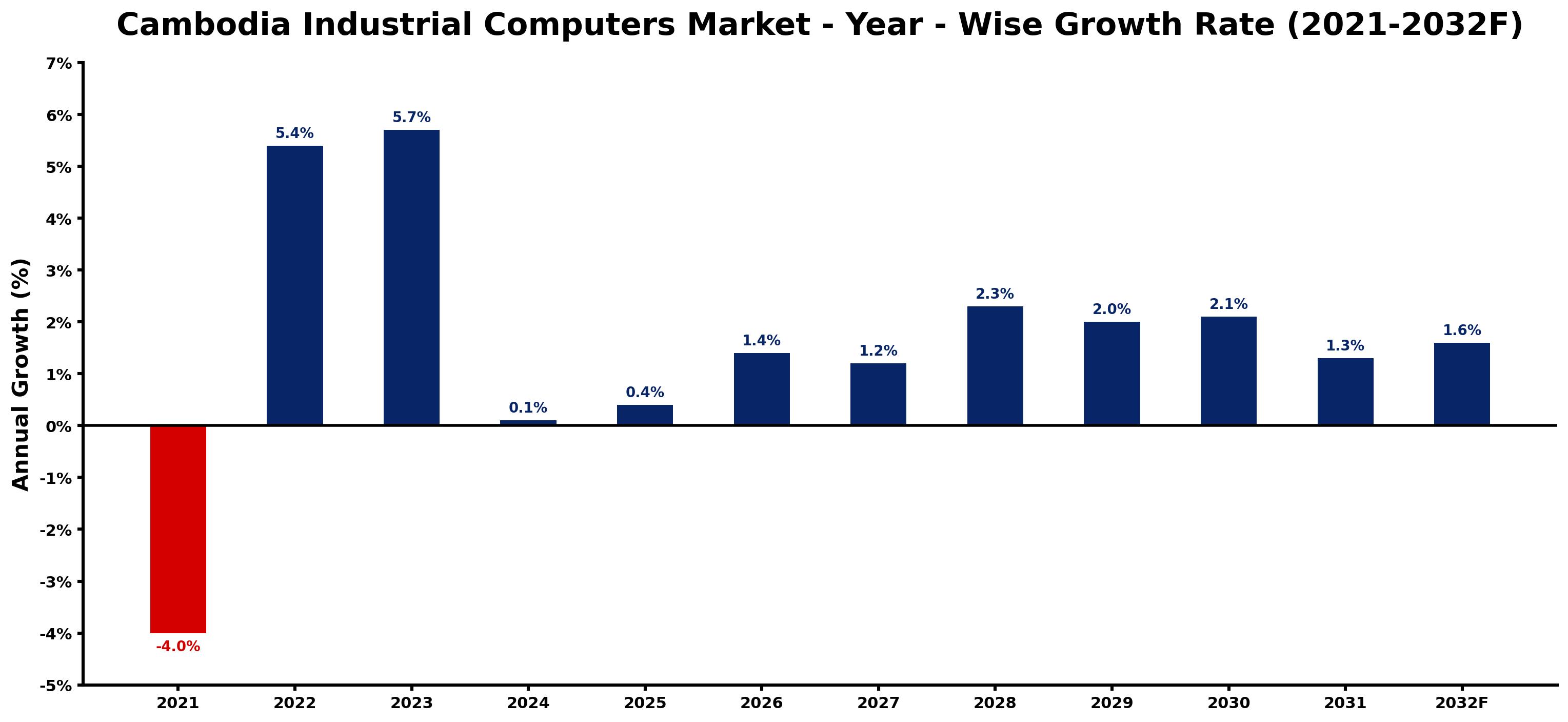
The table below presents the year wise growth rates along with the key drivers influencing the market
| Year | Growth Rate | Major Drivers |
| 2021 | -4.0% | Supply chain disruptions caused by global shipping delays significantly hindered industrial computer availability in Cambodia. |
| 2022 | 5.4% | Supply chain disruptions prompt investments in more resilient industrial computing solutions. |
| 2023 | 5.7% | New manufacturing hubs in Cambodia attract global players seeking reliable tech infrastructure. |
| 2024 | 0.1% | Infrastructure improvements enable smoother integration of industrial computers in various sectors. |
| 2025 | 0.4% | Emergence of smart factories encourages the adoption of IoT-enabled industrial computing devices. |
| 2026 | 1.4% | Increased emphasis on cybersecurity drives advanced computing solutions for industrial applications. |
| 2027 | 1.2% | Local partnerships with tech firms enhance service offerings in the industrial computing market. |
| 2028 | 2.3% | Environmental sustainability goals prompt investment in energy-efficient industrial computing technologies. |
| 2029 | 2.0% | Higher productivity demands lead to innovative software solutions tailored for industrial computers. |
| 2030 | 2.1% | Growing e-commerce activities necessitate advanced computing to manage logistics and operations. |
| 2031 | 1.3% | Technological convergence leads to hybrid solutions blending AI with industrial computing needs. |
| 2032 | 1.6% | Market maturity emerges as competition fosters innovation in industrial computer functionalities. |
Note - Market size estimations and growth projections presented in this report are based on 6Wresearch's advanced forecasting approach, validated with industry datasets as of June 2026.
Cambodia Industrial Computers Market Synopsis
The Cambodia Industrial Computers Market is projected to reach 1.4% and witness significant growth during the forecast period (2026-2032). This growth is underpinned by a surge in automation across various sectors, particularly in manufacturing, logistics, and healthcare. The demand for industrial computers has risen substantially, largely due to their robustness and adaptability to rigorous operational environments. As businesses increasingly embrace Industry 4.0, the reliance on advanced industrial computing solutions has become imperative to enhance operational productivity and efficiency.
Cambodia Industrial Computers Market Growth Drivers
Several factors are catalyzing the growth of the Cambodia Industrial Computers Market. Firstly, the acceleration of automation in key industries is driving the need for rugged computing solutions that can endure adverse conditions. Secondly, the integration of Internet of Things (IoT) technologies is enabling businesses to implement real-time monitoring and analytics, significantly enhancing operational capabilities. Thirdly, the continued emphasis on digital transformation initiatives by the Cambodian government is fostering an environment conducive to industrial computing solutions. Additionally, the escalation of cybersecurity concerns is prompting businesses to invest in more sophisticated industrial computer systems to protect sensitive information. Lastly, the rising demand for efficiency in production and logistics further fuels this market's expansion, as companies strive for increased competitiveness.
Cambodia Industrial Computers Market Trends and Opportunities
The Cambodia Industrial Computers Market is witnessing transformative trends that present substantial opportunities for growth. One notable trend is the shift towards edge computing, enabling faster data processing and decision-making processes. This transition is particularly important in manufacturing and logistics, where timely information is crucial for performance optimization. Furthermore, there is a growing preference for ruggedized and reliable systems capable of functioning in challenging environments, which is essential for sectors like agriculture and transportation. The merging of industrial computing with advanced data analytics and artificial intelligence presents vast opportunities for innovative software solutions, catering to the evolving needs of Cambodian businesses. Additionally, a heightened focus on compliance with international safety and quality standards offers a competitive edge to local firms investing in industrial computer technologies.
Cambodia Industrial Computers Market Challenges and Restraints
Despite the positive growth trajectory, the Cambodia Industrial Computers Market faces several challenges. One major issue is the limited awareness among local businesses regarding the benefits of adopting industrial computing solutions. This lack of understanding can hinder the decision-making process, affecting overall market penetration. Additionally, there is a notable shortage of skilled labor capable of operating and maintaining these advanced systems, which poses a significant barrier to effective implementation. Compounded by difficulties in sourcing reliable and cost-effective components from local suppliers, these challenges can stall the growth of the sector. Moreover, concerns surrounding data security and privacy in an increasingly connected industrial landscape further complicate adoption. To navigate these challenges, there is a pressing need for targeted education initiatives, investment in workforce training, and enhanced collaboration with international technology providers.
Cambodia Industrial Computers Market Investment Opportunities
The Cambodia Industrial Computers Market is ripe with investment opportunities, particularly in the context of the country's expanding industrial landscape. There is a burgeoning demand for various industrial computing solutions, such as panel PCs, embedded systems, and human-machine interface devices. Investors who focus on supplying ruggedized computers tailored to the unique requirements of Cambodian industries are likely to find significant market traction. Furthermore, the integration of software solutions facilitating data analytics and IoT functionalities represents a key area for investment growth. By understanding and navigating local regulations, forging strategic partnerships, and delivering reliable after-sales support, investors can position themselves favorably within this dynamic market.
Cambodia Industrial Computers Market Government Investment and Initiatives
The Cambodian government is actively spearheading initiatives to bolster the industrial computers market through a series of supportive policies. These include tax incentives and exemptions aimed at attracting foreign investment, as well as investments in infrastructure and technology parks designed to enhance the sector's competitiveness. The government is also implementing stringent regulations that ensure high standards for quality and safety in industrial computer products, which is crucial for building consumer trust. Additionally, there is a strategic focus on fostering partnerships between local enterprises and international technology firms, facilitating knowledge transfer and skills development. These policies collectively aim to stimulate innovation in the sector, enhance manufacturing capacity, and position Cambodia as a notable hub for industrial computer production and export.
Cambodia Industrial Computers Market Latest Developments (May 2025 - June 2026)
Recent developments in the Cambodia Industrial Computers Market indicate a trend towards greater collaboration among stakeholders in the industrial sector. There has been a noticeable uptick in workshops and training programs aimed at enhancing the skill sets of local workers, addressing the gap in skilled labor for maintaining advanced industrial computer systems. Additionally, leading manufacturers have begun to explore partnerships with technology firms to leverage emerging technologies such as artificial intelligence and advanced analytics in their offerings. The integration of these technologies is set to improve operational efficiencies across various industries. Furthermore, there has been an increased focus on cybersecurity measures, as industrial businesses recognize the imperative of protecting their data assets in an increasingly digital environment. Such initiatives reflect the market's readiness for adaptation and growth amidst the evolving technological landscape.
Cambodia Industrial Computers Market - Key Attractiveness of the Report
- 10 Years of Market Numbers
- Historical Data Starting from 2022 to 2025
- Base Year: 2025
- Forecast Data until 2032
- Key Performance Indicators Impacting the Market
- Major Upcoming Developments and Projects
Key Highlights of the Report:
- Cambodia Industrial Computers Market Outlook
- Market Size of Cambodia Industrial Computers Market, 2025
- Forecast of Cambodia Industrial Computers Market, 2032F
- Historical Data and Forecast of Cambodia Industrial Computers Revenues & Volume for the Period 2022-2032F
- Cambodia Industrial Computers Market Trend Evolution
- Cambodia Industrial Computers Market Drivers and Challenges
- Cambodia Industrial Computers Price Trends
- Cambodia Industrial Computers Porter's Five Forces
- Cambodia Industrial Computers Industry Life Cycle
- Historical Data and Forecast of Cambodia Industrial Computers Market Revenues & Volume By Type for the Period 2022-2032F
- Historical Data and Forecast of Cambodia Industrial Computers Market Revenues & Volume By Panel for the Period 2022-2032F
- Historical Data and Forecast of Cambodia Industrial Computers Market Revenues & Volume By Box for the Period 2022-2032F
- Historical Data and Forecast of Cambodia Industrial Computers Market Revenues & Volume By Embedded for the Period 2022-2032F
- Historical Data and Forecast of Cambodia Industrial Computers Market Revenues & Volume By Din Rail for the Period 2022-2032F
- Historical Data and Forecast of Cambodia Industrial Computers Market Revenues & Volume By Rack Mount for the Period 2022-2032F
- Historical Data and Forecast of Cambodia Industrial Computers Market Revenues & Volume By Thin Client for the Period 2022-2032F
- Historical Data and Forecast of Cambodia Industrial Computers Market Revenues & Volume By Technology for the Period 2022-2032F
- Historical Data and Forecast of Cambodia Industrial Computers Market Revenues & Volume By Resistive for the Period 2022-2032F
- Historical Data and Forecast of Cambodia Industrial Computers Market Revenues & Volume By Capacitive for the Period 2022-2032F
- Historical Data and Forecast of Cambodia Industrial Computers Market Revenues & Volume By Others for the Period 2022-2032F
- Historical Data and Forecast of Cambodia Industrial Computers Market Revenues & Volume By ?End Use for the Period 2022-2032F
- Historical Data and Forecast of Cambodia Industrial Computers Market Revenues & Volume By Automotive for the Period 2022-2032F
- Historical Data and Forecast of Cambodia Industrial Computers Market Revenues & Volume By Chemicals for the Period 2022-2032F
- Historical Data and Forecast of Cambodia Industrial Computers Market Revenues & Volume By Electronics for the Period 2022-2032F
- Historical Data and Forecast of Cambodia Industrial Computers Market Revenues & Volume By Oil & Gas for the Period 2022-2032F
- Historical Data and Forecast of Cambodia Industrial Computers Market Revenues & Volume By Food & Beverages for the Period 2022-2032F
- Historical Data and Forecast of Cambodia Industrial Computers Market Revenues & Volume By Pharmaceuticals for the Period 2022-2032F
- Historical Data and Forecast of Cambodia Industrial Computers Market Revenues & Volume By Others for the Period 2022-2032F
- Cambodia Industrial Computers Import Export Trade Statistics
- Market Opportunity Assessment By Type
- Market Opportunity Assessment By Technology
- Market Opportunity Assessment By ?End Use
- Cambodia Industrial Computers Top Companies Market Share
- Cambodia Industrial Computers Competitive Benchmarking By Technical and Operational Parameters
- Cambodia Industrial Computers Company Profiles
- Cambodia Industrial Computers Key Strategic Recommendations






































