Cambodia Infrared Imaging Market Size, Share & Growth Rate
The Cambodia Infrared Imaging Market was estimated at USD 1205 Million in 2025 and is projected to reach USD 1724 Million by 2032, growing at a CAGR of 5.2% from 2026 to 2032. This robust growth trajectory is propelled by increasing investments in security infrastructure and the adoption of advanced medical diagnostic tools across the country. Industries are recognizing the value of infrared imaging for temperature measurement and anomaly detection, further fueling demand in both industrial and healthcare applications.
Cambodia Infrared Imaging Market Year-wise Growth Rate and Key Drivers
This graph highlights how the Cambodia Infrared Imaging Market has steadily grown over the years, supported by major growth factors.
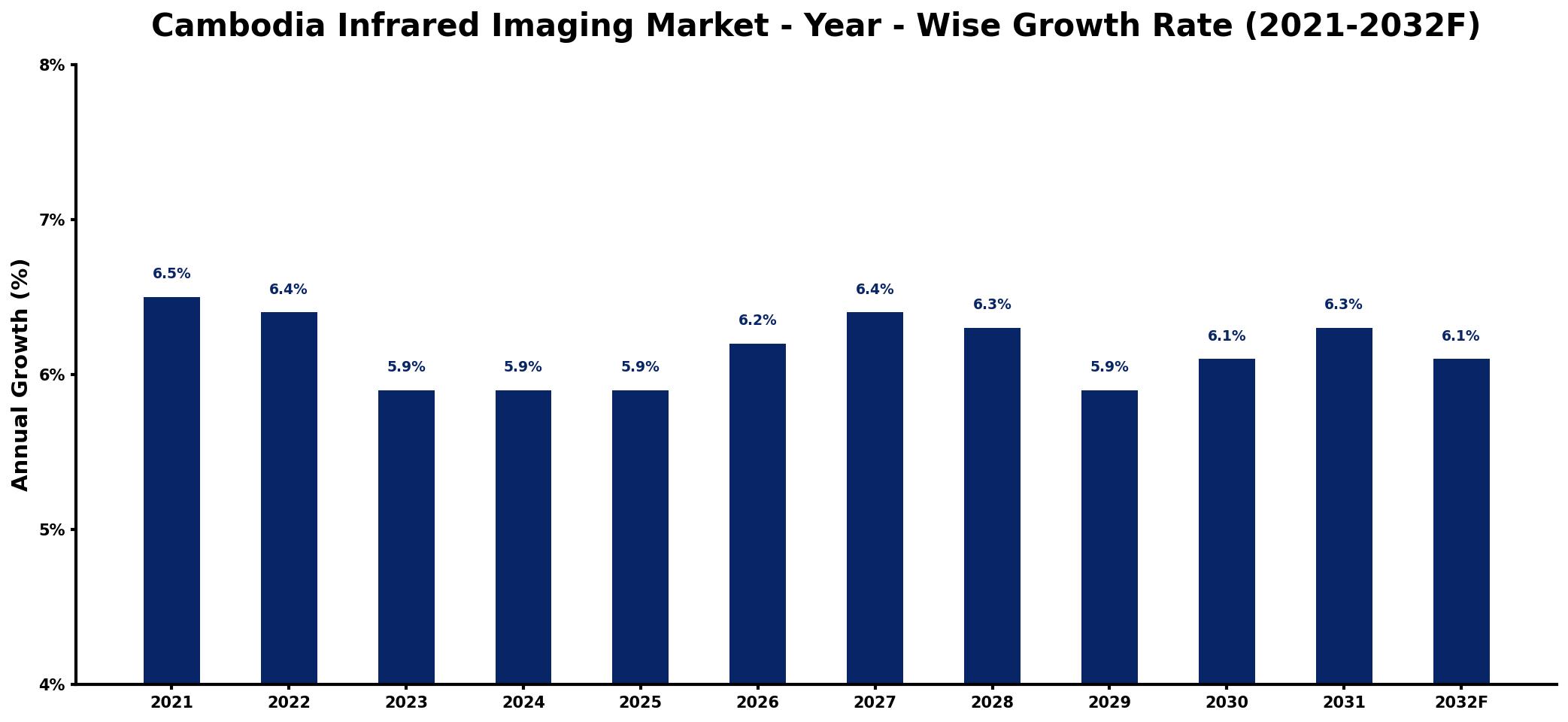
The table below presents the year‑wise growth rates along with the key drivers influencing the market
| Year | Growth Rate | Major Drivers |
| 2021 | 6.5% | Rising healthcare sector investments |
| 2022 | 6.4% | Increased government infrastructure projects |
| 2023 | 5.9% | Growing demand for surveillance technologies |
| 2024 | 5.9% | Expansion of renewable energy initiatives |
| 2025 | 5.9% | Surge in agricultural monitoring applications |
| 2026 | 6.2% | Advancements in research and development |
| 2027 | 6.4% | Enhanced public safety regulations |
| 2028 | 6.3% | Boost in environmental monitoring needs |
| 2029 | 5.9% | Growth in industrial automation systems |
| 2030 | 6.1% | Rising awareness of energy efficiency |
| 2031 | 6.3% | Increased adoption in construction industry |
| 2032 | 6.1% | increased domestic production output |
Note: Market size estimations and growth projections presented in this report are based on 6Wresearch's proprietary forecasting methodology, utilizing the latest available industry data, government publications, and primary research inputs.
Cambodia Infrared Imaging Market Synopsis
In recent years, the Cambodian infrared imaging market has experienced a surge in demand due to growing security concerns and a pressing need for innovative medical technologies. As the market evolves, the focus is shifting toward enhancing the resolution and sensitivity of imaging systems, positioning Cambodia for sustained growth in this sector.
Looking ahead, the market is expected to capitalize on emerging applications such as predictive maintenance in industrial settings. The introduction of portable and user-friendly devices will likely widen adoption, ultimately driving market expansion and technological advancement.
Cambodia Infrared Imaging Market Key Takeaways
- The market is witnessing heightened demand from security and healthcare sectors.
- Technological advancements in resolution and sensitivity are critical growth drivers.
- Government policies are fostering innovation and application of infrared imaging technologies.
- Competition from alternative imaging technologies presents both challenges and opportunities.
- Investment in advanced surveillance systems is likely to boost market growth significantly.
Evaluation of Restraints in Cambodia Infrared Imaging Market
Despite the promising growth outlook, the Cambodia Infrared Imaging Market faces significant restraints that could impact its development. One major constraint is the affordability of advanced imaging systems, which can hinder widespread adoption, particularly in resource-limited sectors. Furthermore, manufacturers are challenged by the need to enhance imaging resolution and thermal sensitivity, which requires considerable investment in R&D. The competition from alternative imaging technologies also complicates market dynamics, necessitating a focused effort to highlight the unique benefits of infrared imaging solutions.
Cambodia Infrared Imaging Market Trends
Current trends in the Cambodia Infrared Imaging Market indicate a growing integration of AI and machine learning technologies. These advancements are improving image analysis capabilities, thereby enhancing diagnostic precision in healthcare and increasing surveillance efficiency in security applications. Additionally, there is a notable trend toward the development of compact, portable infrared imaging devices, facilitating their use in various field applications, from medical diagnostics to industrial inspections.
Cambodia Infrared Imaging Market Opportunities
The Cambodia Infrared Imaging Market presents numerous opportunities for growth, particularly in sectors such as healthcare and industrial maintenance. The rising demand for predictive maintenance practices in manufacturing creates a fertile ground for innovative infrared imaging solutions. Moreover, as healthcare providers seek to adopt more effective diagnostic tools, the need for high-resolution thermal imaging systems is anticipated to grow. Investment in local manufacturing of these technologies could further enhance market accessibility and reduce costs.
Government Initiatives in the Cambodia Infrared Imaging Market
The Cambodian government is actively promoting advancements in imaging technology to ensure safety, accuracy, and compliance across various applications. Policies are expected to focus on establishing performance standards and regulations governing imaging system certification. Additionally, initiatives aimed at supporting research and development in infrared imaging technology may be implemented to foster innovation and collaboration within the industry, enhancing its competitive edge on a global scale.
Future Insights of the Cambodia Infrared Imaging Market
From 2026 to 2032, the Cambodia Infrared Imaging Market is poised for significant transformation, driven by technological advancements and increased industry awareness. The expansion of applications beyond traditional security and healthcare sectors will likely include new areas such as environmental monitoring and energy efficiency. With ongoing improvements in imaging resolution and system capabilities, the market is expected to mature, creating further avenues for investment and development.
Cambodia Infrared Imaging Market Latest Developments (2025 - 2026)
Recent developments in the Cambodia Infrared Imaging Market indicate a shift towards collaboration between public and private sectors to drive innovation. Emerging research initiatives are being launched to enhance imaging technologies, focusing on improving performance and expanding applications. Additionally, industry conferences and workshops have gained traction, fostering knowledge sharing and networking among stakeholders, which is essential for future growth and collaboration.
Cambodia Infrared Imaging Market - Key Attractiveness of the Report
- 10 Years of Market Numbers
- Historical Data Starting from 2022 to 2025
- Base Year: 2025
- Forecast Data until 2032
- Key Performance Indicators Impacting the Market
- Major Upcoming Developments and Projects
Key Highlights of the Report:
- Cambodia Infrared Imaging Market Outlook
- Market Size of Cambodia Infrared Imaging Market, 2025
- Forecast of Cambodia Infrared Imaging Market, 2032
- Historical Data and Forecast of Cambodia Infrared Imaging Revenues & Volume for the Period 2022-2032F
- Cambodia Infrared Imaging Market Trend Evolution
- Cambodia Infrared Imaging Market Drivers and Challenges
- Cambodia Infrared Imaging Price Trends
- Cambodia Infrared Imaging Porter's Five Forces
- Cambodia Infrared Imaging Industry Life Cycle
- Historical Data and Forecast of Cambodia Infrared Imaging Market Revenues & Volume By Technology for the Period 2022-2032F
- Historical Data and Forecast of Cambodia Infrared Imaging Market Revenues & Volume By Cooled Infrared Imaging for the Period 2022-2032F
- Historical Data and Forecast of Cambodia Infrared Imaging Market Revenues & Volume By Uncooled Infrared Imaging for the Period 2022-2032F
- Historical Data and Forecast of Cambodia Infrared Imaging Market Revenues & Volume By Wavelength for the Period 2022-2032F
- Historical Data and Forecast of Cambodia Infrared Imaging Market Revenues & Volume By Near Infrared for the Period 2022-2032F
- Historical Data and Forecast of Cambodia Infrared Imaging Market Revenues & Volume By Shortwave Infrared for the Period 2022-2032F
- Historical Data and Forecast of Cambodia Infrared Imaging Market Revenues & Volume By Mid-wave Infrared for the Period 2022-2032F
- Historical Data and Forecast of Cambodia Infrared Imaging Market Revenues & Volume By Long-wave Infrared for the Period 2022-2032F
- Historical Data and Forecast of Cambodia Infrared Imaging Market Revenues & Volume By Application for the Period 2022-2032F
- Historical Data and Forecast of Cambodia Infrared Imaging Market Revenues & Volume By Security & Surveillance for the Period 2022-2032F
- Historical Data and Forecast of Cambodia Infrared Imaging Market Revenues & Volume By Monitoring & Inspection for the Period 2022-2032F
- Historical Data and Forecast of Cambodia Infrared Imaging Market Revenues & Volume By Detection for the Period 2022-2032F
- Historical Data and Forecast of Cambodia Infrared Imaging Market Revenues & Volume By Vertical for the Period 2022-2032F
- Historical Data and Forecast of Cambodia Infrared Imaging Market Revenues & Volume By Industrial for the Period 2022-2032F
- Historical Data and Forecast of Cambodia Infrared Imaging Market Revenues & Volume By Nonindustrial for the Period 2022-2032F
- Cambodia Infrared Imaging Import Export Trade Statistics
- Market Opportunity Assessment By Technology
- Market Opportunity Assessment By Wavelength
- Market Opportunity Assessment By Application
- Market Opportunity Assessment By Vertical
- Cambodia Infrared Imaging Top Companies Market Share
- Cambodia Infrared Imaging Competitive Benchmarking By Technical and Operational Parameters
- Cambodia Infrared Imaging Company Profiles
- Cambodia Infrared Imaging Key Strategic Recommendations






































