Cambodia Mass Spectrometry Market Size, Share & Growth Rate
The Cambodia Mass Spectrometry Market was estimated at USD 227 Million in 2025 and is projected to reach USD 296 Million by 2032, growing at a CAGR of 3.9% from 2026 to 2032. This growth trajectory is underpinned by a robust expansion of the healthcare and pharmaceutical sectors, coupled with increasing government support for research and development activities. As industries such as environmental testing and food safety continue to evolve, the demand for sophisticated analytical solutions is expected to surge, further propelling market growth.
Cambodia Mass Spectrometry Market Year-wise Growth Rate and Key Drivers
This graph highlights how the Cambodia Mass Spectrometry Market has steadily grown over the years, supported by major growth factors.
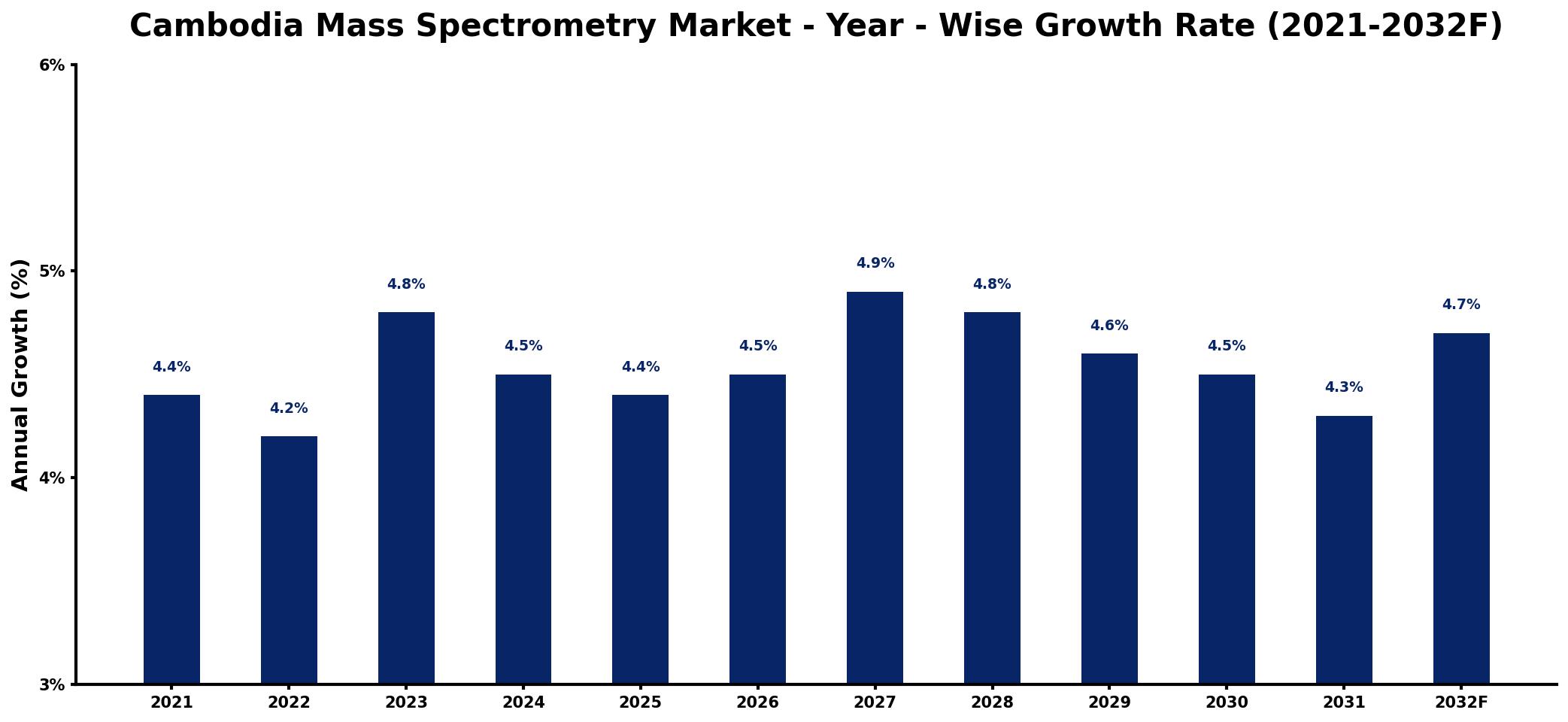
The table below presents the year‑wise growth rates along with the key drivers influencing the market
| Year | Growth Rate | Major Drivers |
| 2021 | 4.4% | Rising demand in pharmaceuticals |
| 2022 | 4.2% | Increased investment in research |
| 2023 | 4.8% | Growth in environmental testing |
| 2024 | 4.5% | Expansion of food safety regulations |
| 2025 | 4.4% | Surge in clinical diagnostics applications |
| 2026 | 4.5% | Advancements in analytical techniques |
| 2027 | 4.9% | expanding healthcare application demand |
| 2028 | 4.8% | Increased use in forensics |
| 2029 | 4.6% | Rising adoption in biotechnology |
| 2030 | 4.5% | Growing interest in proteomics analysis |
| 2031 | 4.3% | Expansion in agricultural applications |
| 2032 | 4.7% | Increased focus on quality control |
Note: Market size estimations and growth projections presented in this report are based on 6Wresearch's proprietary forecasting methodology, utilizing the latest available industry data, government publications, and primary research inputs.
Cambodia Mass Spectrometry Market Synopsis
The growing focus on precision medicine and personalized healthcare in Cambodia is driving the demand for mass spectrometry technologies. As healthcare institutions and research bodies increasingly seek reliable analytical methods, the adoption of mass spectrometry for clinical diagnostics and drug development has gained significant momentum.
In addition, Cambodia's expanding environmental testing sector has underscored the need for high-quality mass spectrometry tools to monitor pollutants and ensure compliance with international safety standards. This trend reflects a broader shift towards sustainability and public health awareness, creating a vibrant ecosystem for mass spectrometry applications.
Cambodia Mass Spectrometry Market Key Takeaways
- The market is positioned for steady growth, driven by healthcare advancements and increased regulatory requirements.
- Technological innovations are enhancing the sensitivity and accuracy of mass spectrometry instruments.
- Collaborations between industry players and academic institutions are fostering research and application development.
- Investment in training programs is crucial for addressing the skills gap in operating mass spectrometry technologies.
- Opportunities for on-site and portable mass spectrometry solutions are emerging, catering to diverse analytical needs.
Evaluation of Restraints in Cambodia Mass Spectrometry Market
While the market is poised for growth, it faces several significant barriers. One of the most pressing challenges is the limited access to advanced mass spectrometry technologies and equipment, which restricts the capabilities of local laboratories. Additionally, a shortage of skilled professionals proficient in mass spectrometry techniques impedes effective deployment. High initial costs associated with acquiring and maintaining sophisticated instruments further complicate market dynamics. Moreover, navigating the regulatory landscape remains cumbersome, as companies must align with various standards while competing in a relatively small market.
Cambodia Mass Spectrometry Market Trends
The Cambodia Mass Spectrometry Market is witnessing several notable trends. One significant trend is the increasing application of mass spectrometry in drug discovery, metabolomics, and proteomics research, driven by the need for accurate and reliable analytical methods. Additionally, miniaturization and portability are becoming more prominent, allowing for field applications and on-site analysis that meets real-time data demands. Furthermore, advancements in mass spectrometry technologies are focusing on achieving higher sensitivity and accuracy, aligning with evolving regulatory requirements.
Cambodia Mass Spectrometry Market Opportunities
The market presents substantial investment opportunities, particularly in the pharmaceutical and biotechnology sectors, which are experiencing rapid growth. As research institutions expand and more funding is allocated to healthcare innovation, the demand for high-performance mass spectrometry instruments is set to rise. Companies that can leverage these trends and address the skills gap through training initiatives will likely find a favorable landscape for growth. Furthermore, the increasing need for environmental monitoring and food safety measures will create additional avenues for mass spectrometry applications.
Government Initiatives in the Cambodia Mass Spectrometry Market
While there are no specific policies targeting the mass spectrometry market, the Cambodian government has implemented regulations to ensure the quality and safety of imported analytical instruments. The Ministry of Health and the Ministry of Industry and Handicrafts oversee these regulations, which indirectly influence the mass spectrometry landscape. Companies operating in this sector should remain vigilant about compliance with quality standards and engage with government entities to navigate regulatory challenges effectively.
Future Insights of the Cambodia Mass Spectrometry Market
Looking ahead to 2026-2032, the Cambodia Mass Spectrometry Market is expected to expand steadily. The increasing focus on research and development, alongside the growing recognition of the benefits of mass spectrometry in various sectors, will drive adoption rates. Technological advancements aimed at developing cost-effective, efficient instruments will facilitate market penetration. However, addressing the skills gap and high costs associated with sophisticated technologies will be essential to unlock the market's full potential.
Cambodia Mass Spectrometry Market Latest Developments (2025 - 2026)
Recent developments in the Cambodia Mass Spectrometry Market indicate a proactive shift towards enhancing collaboration between research institutions and commercial entities. Industry stakeholders are increasingly focusing on technology transfer and shared innovation, which is expected to boost local capabilities in mass spectrometry applications. Additionally, there has been a marked interest in fostering educational programs aimed at developing skilled professionals, ensuring a sustainable workforce to support the growing analytical demands.
Cambodia Mass Spectrometry Market - Key Attractiveness of the Report
- 10 Years of Market Numbers
- Historical Data Starting from 2022 to 2025
- Base Year: 2025
- Forecast Data until 2032
- Key Performance Indicators Impacting the Market
- Major Upcoming Developments and Projects
Key Highlights of the Report:
- Cambodia Mass Spectrometry Market Outlook
- Market Size of Cambodia Mass Spectrometry Market, 2025
- Forecast of Cambodia Mass Spectrometry Market, 2032
- Historical Data and Forecast of Cambodia Mass Spectrometry Revenues & Volume for the Period 2022-2032F
- Cambodia Mass Spectrometry Market Trend Evolution
- Cambodia Mass Spectrometry Market Drivers and Challenges
- Cambodia Mass Spectrometry Price Trends
- Cambodia Mass Spectrometry Porter's Five Forces
- Cambodia Mass Spectrometry Industry Life Cycle
- Historical Data and Forecast of Cambodia Mass Spectrometry Market Revenues & Volume By Technology for the Period 2022-2032F
- Historical Data and Forecast of Cambodia Mass Spectrometry Market Revenues & Volume By Hybrid Mass Spectrometry for the Period 2022-2032F
- Historical Data and Forecast of Cambodia Mass Spectrometry Market Revenues & Volume By Single Mass Spectrometry for the Period 2022-2032F
- Historical Data and Forecast of Cambodia Mass Spectrometry Market Revenues & Volume By Application for the Period 2022-2032F
- Historical Data and Forecast of Cambodia Mass Spectrometry Market Revenues & Volume By Pharmaceutical for the Period 2022-2032F
- Historical Data and Forecast of Cambodia Mass Spectrometry Market Revenues & Volume By Biotechnology for the Period 2022-2032F
- Historical Data and Forecast of Cambodia Mass Spectrometry Market Revenues & Volume By Security for the Period 2022-2032F
- Historical Data and Forecast of Cambodia Mass Spectrometry Market Revenues & Volume By Industrial chemistry for the Period 2022-2032F
- Historical Data and Forecast of Cambodia Mass Spectrometry Market Revenues & Volume By Environmental testing for the Period 2022-2032F
- Historical Data and Forecast of Cambodia Mass Spectrometry Market Revenues & Volume By Food & beverage testing for the Period 2022-2032F
- Historical Data and Forecast of Cambodia Mass Spectrometry Market Revenues & Volume By Forensic for the Period 2022-2032F
- Historical Data and Forecast of Cambodia Mass Spectrometry Market Revenues & Volume By Clinical for the Period 2022-2032F
- Cambodia Mass Spectrometry Import Export Trade Statistics
- Market Opportunity Assessment By Technology
- Market Opportunity Assessment By Application
- Cambodia Mass Spectrometry Top Companies Market Share
- Cambodia Mass Spectrometry Competitive Benchmarking By Technical and Operational Parameters
- Cambodia Mass Spectrometry Company Profiles
- Cambodia Mass Spectrometry Key Strategic Recommendations






































