Cambodia Medicinal Herbs Market Size, Share & Growth Rate
The Cambodia Medicinal Herbs Market was estimated at USD 342 Million in 2025 and is projected to reach USD 464 Million by 2032, growing at a CAGR of 4.5% from 2026 to 2032. This growth trajectory is primarily fueled by a surge in consumer interest in natural and traditional remedies, as well as a strong cultural inclination towards herbal medicine. Additionally, government initiatives to support local farmers and promote sustainable practices are contributing to the markets robust expansion.
Cambodia Medicinal Herbs Market Year-wise Growth Rate and Key Drivers
This graph highlights how the Cambodia Medicinal Herbs Market has steadily grown over the years, supported by major growth factors.
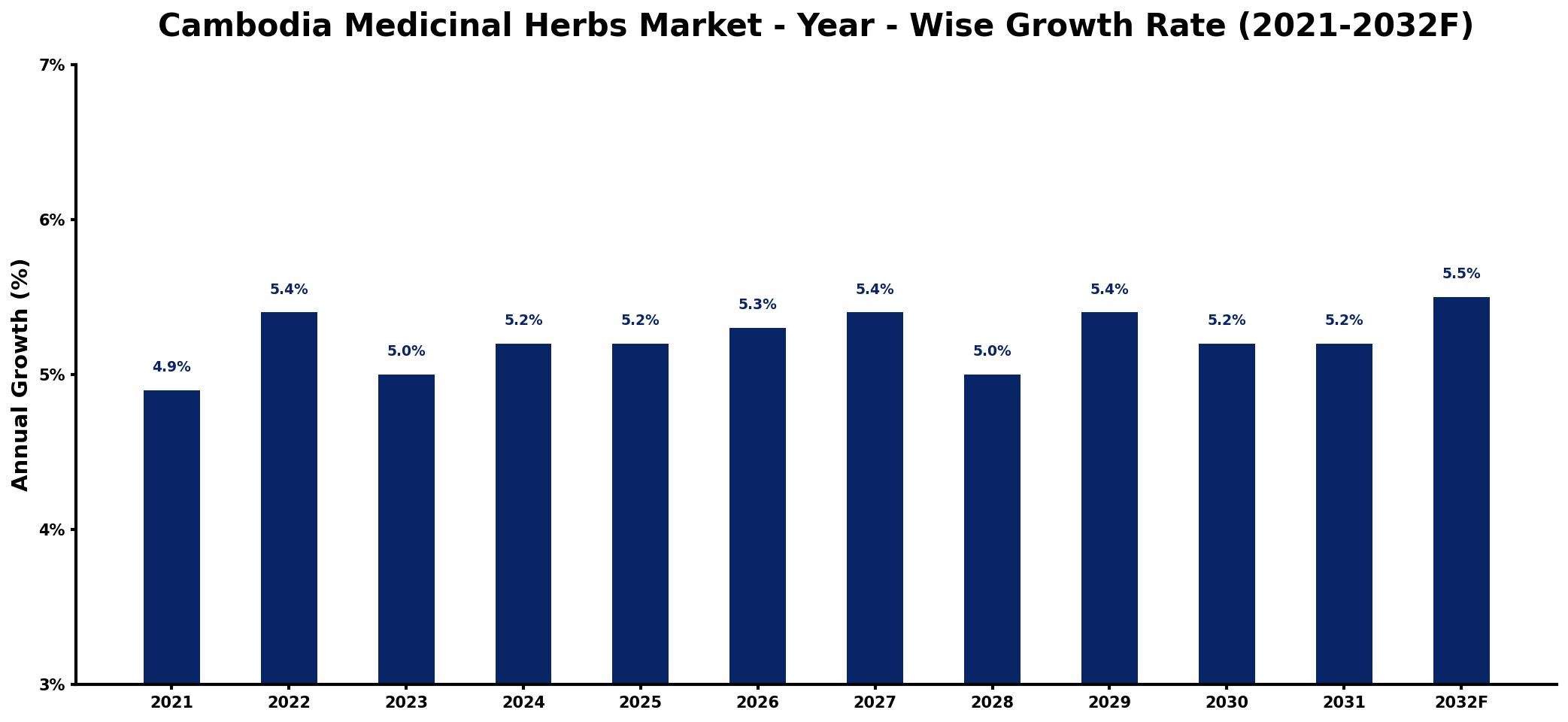
The table below presents the year‑wise growth rates along with the key drivers influencing the market
| Year | Growth Rate | Major Drivers |
| 2021 | 4.9% | Increased consumer health awareness |
| 2022 | 5.4% | Growing interest in natural remedies |
| 2023 | 5.0% | Expansion of local cultivation practices |
| 2024 | 5.2% | Rising demand for holistic therapies |
| 2025 | 5.2% | Investment in research and development |
| 2026 | 5.3% | Emergence of new distribution channels |
| 2027 | 5.4% | Strengthening of local supply chains |
| 2028 | 5.0% | Collaboration with wellness tourism sector |
| 2029 | 5.4% | Enhanced regulatory support frameworks |
| 2030 | 5.2% | Growing popularity of organic products |
| 2031 | 5.2% | Increased export opportunities for products |
| 2032 | 5.5% | Development of innovative product formulations |
Note: Market size estimations and growth projections presented in this report are based on 6Wresearch's proprietary forecasting methodology, utilizing the latest available industry data, government publications, and primary research inputs.
Cambodia Medicinal Herbs Market Synopsis
A notable factor driving the Cambodia Medicinal Herbs Market is the increasing cultivation of local herbs such as turmeric and moringa, which have gained popularity for their numerous health benefits. Local farmers are central to this movement, engaging in sustainable practices that bolster both the economy and consumer trust.
Furthermore, a growing number of consumers are seeking herbal products for health conditions that conventional medicine does not address adequately. This rising demand has led to a proliferation of herbal medicine shops, further embedding herbal remedies in Cambodian culture.
Cambodia Medicinal Herbs Market Key Takeaways
- The market is experiencing consistent growth driven by increased consumer preference for natural remedies.
- Key herbs like turmeric, ginger, and lemongrass are central to both local and international demand.
- Government policies are increasingly supportive of sustainable farming and the regulation of herbal products.
- There is a notable challenge in the form of inconsistent quality standards affecting consumer confidence.
- Investment opportunities are rising in the realms of processing, cultivation, and branding of medicinal herbs.
Evaluation of Restraints in Cambodia Medicinal Herbs Market
Despite its growth potential, the Cambodia Medicinal Herbs Market faces several constraints that could hinder its development. The lack of standardized regulations and quality assurance poses a significant challenge, leading to variability in product effectiveness and safety. Additionally, limited awareness among consumers regarding the benefits of medicinal herbs may restrict market penetration. Poor infrastructure for herb cultivation and processing also limits the supply chain efficiency, making it harder to meet rising demand. Addressing these issues through consumer education and investment in agricultural infrastructure will be essential for the market's advancement.
Cambodia Medicinal Herbs Market Trends
Current trends indicate a pronounced shift towards organic and sustainably sourced medicinal herbs. Consumers are increasingly aware of the environmental impacts of their choices, prompting a demand for products that align with their values. Moreover, the rise of e-commerce platforms is facilitating easier access to medicinal herbs, which is likely to broaden market outreach. The integration of technological advancements in herb processing is also beginning to reshape production practices, offering new avenues for quality enhancement.
Cambodia Medicinal Herbs Market Opportunities
Investment opportunities within the Cambodia Medicinal Herbs Market are notably expansive. High-demand herbs such as turmeric and lemongrass present lucrative prospects for cultivation and export. There is also a significant opportunity in the development of new products that capitalize on the therapeutic qualities of these herbs, particularly in areas such as natural cosmetics and dietary supplements. Furthermore, forming partnerships with local farmers can ensure a reliable supply chain while fostering community growth, creating a win-win situation for investors and local economies.
Government Initiatives in the Cambodia Medicinal Herbs Market
The Cambodian government has been proactive in establishing policies aimed at regulating and promoting the medicinal herbs market. These include guidelines for cultivation, harvesting, and processing, ensuring that herbal products meet safety standards. Additionally, the government supports public awareness campaigns to educate consumers about the benefits of herbal medicine. This not only enhances consumer confidence but also contributes to a more structured market landscape.
Future Insights of the Cambodia Medicinal Herbs Market
Looking ahead to 2026-2032, the Cambodia Medicinal Herbs Market is positioned for substantial growth, driven by a combination of increased consumer awareness and a cultural shift towards holistic health solutions. As the local population continues to embrace natural products, coupled with government support for the herbal industry, the market is expected to flourish. However, addressing existing challenges like quality control and regulatory compliance will be crucial for unlocking the market's full potential.
Cambodia Medicinal Herbs Market Latest Developments (2025 - 2026)
In recent months, the Cambodia Medicinal Herbs Market has seen various initiatives aimed at enhancing the sustainability of herb production. Local farmers are increasingly adopting organic farming practices, encouraged by government incentives. Additionally, several workshops have been launched to improve cultivation techniques and educate farmers on sustainable harvesting methods. These steps are vital as they not only improve the quality of the herbs but also attract more environmentally conscious consumers.
Cambodia Medicinal Herbs Market - Key Attractiveness of the Report
- 10 Years of Market Numbers
- Historical Data Starting from 2022 to 2025
- Base Year: 2025
- Forecast Data until 2032
- Key Performance Indicators Impacting the Market
- Major Upcoming Developments and Projects
Key Highlights of the Report:
- Cambodia Medicinal Herbs Market Outlook
- Market Size of Cambodia Medicinal Herbs Market, 2025
- Forecast of Cambodia Medicinal Herbs Market, 2032
- Historical Data and Forecast of Cambodia Medicinal Herbs Revenues & Volume for the Period 2022-2032F
- Cambodia Medicinal Herbs Market Trend Evolution
- Cambodia Medicinal Herbs Market Drivers and Challenges
- Cambodia Medicinal Herbs Price Trends
- Cambodia Medicinal Herbs Porter's Five Forces
- Cambodia Medicinal Herbs Industry Life Cycle
- Historical Data and Forecast of Cambodia Medicinal Herbs Market Revenues & Volume By Type for the Period 2022-2032F
- Historical Data and Forecast of Cambodia Medicinal Herbs Market Revenues & Volume By Horsetail for the Period 2022-2032F
- Historical Data and Forecast of Cambodia Medicinal Herbs Market Revenues & Volume By Dandelion for the Period 2022-2032F
- Historical Data and Forecast of Cambodia Medicinal Herbs Market Revenues & Volume By Echinacea for the Period 2022-2032F
- Historical Data and Forecast of Cambodia Medicinal Herbs Market Revenues & Volume By Valerian for the Period 2022-2032F
- Historical Data and Forecast of Cambodia Medicinal Herbs Market Revenues & Volume By St. John??s Wort for the Period 2022-2032F
- Historical Data and Forecast of Cambodia Medicinal Herbs Market Revenues & Volume By Lemon Balm for the Period 2022-2032F
- Historical Data and Forecast of Cambodia Medicinal Herbs Market Revenues & Volume By Yarrow for the Period 2022-2032F
- Historical Data and Forecast of Cambodia Horsetail Medicinal Herbs Market Revenues & Volume By Calendula for the Period 2022-2032F
- Historical Data and Forecast of Cambodia Medicinal Herbs Market Revenues & Volume By Nature for the Period 2022-2032F
- Historical Data and Forecast of Cambodia Medicinal Herbs Market Revenues & Volume By Organic for the Period 2022-2032F
- Historical Data and Forecast of Cambodia Medicinal Herbs Market Revenues & Volume By Conventional for the Period 2022-2032F
- Historical Data and Forecast of Cambodia Medicinal Herbs Market Revenues & Volume By Form for the Period 2022-2032F
- Historical Data and Forecast of Cambodia Medicinal Herbs Market Revenues & Volume By Whole for the Period 2022-2032F
- Historical Data and Forecast of Cambodia Medicinal Herbs Market Revenues & Volume By Powder for the Period 2022-2032F
- Historical Data and Forecast of Cambodia Medicinal Herbs Market Revenues & Volume By Liquid for the Period 2022-2032F
- Historical Data and Forecast of Cambodia Medicinal Herbs Market Revenues & Volume By End-Use for the Period 2022-2032F
- Historical Data and Forecast of Cambodia Medicinal Herbs Market Revenues & Volume By Medicinal Tea for the Period 2022-2032F
- Historical Data and Forecast of Cambodia Medicinal Herbs Market Revenues & Volume By Health Supplement for the Period 2022-2032F
- Historical Data and Forecast of Cambodia Medicinal Herbs Market Revenues & Volume By Nutritive Jams for the Period 2022-2032F
- Historical Data and Forecast of Cambodia Medicinal Herbs Market Revenues & Volume By Herbal Medicines for the Period 2022-2032F
- Historical Data and Forecast of Cambodia Medicinal Herbs Market Revenues & Volume By Cosmeceuticals for the Period 2022-2032F
- Historical Data and Forecast of Cambodia Medicinal Herbs Market Revenues & Volume By Other Uses for the Period 2022-2032F
- Cambodia Medicinal Herbs Import Export Trade Statistics
- Market Opportunity Assessment By Type
- Market Opportunity Assessment By Nature
- Market Opportunity Assessment By Form
- Market Opportunity Assessment By End-Use
- Cambodia Medicinal Herbs Top Companies Market Share
- Cambodia Medicinal Herbs Competitive Benchmarking By Technical and Operational Parameters
- Cambodia Medicinal Herbs Company Profiles
- Cambodia Medicinal Herbs Key Strategic Recommendations






































