Cambodia Passive Fire Protection Market Size, Share & Growth Rate
The Cambodia Passive Fire Protection Market was estimated at USD 321 Million in 2025 and is projected to reach USD 453 Million by 2032, growing at a CAGR of 5.0% from 2026 to 2032. This growth trajectory is significantly influenced by an upsurge in construction activities across commercial and residential sectors, alongside a heightened focus on stringent fire safety regulations. As awareness about fire protection standards increases, the demand for innovative fire-resistant materials is expected to soar, solidifying the market's expansion.
Cambodia Passive Fire Protection Market Year-wise Growth Rate and Key Drivers
This graph highlights how the Cambodia Passive Fire Protection Market has steadily grown over the years, supported by major growth factors.
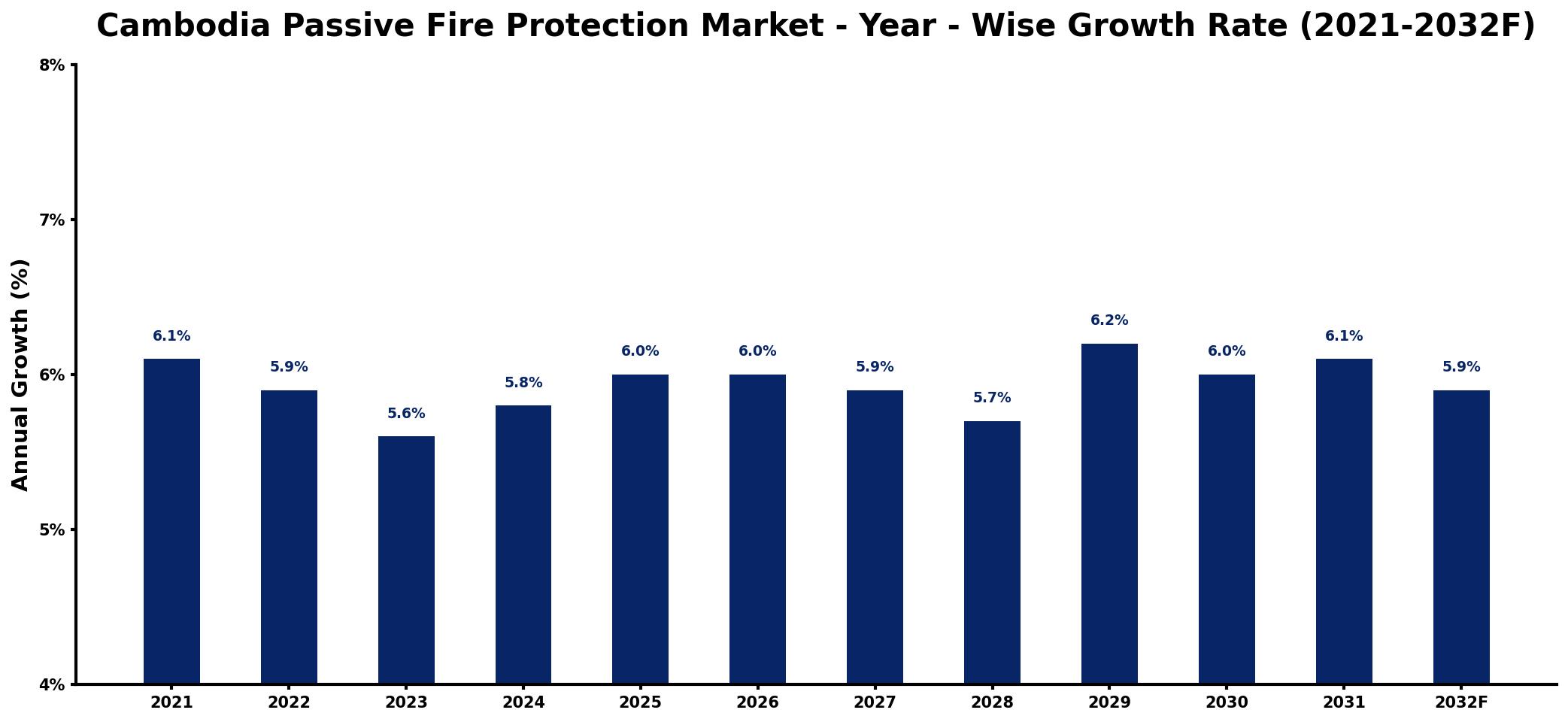
The table below presents the year‑wise growth rates along with the key drivers influencing the market
| Year | Growth Rate | Major Drivers |
| 2021 | 6.1% | Increased construction sector investments |
| 2022 | 5.9% | Growing urbanization and infrastructure needs |
| 2023 | 5.6% | Rising safety regulations enforcement |
| 2024 | 5.8% | Expansion of commercial real estate |
| 2025 | 6.0% | Boost in government infrastructure projects |
| 2026 | 6.0% | Higher awareness of safety standards |
| 2027 | 5.9% | Demand from industrial applications rising |
| 2028 | 5.7% | Increased focus on disaster management |
| 2029 | 6.2% | Growth in residential building projects |
| 2030 | 6.0% | rising infrastructure development spending |
| 2031 | 6.1% | Surge in hospitality sector developments |
| 2032 | 5.9% | Investment in green building initiatives |
Note: Market size estimations and growth projections presented in this report are based on 6Wresearch's proprietary forecasting methodology, utilizing the latest available industry data, government publications, and primary research inputs.
Cambodia Passive Fire Protection Market Synopsis
The growing emphasis on building safety standards in Cambodia is leading to an uptick in the adoption of passive fire protection systems. This is particularly evident in the rising preference for fire-rated doors and fireproof coatings, which are becoming essential components in both new and retrofitted constructions.
Moreover, the increasing number of commercial projects and residential developments is creating robust demand for effective fire barriers. Regulatory frameworks are evolving to include more comprehensive fire safety measures, making compliance not just advisable but necessary for new construction ventures.
Cambodia Passive Fire Protection Market Key Takeaways
- The market is driven by rising construction activities across both commercial and residential sectors.
- Growing awareness of fire safety regulations is prompting increased adoption of fire-resistant materials.
- Regulatory compliance is becoming mandatory, further fueling demand for passive fire protection solutions.
- Innovative product developments and partnerships are emerging to meet evolving market needs.
- The market is well-positioned for sustained growth as fire safety measures continue to gain importance.
Evaluation of Restraints in Cambodia Passive Fire Protection Market
Despite promising growth, the Cambodia Passive Fire Protection Market faces several restraints. A notable challenge is the limited awareness among property developers regarding the critical nature of fire protection measures, which affects the demand for necessary products and services. Furthermore, the inconsistent enforcement of building codes leads to gaps in compliance, hindering the widespread adoption of fire safety systems. The scarcity of qualified professionals adept in the installation and maintenance of these systems also presents a barrier to market growth. Addressing these issues through enhanced public education and stricter regulatory enforcement will be essential for advancing the market.
Cambodia Passive Fire Protection Market Trends
In recent years, the Cambodia Passive Fire Protection Market has observed several key trends. A marked increase in the construction of high-rise buildings has amplified the need for effective fire safety measures. Additionally, there is a growing shift towards the utilization of advanced technologies in passive fire protection solutions, including fire-retardant coatings and specially designed fire doors. Collaboration between manufacturers and construction firms is also on the rise, aimed at developing customized solutions that cater specifically to local building safety requirements.
Cambodia Passive Fire Protection Market Opportunities
The Cambodia Passive Fire Protection Market presents numerous investment opportunities, particularly in the production and distribution of fire-resistant materials. This includes intumescent coatings, fire-retardant sealants, and fireproof insulation. As construction regulations tighten, the demand for these materials is expected to increase. Furthermore, investment in research and development to deliver innovative and cost-effective solutions tailored for the local market can yield significant rewards. Training and certification programs for construction professionals on the proper implementation of passive fire protection systems could also differentiate companies in this evolving landscape.
Government Initiatives in the Cambodia Passive Fire Protection Market
The Cambodian government is taking proactive measures to enhance fire safety standards in the construction sector. The Ministry of Interior has issued guidelines emphasizing the importance of passive fire protection solutions. These regulations not only mandate adherence to specific fire safety standards for obtaining construction permits but also promote ongoing education about fire safety. As public investment in infrastructure continues to grow, so too does the government's commitment to fostering an environment where fire protection is prioritized, thereby bolstering market growth.
Future Insights of the Cambodia Passive Fire Protection Market
Looking ahead, the Cambodia Passive Fire Protection Market is poised for substantial growth through 2026 to 2032. The continual evolution of building codes and increasing public awareness regarding fire safety is likely to drive demand for passive protection solutions. As the construction industry modernizes, the need for compliant and effective fire safety measures will intensify, leading to innovative product developments tailored to meet these new standards. This creates a ripe environment for both domestic and international players to enter the market and leverage the expanding opportunities.
Cambodia Passive Fire Protection Market Latest Developments (2025 - 2026)
Recent developments in the Cambodia Passive Fire Protection Market indicate a strong shift towards innovative fire safety solutions. Numerous companies are engaging in collaborations to enhance their product offerings, focusing on integrating advanced technology with traditional passive fire protection methods. Additionally, training initiatives for installers are being rolled out, aiming to address the skills gap in the market. The regulatory environment is also evolving, as the government continues to refine its guidelines, thereby reinforcing the importance of fire safety across construction projects.
Cambodia Passive Fire Protection Market - Key Attractiveness of the Report
- 10 Years of Market Numbers
- Historical Data Starting from 2022 to 2025
- Base Year: 2025
- Forecast Data until 2032
- Key Performance Indicators Impacting the Market
- Major Upcoming Developments and Projects
Key Highlights of the Report:
- Cambodia Passive Fire Protection Market Outlook
- Market Size of Cambodia Passive Fire Protection Market, 2025
- Forecast of Cambodia Passive Fire Protection Market, 2032
- Historical Data and Forecast of Cambodia Passive Fire Protection Revenues & Volume for the Period 2022-2032F
- Cambodia Passive Fire Protection Market Trend Evolution
- Cambodia Passive Fire Protection Market Drivers and Challenges
- Cambodia Passive Fire Protection Price Trends
- Cambodia Passive Fire Protection Porter's Five Forces
- Cambodia Passive Fire Protection Industry Life Cycle
- Historical Data and Forecast of Cambodia Passive Fire Protection Market Revenues & Volume By Product for the Period 2022-2032F
- Historical Data and Forecast of Cambodia Passive Fire Protection Market Revenues & Volume By Cementitious Materials for the Period 2022-2032F
- Historical Data and Forecast of Cambodia Passive Fire Protection Market Revenues & Volume By Intumescent Coatings for the Period 2022-2032F
- Historical Data and Forecast of Cambodia Passive Fire Protection Market Revenues & Volume By Fireproofing Cladding for the Period 2022-2032F
- Historical Data and Forecast of Cambodia Passive Fire Protection Market Revenues & Volume By Others for the Period 2022-2032F
- Historical Data and Forecast of Cambodia Passive Fire Protection Market Revenues & Volume By Application for the Period 2022-2032F
- Historical Data and Forecast of Cambodia Passive Fire Protection Market Revenues & Volume By Oil & Gas for the Period 2022-2032F
- Historical Data and Forecast of Cambodia Passive Fire Protection Market Revenues & Volume By Construction for the Period 2022-2032F
- Historical Data and Forecast of Cambodia Passive Fire Protection Market Revenues & Volume By Industrial for the Period 2022-2032F
- Historical Data and Forecast of Cambodia Passive Fire Protection Market Revenues & Volume By Warehousing for the Period 2022-2032F
- Historical Data and Forecast of Cambodia Passive Fire Protection Market Revenues & Volume By Others for the Period 2022-2032F
- Cambodia Passive Fire Protection Import Export Trade Statistics
- Market Opportunity Assessment By Product
- Market Opportunity Assessment By Application
- Cambodia Passive Fire Protection Top Companies Market Share
- Cambodia Passive Fire Protection Competitive Benchmarking By Technical and Operational Parameters
- Cambodia Passive Fire Protection Company Profiles
- Cambodia Passive Fire Protection Key Strategic Recommendations






































