Cambodia Physical Security Market Size & Growth Rate (2026-2032)
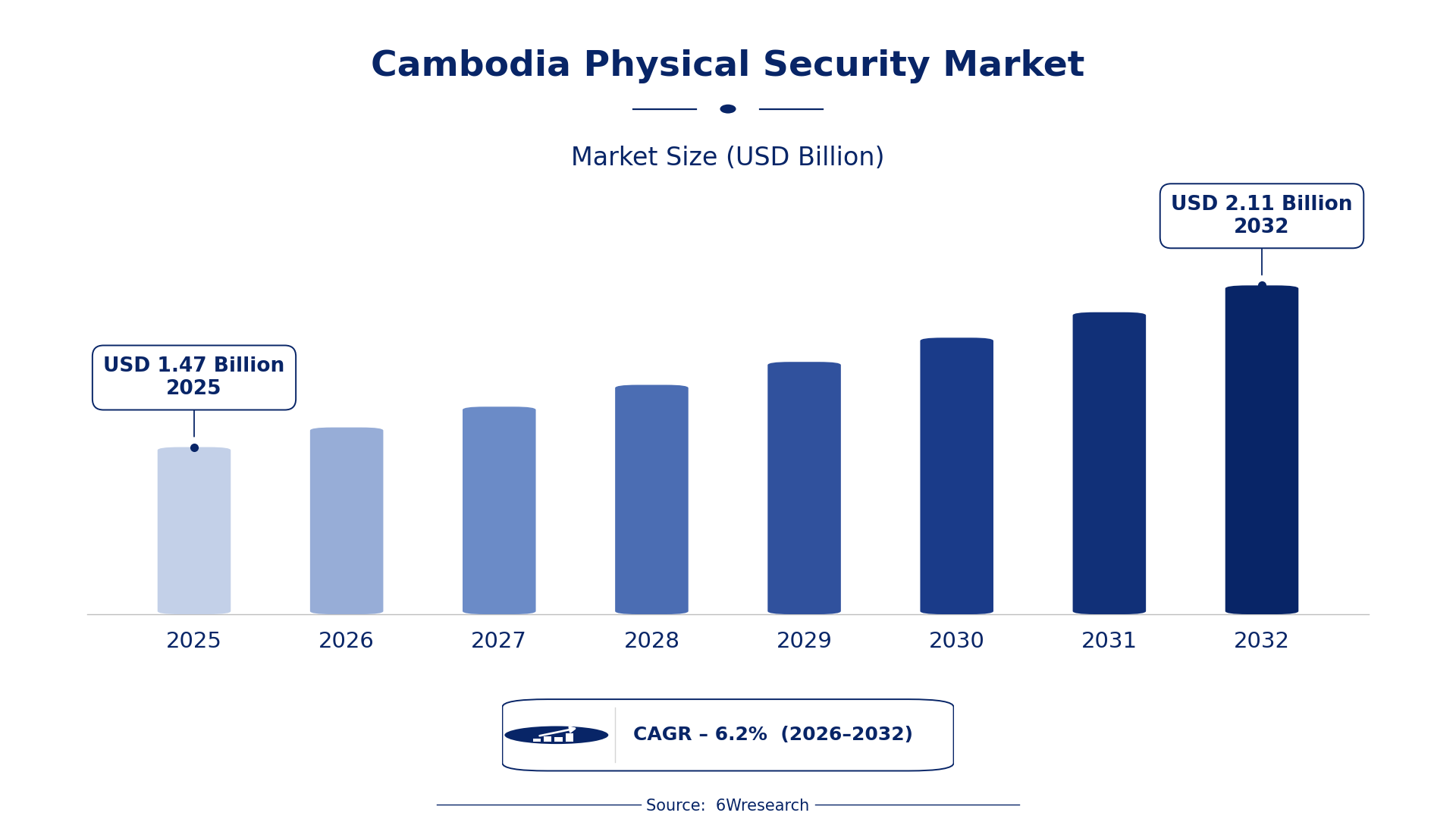
The Cambodia Physical Security Market was estimated at USD 1468 Million in 2025 and is projected to reach USD 2107 Million by 2032, growing at a CAGR of 6.2% from 2026 to 2032.
Cambodia Physical Security Market Synopsis
The most influential factor driving the Cambodia Physical Security Market is the increasing urgency to enhance security measures across various sectors. A surge in crime rates, combined with a burgeoning urban population, is compelling businesses and government institutions to invest in comprehensive security solutions.
In response to these challenges, the market is witnessing a growing adoption of advanced technologies such as video surveillance, access control, and biometrics. The Cambodian government is also making strides in improving public safety, which is likely to create further demand for sophisticated physical security measures.
Cambodia Physical Security Market Year-wise Growth Rate and Key Drivers
This graph illustrates the annual growth rates of the Cambodia Physical Security Market from 2021 to 2032, highlighting a steady upward trajectory and projected expansion over the forecast period.
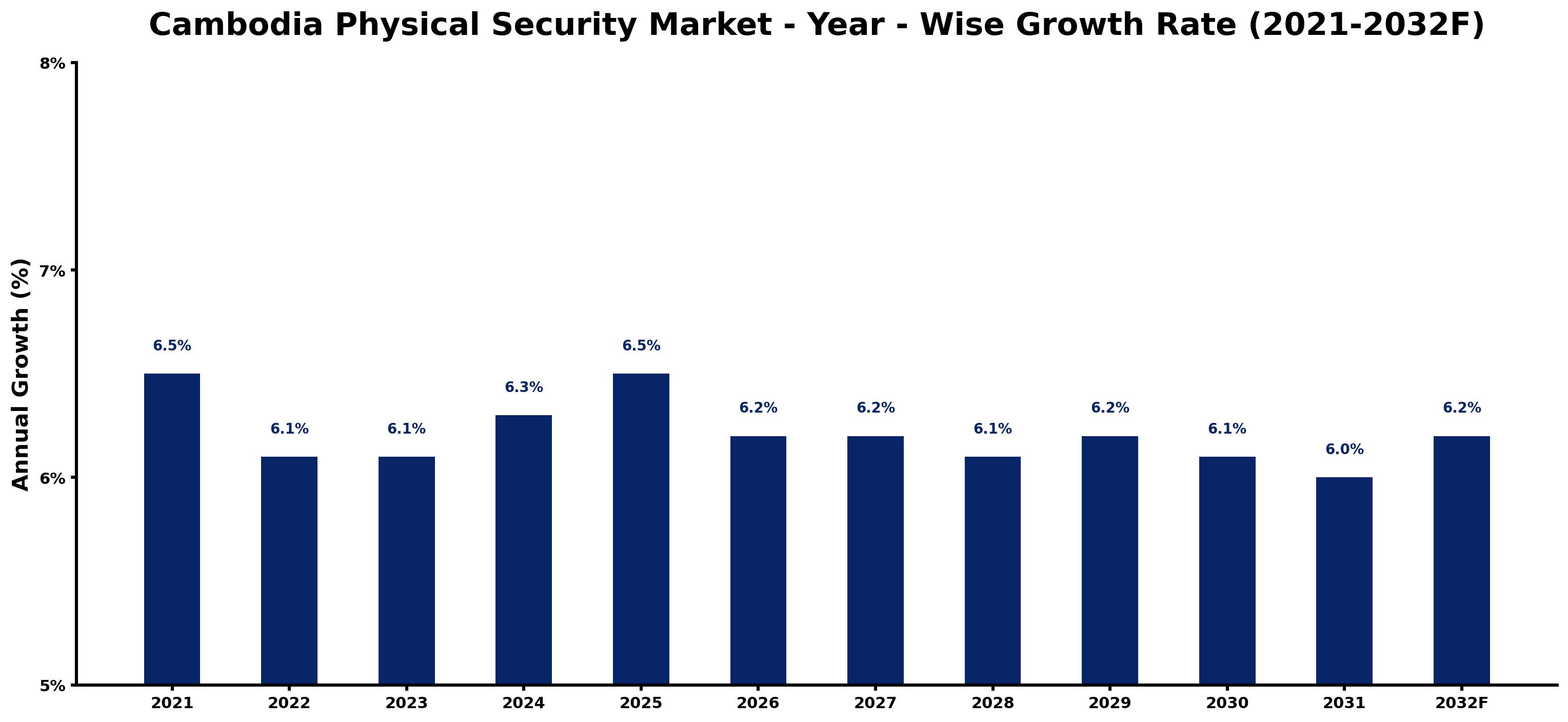
The table below presents the year‑wise growth rates along with the key drivers influencing the market
| Year | Growth Rate | Major Drivers |
| 2021 | 6.5% | Increased concerns over crime rates in urban centers. |
| 2022 | 6.1% | Government initiatives enhancing public safety protocols. |
| 2023 | 6.1% | Rising foreign investments requiring improved site security measures. |
| 2024 | 6.3% | Local businesses expanding safety infrastructure for workforce. |
| 2025 | 6.5% | Regulatory frameworks promoting advanced surveillance technologies. |
| 2026 | 6.2% | Heightened awareness of cybersecurity integrating physical security. |
| 2027 | 6.2% | Emerging trends in smart security technology adoption. |
| 2028 | 6.1% | Demand from retail sector for anti-theft solutions rising. |
| 2029 | 6.2% | Implementation of community policing encouraging security upgrades. |
| 2030 | 6.1% | Growing enterprise interest in integrated security systems. |
| 2031 | 6.0% | Increased government funding for public safety initiatives. |
| 2032 | 6.2% | Trend towards biometric security systems gaining traction. |
Note: Market size estimations and growth projections presented in this report are based on 6Wresearch's proprietary forecasting methodology, utilizing the latest available industry data, government publications, and primary research inputs.
Cambodia Physical Security Market Key Takeaways
Below are some of the specific key takeaways from the market, including:
- The demand for integrated security solutions is rising as organizations seek real-time monitoring capabilities.
- Government initiatives focused on public safety are catalyzing investments in security technologies.
- Urbanization is pushing the growth of smart cities, further driving the need for IoT-based security systems.
- High installation and maintenance costs remain a barrier for many potential adopters of advanced security technologies.
- Collaboration between local firms and international partners is expected to enhance the quality of security services.
Evaluation of Restraints in Cambodia Physical Security Market
Despite the growth potential, the Cambodia Physical Security Market faces real challenges that hinder its progress. Limited awareness among businesses about advanced security technologies leads to a reliance on traditional solutions, which can be inadequate for modern threats. Regulatory inconsistencies also pose obstacles, as the lack of stringent standards affects the quality of services provided. on top of that, the high costs associated with sophisticated security systems deter many organizations, particularly in a market that is still maturing. To thrive, stakeholders must focus on education and cost-effective, tailored solutions to meet diverse security needs.
Cambodia Physical Security Market Trends
The current trend in the Cambodia Physical Security Market is a clear shift towards smart, technology-driven solutions. Surveillance systems are increasingly integrated with AI for enhanced analytics and responsiveness. The push for smart city initiatives is leading to an emphasis on IoT-based systems that can provide improved efficiency. on top of that, biometric solutions are gaining traction as organizations seek to strengthen access control measures. This trend toward comprehensive security systems aims to address evolving threats effectively.
Cambodia Physical Security Market Opportunities
There is a wealth of investment opportunities within the Cambodia Physical Security Market, primarily due to urbanization and increased infrastructure projects. The demand for surveillance and access control systems is on the rise, particularly in commercial sectors like banking and hospitality. on top of that, partnerships with local security firms can offer foreign investors a strategic advantage, allowing them to penetrate the market more effectively. This growing need for advanced technologies and tailored solutions presents a rich landscape for new ventures and innovations.
Government Initiatives in the Cambodia Physical Security Market
The Cambodian government is taking steps to enhance physical security through various initiatives that shape the market dynamics. Regulatory frameworks are being established to ensure compliance with international safety standards. This focus on regulation not only aims to elevate the quality of services but also boosts investor confidence in the market.
- A recently completed policy framework established new licensing requirements for security providers, enhancing operational standards.
- A current initiative seeks to improve training programs for security personnel, emphasizing skill development and professionalism.
- Planned regulations for the deployment of advanced surveillance technologies are expected to roll out by late 2026, further pushing the market towards modernization.
- Government partnerships with private firms aim to bolster public safety through collaborative security projects underway since early 2025.
- A national digital infrastructure upgrade initiative is anticipated to launch in 2027, integrating advanced security solutions into the public sector.
Future Insights of the Cambodia Physical Security Market
Looking ahead to 2026-2032, the Cambodia Physical Security Market is on a trajectory of significant growth. The convergence of increased crime awareness, urbanization, and economic development suggests a heightened demand for advanced security solutions. As businesses and government bodies prioritize safety, the adoption of technologies like biometrics, video surveillance, and real-time analytics is set to surge. This evolving landscape indicates that both local and international players will find lucrative opportunities in a market hungry for security enhancements.
Cambodia Physical Security Market Latest Developments
Recent activity in the Cambodia Physical Security Market has demonstrated a strong commitment to innovation and improvement over the past year. A noticeable uptick in investment from both local and foreign entities signifies growing confidence in the market's potential. Businesses are increasingly recognizing the necessity of modern security solutions as threats become more complex.
- A major technology vendor launched a new AI-enhanced surveillance system in Q1 2025, designed to improve monitoring accuracy and response times.
- An ongoing project aimed at upgrading security systems in commercial buildings began in mid-2025 and is expected to conclude by early 2026.
- A partnership between a leading regional operator and a local security firm was announced in Q2 2025 to expand service capabilities.
- An upcoming initiative plans to introduce mobile security applications to enhance user access to monitoring services, with a rollout expected in late 2026.
- A service upgrade focusing on cloud-based security solutions commenced in early 2025 and continues to attract interest from various sectors.
Cambodia Physical Security Market - Key Attractiveness of the Report
- 10 Years of Market Numbers
- Historical Data Starting from 2022 to 2025
- Base Year: 2025
- Forecast Data until 2032
- Key Performance Indicators Impacting the Market
- Major Upcoming Developments and Projects
Key Highlights of the Report:
- Cambodia Physical Security Market Outlook
- Market Size of Cambodia Physical Security Market, 2025
- Forecast of Cambodia Physical Security Market, 2032
- Historical Data and Forecast of Cambodia Physical Security Revenues & Volume for the Period 2022-2032F
- Cambodia Physical Security Market Trend Evolution
- Cambodia Physical Security Market Drivers and Challenges
- Cambodia Physical Security Price Trends
- Cambodia Physical Security Porter's Five Forces
- Cambodia Physical Security Industry Life Cycle
- Historical Data and Forecast of Cambodia Physical Security Market Revenues & Volume By Component for the Period 2022-2032F
- Historical Data and Forecast of Cambodia Physical Security Market Revenues & Volume By Systems (PACS, PSIM, PIAM, Video Surveillance, Fire and Life Safety) for the Period 2022-2032F
- Historical Data and Forecast of Cambodia Physical Security Market Revenues & Volume By Services for the Period 2022-2032F
- Historical Data and Forecast of Cambodia Physical Security Market Revenues & Volume By Vertical for the Period 2022-2032F
- Historical Data and Forecast of Cambodia Physical Security Market Revenues & Volume By BFSI for the Period 2022-2032F
- Historical Data and Forecast of Cambodia Physical Security Market Revenues & Volume By Government for the Period 2022-2032F
- Historical Data and Forecast of Cambodia Physical Security Market Revenues & Volume By Retail for the Period 2022-2032F
- Historical Data and Forecast of Cambodia Physical Security Market Revenues & Volume By Transportation for the Period 2022-2032F
- Historical Data and Forecast of Cambodia Physical Security Market Revenues & Volume By Residential for the Period 2022-2032F
- Historical Data and Forecast of Cambodia Physical Security Market Revenues & Volume By Telecom and IT for the Period 2022-2032F
- Historical Data and Forecast of Cambodia Physical Security Market Revenues & Volume By Other Verticals (Healthcare, Manufacturing, Energy and Utilities, and Education). for the Period 2022-2032F
- Historical Data and Forecast of Cambodia Physical Security Market Revenues & Volume By Organization Size for the Period 2022-2032F
- Historical Data and Forecast of Cambodia Physical Security Market Revenues & Volume By SMEs for the Period 2022-2032F
- Historical Data and Forecast of Cambodia Physical Security Market Revenues & Volume By Large Enterprises for the Period 2022-2032F
- Cambodia Physical Security Import Export Trade Statistics
- Market Opportunity Assessment By Component
- Market Opportunity Assessment By Vertical
- Market Opportunity Assessment By Organization Size
- Cambodia Physical Security Top Companies Market Share
- Cambodia Physical Security Competitive Benchmarking By Technical and Operational Parameters
- Cambodia Physical Security Company Profiles
- Cambodia Physical Security Key Strategic Recommendations






































