Cambodia Policy Management in Telecom Market Size & Growth Rate (2026-2032)
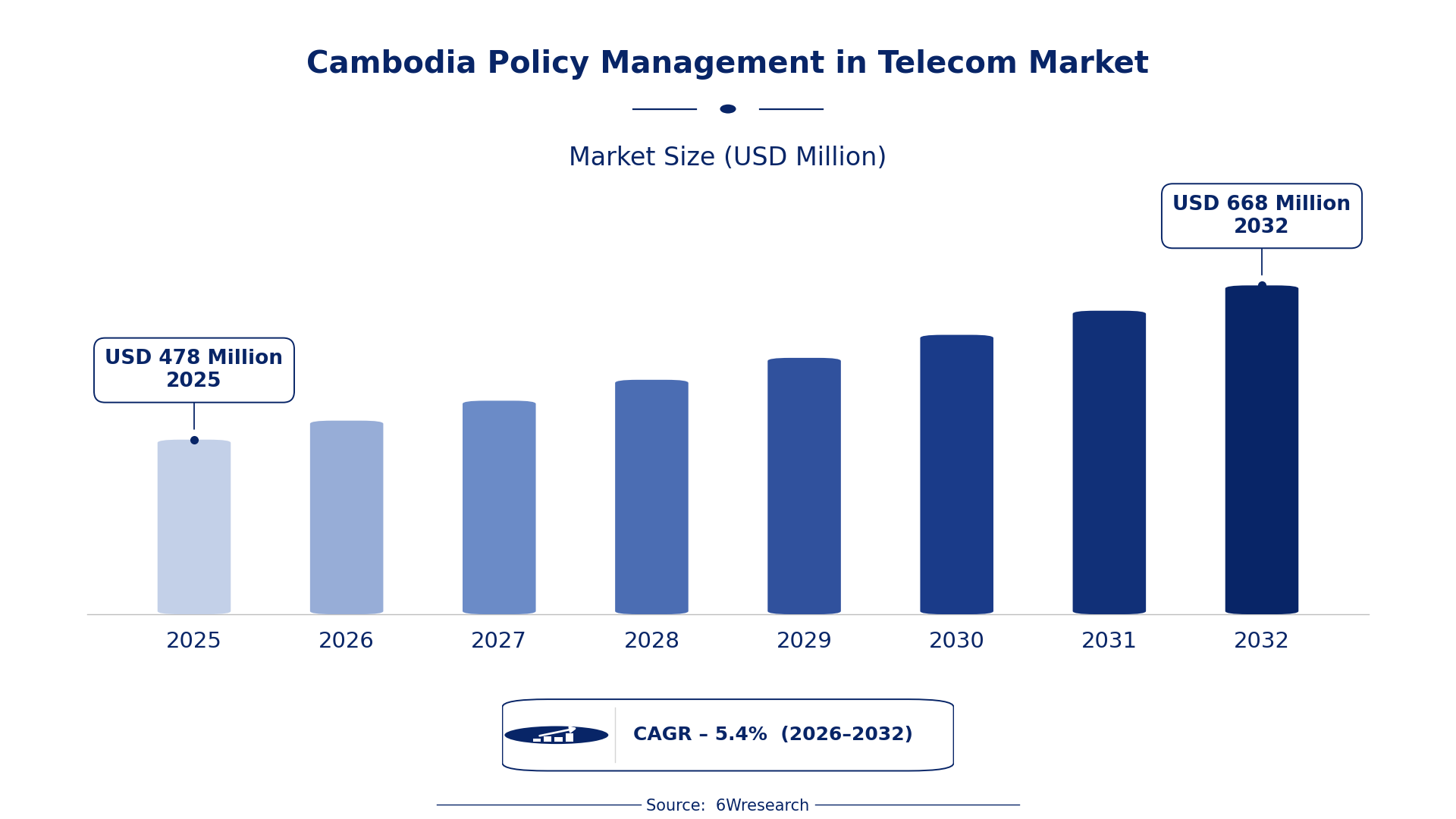
The Cambodia Policy Management in Telecom Market was estimated at USD 478 Million in 2025 and is projected to reach USD 668 Million by 2032, growing at a CAGR of 5.4% from 2026 to 2032.
Cambodia Policy Management in Telecom Market Synopsis
Cambodia's telecom sector is at a critical juncture, as government policies increasingly shape its trajectory. Regulatory frameworks concerning spectrum allocation and licensing are evolving to foster competition and innovation, reflecting the pressing need for enhanced telecom services in a digitizing economy.
With the rise of mobile penetration and internet access, the Cambodian government recognizes the importance of effective policy management in telecom. This framework is crucial not just for industry players but also for promoting digital inclusion among the populace, ensuring that connectivity reaches every corner of the country.
Cambodia Policy Management in Telecom Market Year-wise Growth Rate and Key Drivers
This graph illustrates the annual growth rates of the Cambodia Policy Management in Telecom Market from 2021 to 2032, highlighting a steady upward trajectory and projected expansion over the forecast period.
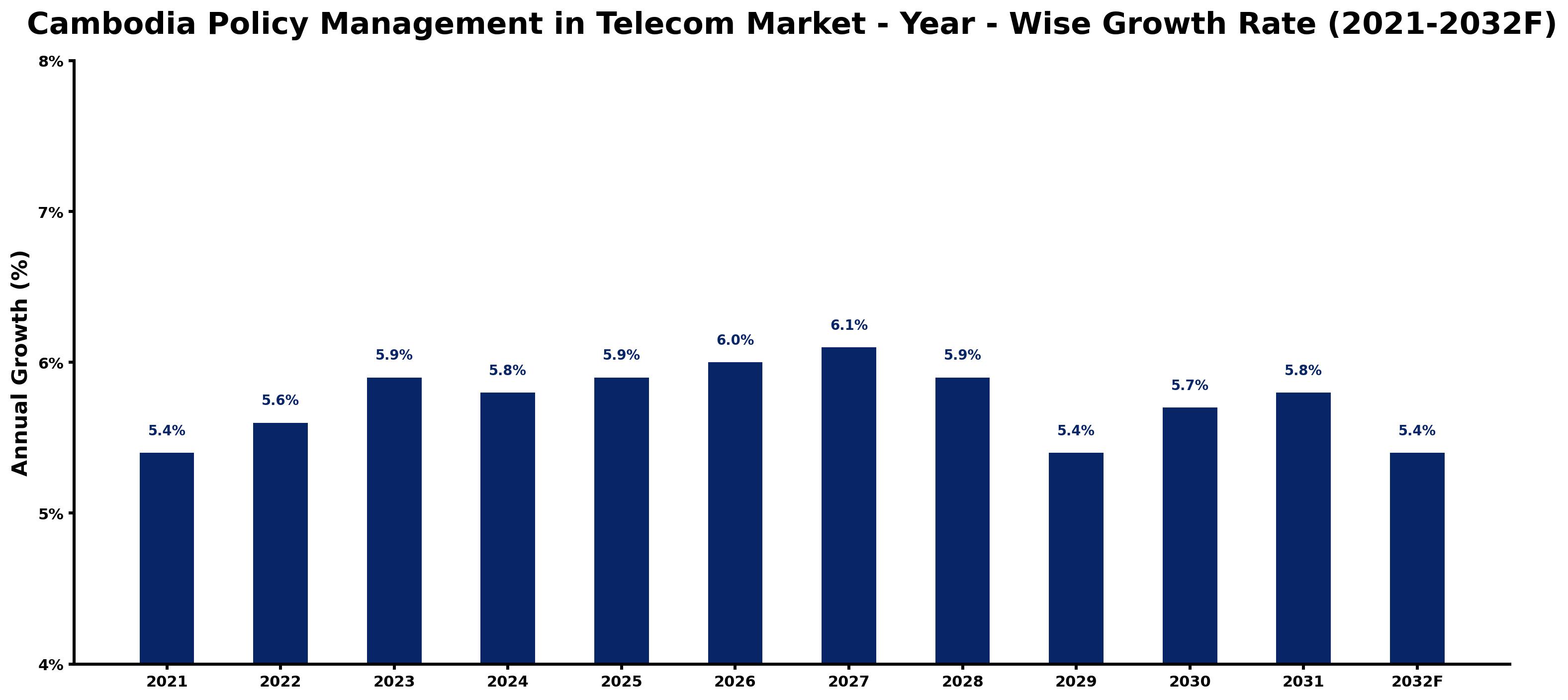
The table below presents the year‑wise growth rates along with the key drivers influencing the market
| Year | Growth Rate | Major Drivers |
| 2021 | 5.4% | Telecom Regulatory Authority promoting mobile financial services. |
| 2022 | 5.6% | Increased digital literacy driving mobile internet subscriptions. |
| 2023 | 5.9% | Government incentives for rural telecom infrastructure development. |
| 2024 | 5.8% | 5G rollout plans announced enhancing competitive landscape. |
| 2025 | 5.9% | Foreign investments boosting telecom service innovations. |
| 2026 | 6.0% | Rising smartphone adoption among young population. |
| 2027 | 6.1% | National policy supporting broadband access across provinces. |
| 2028 | 5.9% | Partnerships with tech firms for digital transformation initiatives. |
| 2029 | 5.4% | Substantial rise in demand for VoIP services. |
| 2030 | 5.7% | Regulatory changes favoring competition in telecom industry. |
| 2031 | 5.8% | Local startups developing innovative telecom solutions. |
| 2032 | 5.4% | Increased focus on cybersecurity regulations in telecommunications. |
Note: Market size estimations and growth projections presented in this report are based on 6Wresearch's proprietary forecasting methodology, utilizing the latest available industry data, government publications, and primary research inputs.
Cambodia Policy Management in Telecom Market Key Takeaways
Below are some of the specific key takeaways from the market, including:
- Government regulations are pivotal in driving competition among telecom operators.
- Recent initiatives focus on expanding broadband access, especially in rural areas.
- Consumer protection policies are gaining traction, addressing data privacy and cybersecurity.
- Investment in digital infrastructure is a government priority to support economic growth.
- The market shows a promising growth trajectory with a projected CAGR of 5.7% from 2026 to 2032.
Evaluation of Restraints in Cambodia Policy Management in Telecom Market
One of the most pressing constraints in Cambodia’s telecom sector is the regulatory framework’s ability to adapt to rapid technological changes. While policies exist to encourage competition, they often lag behind the fast-paced evolution of technology. Additionally, infrastructure challenges persist, particularly in rural regions, limiting access and affordability for many users. Balancing the need for fair competition with adequate consumer protection is a complex task that the government must navigate to promote sustainable growth in this sector.
Cambodia Policy Management in Telecom Market Trends
A notable trend is the increasing focus on digital inclusivity, with policies aimed at enhancing internet access in underserved areas. Furthermore, data privacy regulations are becoming more stringent, responding to consumer concerns over security. The introduction of 5G technology will also reshape market dynamics, compelling operators to upgrade infrastructure while fostering innovative service offerings.
Cambodia Policy Management in Telecom Market Opportunities
Significant opportunities lie in the government’s commitment to expanding broadband infrastructure. Investments in public-private partnerships can accelerate deployment in rural and remote areas. Additionally, as the demand for enhanced connectivity grows, operators can explore innovative services that cater to a digitally literate population, particularly among the youth and emerging businesses. The anticipated rollout of 5G technology could lead to new service applications, further driving market expansion.
Government Initiatives in the Cambodia Policy Management in Telecom Market
The Cambodian government plays an active role in shaping the telecom market through targeted policies aimed at enhancing competition and infrastructure development. Regulatory frameworks are evolving to support these goals, which are critical for ensuring the sector’s growth and consumer protection. With ongoing initiatives, the government is focused on bridging the digital divide and fostering a thriving telecom environment.
- A recently completed initiative focused on licensing reforms aimed at streamlining the operator entry process.
- Current efforts include an ongoing program to enhance broadband accessibility in rural communities.
- A planned public-private partnership is set to roll out new fiber optic networks by 2027.
- Regulatory measures established in 2024 mandate increased transparency in telecom billing practices.
- Another recent initiative involves introducing cybersecurity frameworks to safeguard consumer data.
Future Insights of the Cambodia Policy Management in Telecom Market
Looking ahead to 2026-2032, the Cambodia Policy Management in Telecom Market is poised for substantial growth, driven by the government's proactive approach in policy management and infrastructure development. The push for digital inclusivity will continue to shape regulatory agendas, ensuring broader access to telecom services. Investment in new technologies, particularly in 5G, will likely present both challenges and opportunities, influencing market dynamics in unexpected ways.
Cambodia Policy Management in Telecom Market Latest Developments
Recent months have seen a flurry of activities within Cambodia's telecom sector, as operators and regulators work together to address the growing demand for improved services. Initiatives focused on regulatory reforms and infrastructure enhancements are shaping the future of the market.
- A major regulatory overhaul was completed in early 2025, simplifying the licensing process for new telecom operators.
- An infrastructure upgrade initiative began in mid-2025 to enhance broadband capabilities across urban and rural areas.
- A newly introduced cybersecurity initiative is currently underway, aiming to strengthen data protection for consumers.
- Upcoming is a public awareness campaign planned for late 2025 to educate citizens about digital services and security.
- By 2026, a collaboration between the government and a technology vendor is expected to roll out innovative 5G services.
Cambodia Policy Management in Telecom Market - Key Attractiveness of the Report
- 10 Years of Market Numbers
- Historical Data Starting from 2022 to 2025
- Base Year: 2025
- Forecast Data until 2032
- Key Performance Indicators Impacting the Market
- Major Upcoming Developments and Projects
Key Highlights of the Report:
- Cambodia Policy Management in Telecom Market Outlook
- Market Size of Cambodia Policy Management in Telecom Market, 2025
- Forecast of Cambodia Policy Management in Telecom Market, 2032
- Historical Data and Forecast of Cambodia Policy Management in Telecom Revenues & Volume for the Period 2022-2032F
- Cambodia Policy Management in Telecom Market Trend Evolution
- Cambodia Policy Management in Telecom Market Drivers and Challenges
- Cambodia Policy Management in Telecom Price Trends
- Cambodia Policy Management in Telecom Porter's Five Forces
- Cambodia Policy Management in Telecom Industry Life Cycle
- Historical Data and Forecast of Cambodia Policy Management in Telecom Market Revenues & Volume By Network for the Period 2022-2032F
- Historical Data and Forecast of Cambodia Policy Management in Telecom Market Revenues & Volume By Fixed for the Period 2022-2032F
- Historical Data and Forecast of Cambodia Policy Management in Telecom Market Revenues & Volume By Wireless for the Period 2022-2032F
- Historical Data and Forecast of Cambodia Policy Management in Telecom Market Revenues & Volume By Component for the Period 2022-2032F
- Historical Data and Forecast of Cambodia Policy Management in Telecom Market Revenues & Volume By Solutions for the Period 2022-2032F
- Historical Data and Forecast of Cambodia Policy Management in Telecom Market Revenues & Volume By Services for the Period 2022-2032F
- Historical Data and Forecast of Cambodia Policy Management in Telecom Market Revenues & Volume By Deployment for the Period 2022-2032F
- Historical Data and Forecast of Cambodia Policy Management in Telecom Market Revenues & Volume By Cloud for the Period 2022-2032F
- Historical Data and Forecast of Cambodia Policy Management in Telecom Market Revenues & Volume By On-Premises for the Period 2022-2032F
- Cambodia Policy Management in Telecom Import Export Trade Statistics
- Market Opportunity Assessment By Network
- Market Opportunity Assessment By Component
- Market Opportunity Assessment By Deployment
- Cambodia Policy Management in Telecom Top Companies Market Share
- Cambodia Policy Management in Telecom Competitive Benchmarking By Technical and Operational Parameters
- Cambodia Policy Management in Telecom Company Profiles
- Cambodia Policy Management in Telecom Key Strategic Recommendations






































