Cambodia Retail and Wholesale Market: Import Trend Analysis
In 2024, Cambodia retail and wholesale market witnessed a steady increase in imports, driven by rising consumer demand and expanding businesses. The import trend reflected a growing appetite for a diverse range of products, contributing to the market`s overall growth and competitiveness.
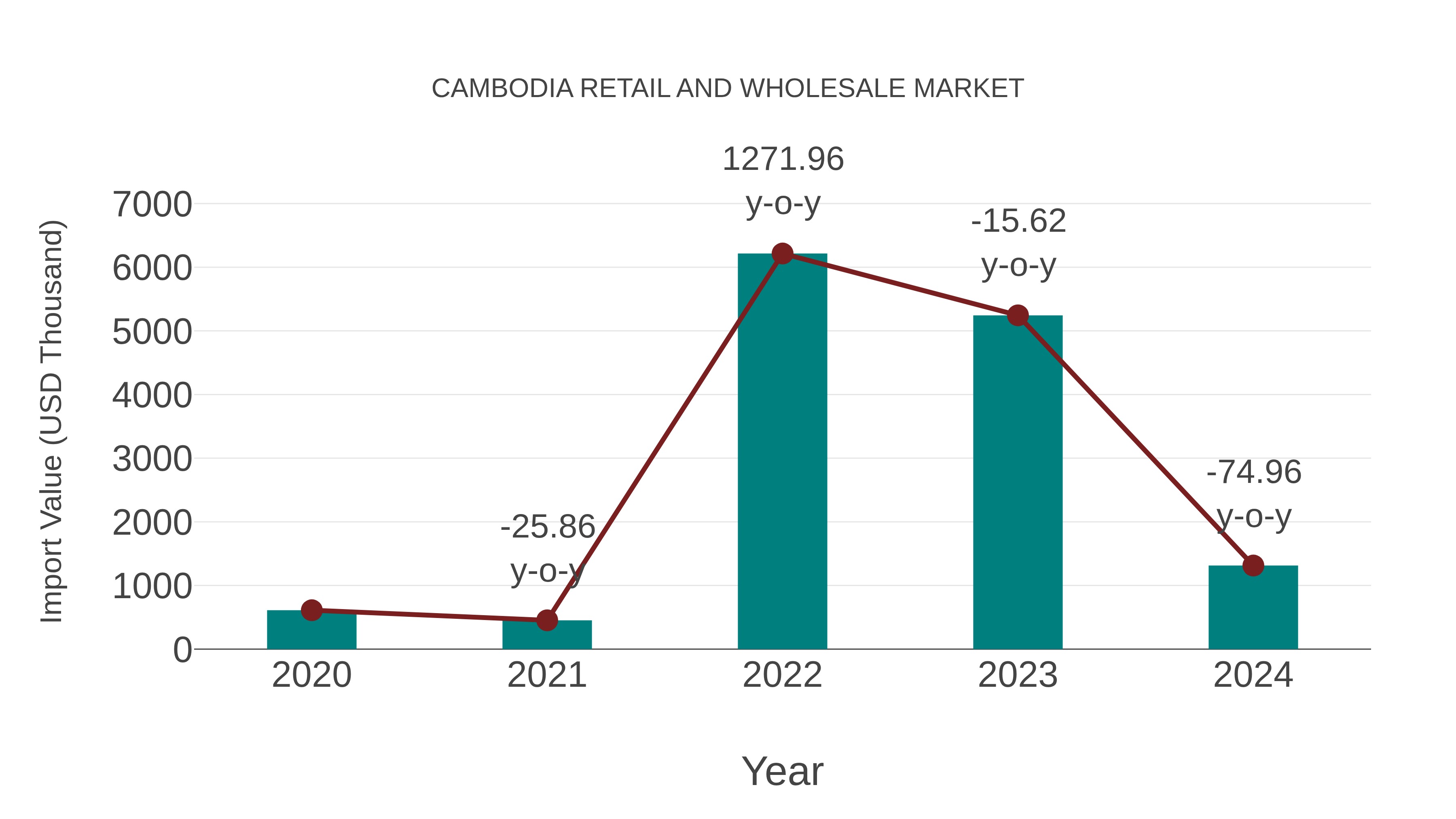
Cambodia Retail and Wholesale Market Growth Rate
According to 6Wresearch internal database and industry insights, the Cambodia Retail and Wholesale Market is projected to grow at a compound annual growth rate (CAGR) of 7.4% during the forecast period (2026-2032).
Topics Covered in the Cambodia Retail and Wholesale Market Report
The Cambodia Retail and Wholesale Market report thoroughly covers the market by type, Ownership, Price Range and Distribution Channel. The market report provides an unbiased and detailed analysis of ongoing market trends, opportunities/high growth areas, and market drivers, which help stakeholders devise and align their market strategies according to the current and future market dynamics.
Cambodia Retail and Wholesale Market Highlights
| Report Name |
Cambodia Retail and Wholesale Market |
| Forecast period | 2026-2032 |
| CAGR | 7.4% |
| Growing Sector |
Organized Retail Chains & Supermarkets |
Cambodia Retail and Wholesale Market Synopsis
Cambodia Retail and Wholesale Market is witnessing steady expansion driven by increasing urbanization, rising disposable incomes, and the gradual shift from traditional markets to organized retail formats, while evolving consumer preferences are encouraging retailers to diversify offerings and enhance in-store experiences, and at the same time, improvements in logistics and supply chain infrastructure are enabling wholesalers to expand distribution networks efficiently, thereby supporting market penetration across both urban and semi-urban regions.
Evaluation of Growth Drivers in the Cambodia Retail and Wholesale Market
Below mentioned are some prominent drivers and their influence on the market dynamics:
| Drivers | Primary Segments Affected | Why it Matters (Evidence) |
| Rising Urbanization | Retail, Supermarkets | Urban population growth increases demand for organized retail outlets and modern shopping experiences. |
| Retail Chain Expansion | Retail Chain, Mid-Ranges | The entry of foreign and regional retail chains increases product diversity and consumer choice. |
| Improvements in Logistics Infrastructure | Wholesale & Distribution Networks | The better transportation and storage facilities ensure efficient delivery of products across the country. |
| Rising Disposible Income | Premium & Mid-Range, Retail | Buying capacity influences the demand for branded and premium products. |
| Digital Payment Adoption | Retail & Wholesale, All Channels | Cashless transactions improve customer convenience and boost retail sales volumes. |
Cambodia Retail and Wholesale Market is expected to grow at the CAGR of 7.4% during the forecast period of 2026-2032. Growth is supported by rising consumer spending, expansion of modern retail formats, and improving logistics infrastructure that enhances product accessibility across regions, while increasing participation from international retail chains and evolving consumer shopping habits further contribute to strengthening market dynamics and long-term growth prospects.
Evaluation of Restraints in the Cambodia Retail and Wholesale Market
Below mentioned are some major restraints and their influence on the market dynamics:
| Restraints | Primary Segments Affected | What This Means (Evidence) |
| Dominance of Traditional Markets | Retail, Independent Retailers | Informal retail sector limits rapid adoption of organized retail formats. |
| Rural Infrastructure Limitations | Retail, Logistics | The poor connectivity hinders supply chain management in rural areas. |
| Consumers’ Price Sensitiveness | Economy Segment, Retail | The high reliance on affordable products affects premium products’ sales. |
| Inefficient Supply Chain | Logistics, Independent Wholesalers | Non-standardization leads to inefficiencies in supply chain management. |
| Regulatory and Import Challenges | Retail Chains, Wholesale | Import duties and compliance processes affect product availability and pricing |
Cambodia Retail and Wholesale Market Challenges
Irrespective of massive growth and development, the market faces several challenges such as the dominance of informal retail channels, fragmented supply chains, and uneven infrastructure development across rural areas, which collectively hinder consistent market expansion, while additional constraints including fluctuating import regulations, limited cold chain facilities, and price-sensitive consumer behavior continue to impact profitability and scalability, thereby influencing Cambodia Retail and Wholesale Market Growth in a competitive and evolving business environment.
Cambodia Retail and Wholesale Market Trends
The key trends affecting the Cambodia Retail and Wholesale Market are as follows:
- Organization of Retailing: The development of supermarkets and hypermarkets has resulted in an increased choice of products, transparent pricing, and improved shopping experience for consumers compared to conventional retail formats.
- Private Labels: Retailers have started developing their private label brands for enhanced profits and competitive pricing in order to attract value-conscious customers.
- Digital Transformation: The use of POS solutions and other digital technologies has helped retailers and wholesalers in optimizing their operations and improving service delivery to their customers.
- Moving to Secondary Cities: Retail players are also looking at the potential in secondary cities in the country.
Investment Opportunities in the Cambodia Retail and Wholesale Market
Some Significant Investment Potential in the Retail and Wholesale Industry of Cambodia are:
- Retail Infrastructure: Developing retail infrastructure such as malls, supermarkets, and retail parks that will cater to the increasing demand for organized shopping.
- Optimizing the Logistics Chain: Making investments in warehouses and cold storages.
- E-commerce and Retailing: Integrating E-commerce with retailing.
- Development of Wholesale Distribution Channels: Creation of regional distribution centers to improve product availability in rural and semi-urban areas.
Top 5 Leading Players in the Cambodia Retail and Wholesale Market
Key companies operating in the Cambodia Retail and Wholesale Market include:
1. AEON Co Ltd
| Company Name | AEON Co., Ltd. |
|---|---|
| Established Year | 1926 |
| Headquarters | Chiba, Japan |
| Official Website | Click Here |
AEON operates large shopping malls and supermarkets in Cambodia, offering a wide range of consumer goods and enhancing modern retail infrastructure through high-quality shopping environments, diverse product offerings, and strategic expansion into urban retail hubs.
2. Makro Cambodia
| Company Name | Makro Cambodia (CP ALL Group) |
|---|---|
| Established Year | 1988 |
| Headquarters | Bangkok, Thailand |
| Official Website | Click Here |
Makro focuses on wholesale distribution, supplying food and non-food products to businesses, restaurants, and retailers, while strengthening Cambodia’s wholesale ecosystem through bulk supply efficiency, competitive pricing, and strong logistics capabilities.
3. Lucky Supermarket Group
| Company Name | Lucky Supermarket Group |
|---|---|
| Established Year | 1993 |
| Headquarters | Phnom Penh, Cambodia |
| Official Website | - |
Lucky Supermarket is a leading local retail chain offering groceries and household products, known for its extensive network, consistent product availability, and contribution to the modernization of Cambodia’s retail landscape.
4. Chip Mong Retail
| Company Name | Chip Mong Retail |
|---|---|
| Established Year | 2018 |
| Headquarters | Phnom Penh, Cambodia |
| Official Website | Click Here |
Chip Mong Retail operates supermarkets and convenience stores, focusing on premium retail experiences, modern store formats, and diversified product offerings that cater to Cambodia’s growing middle-class consumer base.
5. Thai Huot Market
| Company Name | Thai Huot Market |
|---|---|
| Established Year | 1998 |
| Headquarters | Phnom Penh, Cambodia |
| Official Website | Click Here |
Thai Huot Market specializes in imported goods and premium grocery products, serving urban consumers seeking high-quality international brands while contributing to the diversification of Cambodia’s retail product landscape.
Government Regulations Introduced in the Cambodia Retail and Wholesale Market
According to Cambodia Government Data, the government has taken up many measures like the Trade Development Strategy 2019-2023 and reforms in the retail sector to increase market efficiency and improve supply chains, while investments from foreign investors for retail infrastructure and streamlined business registration procedures have made it easier for international retailers to enter the market, and also, measures have been taken by the government to encourage the use of digital payments and growth of SMEs, which has helped in improving both the retail and wholesale sectors.
Future Insights of the Cambodia Retail and Wholesale Market
Cambodia Retail and Wholesale Industry is expected to experience sustained growth as increasing urbanization, rising consumer income levels, and the continuous expansion of organized retail formats create new opportunities for market players, while advancements in logistics infrastructure, growing digital adoption in retail operations, and supportive government policies are likely to enhance efficiency and market penetration, thereby contributing significantly to the growth over the coming years.
Market Segmentation Analysis
The report offers a comprehensive study of the subsequent market segments and their leading categories:
Retail Segment to Dominate the Market- By Type
According to Adwait, Senior Research Analyst, 6Wresearch, the retail segment is expected to dominate the Cambodia Retail and Wholesale Market Share due to the rapid expansion of supermarkets, convenience stores, and shopping malls, which are increasingly preferred by urban consumers seeking convenience, product variety, and better shopping experiences.
Retail Chain/Wholesale Chain to Dominate the Market- By Ownership
Retail and wholesale chains are gaining dominance due to their ability to offer standardized pricing, bulk purchasing advantages, and strong supply chain networks, which enhance operational efficiency and customer trust across both retail and wholesale segments.
Mid-Range Segment to Dominate the Market- By Price Range
The mid-range segment is leading the market as it balances affordability and quality, attracting a broad consumer base that is transitioning from economy products to branded goods with improved value propositions.
Supermarkets/Hypermarkets to Dominate the Market- By Distribution Channel
Supermarkets and hypermarkets are dominating due to their wide product assortment, competitive pricing, and ability to provide a one-stop shopping experience, making them highly attractive to Cambodia’s growing urban population.
Key Attractiveness of the Report
- 10 Years of Market Numbers.
- Historical Data Starting from 2022 to 2025.
- Base Year: 2025.
- Forecast Data until 2032.
- Key Performance Indicators Impacting the Market.
- Major Upcoming Developments and Projects.
Key Highlights of the Report:
- Cambodia Retail And Wholesale Market Outlook
- Market Size of Cambodia Retail And Wholesale Market, 2025
- Forecast of Cambodia Retail And Wholesale Market, 2032
- Historical Data and Forecast of Cambodia Retail And Wholesale Revenues & Volume for the Period 2022 - 2032F
- Cambodia Retail And Wholesale Market Trend Evolution
- Cambodia Retail And Wholesale Market Drivers and Challenges
- Cambodia Retail And Wholesale Price Trends
- Cambodia Retail And Wholesale Porter's Five Forces
- Cambodia Retail And Wholesale Industry Life Cycle
- Historical Data and Forecast of Cambodia Retail And Wholesale Market Revenues & Volume By Type for the Period 2022 - 2032F
- Historical Data and Forecast of Cambodia Retail And Wholesale Market Revenues & Volume By Retail for the Period 2022 - 2032F
- Historical Data and Forecast of Cambodia Retail And Wholesale Market Revenues & Volume By Wholesale for the Period 2022 - 2032F
- Historical Data and Forecast of Cambodia Retail And Wholesale Market Revenues & Volume By Ownership for the Period 2022 - 2032F
- Historical Data and Forecast of Cambodia Retail And Wholesale Market Revenues & Volume By Retail Chain/Wholesale Chain for the Period 2022 - 2032F
- Historical Data and Forecast of Cambodia Retail And Wholesale Market Revenues & Volume By Independent Retailer/Independent Wholesalers for the Period 2022 - 2032F
- Historical Data and Forecast of Cambodia Retail And Wholesale Market Revenues & Volume By Price Range for the Period 2022 - 2032F
- Historical Data and Forecast of Cambodia Retail And Wholesale Market Revenues & Volume By Premium for the Period 2022 - 2032F
- Historical Data and Forecast of Cambodia Retail And Wholesale Market Revenues & Volume By Mid-Range for the Period 2022 - 2032F
- Historical Data and Forecast of Cambodia Retail And Wholesale Market Revenues & Volume By Economy for the Period 2022 - 2032F
- Historical Data and Forecast of Cambodia Retail And Wholesale Market Revenues & Volume By Distribution Channel for the Period 2022 - 2032F
- Historical Data and Forecast of Cambodia Retail And Wholesale Market Revenues & Volume By Supermarkets/Hypermarkets for the Period 2022 - 2032F
- Historical Data and Forecast of Cambodia Retail And Wholesale Market Revenues & Volume By Convenience Stores for the Period 2022 - 2032F
- Historical Data and Forecast of Cambodia Retail And Wholesale Market Revenues & Volume By Department Stores for the Period 2022 - 2032F
- Historical Data and Forecast of Cambodia Retail And Wholesale Market Revenues & Volume By Specialty Stores for the Period 2022 - 2032F
- Cambodia Retail And Wholesale Import Export Trade Statistics
- Market Opportunity Assessment By Type
- Market Opportunity Assessment By Ownership
- Market Opportunity Assessment By Price Range
- Market Opportunity Assessment By Distribution Channel
- Cambodia Retail And Wholesale Top Companies Market Share
- Cambodia Retail And Wholesale Competitive Benchmarking By Technical and Operational Parameters
- Cambodia Retail And Wholesale Company Profiles
- Cambodia Retail And Wholesale Key Strategic Recommendations
Market Covered
The report offers a comprehensive study of the subsequent market segments:
By Type
- Retail
- Wholesale
By Ownership
- Retail Chain / Wholesale Chain
- Independent Retailer / Independent Wholesalers
By Price Range
- Premium
- Mid-Range
- Economy
By Distribution Channel
- Supermarkets / Hypermarkets
- Convenience Stores
- Department Stores
- Specialty Stores






































