Cambodia Workspace as a Service Market Size & Growth Rate (2026-2032)
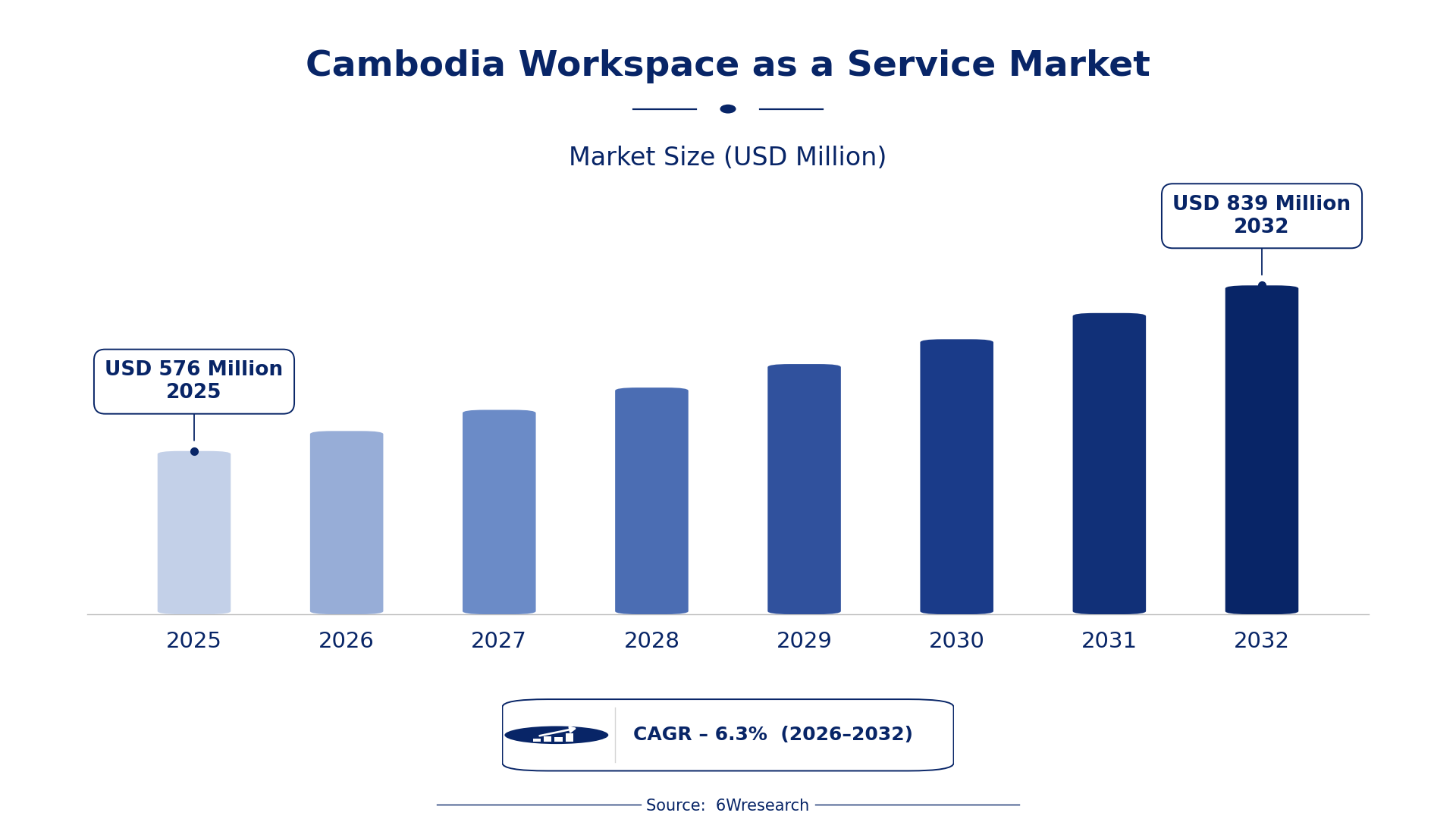
The Cambodia Workspace as a Service Market was estimated at USD 576 Million in 2025 and is projected to reach USD 839 Million by 2032, growing at a CAGR of 6.3% from 2026 to 2032.
Cambodia Workspace as a Service Market Synopsis
The Cambodia Workspace as a Service Market is on a promising trajectory, fueled by the rapid development of the digital economy and an increasing appetite for flexible work arrangements. Businesses are seeking adaptable solutions that enable remote work, which is quickly becoming a standard expectation rather than a temporary fix.
As the market matures, organizations are increasingly adopting WaaS solutions for their ability to support workforce mobility and operational efficiency. This shift is not merely a trend but a fundamental change in how companies operate, indicating a strong future demand for these services.
Cambodia Workspace as a Service Market Year-wise Growth Rate and Key Drivers
This graph illustrates the annual growth rates of the Cambodia Workspace as a Service Market from 2021 to 2032, highlighting a steady upward trajectory and projected expansion over the forecast period.
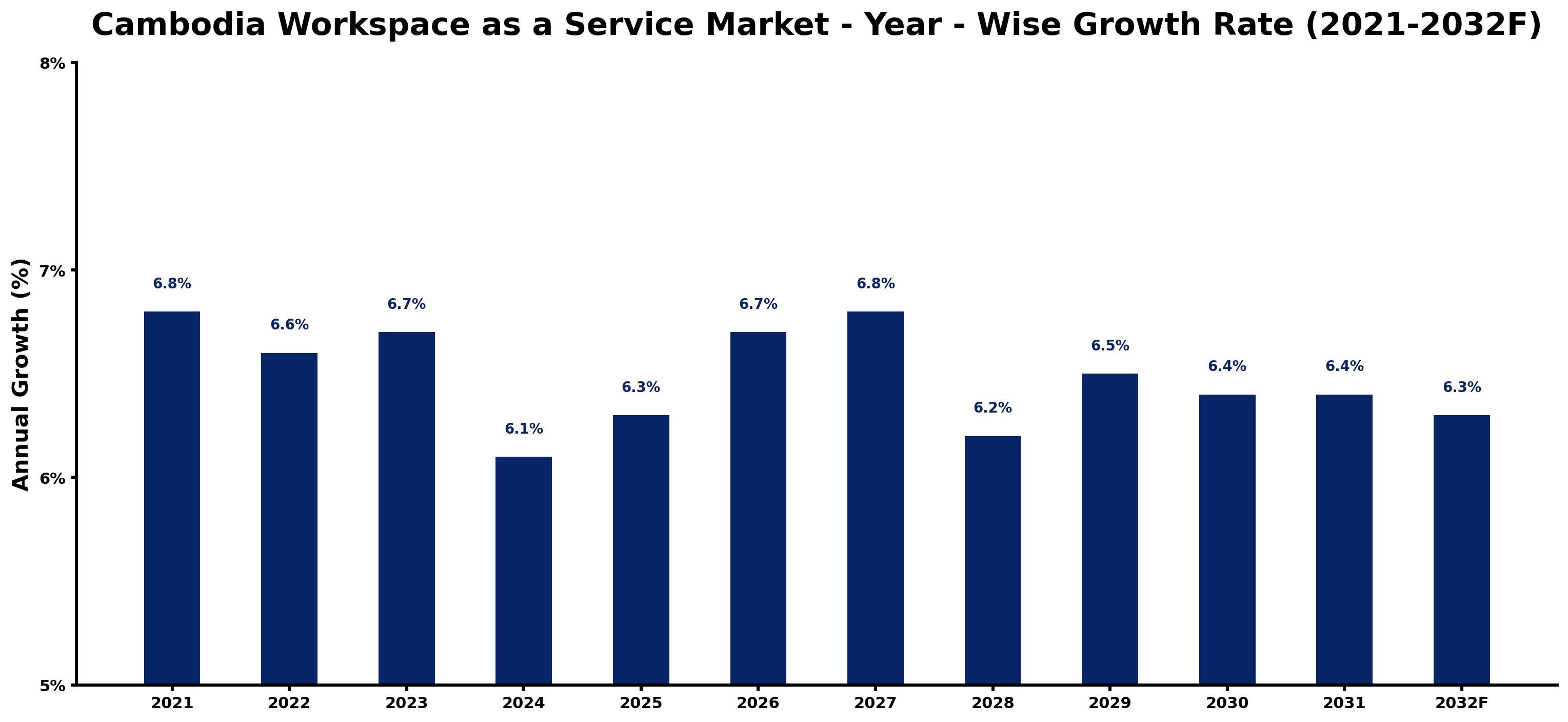
The table below presents the year‑wise growth rates along with the key drivers influencing the market
| Year | Growth Rate | Major Drivers |
| 2021 | 6.8% | Rise of digital nomad culture in Phnom Penh |
| 2022 | 6.6% | Government support for startup ecosystems and co-working spaces |
| 2023 | 6.7% | Increased foreign investment driving flexible workspace demand |
| 2024 | 6.1% | Young workforce prioritizing collaborative work environments |
| 2025 | 6.3% | Emerging technology hubs expanding need for workspace solutions |
| 2026 | 6.7% | Growing entrepreneurship fostering demand for shared office space |
| 2027 | 6.8% | Cambodia's digital economy initiative boosting office innovation |
| 2028 | 6.2% | Increased expatriate population seeking temporary work solutions |
| 2029 | 6.5% | Rising gig economy leading to flexible workspace preferences |
| 2030 | 6.4% | Local businesses shifting to hybrid work models post-pandemic |
| 2031 | 6.4% | Continued urbanization driving demand for versatile workspaces |
| 2032 | 6.3% | Government incentives for small businesses incorporating shared spaces |
Note: Market size estimations and growth projections presented in this report are based on 6Wresearch's proprietary forecasting methodology, utilizing the latest available industry data, government publications, and primary research inputs.
Cambodia Workspace as a Service Market Key Takeaways
Below are some of the specific key takeaways from the market, including:
- The demand for flexible workspace solutions is escalating, particularly in urban centers.
- Cloud computing adoption is a primary driver of the WaaS market in Cambodia.
- Government policies are increasingly supportive of digital and flexible work solutions.
- Concerns regarding data security remain a barrier to wider adoption of WaaS.
- Businesses are prioritizing cost-effectiveness and scalability in their workspace strategies.
Evaluation of Restraints in Cambodia Workspace as a Service Market
Several factors are limiting the growth of the Cambodia Workspace as a Service Market. A lack of awareness about flexible workspace solutions outside major urban areas hampers broader adoption. Many businesses continue to rely on traditional office setups, which do not offer the flexibility needed for modern work environments. Additionally, competition from conventional office space providers creates challenges for WaaS market players. Concerns over data security and reliable connectivity further complicate the decision-making process for organizations considering these solutions.
Cambodia Workspace as a Service Market Trends
The demand for remote work capabilities is shaping how businesses view workspace solutions. Increasingly, organizations are implementing Bring Your Own Device (BYOD) policies, allowing employees to use personal devices to access work resources securely. This trend is complemented by the ongoing digital transformation across sectors, with companies investing in cloud-based platforms that enhance productivity and collaboration. on top of that, the rise of hybrid work models is driving the need for scalable solutions that can adapt to varying workforce requirements.
Cambodia Workspace as a Service Market Opportunities
Investment opportunities in the Cambodia Workspace as a Service Market are abundant, particularly for companies focused on innovation in cloud technologies. As organizations seek cost-effective solutions, there is a notable demand for providers that can deliver customized WaaS offerings tailored to specific business needs. on top of that, partnerships with technology firms can enhance service delivery and broaden market reach. The ongoing development of urban infrastructure presents another avenue for expansion, as businesses increasingly look for integrated solutions that accommodate both physical and virtual workspace needs.
Government Initiatives in the Cambodia Workspace as a Service Market
The Cambodian government recognizes the vital role that flexible workspace solutions play in fostering economic growth and enhancing productivity. Current policies aim to facilitate the adoption of Workspace as a Service by improving digital infrastructure and creating a conducive regulatory environment. This proactive approach is crucial for ensuring that businesses can leverage the benefits of remote work and digital collaboration.
- A regulatory framework introduced in 2025 mandating transparency in workspace billing practices.
- An initiative launched in early 2025 to improve digital connectivity in rural areas, thereby enhancing access to WaaS solutions.
- A public-private partnership underway to develop coworking spaces across urban centers, aimed at promoting flexible work environments.
- A planned infrastructure upgrade program expected to roll out by 2027, focusing on enhancing cloud service capabilities.
Future Insights of the Cambodia Workspace as a Service Market
Looking ahead to 2026-2032, the Cambodia Workspace as a Service Market is expected to flourish as organizations continue to embrace flexible work arrangements. The increasing reliance on cloud technologies will drive innovation and competition among service providers. As workforce mobility becomes standard practice, companies will prioritize solutions that enhance collaboration and productivity. The government's supportive policies will further bolster market growth, creating an environment ripe for investment and development.
Cambodia Workspace as a Service Market Latest Developments
Recent activity in the Cambodia Workspace as a Service Market highlights the rapid evolution of the sector, with many businesses adopting new technologies and practices to stay competitive. A surge in partnerships and technology rollouts signifies a market on the cusp of transformation, as organizations seek to enhance their operational efficiency and workforce flexibility.
- A major technology vendor announced an ongoing initiative to integrate AI-driven tools into its WaaS offerings, enhancing user experience and productivity.
- In Q1 2025, a leading regional operator launched a collaborative platform aimed at streamlining remote teamwork and communication.
- A coworking space provider began a phased expansion plan in early 2025 to open new locations across Cambodia, focusing on urban hotspots.
- An initiative that started in mid-2025 is underway to increase data security standards for WaaS solutions, responding to growing concerns among businesses.
Cambodia Workspace as a Service Market - Key Attractiveness of the Report
- 10 Years of Market Numbers
- Historical Data Starting from 2022 to 2025
- Base Year: 2025
- Forecast Data until 2032
- Key Performance Indicators Impacting the Market
- Major Upcoming Developments and Projects
Key Highlights of the Report:
- Cambodia Workspace as a Service Market Outlook
- Market Size of Cambodia Workspace as a Service Market, 2025
- Forecast of Cambodia Workspace as a Service Market, 2032
- Historical Data and Forecast of Cambodia Workspace as a Service Revenues & Volume for the Period 2022-2032F
- Cambodia Workspace as a Service Market Trend Evolution
- Cambodia Workspace as a Service Market Drivers and Challenges
- Cambodia Workspace as a Service Price Trends
- Cambodia Workspace as a Service Porter's Five Forces
- Cambodia Workspace as a Service Industry Life Cycle
- Historical Data and Forecast of Cambodia Workspace as a Service Market Revenues & Volume By Solutions for the Period 2022-2032F
- Historical Data and Forecast of Cambodia Workspace as a Service Market Revenues & Volume By VDI and Applications for the Period 2022-2032F
- Historical Data and Forecast of Cambodia Workspace as a Service Market Revenues & Volume By Desktop as a Service for the Period 2022-2032F
- Historical Data and Forecast of Cambodia Workspace as a Service Market Revenues & Volume By Hosted Applications (Unified Communication Applications) for the Period 2022-2032F
- Historical Data and Forecast of Cambodia Workspace as a Service Market Revenues & Volume By Security Solutions for the Period 2022-2032F
- Historical Data and Forecast of Cambodia Workspace as a Service Market Revenues & Volume By Others (Browser-based WaaS solutions) for the Period 2022-2032F
- Historical Data and Forecast of Cambodia Workspace as a Service Market Revenues & Volume By Services for the Period 2022-2032F
- Historical Data and Forecast of Cambodia Workspace as a Service Market Revenues & Volume By System Integration for the Period 2022-2032F
- Historical Data and Forecast of Cambodia Workspace as a Service Market Revenues & Volume By Consulting services for the Period 2022-2032F
- Historical Data and Forecast of Cambodia Workspace as a Service Market Revenues & Volume By Managed services for the Period 2022-2032F
- Historical Data and Forecast of Cambodia Workspace as a Service Market Revenues & Volume By Deployment Type for the Period 2022-2032F
- Historical Data and Forecast of Cambodia Workspace as a Service Market Revenues & Volume By Public for the Period 2022-2032F
- Historical Data and Forecast of Cambodia Workspace as a Service Market Revenues & Volume By Private for the Period 2022-2032F
- Historical Data and Forecast of Cambodia Workspace as a Service Market Revenues & Volume By Hybrid for the Period 2022-2032F
- Historical Data and Forecast of Cambodia Workspace as a Service Market Revenues & Volume By End-Users for the Period 2022-2032F
- Historical Data and Forecast of Cambodia Workspace as a Service Market Revenues & Volume By Enterprises for the Period 2022-2032F
- Historical Data and Forecast of Cambodia Workspace as a Service Market Revenues & Volume By Small and medium businesses(SMB) for the Period 2022-2032F
- Historical Data and Forecast of Cambodia Workspace as a Service Market Revenues & Volume By Verticals for the Period 2022-2032F
- Historical Data and Forecast of Cambodia Workspace as a Service Market Revenues & Volume By Banking, Financial Services and Insurance (BFSI) for the Period 2022-2032F
- Historical Data and Forecast of Cambodia Workspace as a Service Market Revenues & Volume By Retail for the Period 2022-2032F
- Historical Data and Forecast of Cambodia Workspace as a Service Market Revenues & Volume By Government for the Period 2022-2032F
- Historical Data and Forecast of Cambodia Workspace as a Service Market Revenues & Volume By Healthcare for the Period 2022-2032F
- Historical Data and Forecast of Cambodia Workspace as a Service Market Revenues & Volume By Manufacturing for the Period 2022-2032F
- Historical Data and Forecast of Cambodia Workspace as a Service Market Revenues & Volume By Telecom and IT for the Period 2022-2032F
- Historical Data and Forecast of Cambodia Workspace as a Service Market Revenues & Volume By Utilities for the Period 2022-2032F
- Historical Data and Forecast of Cambodia Workspace as a Service Market Revenues & Volume By Travel and Hospitality for the Period 2022-2032F
- Cambodia Workspace as a Service Import Export Trade Statistics
- Market Opportunity Assessment By Solutions
- Market Opportunity Assessment By Services
- Market Opportunity Assessment By Deployment Type
- Market Opportunity Assessment By End-Users
- Market Opportunity Assessment By Verticals
- Cambodia Workspace as a Service Top Companies Market Share
- Cambodia Workspace as a Service Competitive Benchmarking By Technical and Operational Parameters
- Cambodia Workspace as a Service Company Profiles
- Cambodia Workspace as a Service Key Strategic Recommendations






































