Cameroon Bulk Food Ingredients Market: Top 5 Importing Countries and Market Competition (HHI) Analysis
In 2023, Cameroon continued to see a high concentration of bulk food ingredients imports, with France, India, United Arab Emirates, Israel, and Belgium emerging as the top exporters. The high Herfindahl-Hirschman Index (HHI) indicates a market dominated by a few key players. With a remarkable Compound Annual Growth Rate (CAGR) of 35.08%, and a growth rate of 17.18%, the bulk food ingredients market in Cameroon is showing strong momentum and opportunities for further expansion in the coming years.
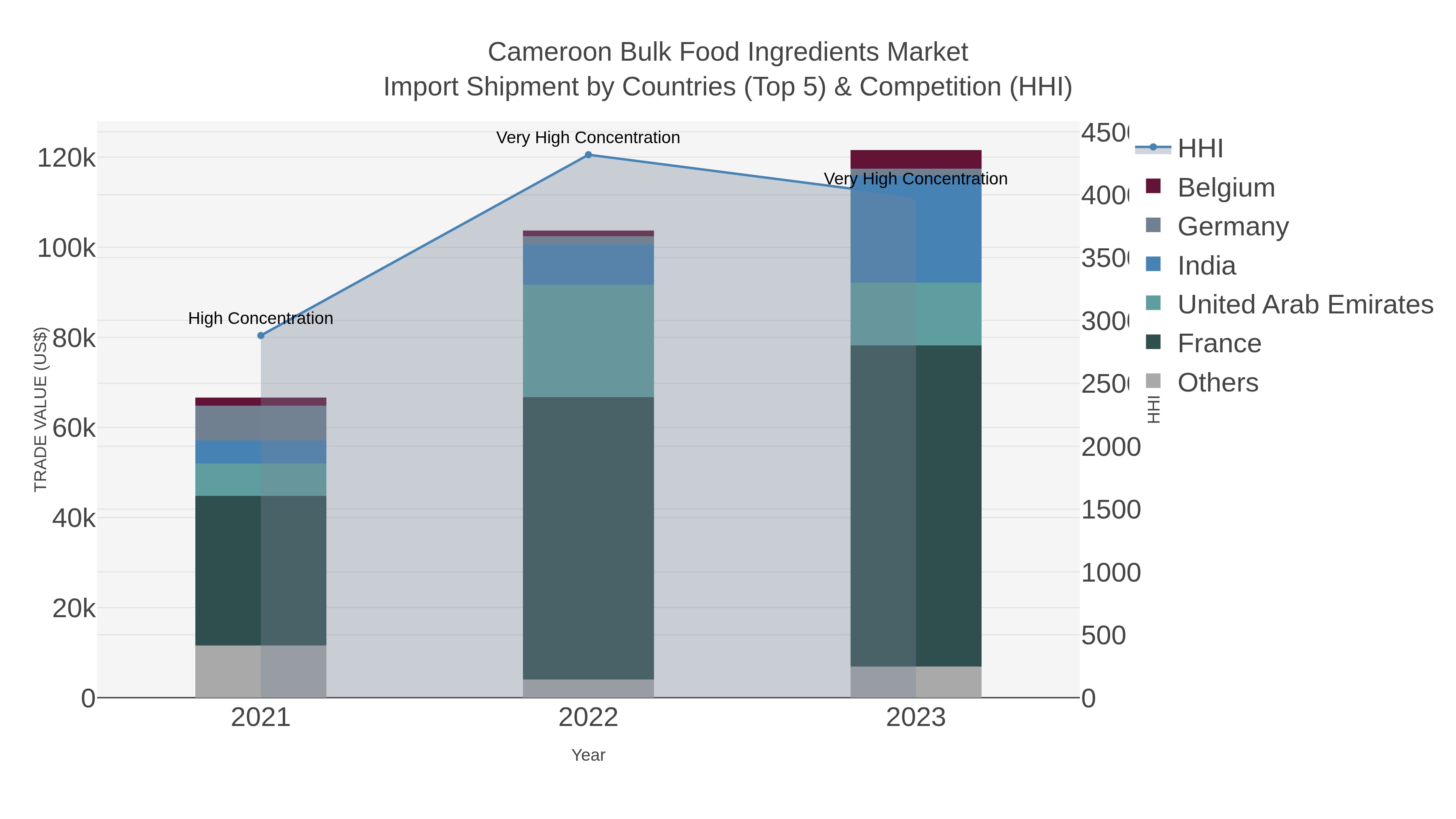
Cameroon Bulk Food Ingredients Market Overview
The bulk food ingredients market in Cameroon is expanding with the growth of the food processing and manufacturing sectors. Bulk ingredients, such as grains, sugar, and oils, are essential for producing various food products. The market is driven by rising consumer demand and industrial growth. Challenges include supply chain management and fluctuations in raw material prices.
Drivers of the market
The Cameroon bulk food ingredients market is influenced by the growth of the food processing and manufacturing industries. The increasing demand for processed and packaged food products drives the need for bulk food ingredients. Additionally, the trend toward convenience foods and the expansion of food distribution networks contribute to market growth.
Challenges of the market
Challenges in the Cameroon bulk food ingredients market include inconsistent supply and quality of ingredients due to reliance on imports. There is also a lack of local processing facilities and infrastructure, which affects market stability and pricing. Additionally, regulatory issues related to food safety and quality standards pose challenges for market players.
Government Policy of the market
Cameroonian policies related to the bulk food ingredients market aim to ensure food safety and quality. Regulations govern the sourcing, processing, and distribution of bulk food ingredients to maintain high standards. The government also supports initiatives that promote local production and reduce reliance on imported ingredients.
Key Highlights of the Report:
- Cameroon Bulk Food Ingredients Market Outlook
- Market Size of Cameroon Bulk Food Ingredients Market, 2024
- Forecast of Cameroon Bulk Food Ingredients Market, 2031
- Historical Data and Forecast of Cameroon Bulk Food Ingredients Revenues & Volume for the Period 2021-2031
- Cameroon Bulk Food Ingredients Market Trend Evolution
- Cameroon Bulk Food Ingredients Market Drivers and Challenges
- Cameroon Bulk Food Ingredients Price Trends
- Cameroon Bulk Food Ingredients Porter`s Five Forces
- Cameroon Bulk Food Ingredients Industry Life Cycle
- Historical Data and Forecast of Cameroon Bulk Food Ingredients Market Revenues & Volume By Application for the Period 2021-2031
- Historical Data and Forecast of Cameroon Bulk Food Ingredients Market Revenues & Volume By Food for the Period 2021-2031
- Historical Data and Forecast of Cameroon Bulk Food Ingredients Market Revenues & Volume By Beverages for the Period 2021-2031
- Historical Data and Forecast of Cameroon Bulk Food Ingredients Market Revenues & Volume By Distribution Channel for the Period 2021-2031
- Historical Data and Forecast of Cameroon Bulk Food Ingredients Market Revenues & Volume By Direct From Manufacturers for the Period 2021-2031
- Historical Data and Forecast of Cameroon Bulk Food Ingredients Market Revenues & Volume By Distributors for the Period 2021-2031
- Cameroon Bulk Food Ingredients Import Export Trade Statistics
- Market Opportunity Assessment By Application
- Market Opportunity Assessment By Distribution Channel
- Cameroon Bulk Food Ingredients Top Companies Market Share
- Cameroon Bulk Food Ingredients Competitive Benchmarking By Technical and Operational Parameters
- Cameroon Bulk Food Ingredients Company Profiles
- Cameroon Bulk Food Ingredients Key Strategic Recommendations






































