Cameroon Modular Kitchen Market: Top 5 Importing Countries and Market Competition (HHI) Analysis
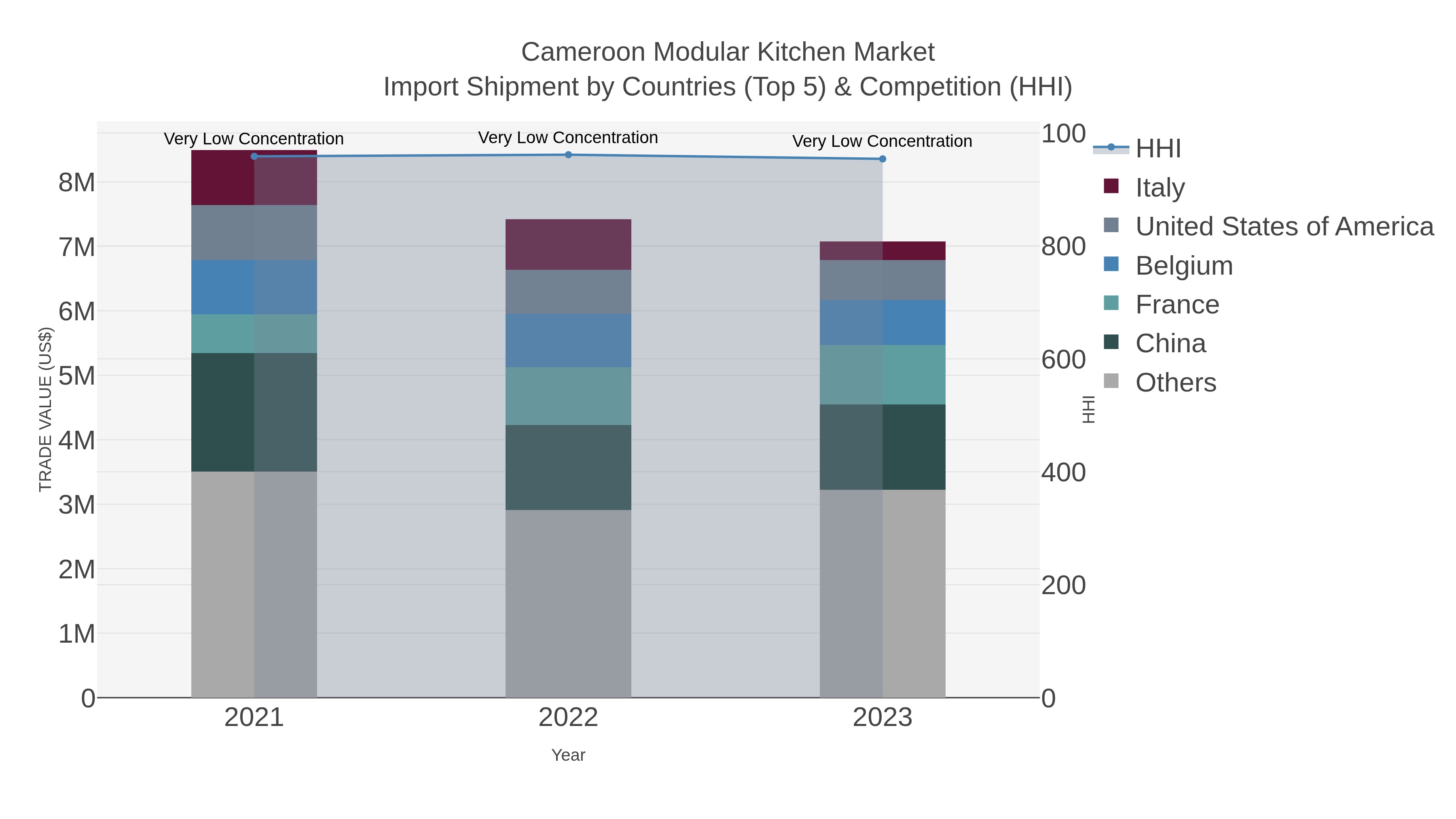
In 2023, Cameroon continued to see a diverse range of modular kitchen imports from top exporters including China, France, UAE, Belgium, and the USA. The market remained highly competitive with a low concentration level, indicating a balanced presence of suppliers. However, the industry experienced a decline with a negative Compound Annual Growth Rate (CAGR) of -8.72% and a growth rate of -4.64%. This suggests a challenging environment for modular kitchen imports in Cameroon, requiring exporters to adapt their strategies to navigate the changing market dynamics.
Cameroon Modular Kitchen Market Overview
The modular kitchen market in Cameroon is developing due to the growing demand for customizable and space-efficient kitchen solutions. Modular kitchens offer flexibility in design and functionality, catering to diverse preferences and space constraints. The market growth is supported by the increasing focus on home improvement and modern kitchen designs.
Drivers of the market
The Modular Kitchen market in Cameroon is expanding as the demand for functional and aesthetically pleasing kitchen solutions increases in residential and commercial sectors. Modular kitchens offer customizable and space-efficient designs, enhancing convenience and optimizing kitchen layout and storage. The market is driven by the increasing focus on home improvement and interior design, the demand for modern and ergonomic kitchen solutions, and the growing adoption of modular kitchens in urban areas. Additionally, advancements in kitchen materials and design technologies, such as smart storage solutions and sustainable materials, are further propelling market growth.
Challenges of the market
Challenges in the Modular Kitchen Market in Cameroon include high costs for modular kitchen systems and limited local manufacturing capabilities. There is a lack of awareness among consumers and builders about the benefits of modular kitchens, such as efficiency and customization options. Technical issues related to installation and design integration further affect market growth. Additionally, regulatory hurdles and the absence of supportive policies for home improvement and construction create significant barriers.
Government Policy of the market
To enhance the housing and construction sector, the Cameroonian government is encouraging the growth of the modular kitchen market. Policies include offering incentives for the development and installation of modular kitchen systems and supporting local manufacturing. The government also focuses on improving building standards and regulations to promote the use of modular kitchens in residential and commercial properties.
Key Highlights of the Report:
- Cameroon Modular Kitchen Market Outlook
- Market Size of Cameroon Modular Kitchen Market, 2024
- Forecast of Cameroon Modular Kitchen Market, 2031
- Historical Data and Forecast of Cameroon Modular Kitchen Revenues & Volume for the Period 2021-2031
- Cameroon Modular Kitchen Market Trend Evolution
- Cameroon Modular Kitchen Market Drivers and Challenges
- Cameroon Modular Kitchen Price Trends
- Cameroon Modular Kitchen Porter`s Five Forces
- Cameroon Modular Kitchen Industry Life Cycle
- Historical Data and Forecast of Cameroon Modular Kitchen Market Revenues & Volume By Product for the Period 2021-2031
- Historical Data and Forecast of Cameroon Modular Kitchen Market Revenues & Volume By Floor Cabinet & Wall Cabinets for the Period 2021-2031
- Historical Data and Forecast of Cameroon Modular Kitchen Market Revenues & Volume By Tall Storage Cabinets for the Period 2021-2031
- Historical Data and Forecast of Cameroon Modular Kitchen Market Revenues & Volume By Others for the Period 2021-2031
- Historical Data and Forecast of Cameroon Modular Kitchen Market Revenues & Volume By End-User for the Period 2021-2031
- Historical Data and Forecast of Cameroon Modular Kitchen Market Revenues & Volume By Residential for the Period 2021-2031
- Historical Data and Forecast of Cameroon Modular Kitchen Market Revenues & Volume By Commercial for the Period 2021-2031
- Historical Data and Forecast of Cameroon Modular Kitchen Market Revenues & Volume By Distribution Channel for the Period 2021-2031
- Historical Data and Forecast of Cameroon Modular Kitchen Market Revenues & Volume By Offline (Contractors, Builders, and Others) for the Period 2021-2031
- Historical Data and Forecast of Cameroon Modular Kitchen Market Revenues & Volume By Online for the Period 2021-2031
- Cameroon Modular Kitchen Import Export Trade Statistics
- Market Opportunity Assessment By Product
- Market Opportunity Assessment By End-User
- Market Opportunity Assessment By Distribution Channel
- Cameroon Modular Kitchen Top Companies Market Share
- Cameroon Modular Kitchen Competitive Benchmarking By Technical and Operational Parameters
- Cameroon Modular Kitchen Company Profiles
- Cameroon Modular Kitchen Key Strategic Recommendations






































