Cameroon Potato Starch Market: Top 5 Importing Countries and Market Competition (HHI) Analysis
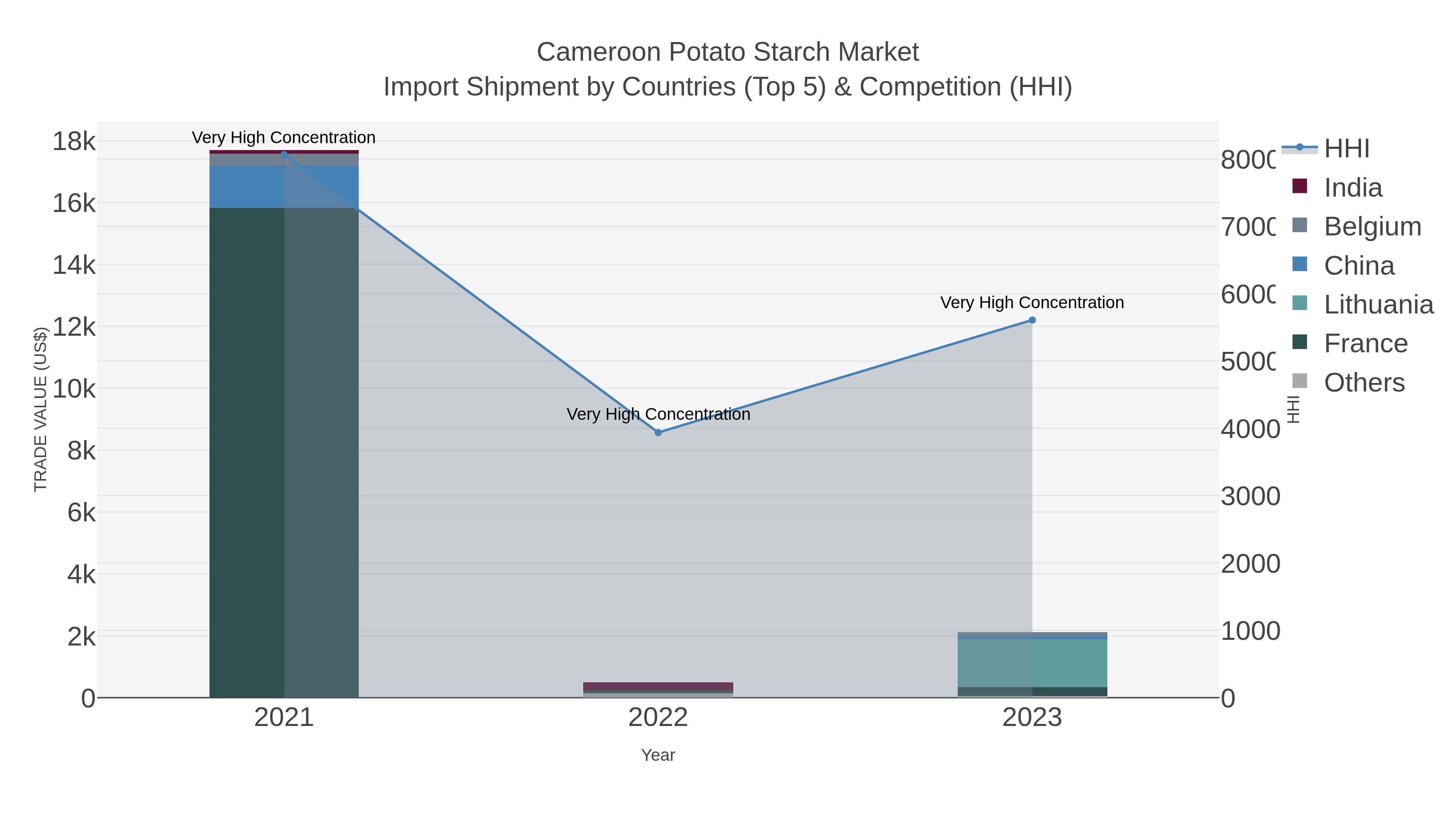
In 2023, Cameroon import shipments of potato starch continued to be dominated by Lithuania, France, Belgium, China, and Italy. Despite the high Herfindahl-Hirschman Index (HHI) indicating market concentration, the industry experienced a significant decline with a CAGR of -65.4%. However, there was an exceptional growth rate of 322.67%, reflecting potential opportunities for both exporters and importers in the market. The presence of key players and rapid growth signals a dynamic and competitive landscape in the Cameroon potato starch import market.
Potato Starch Market: Cameroon vs Top 5 Major Economies in 2027 (Africa)
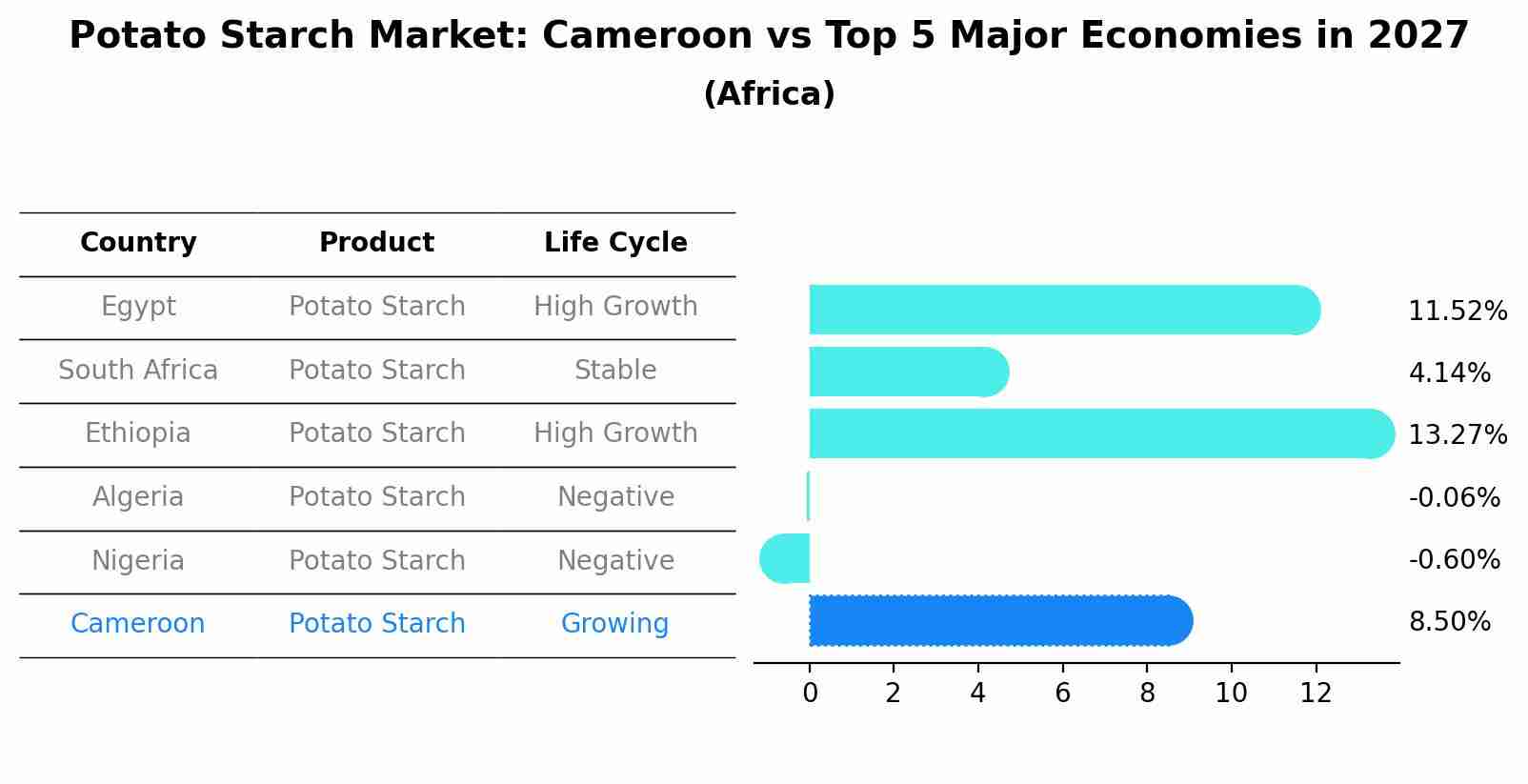
In the Africa region, the Potato Starch market in Cameroon is projected to expand at a growing growth rate of 8.50% by 2027. The largest economy is Egypt, followed by South Africa, Ethiopia, Algeria and Nigeria.
Cameroon Potato Starch Market Overview
The Potato Starch market in Cameroon is expanding as potato starch is used in various applications, including food processing, textiles, and pharmaceuticals. Potato starch provides benefits such as thickening and binding properties. The market growth is driven by the increasing demand for starch-based products and advancements in starch production technologies.
Drivers of the market
The potato starch market in Cameroon is driven by the demand for this starch in food processing, textiles, and industrial applications. Potato starch is valued for its thickening and binding properties. The growth of the food processing and textile industries, coupled with increasing demand for high-quality and versatile starches, supports market expansion. Additionally, advancements in starch production technologies and the focus on developing new applications contribute to market growth.
Challenges of the market
The Potato Starch Market in Cameroon faces challenges such as high production costs and limited local processing capabilities. The market relies heavily on imported raw materials and technology, impacting pricing and availability. There is a lack of awareness among industries about the benefits of potato starch for applications in food and industrial processes. Technical issues related to starch quality and processing standards further constrain market growth. Additionally, regulatory uncertainties and the absence of supportive policies for food and industrial processing create significant barriers.
Government Policy of the market
Cameroons policy on the potato starch market emphasizes supporting local production and application of potato starch. The government offers incentives for manufacturers and ensures that potato starch meets regulatory standards for quality and safety. Efforts are directed towards promoting innovation in starch processing technologies and improving efficiency. The government also works to expand market access and support the growth of the potato starch industry in various applications, including food and industrial uses.
Key Highlights of the Report:
- Cameroon Potato Starch Market Outlook
- Market Size of Cameroon Potato Starch Market, 2024
- Forecast of Cameroon Potato Starch Market, 2031
- Historical Data and Forecast of Cameroon Potato Starch Revenues & Volume for the Period 2021-2031
- Cameroon Potato Starch Market Trend Evolution
- Cameroon Potato Starch Market Drivers and Challenges
- Cameroon Potato Starch Price Trends
- Cameroon Potato Starch Porter`s Five Forces
- Cameroon Potato Starch Industry Life Cycle
- Historical Data and Forecast of Cameroon Potato Starch Market Revenues & Volume By Nature for the Period 2021-2031
- Historical Data and Forecast of Cameroon Potato Starch Market Revenues & Volume By Organic for the Period 2021-2031
- Historical Data and Forecast of Cameroon Potato Starch Market Revenues & Volume By Conventional for the Period 2021-2031
- Historical Data and Forecast of Cameroon Potato Starch Market Revenues & Volume By End-users for the Period 2021-2031
- Historical Data and Forecast of Cameroon Potato Starch Market Revenues & Volume By Textile & Paper for the Period 2021-2031
- Historical Data and Forecast of Cameroon Potato Starch Market Revenues & Volume By Food & Beverages for the Period 2021-2031
- Historical Data and Forecast of Cameroon Potato Starch Market Revenues & Volume By Pharmaceuticals for the Period 2021-2031
- Cameroon Potato Starch Import Export Trade Statistics
- Market Opportunity Assessment By Nature
- Market Opportunity Assessment By End-users
- Cameroon Potato Starch Top Companies Market Share
- Cameroon Potato Starch Competitive Benchmarking By Technical and Operational Parameters
- Cameroon Potato Starch Company Profiles
- Cameroon Potato Starch Key Strategic Recommendations






































