Canada Cement Market Growth Rate
According to 6Wresearch internal database and industry insights, the Canada Cement Market is growing at a compound annual growth rate (CAGR) of 4.85% during the forecast period (2026-2032).
Canada Cement Market Year-wise Growth Rate and Key Drivers (2022-2032)
This graph illustrates the annual growth rates of the Canada Cement Market from 2022 to 2032, highlighting stable industrial expansion, infrastructure-driven demand, and increasing adoption of precision finishing solutions.
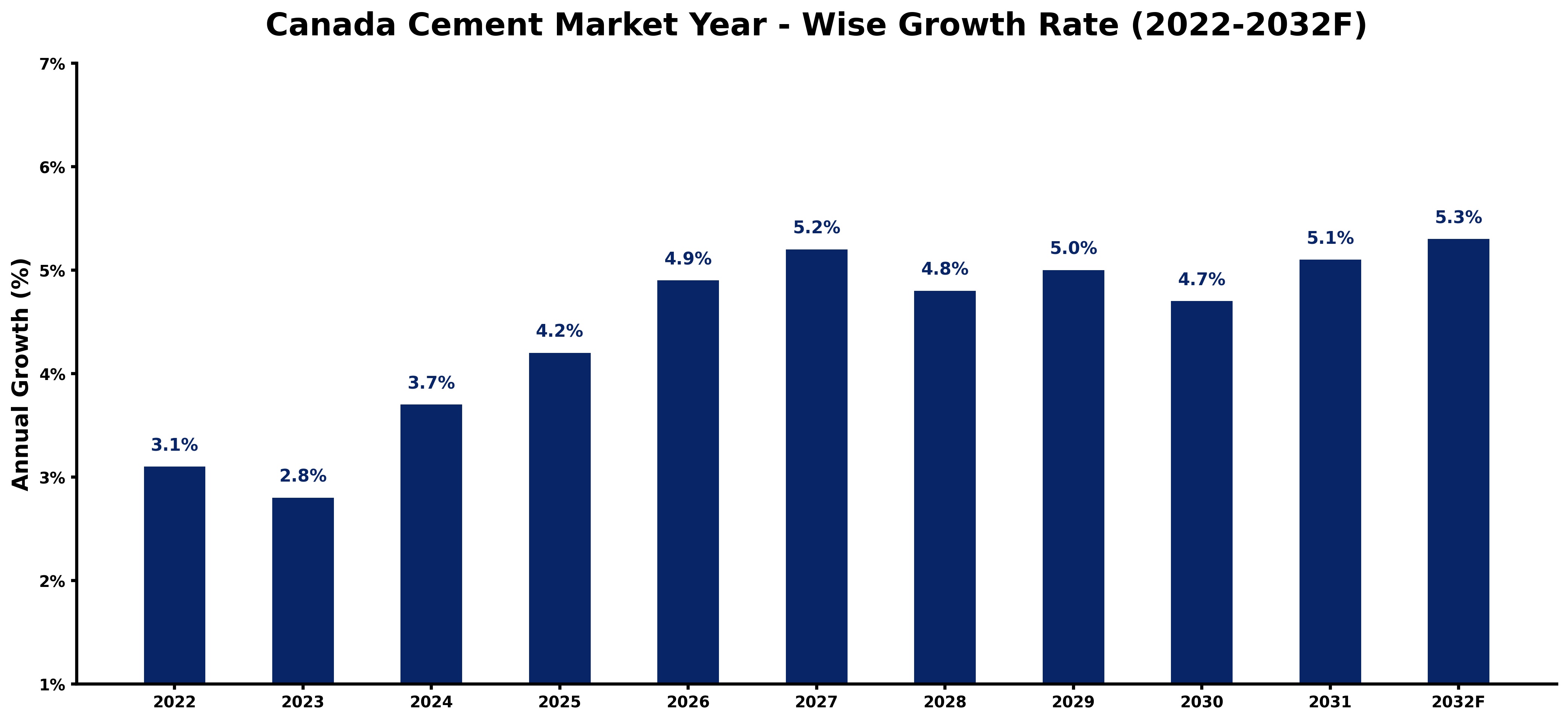
The following table summarizes the historical and forecasted growth rates of the Canada Cement Market, along with the rationale behind each year’s performance.
| Year | Estimated Growth (%) | Market Rationale |
| 2022 | 3.1% | Recovery in residential and commercial construction supported cement demand despite inflationary pressures. |
| 2023 | 2.8% | Higher interest rates and slower housing starts moderated market expansion. |
| 2024 | 3.7% | Public infrastructure investments and industrial projects improved cement consumption. |
| 2025 | 4.2% | Stabilizing construction activity and increased non-residential development supported market growth. |
| 2026 | 4.9% | Major infrastructure modernization and transportation projects accelerated demand. |
| 2027 | 5.2% | Growth benefited from commercial construction and provincial infrastructure investments. |
| 2028 | 4.8% | Higher production costs and moderate housing activity slightly softened market expansion. |
| 2029 | 5% | Continued investments in roads, bridges, and energy infrastructure sustained demand. |
| 2030 | 4.7% | Market growth remained healthy despite economic moderation and cost pressures. |
| 2031 | 5.1% | Increased industrial construction and low-carbon cement adoption supported market expansion. |
| 2032 | 5.3% | Long-term infrastructure programs and sustainable construction initiatives drove steady demand. |
Topics Covered in the Canada Cement Market Report
The Canada Cement Market report thoroughly covers the market by product types and application. The report provides an unbiased and detailed analysis of ongoing market trends, growth opportunities, and market drivers, which would help stakeholders devise and align their market strategies according to the current and future market dynamics.
Canada Cement Market Highlights
| Report Name | Canada Cement Market |
| Forecast period | 2026-2032 |
| CAGR | 4.85% |
| Growing Sector | Non-residential/Infrastructure |
Canada Cement Market Synopsis
The Canada cement market is growing robustly. This boost is given by increased infrastructural development in Canada by both residential and non-residential sectors. Mainly, the non-residential sector is gaining more benefit from this large-scale infrastructural development growth due to increased population and rising tourism in Canada. Moreover, government initiatives are propelling this industry expansion by supporting the country's infrastructure development projects and urbanizing the rural areas. There is a burgeoning demand for eco-friendly construction materials in Canada due to increased consumer awareness about environmental concerns.
Key Drivers of the Canada Cement Market
Below are the primary drivers and their impact on market dynamics:
| Drivers | Primary Segments Affected | Why It Matters |
| Government Support & Infrastructure Growth | Non-residential/Infrastructure, Residential | Makes the demand higher and sales gets increased. |
| Increasing Demand for Sustainable Materials | Portland Cement, Other Cement Types | This helps to deal with environmental concerns. |
| Technological Advancements in Cement Production | All Segments | The production efficiency gets higher with trust. |
| Rising Demand from Construction Projects | Residential, Non-residential | The demand for cement gets higher for construction purpose. |
| Export Growth | Portland Cement | Expands market reach and competitiveness globally. |
The Canada Cement market is expected to grow robustly at a CAGR of 4.85% during the forecast period of 2026-2032. Government support for infrastructure projects propels the Canada Cement Market demand in both residential and non-residential sectors. One factor behind the growth of the market is the demand for both housing and big infrastructure projects. Consequently, increased exports, mostly to neighbouring markets, not only strengthen Canada's position in the worldwide market but also assure that the growth will continue. Additionally, the higher use of sustainable materials in construction, such as different eco-friendly cements, is largely responsible for the changing trends in construction. Besides that, innovations in cement manufacturing facilitate the company to become more efficient and still eco-friendly.
Key Restraints of the Canada Cement Market
Below are the primary restraints and their impact on market dynamics:
| Restraints | Primary Segments Affected | Why It Matters |
| High Production Costs | Portland Cement, Other Cement Types | Impacts the pricing of cement and limits profit margins. |
| Environmental Regulations | Portland Cement, Other Cement Types | May cause difficulty in production ad innovation of the product. |
| Supply Chain Disruptions | All Segments | This limits availability and the infrastructural projects get delayed. |
| Competition from Alternative Materials | Portland Cement, Other Cement Types | Hampers the usage and impacts the market growth. |
| Fluctuating Raw Material Prices | All Segments | Creates instability in cement pricing and affects profitability. |
Canada Cement Market Challenges
The Canada Cement Market encounters difficulties, including high production costs, raw material scarcity, and strict environmental regulations. Additionally, competing materials like steel and wood, along with economic cycles that cause demand shifts, contribute to market volatility. Sustainability concerns and maintaining consistent quality are further challenges the industry needs to address for long-term growth.
Canada Cement Market Trends
Key trends that are contributing towards Canada Cement Market Growth are:
- Sustainability in Cement Production: increasing focus on eco-friendly production, reducing emissions, and using recycled materials.
- Government Infrastructure Projects: increases the cement demand for construction activities within both urban and rural areas.
- Technological Advancements: better cement production technologies enhance efficiency, sustainability, and product quality.
- Rise in Green Building Practices: of sustainable, low-carbon cement in energy-efficient building projects.
Canada Cement Market Investment Opportunities
Here are the key investment opportunities present in the Canada Cement industry:
- Expanding Cement Production Capacity: putting money into new plants or expanding existing ones to meet demand.
- Green Cement Initiatives: Focus on developing and producing eco-friendly, low-carbon cement for sustainability.
- Digitalization in Cement Manufacturing: Automating production and using digital tools to improve operational efficiency.
- E-commerce and Direct-to-Consumer Sales: Utilize online platforms to sell cement directly, targeting urban and DIY markets.
Leading Players in the Canada Cement Market
Top leading players contributing to Canada Cement Market share:
1. Lafarge Canada Inc.
| Company Name | Lafarge Canada Inc. |
|---|---|
| Established Year | 1907 |
| Headquarters | Calgary, Canada |
| Official Website | Click Here |
Lafarge Canada is a key player in the Canadian cement market, providing a range of products including Portland and blended cement. They focus on sustainability and innovation in cement production, including environmentally friendly alternatives and green building certifications. Lafarge has a strong presence in both the residential and infrastructure sectors, benefiting from its extensive distribution network.
2. Holcim (Canada) Inc.
| Company Name | Holcim (Canada) Inc. |
|---|---|
| Established Year | 1912 |
| Headquarters | Montreal, Canada |
| Official Website | Click Here |
Holcim is one of the largest cement manufacturers in Canada, offering a broad range of cement products. Their emphasis on sustainability and technological advancements in cement production allows them to maintain a competitive edge in both the residential and commercial markets. Holcim's commitment to reducing environmental impact positions them as a leader in the market.
3. Cement Canada Inc.
| Company Name | Cement Canada Inc. |
|---|---|
| Established Year | 1975 |
| Headquarters | Ottawa, Canada |
| Official Website | Click Here |
Cement Canada is a prominent producer of high-quality Portland cement and other specialized products for construction projects. Their focus on technological innovation and reducing environmental impact aligns with current market trends, allowing them to expand in both domestic and international markets.
4. St. Lawrence Cement
| Company Name | St. Lawrence Cement |
|---|---|
| Established Year | 1964 |
| Headquarters | Quebec City, Canada |
| Official Website | Click Here |
St. Lawrence Cement has a significant presence in the Canadian market, specializing in high-quality cement products for residential and non-residential construction projects. The company has invested in sustainable production methods, focusing on reducing carbon emissions and increasing production efficiency.
5. Lehigh Hanson Canada
| Company Name | Lehigh Hanson Canada |
|---|---|
| Established Year | 1977 |
| Headquarters | Mississauga, Canada |
| Official Website | Click Here |
Lehigh Hanson Canada is a major producer of ement and ready-mix concrete in the country. With a strong emphasis on sustainability and eco-friendly products, they provide a range of cement products used in residential, commercial, and infrastructure projects.
Government Regulations in the Canada Cement Market
According to Canadian government data, the cement industry in Canada is strongly shaped by regulatory frameworks focused on environmental sustainability and emissions control. The Canadian Environmental Assessment Act (CEAA) and the Canadian Environmental Protection Act (CEPA) regulate cement manufacturing operations, ensuring compliance with strict environmental and air-quality standards. In addition, initiatives supported by the Canada Green Building Council promote sustainable construction practices, encouraging the adoption of low-carbon and eco-friendly cement products. These regulations are driving innovation in cleaner production technologies, lowering carbon emissions, and increasing the use of alternative fuels and sustainable raw materials in cement manufacturing.
Future Outlook of the Canada Cement Market
The future outlook for the Canada Cement Market remains positive, with steady growth expected over the forecast period. Government-backed infrastructure development programs and a strong focus on sustainable construction will continue to support market expansion. Rising adoption of green cement products, advancements in manufacturing technologies, and efficiency improvements will further strengthen market growth. Moreover, increasing demand from both residential and non-residential construction, along with expanding export opportunities, positions Canada as a competitive player in the global cement industry.
Market Segmentation Analysis
The report offers a comprehensive study of the following market segments and their leading categories.
Portland Cement to Dominate the Market – By Product
According to Guneet Kaur, Senior Research Analyst, 6Wresearch, Portland cement dominates the Canada Cement Market due to its extensive use across residential, commercial, and infrastructure projects. Its durability, versatility, and ability to perform under diverse climatic conditions make it the preferred choice for a wide range of construction applications.
Non-residential/Infrastructure to Dominate the Market – By Application
The non-residential and infrastructure segment leads the market, supported by significant government investments in public infrastructure projects. Growing demand for cement in large-scale commercial buildings, transportation networks, and public facilities is driving this segment’s dominance. Continued urbanization and expansion of public works are expected to further increase cement consumption in this category.
Key Attractiveness of the Report
- 10 Years of Market Numbers.
- Historical Data Starting from 2022 to 2025.
- Base Year: 2025.
- Forecast Data until 2032.
- Key Performance Indicators Impacting the Market.
- Major Upcoming Developments and Projects.
Key Highlights of the Report:
- Canada Cement Market Outlook
- Market Size of Canada Cement Market, 2025
- Forecast of Canada Cement Market, 2032
- Historical Data and Forecast of Canada Cement Revenues & Volume for the Period 2022-2032
- Canada Cement Market Trend Evolution
- Canada Cement Market Drivers and Challenges
- Canada Cement Price Trends
- Canada Cement Porter`s Five Forces
- Canada Cement Industry Life Cycle
- Historical Data and Forecast of Canada Cement Market Revenues & Volume By Product for the Period 2022-2032
- Historical Data and Forecast of Canada Cement Market Revenues & Volume By Portland for the Period 2022-2032
- Historical Data and Forecast of Canada Cement Market Revenues & Volume By Others for the Period 2022-2032
- Historical Data and Forecast of Canada Cement Market Revenues & Volume By Application for the Period 2022-2032
- Historical Data and Forecast of Canada Cement Market Revenues & Volume By Residential for the Period 2022-2032
- Historical Data and Forecast of Canada Cement Market Revenues & Volume By Non-residential/Infrastructure for the Period 2022-2032
- Canada Cement Import Export Trade Statistics
- Market Opportunity Assessment By Product
- Market Opportunity Assessment By Application
- Canada Cement Top Companies Market Share
- Canada Cement Competitive Benchmarking By Technical and Operational Parameters
- Canada Cement Company Profiles
- Canada Cement Key Strategic Recommendations
Market Covered
The report subsequently covers the market by following segments and subsegments:
By Product
- Portland
- Others
By Application
- Residential
- Non-residential/Infrastructure






































