Canada Data Center Market Growth Rate
According to 6Wresearch internal databases and industry insights, the Canada Data Center Market is projected to grow at a strong compound annual growth rate (CAGR) of 8.72% during the forecast period 2026–2032.
Canada Data Center Market Year-wise Growth Rate and Key Drivers (2022–2032)
This graph illustrates the annual growth rates of the Canada Data Center Market from 2022 to 2032, highlighting a steady upward trajectory and projected market expansion over the forecast period.
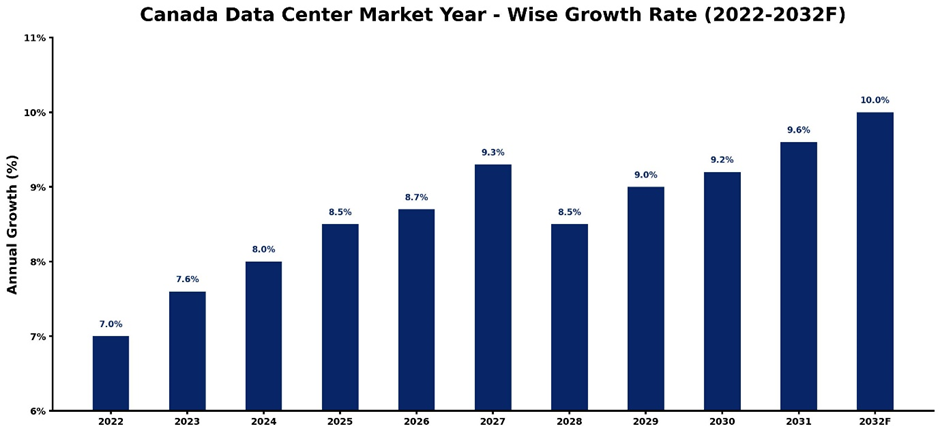
The following table summarizes the historical and forecasted growth rates of the Canada Data Center Market, along with the rationale behind each year’s performance.
| Year | Estimated Growth (%) | Market Rationale |
| 2022 | 7% | Growth supported by increased cloud adoption among enterprises, along with demand for secure hosting environments. |
| 2023 | 7.6% | Expansion driven by higher demand for colocation services, enterprise hybrid cloud adoption, and investments by telecom operators. |
| 2024 | 8% | Market growth strengthened due to increasing AI-related computing requirements, data sovereignty concerns, and innovation of IT infrastructure. |
| 2025 | 8.5% | Growth supported by new hyperscale projects, rising demand from BFSI and government sectors, and rising adoption of high-density computing setting. |
| 2026 | 8.7% | Expansion driven by AI data centres, advanced cooling technologies, and increasing deployment of cloud platforms across enterprises. |
| 2027 | 9.3% | Growth supported by increasing edge data center deployments and rising requirements for low-latency processing in manufacturing industries. |
| 2028 | 8.5% | Market acceleration due to expansion of hyperscale facilities, renewable energy integration, and demand for sustainable data center operations. |
| 2029 | 9% | Growth continues through increased enterprise outsourcing of IT infrastructure and adoption of managed data center services. |
| 2030 | 9.2% | Expansion supported by AI workloads, cybersecurity requirements, and increasing adoption of advanced networking solutions. |
| 2031 | 9.6% | Growth maintained through continuous cloud migration and modernization of digital infrastructure across industries. |
| 2032 | 10% | Market growth sustained by long-term demand for scalable computing infrastructure, and next-generation data processing. |
Topics Covered in the Canada Data Center Market Report
The Canada Data Center industry report covers the market by component and by vertical. The report provides a detailed analysis of ongoing market trends, opportunities/high-growth areas, and market drivers that will help stakeholders align strategies based on current and future market dynamics.
Canada Data Center Market Highlights
| Report Name | Canada Data Center Market |
| Forecast period | 2026-2032 |
| CAGR | 8.72% |
| Growing Sector | AI-Driven Data Center Infrastructure & Hyperscale Facilities |
Canada Data Center Market Synopsis
The Canada Data Center Market represents the growing ecosystem of physical infrastructure facilities that includes servers, storage systems, networking equipment and essential IT operations for enterprises, cloud providers, government organizations and digital service companies. Data centres in Canada are essential for delivering essential services, such as cloud computing, Artificial Intelligence processing, cybersecurity operations, enterprise applications, and large-scale data management.
The market is undergoing a significant transformation, owing to increasing demand for high-performance computing, surging demand for localized data storage, and growing data generation from connected devices. In addition, growing adoption of AI applications and machine learning workloads is generating high demand for advanced electrical, liquid cooling, high-density racks and upgraded networking infrastructure.
Evaluation of Growth Drivers in Canada Data Center Market (2026–2032)
Below are some major drivers and their influence on market dynamics:
| Drivers | Primary Segment Affected | Why It Matters (Evidence) |
| Rising AI and High-Performance Computing Adoption | Data Center Infrastructure Providers | AI models need high-density computing environments, which creates demand for advanced servers and GPUs. |
| Expansion of Cloud Computing Services | Colocation Providers & Enterprise Data Centres | Demand for scalable and reliable data center capacity is increasing, as businesses move their workloads to cloud platforms. |
| Data Sovereignty and Regulatory Requirements | Government & BFSI Sector | Local companies demand secure domestic infrastructure to process sensitive financial and public sector data. |
| Rise of Online Platforms and Digital Services | IT & Telecom Sector | Increase in internet traffic, streaming services and online applications is generating the demand for computing power. |
| Sustainability and Renewable Energy Integration | Hyperscale Data Centres | Firms are investing in energy effective designs and renewable power sources to decrease carbon emissions and operational costs. |
The Canada Data Center Market is projected to grow at a CAGR of 8.72% during the forecast period (2026–2032), driven by large investments in hyperscale infrastructure, rising cloud adoption, and rapid deployment of AI-based computing systems. Canada has become a preferred destination for data center operators, owing to its reliable power infrastructure, availability of renewable energy, and comparatively favourable operating conditions.
Evaluation of Restraints in Canada Data Center Market
Below are some major restraints and their influence on market dynamics:
| Restraints | Primary Segment Affected | What This Means (Evidence) |
| High Initial Capital Investment | Data Center Developers | Sophisticated facilities require large capital investments in land, power systems, and security solutions. |
| Increasing Energy Consumption Concerns | Hyperscale Operators | Major facilities require huge amount of electricity, which makes them more efficient to adopt renewable energy solutions. |
| Limited Availability of Skilled Workforce | Data Center Operations | Lack of specialists in infrastructure management and data center engineering influences further expansion of operations. |
| Complex Regulatory Approvals | New Data Center Projects | Zoning requirements, energy regulations and environmental assessments can delay project development. |
| Rising Operational Costs | Colocation Providers | Electricity prices, maintenance and technology upgrades can impact profitability. |
Canada Data Center Market Challenges
The Canada data center market growth is experiencing numerous challenges. For instance, the high-power demand, complex cooling requirements, and complicated infrastructure, are the major concern factors that increases the cost of building large scale facilities. Meanwhile, data center operators are increasing their capital expenditures, for continuously refreshing systems, to handle AI workloads and high-performance computing.
Canada Data Center Market Trends
Vital trends shaping the Canada Data Center Market are detailed below:
- Rapid Expansion of AI-Advanced Data Centres: Rising adoption of generative AI and machine learning applications is encouraging operators to develop facilities capable of supporting high-density GPU-based computing environments.
- Growing Inclusion of Liquid Cooling Technologies: Conventional air-cooling methods are less effective for high-performance workloads, which leads to increased deployment of liquid cooling solutions for improved energy efficiency.
- Establishment of Edge Data Centres: Organizations are including smaller distributed facilities, closer to end users to reduce latency and improve present processing capabilities.
- Main Focus on Sustainable Data Centres: Operators are integrating renewable energy, effective power management systems, and environment friendly cooling solutions to achieve sustainability goals.
- Increased Hyperscale Infrastructure: Large tech companies are expanding their data center capacity, to support cloud services, digital platforms, and enterprise workloads.
Investment Opportunities in the Canada Data Center Industry
Potential investment avenues present in the Canada Data Center Industry are mentioned below:
- AI Infrastructure Development: Investors have started investing in AI-oriented data centres, equipped with state-of-the-art processors and high-density racks, along with cooling systems.
- Renewable Energy Data Centres:Canada's ample supply of renewable energy offers scope to build sustainable data centres at a low cost.
- Colocation Services Development: Demand from enterprises for scalable infrastructure services presents new investment opportunities for colocation companies.
- Edge Computing Infrastructure: The prospects of investing in regional edge centres, that support manufacturing, telecommunication, autonomous and other low latency applications.
- Data Center Upgrades: Companies are enhancing their data center infrastructure with advanced networking, security and energy saving technologies.
Top 5 Leading Players in Canada Data Center Market
A detailed compilation of major companies active in the Canada Data Center Market is presented below:
1. Equinix
| Company Name | Equinix |
|---|---|
| Established Year | 1998 |
| Headquarters | Redwood City, California, United States |
| Official Website | Click Here |
Equinix is one of the world’s largest digital infrastructure providers, operating interconnected data centres across multiple Canadian markets.
2. Digital Realty
| Company Name | Digital Realty |
|---|---|
| Established Year | 2001 |
| Headquarters | Austin, Texas, United States |
| Official Website | Click Here |
Digital Realty operates a global data center platform providing colocation, connectivity, and hyperscale infrastructure solutions.
3. CyrusOne
| Company Name | CyrusOne |
|---|---|
| Established Year | 2001 |
| Headquarters | Dallas, Texas, United States |
| Official Website | Click Here |
CyrusOne provides enterprise-scale data center solutions focused on hyperscale deployments, build-to-suit facilities, and high-performance computing environments.
4. Vantage Data Centres
| Company Name | Vantage Data Centres |
|---|---|
| Established Year | 2010 |
| Headquarters | Denver, Colorado, United States |
| Official Website | Click Here |
Vantage Data Centres specializes in developing and operating hyperscale data center campuses and provides customized infrastructure solutions.
5. Bell Canada
| Company Name | Bell Canada |
|---|---|
| Established Year | 1880 |
| Headquarters | Montreal, Quebec, Canada |
| Official Website | Click Here |
Bell Canada operates telecommunications and digital infrastructure services across Canada, including managed hosting, cloud connectivity, and enterprise data solutions.
Government Initiatives Being Implemented in the Canada Data Center Market
The Canadian government is investing abundantly in the development of digital infrastructure through programs that have emphasized cybersecurity, cloud computing, artificial intelligence, and sustainable development of technology. Additionally, federal and provincial programs have been working towards investing in computing infrastructure, and enhancing digital resiliency among industries. Programs like the Canadian Digital Adoption Program (CDAP) can be an example of how the Canadian government can assist businesses in using digital technologies and enhancing their technological expertise.
Future Insights of the Canada Data Center Market
The Canada Data Center Market is transitioning from traditional infrastructure models to highly automated, energy-efficient and AI-optimized facilities. Renewable energy sourcing, advanced cooling systems and improved power efficiency will be invested in by operators, as sustainable data center development will become a high priority. The increasing adoption of generative AI is expected to drive strong demand for high-density computing environments, dedicated networking infrastructure, and upgrades to electrical systems.
Market Segmentation Analysis
This report presents a detailed analysis of the market segments along with their leading categories:
By Component – Electrical Infrastructure Dominates Market
According to Ravi Bhandari, Research Head, 6Wresearch, Electrical Systems accounts for the largest market share of the Canada Data Center Market in 2025, having approximately 32.5% of total value. The dominance of electrical infrastructure is attributed to the pivotal role of power distribution systems, uninterruptible power supply (UPS), generators, and energy management solutions in maintaining continuous data center operations. During the forecast period of 2026–2032, the electrical segment is projected to expand at a CAGR of 8.45%, supported by new hyperscale facilities and modernization of existing infrastructure.
By Vertical – IT & Telecom Leads Market Growth
The IT & Telecom sector holds a commanding position in the Canada Data Center Market, accounting for 34.8% of the total market revenue. The segment’s dominance is supported by extensive cloud service adoption, increasing internet traffic, expansion of telecommunications network and rising demand for digital infrastructure from technology companies. Telecom operators and IT companies are constantly increasing the capacity of data centres to support 5G networks, cloud platforms, artificial intelligence applications and Enterprise connectivity solutions. The IT & Telecom sector is expected to grow at a CAGR of 9.15% during the forecast period of 2026-2032.
Note: Market size estimations and growth projections presented in this report are based on 6Wresearch's proprietary forecasting methodology, utilizing the latest available industry data, government publications, and primary research inputs.
Key Attractiveness of the Report
- 10 Years of Market Numbers
- Historical Data Starting from 2022 to 2025
- Base Year: 2025
- Forecast Data until 2032
- Key Performance Indicators Impacting the Market
- Major Upcoming Developments and Projects
Key Highlights of the Report:
- Canada Data Center Market Outlook
- Market Size of Canada Data Center Market, 2025
- Forecast of Canada Data Center Market, 2032
- Historical Data and Forecast of Canada Data Center Revenues & Volume for the Period 2022-2032
- Canada Data Center Market Trend Evolution
- Canada Data Center Market Drivers and Challenges
- Canada Data Center Price Trends
- Canada Data Center Porter`s Five Forces
- Canada Data Center Industry Life Cycle
- Historical Data and Forecast of Canada Data Center Market Revenues & Volume By Component for the Period 2022-2032
- Historical Data and Forecast of Canada Data Center Market Revenues & Volume By Electrical for the Period 2022-2032
- Historical Data and Forecast of Canada Data Center Market Revenues & Volume By Mechanical for the Period 2022-2032
- Historical Data and Forecast of Canada Data Center Market Revenues & Volume By Networking for the Period 2022-2032
- Historical Data and Forecast of Canada Data Center Market Revenues & Volume By Racks for the Period 2022-2032
- Historical Data and Forecast of Canada Data Center Market Revenues & Volume By Security Systems for the Period 2022-2032
- Historical Data and Forecast of Canada Data Center Market Revenues & Volume By Fire Systems for the Period 2022-2032
- Historical Data and Forecast of Canada Data Center Market Revenues & Volume By Vertical for the Period 2022-2032
- Historical Data and Forecast of Canada Data Center Market Revenues & Volume By Banking Financial Services & Insurance (BFSI) for the Period 2022-2032
- Historical Data and Forecast of Canada Data Center Market Revenues & Volume By Government for the Period 2022-2032
- Historical Data and Forecast of Canada Data Center Market Revenues & Volume By IT & Telecom for the Period 2022-2032
- Historical Data and Forecast of Canada Data Center Market Revenues & Volume By Media for the Period 2022-2032
- Historical Data and Forecast of Canada Data Center Market Revenues & Volume By Retail for the Period 2022-2032
- Historical Data and Forecast of Canada Data Center Market Revenues & Volume By Manufacturing for the Period 2022-2032
- Historical Data and Forecast of Canada Data Center Market Revenues & Volume By Others for the Period 2022-2032
- Canada Data Center Import Export Trade Statistics
- Market Opportunity Assessment By Component
- Market Opportunity Assessment By Vertical
- Canada Data Center Top Companies Market Share
- Canada Data Center Competitive Benchmarking By Technical and Operational Parameters
- Canada Data Center Company Profiles
- Canada Data Center Key Strategic Recommendations
Market Covered
The report offers an extensive study of the following market segments:
By Component
- Electrical Systems
- Mechanical Systems
- Networking
- Racks
- Security Systems
- Fire Systems
By Vertical
- Banking Financial Services & Insurance (BFSI)
- Government
- IT & Telecom
- Media
- Retail
- Manufacturing
- Others






































