Canada Disinfectant Market: Import Trend Analysis
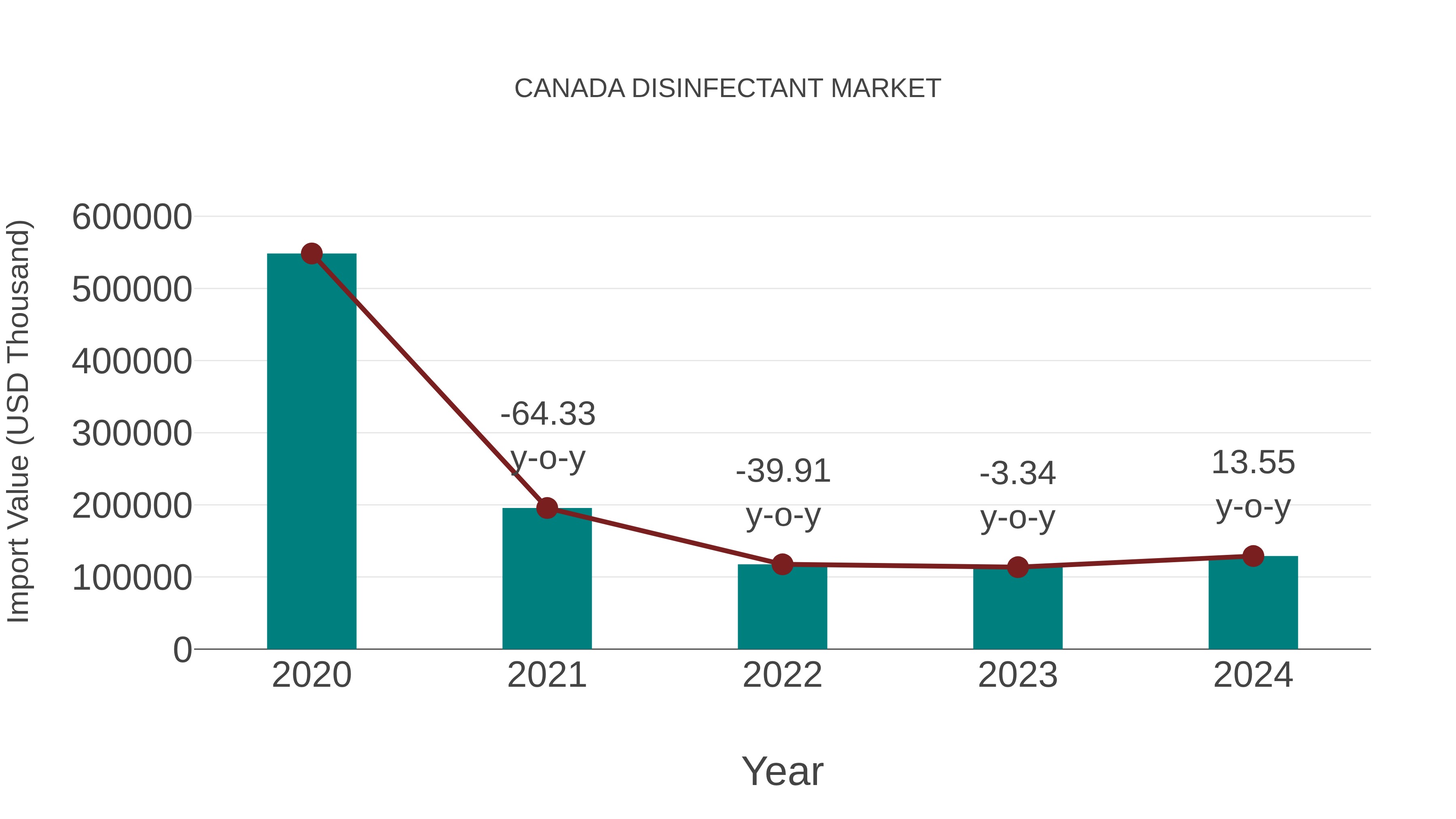
Canada`s import trend for the disinfectant market exhibited notable fluctuations. From 2023 to 2024, the growth rate surged by 13.55%, contrasting sharply with the compound annual growth rate (CAGR) of -30.36% for the period from 2020 to 2024. This drastic shift could be attributed to evolving consumer preferences post-pandemic, altering trade policies, or market stabilization efforts.
Canada Disinfectant Market Overview
The Canada disinfectant market is experiencing steady growth driven by increased awareness about hygiene and sanitation, especially in light of the COVID-19 pandemic. The market is primarily dominated by key players offering a wide range of disinfectant products such as sprays, wipes, and solutions targeting various surfaces and environments. With a growing emphasis on maintaining clean and germ-free surroundings in households, healthcare facilities, and public spaces, the demand for disinfectants in Canada is expected to continue rising. The market is also witnessing a shift towards eco-friendly and natural disinfectant products to cater to the increasing consumer preference for sustainable and non-toxic cleaning solutions. Overall, the Canada disinfectant market is poised for further expansion as consumers prioritize health and cleanliness in their daily lives.
Canada Disinfectant Market Trends
The Canadian disinfectant market is experiencing a surge in demand due to the ongoing COVID-19 pandemic, with consumers prioritizing cleanliness and hygiene. There is a growing preference for eco-friendly and natural disinfectant products that are effective against viruses and bacteria. Companies are also focusing on innovative packaging designs and convenient dispensing methods to cater to the changing consumer preferences. The market is witnessing an increase in the use of disinfectants in various sectors such as healthcare, hospitality, and residential spaces. With heightened awareness about the importance of disinfection in preventing the spread of diseases, the Canadian disinfectant market is expected to continue growing in the coming years.
Canada Disinfectant Market Challenges
In the Canadian disinfectant market, some challenges include regulatory compliance and product registration requirements, increasing competition leading to price pressures, consumer skepticism towards certain chemical ingredients, and the need for effective marketing strategies to stand out in a crowded market. Additionally, the ongoing COVID-19 pandemic has heightened the demand for disinfectant products, leading to supply chain disruptions and fluctuating raw material costs. Companies in the Canadian disinfectant market must navigate these challenges by ensuring regulatory compliance, investing in research and development for innovative products, and communicating transparently with consumers to build trust in their brand and products.
Canada Disinfectant Market Investment Opportunities
In the Canadian disinfectant market, there are several investment opportunities to consider. With the increasing focus on cleanliness and hygiene due to the ongoing COVID-19 pandemic, the demand for disinfectant products is expected to remain strong. Investors can look into companies that manufacture or distribute disinfectant products, as well as those involved in research and development of innovative disinfection technologies. Additionally, there is potential for growth in the eco-friendly and sustainable disinfectant segment, as consumers become more environmentally conscious. Investing in companies that prioritize sustainability and offer effective yet safe disinfectant solutions could prove to be a lucrative opportunity in the Canadian market. Overall, the disinfectant market in Canada presents a promising investment landscape for those looking to capitalize on the growing demand for hygiene products.
Canada Disinfectant Market Government Policy
Government policies in Canada related to the disinfectant market primarily focus on regulating product safety and efficacy to ensure protection of public health. Health Canada oversees the registration and approval of disinfectant products, setting standards for ingredients, labeling, and advertising to prevent misleading claims and ensure consumer safety. Additionally, the Pest Management Regulatory Agency (PMRA) regulates disinfectants used in non-household settings to ensure they meet health and environmental safety standards. The government also promotes the use of environmentally friendly and Health Canada-approved disinfectants through various incentive programs and guidelines. Overall, these policies aim to maintain a balance between effective disinfection, consumer safety, and environmental sustainability within the Canadian market.
Canada Disinfectant Market Future Outlook
The future outlook for the Canadian disinfectant market appears promising, driven by several key factors. Increasing awareness about the importance of cleanliness and hygiene due to the ongoing COVID-19 pandemic is expected to sustain demand for disinfectant products across various sectors such as healthcare, hospitality, and residential. Furthermore, the growing emphasis on infection prevention and control in public spaces, coupled with the rising prevalence of infectious diseases, is likely to fuel market growth. Technological advancements leading to the development of innovative and sustainable disinfectant solutions are also anticipated to drive market expansion. Overall, the Canadian disinfectant market is poised for steady growth in the coming years as consumers continue to prioritize health and sanitation in their daily routines.
Key Highlights of the Report:
- Canada Disinfectant Market Outlook
- Market Size of Canada Disinfectant Market,2025
- Forecast of Canada Disinfectant Market, 2032
- Historical Data and Forecast of Canada Disinfectant Revenues & Volume for the Period 2022-2032F
- Canada Disinfectant Market Trend Evolution
- Canada Disinfectant Market Drivers and Challenges
- Canada Disinfectant Price Trends
- Canada Disinfectant Porter's Five Forces
- Canada Disinfectant Industry Life Cycle
- Historical Data and Forecast of Canada Disinfectant Market Revenues & Volume By Product Type for the Period 2022-2032F
- Historical Data and Forecast of Canada Disinfectant Market Revenues & Volume By Alcoholbased for the Period 2022-2032F
- Historical Data and Forecast of Canada Disinfectant Market Revenues & Volume By Hydrogen Peroxide for the Period 2022-2032F
- Historical Data and Forecast of Canada Disinfectant Market Revenues & Volume By Quaternary Ammonium Compounds for the Period 2022-2032F
- Historical Data and Forecast of Canada Disinfectant Market Revenues & Volume By Application for the Period 2022-2032F
- Historical Data and Forecast of Canada Disinfectant Market Revenues & Volume By Surface Cleaning for the Period 2022-2032F
- Historical Data and Forecast of Canada Disinfectant Market Revenues & Volume By Wound Care for the Period 2022-2032F
- Historical Data and Forecast of Canada Disinfectant Market Revenues & Volume By Industrial Cleaning for the Period 2022-2032F
- Historical Data and Forecast of Canada Disinfectant Market Revenues & Volume By End Use for the Period 2022-2032F
- Historical Data and Forecast of Canada Disinfectant Market Revenues & Volume By Healthcare for the Period 2022-2032F
- Historical Data and Forecast of Canada Disinfectant Market Revenues & Volume By Pharmaceuticals for the Period 2022-2032F
- Historical Data and Forecast of Canada Disinfectant Market Revenues & Volume By Foodservice for the Period 2022-2032F
- Historical Data and Forecast of Canada Disinfectant Market Revenues & Volume By Form for the Period 2022-2032F
- Historical Data and Forecast of Canada Disinfectant Market Revenues & Volume By Liquid for the Period 2022-2032F
- Historical Data and Forecast of Canada Disinfectant Market Revenues & Volume By Gel for the Period 2022-2032F
- Historical Data and Forecast of Canada Disinfectant Market Revenues & Volume By Spray for the Period 2022-2032F
- Historical Data and Forecast of Canada Disinfectant Market Revenues & Volume By Distribution Channel for the Period 2022-2032F
- Historical Data and Forecast of Canada Disinfectant Market Revenues & Volume By Online Retail for the Period 2022-2032F
- Historical Data and Forecast of Canada Disinfectant Market Revenues & Volume By Offline Retail for the Period 2022-2032F
- Historical Data and Forecast of Canada Disinfectant Market Revenues & Volume By B2B Sales for the Period 2022-2032F
- Canada Disinfectant Import Export Trade Statistics
- Market Opportunity Assessment By Product Type
- Market Opportunity Assessment By Application
- Market Opportunity Assessment By End Use
- Market Opportunity Assessment By Form
- Market Opportunity Assessment By Distribution Channel
- Canada Disinfectant Top Companies Market Share
- Canada Disinfectant Competitive Benchmarking By Technical and Operational Parameters
- Canada Disinfectant Company Profiles
- Canada Disinfectant Key Strategic Recommendations






































