Canada Food Products Machinery Market Year-wise Growth Rate (2021-2031F)
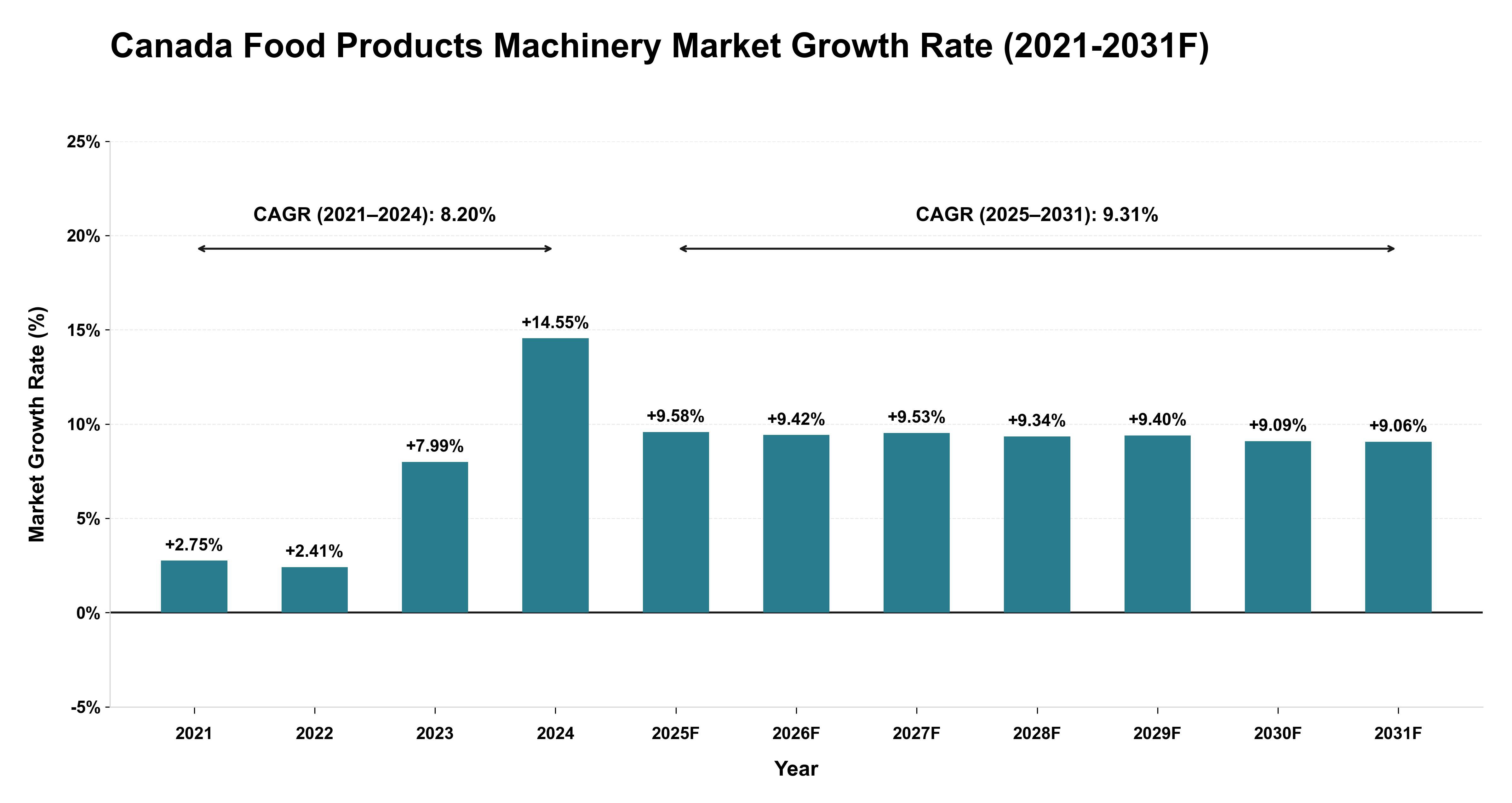
Over the period 2021-2024, the Canada Food Products Machinery Market demonstrated a steady growth trajectory with fluctuations. The market experienced modest growth in 2021 and 2022 at 2.75% and 2.41%, respectively, reflecting stable demand dynamics. However, in 2023, growth surged to 7.99% driven by technological advancements and efficiency improvements in the supply chain. The peak in 2024 at 14.55% was propelled by increased investments in food processing infrastructure. Looking ahead to 2025-2031, the market is poised to sustain this momentum with a forecasted CAGR of 9.31%. This expected growth signifies a continued emphasis on automation and innovation within the food processing industry, as manufacturers seek to enhance productivity and meet evolving consumer preferences for processed food products, ensuring a resilient and dynamic market landscape.
Key Highlights of the Report:
- Canada Food products machinery Market Outlook
- Market Size of Canada Food products machinery Market, 2024
- Forecast of Canada Food products machinery Market, 2031
- Historical Data and Forecast of Canada Food products machinery Revenues & Volume for the Period 2021-2031
- Canada Food products machinery Market Trend Evolution
- Canada Food products machinery Market Drivers and Challenges
- Canada Food products machinery Price Trends
- Canada Food products machinery Porter`s Five Forces
- Canada Food products machinery Industry Life Cycle
- Historical Data and Forecast of Canada Food products machinery Market Revenues & Volume By Type for the Period 2021-2031
- Historical Data and Forecast of Canada Food products machinery Market Revenues & Volume By Dairy Product Plant Machinery and Equipment for the Period 2021-2031
- Historical Data and Forecast of Canada Food products machinery Market Revenues & Volume By Bakery Machinery and Equipment for the Period 2021-2031
- Historical Data and Forecast of Canada Food products machinery Market Revenues & Volume By Meat and Poultry Processing And Preparation Machinery for the Period 2021-2031
- Historical Data and Forecast of Canada Food products machinery Market Revenues & Volume By Other Commercial Food Products Machinery for the Period 2021-2031
- Historical Data and Forecast of Canada Food products machinery Market Revenues & Volume By Applications for the Period 2021-2031
- Historical Data and Forecast of Canada Food products machinery Market Revenues & Volume By Bakery & Confectionery for the Period 2021-2031
- Historical Data and Forecast of Canada Food products machinery Market Revenues & Volume By Meat, Poultry, and Seafood for the Period 2021-2031
- Historical Data and Forecast of Canada Food products machinery Market Revenues & Volume By Dairy for the Period 2021-2031
- Historical Data and Forecast of Canada Food products machinery Market Revenues & Volume By Beverages for the Period 2021-2031
- Historical Data and Forecast of Canada Food products machinery Market Revenues & Volume By Others for the Period 2021-2031
- Canada Food products machinery Import Export Trade Statistics
- Market Opportunity Assessment By Type
- Market Opportunity Assessment By Applications
- Canada Food products machinery Top Companies Market Share
- Canada Food products machinery Competitive Benchmarking By Technical and Operational Parameters
- Canada Food products machinery Company Profiles
- Canada Food products machinery Key Strategic Recommendations






































