Canada Gasification Market: Import Trend Analysis
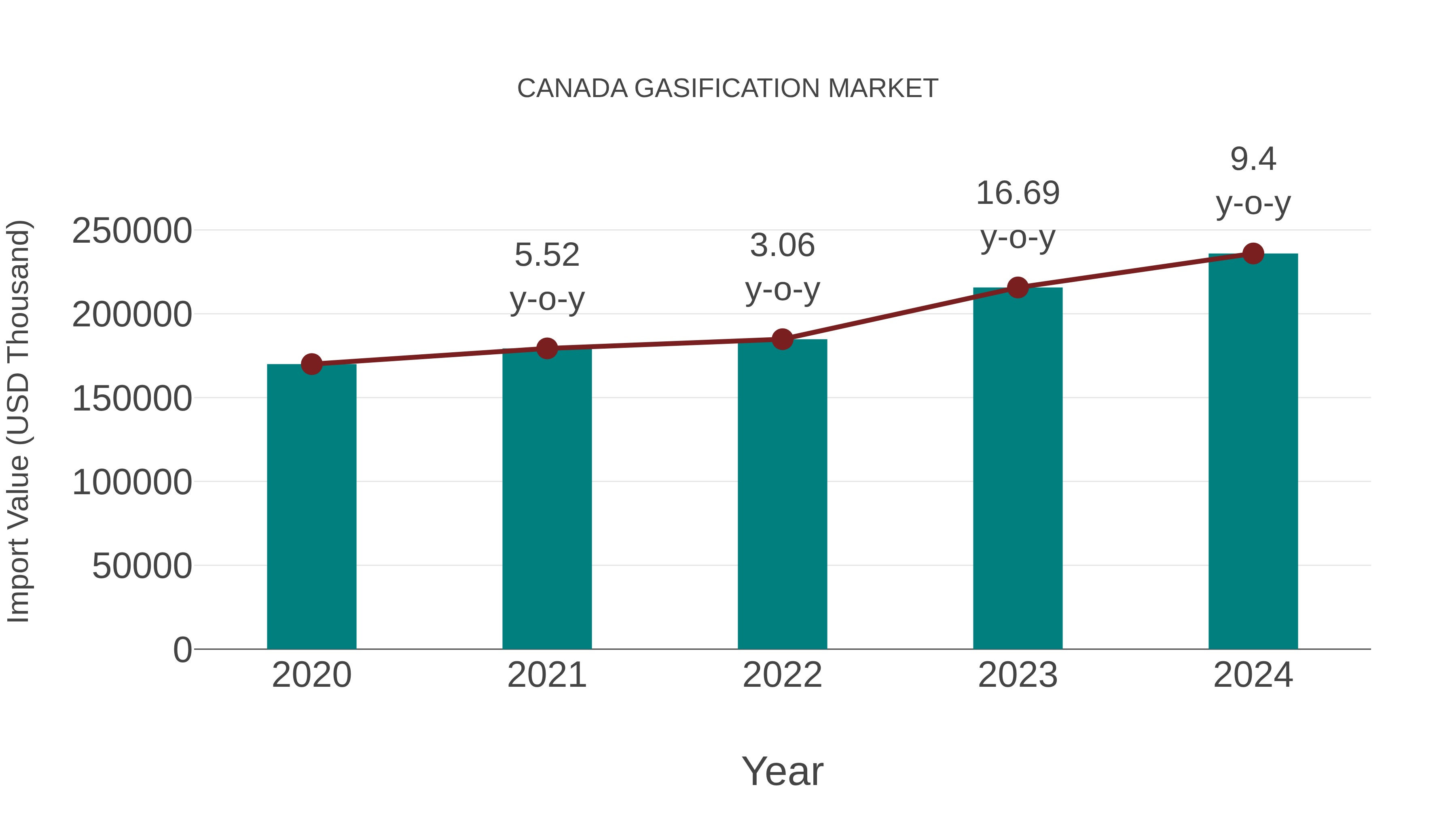
In the Canada gasification market, the import trend showed significant growth from 2023 to 2024, with a 9.4% increase. The compound annual growth rate (CAGR) for imports from 2020 to 2024 stood at 8.55%. This uptrend could be attributed to a shift in demand towards cleaner energy sources and stable market conditions during the period.
Canada Gasification Market Overview
The Canada gasification market is experiencing steady growth driven by increasing environmental concerns and a shift towards cleaner energy sources. Gasification technology is gaining traction in Canada due to its ability to convert various feedstocks, such as coal, biomass, and waste, into syngas for power generation, chemical production, and fuel synthesis. The Canadian government`s supportive policies and incentives for renewable energy projects further propel the market expansion. Key players in the Canada gasification market include General Electric, Air Liquide, and Shell, who are investing in research and development initiatives to enhance gasification technology efficiency and reduce carbon emissions. The market is poised for continued advancement as Canada aims to achieve its climate targets and transition towards a sustainable energy future.
Canada Gasification Market Trends
The gasification market in Canada is experiencing a growth trend driven by the increasing emphasis on clean energy solutions and the need to reduce carbon emissions. The shift towards more sustainable energy sources has led to a growing interest in gasification technology, which converts carbon-based materials into syngas for use in power generation and industrial applications. Government support and incentives for renewable energy projects have also contributed to the market expansion. Additionally, the desire to reduce reliance on traditional fossil fuels is driving investments in gasification projects across various sectors, including power generation, chemicals, and transportation. Overall, the Canada gasification market is expected to continue growing as the country aims to achieve its environmental goals and transition towards a more sustainable energy future.
Canada Gasification Market Challenges
In the Canada gasification market, some key challenges include high capital costs associated with setting up gasification plants, regulatory hurdles related to environmental permits and compliance, and the need for technology advancement to improve process efficiency and reduce emissions. Additionally, securing long-term feedstock supply agreements can be a challenge, as the availability and cost of biomass or waste materials fluctuate. Furthermore, public perception and acceptance of gasification as a sustainable and efficient waste management solution can also pose challenges, requiring education and outreach efforts. Overall, overcoming these obstacles will be crucial for the growth and development of the gasification market in Canada.
Canada Gasification Market Investment Opportunities
In the Canada gasification market, there are promising investment opportunities in the areas of renewable natural gas (RNG) production, hydrogen production, and carbon capture and utilization. RNG production from organic waste sources has gained traction as a sustainable alternative to traditional natural gas and offers significant growth potential. The increasing focus on decarbonization and transitioning to a low-carbon economy has also spurred interest in hydrogen production through gasification processes. Additionally, advancements in carbon capture and utilization technologies present opportunities for investors looking to support efforts to reduce greenhouse gas emissions. Overall, the Canada gasification market offers diverse and evolving investment avenues that align with the country`s goals of achieving a more sustainable energy future.
Canada Gasification Market Government Policy
In Canada, government policies related to the gasification market focus on promoting clean energy and reducing greenhouse gas emissions. The Canadian government has implemented various measures to support the development of gasification technologies, including providing funding and incentives for research and development projects. Additionally, there are regulations in place to ensure the safe and environmentally responsible operation of gasification facilities. The government has also set targets for increasing the use of renewable and low-carbon energy sources, which could further drive the adoption of gasification technology in the country. Overall, Canada`s policies aim to encourage innovation in the gasification sector while contributing to the country`s transition towards a more sustainable energy future.
Canada Gasification Market Future Outlook
The Canada gasification market is expected to witness steady growth in the coming years, driven by increasing focus on reducing carbon emissions and transitioning towards cleaner energy sources. The government`s initiatives to promote renewable energy and sustainable development will further boost the demand for gasification technologies. Key sectors such as power generation, chemicals, and refining are likely to adopt gasification processes to achieve efficiency and environmental sustainability goals. Additionally, the growing interest in producing hydrogen from natural gas through gasification is anticipated to create new opportunities in the market. Overall, the Canada gasification market is poised for expansion as industries seek innovative solutions to address environmental concerns and enhance energy security.
Key Highlights of the Report:
- Canada Gasification Market Outlook
- Market Size of Canada Gasification Market,2025
- Forecast of Canada Gasification Market, 2032
- Historical Data and Forecast of Canada Gasification Revenues & Volume for the Period 2022-2032F
- Canada Gasification Market Trend Evolution
- Canada Gasification Market Drivers and Challenges
- Canada Gasification Price Trends
- Canada Gasification Porter's Five Forces
- Canada Gasification Industry Life Cycle
- Historical Data and Forecast of Canada Gasification Market Revenues & Volume By Gasifier Medium for the Period 2022-2032F
- Historical Data and Forecast of Canada Gasification Market Revenues & Volume By Air for the Period 2022-2032F
- Historical Data and Forecast of Canada Gasification Market Revenues & Volume By Oxygen for the Period 2022-2032F
- Historical Data and Forecast of Canada Gasification Market Revenues & Volume By Vapor for the Period 2022-2032F
- Historical Data and Forecast of Canada Gasification Market Revenues & Volume By Application for the Period 2022-2032F
- Historical Data and Forecast of Canada Gasification Market Revenues & Volume By Electricity for the Period 2022-2032F
- Historical Data and Forecast of Canada Gasification Market Revenues & Volume By Chemicals for the Period 2022-2032F
- Historical Data and Forecast of Canada Gasification Market Revenues & Volume By Fertilizers for the Period 2022-2032F
- Historical Data and Forecast of Canada Gasification Market Revenues & Volume By Liquid Fuels for the Period 2022-2032F
- Historical Data and Forecast of Canada Gasification Market Revenues & Volume By Synthetic Natural Gas (SNG) for the Period 2022-2032F
- Historical Data and Forecast of Canada Gasification Market Revenues & Volume By Hydrogen for the Period 2022-2032F
- Historical Data and Forecast of Canada Gasification Market Revenues & Volume By Type for the Period 2022-2032F
- Historical Data and Forecast of Canada Gasification Market Revenues & Volume By Fixed Bed for the Period 2022-2032F
- Historical Data and Forecast of Canada Gasification Market Revenues & Volume By Fluidized Bed for the Period 2022-2032F
- Historical Data and Forecast of Canada Gasification Market Revenues & Volume By Entrained Flow for the Period 2022-2032F
- Historical Data and Forecast of Canada Gasification Market Revenues & Volume By Feedstock for the Period 2022-2032F
- Historical Data and Forecast of Canada Gasification Market Revenues & Volume By Biomass for the Period 2022-2032F
- Historical Data and Forecast of Canada Gasification Market Revenues & Volume By Waste for the Period 2022-2032F
- Historical Data and Forecast of Canada Gasification Market Revenues & Volume By Coal for the Period 2022-2032F
- Historical Data and Forecast of Canada Gasification Market Revenues & Volume By Petroleum for the Period 2022-2032F
- Historical Data and Forecast of Canada Gasification Market Revenues & Volume By Gas for the Period 2022-2032F
- Historical Data and Forecast of Canada Gasification Market Revenues & Volume By Petcoke for the Period 2022-2032F
- Canada Gasification Import Export Trade Statistics
- Market Opportunity Assessment By Gasifier Medium
- Market Opportunity Assessment By Application
- Market Opportunity Assessment By Type
- Market Opportunity Assessment By Feedstock
- Canada Gasification Top Companies Market Share
- Canada Gasification Competitive Benchmarking By Technical and Operational Parameters
- Canada Gasification Company Profiles
- Canada Gasification Key Strategic Recommendations






































