By Product Type (Pumps, Motors, Valves, Cylinders, Filters & Accumulators, Transmissions, Others), By Application (Mobile Hydraulics, Industrial Stationary Hydraulics)
| Product Code: ETC5070108 | Publication Date: Nov 2023 | Updated Date: May 2026 | Product Type: Market Research Report | |
| Publisher: 6Wresearch | Author: Shubham Padhi | No. of Pages: 104 | No. of Figures: 120 | No. of Tables: 10 |
Canada Hydraulic Equipment Market Report thoroughly covers the market by product type, application, end-user industry & region. Canada Hydraulic Equipment Market Outlook report provides an unbiased and detailed analysis of the ongoing Canada Hydraulic Equipment Market trends, opportunities/high growth areas, and market drivers. This would help stakeholders devise and align their market strategies according to the current and future market dynamics.
Canada's hydraulic equipment market is experiencing steady growth, driven by the manufacturing sector's role as a primary economic driver, contributing to national GDP. Strategic industrial modernization and substantial capital inflows are fueling this expansion, supported by massive construction activity with a project pipeline increasing and major transit developments such as the Ontario Line Subway underway. Demand is further anchored by robust infrastructure expansion and record-breaking mining exploration, steering investment toward advanced, electrified, and IoT-integrated technologies.
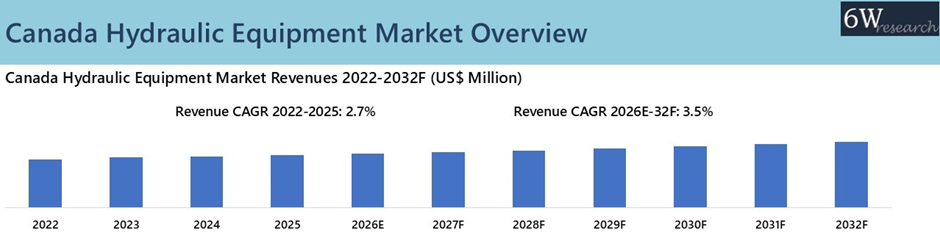
According to 6Wresearch, Canada Hydraulic Equipment market is projected to grow at a CAGR of 3.5% during 2026-2032F, fueled by the execution of national production targets and capital deployment, the market expansion is driven by the phased rollout in exploration projects and annual sector investments, which would necessitate continuous procurement of advanced machinery. Federal initiatives, such as the Critical Minerals Infrastructure Fund (CMIF), ensure sustained long-term demand for heavy machinery through 2030. This is supported by strong sector performance, where mineral exploration budgets have surged to a new high.
In March 2026, in Critical Minerals Strategy, the Minister announced up a heavy investment for few Canadian projects that would be able to accelerate planning, development and processing capacity across the country to unlock a significant Canadian project capital in critical minerals projects across eight provinces. Expansion and equipment acquisition: The aim of the project is to increase production capacity and productivity at this business, which specializes in designing and manufacturing hydraulic cylinders.
Meanwhile, agriculture benefited from the Sustainable Canadian Agricultural Partnership (2023–2028), encouraging replacement of older tractors and combines with more efficient hydraulic equipment. This capital would target meeting 2030 output goals, including a high copper production and gold output, creating a demand cycle for extraction and processing equipment. As mining companies scale copper, gold, uranium, and critical mineral output to meet long-term production goals, demand would intensify for high-capacity excavation, drilling, crushing, mineral processing equipments.
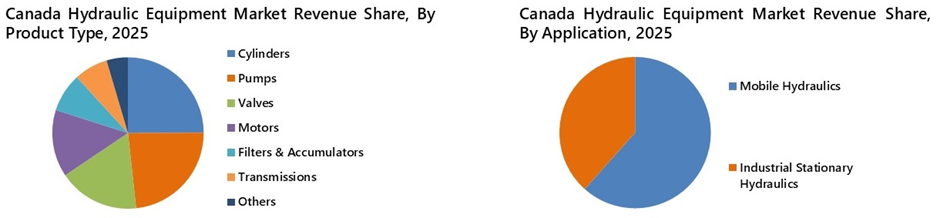
Cylinders are expected to account for the highest revenue share and register the fastest growth in the Canada hydraulic equipment market by product type by 2032, supported by their critical role in converting fluid power into linear motion across both mobile and industrial applications. Strong demand from construction, material handling, and industrial equipment, along with rising replacement needs due to wear and tear, continues to drive their adoption.
Mobile hydraulics is expected to account for the highest revenue share and register the fastest growth in the Canada hydraulic equipment market by application by 2032, driven by strong demand from construction, mining, and agricultural equipment, along with high equipment utilization and ongoing replacement needs, supported by infrastructure expansion and fleet modernization activities.
Construction is expected to account for the highest revenue share, while mining is projected to register the fastest growth in the Canada hydraulic equipment market by end-user industry by 2032, driven by ongoing infrastructure development, rising resource extraction activities, and increasing demand for heavy-duty hydraulic equipment, supported by commodity demand and continued investments in mining operations.
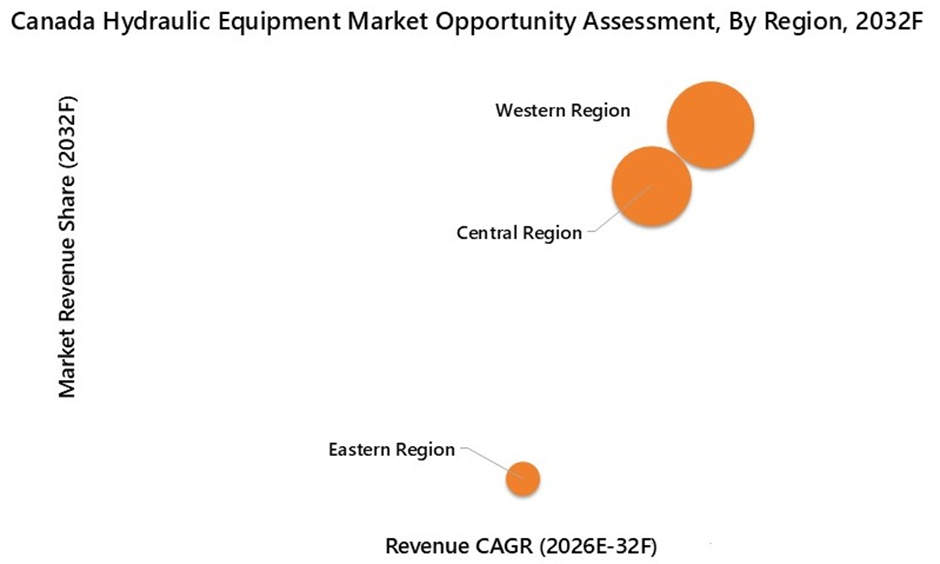
The Western region is expected to account for the highest revenue share and register the fastest growth in the Canada hydraulic equipment market by 2032, driven by strong activity in construction, mining, and oil & gas sectors, along with continued demand for heavy machinery and hydraulic systems across ongoing infrastructure and resource-based projects.
The report provides a detailed analysis of the following market segments:
| 1. Executive Summary |
| 2. Introduction |
| 2.1. Report Description |
| 2.2. Key Highlights of the Report |
| 2.3. Market Scope & Segmentation |
| 2.4. Research Methodology |
| 2.5. Assumptions |
| 3. Global Hydraulic Equipment Market Overview |
| 3.1. Global Hydraulic Equipment Market Revenues, 2022-2032F |
| 4. Canada Hydraulic Equipment Market Overview |
| 4.1. Canada Macro Economic Indicators |
| 4.2. Canada Hydraulic Equipment Market Revenues 2022-2032F |
| 4.3. Canada Hydraulic Equipment Market Industry Life Cycle |
| 4.4. Canada Hydraulic Equipment Market Porter's Five Forces |
| 4.5. Canada Hydraulic Equipment Market Value Chain Mapping |
| 5. Canada Hydraulic Equipment Market Dynamics |
| 5.1. Impact Analysis |
| 5.2. Market Drivers |
| 5.2.1. Increasing Industrial Activities |
| 5.2.2. Minerals and Mining Expansion |
| 5.3. Market Restraints |
| 5.3.1. Raw Material Price Fluctuations in Canada |
| 6. Canada Hydraulic Equipment Market Trends and Developments |
| 7. Canada Hydraulic Equipment Market Overview, By Product Type |
| 7.1. Canada Hydraulic Equipment Market Revenue Share, By Product Type, 2025 & 2032F |
| 7.1.1. Canada Hydraulic Equipment Market Revenues By Pumps, 2022-2032F |
| 7.1.2. Canada Hydraulic Equipment Market Revenues By Motors, 2022-2032F |
| 7.1.3. Canada Hydraulic Equipment Market Revenues By Valves, 2022-2032F |
| 7.1.4. Canada Hydraulic Equipment Market Revenues By Cylinders, 2022-2032F |
| 7.1.5. Canada Hydraulic Equipment Market Revenues By Filters & Accumulators, 2022-2032F |
| 7.1.6. Canada Hydraulic Equipment Market Revenues By Transmissions, 2022-2032F |
| 7.1.7. Canada Hydraulic Equipment Market Revenues By Others, 2022-2032F |
| 8. Canada Hydraulic Equipment Market Overview, By Application |
| 8.1. Canada Hydraulic Equipment Market Revenue Share, By Application, 2025 & 2032F |
| 8.1.1. Canada Hydraulic Equipment Market Revenues, By Mobile Hydraulics, 2022-2032F |
| 8.1.2. Canada Hydraulic Equipment Market Revenues, By Industrial Stationary Hydraulics, 2022-2032F |
| 9. Canada Hydraulic Equipment Market Overview, By End-User Industry |
| 9.1 Canada Hydraulic Equipment Market Revenue Share, By End-User Industry, 2025 & 2032F |
| 9.1.1. Canada Hydraulic Equipment Market Revenues, By Construction, 2022-2032F |
| 9.1.2. Canada Hydraulic Equipment Market Revenues, By Agriculture, 2022-2032F |
| 9.1.3. Canada Hydraulic Equipment Market Revenues, By Mining, 2022-2032F |
| 9.1.4. Canada Hydraulic Equipment Market Revenues, By Material Handling, 2022-2032F |
| 9.1.5. Canada Hydraulic Equipment Market Revenues, By Industrial Manufacturing, 2022-2032F |
| 9.1.6. Canada Hydraulic Equipment Market Revenues, By Oil & Gas, 2022-2032F |
| 9.1.7. Canada Hydraulic Equipment Market Revenues, By Others, 2022-2032F |
| 10. Canada Hydraulic Equipment Market Overview, By Region |
| 10.1 Canada Hydraulic Equipment Market Revenue Share, By Region, 2025 & 2032F |
| 10.1.1. Canada Hydraulic Equipment Market Revenues, By Western Region, 2022-2032F |
| 10.1.2. Canada Hydraulic Equipment Market Revenues, By Central Region, 2022-2032F |
| 10.1.3. Canada Hydraulic Equipment Market Revenues, By Eastern Region, 2022-2032F |
| 11. Canada Hydraulic Equipment Market Key Performance Indicator |
| 12. Canada Hydraulic Equipment Market Application-Level Insights |
| 13. Canada Hydraulic Equipment Market- Aftermarket Dynamics |
| 14. Canada Hydraulic Equipment Market- Customer Analysis |
| 15. Canada Hydraulic Equipment Market- Pricing Level and Margin Analysis |
| 16. Canada Hydraulic Equipment Market Opportunity Assessment |
| 16.1. Canada Hydraulic Equipment Market Opportunity Assessment, By Product Type, 2032F |
| 16.2. Canada Hydraulic Equipment Market Opportunity Assessment, By Application, 2032F |
| 16.3. Canada Hydraulic Equipment Market Opportunity Assessment, By End-User Industry, 2032F |
| 16.4. Canada Hydraulic Equipment Market Opportunity Assessment, By Region, 2032F |
| 17. Canada Hydraulic Equipment Market Competitive Landscape |
| 17.1. Canada Hydraulic Equipment Market Revenue Ranking, By Top 3 Companies, 2025 |
| 17.2. Canada Hydraulic Equipment Market Competitive Benchmarking, By Technical & Operating Parameters |
| 17.3. Canada Hydraulic Equipment Market Positioning, by Brands, 2025 |
| 18. Company Profiles |
| 18.1 Bosch Rexroth Canada |
| 18.2 Parker Hannifin Canada |
| 18.3 Danfoss Power Solutions Canada |
| 18.4 Mailhot Industries |
| 18.5 RHK Hydraulic Cylinder Services |
| 18.6 HYDAC Corporation Canada |
| 18.7 Wainbee Limited |
| 18.8 Bucher Hydraulics GmbH |
| 18.9 Bailey Hydraulics Canada |

| 18.10 Eagle Hydraulic |
| 19. Distribution Structure |
| 19.1. Canada Hydraulic Equipment Local Distributor Market Positioning, By Brands, 2025 |
| 19.2. Canada Hydraulic Equipment Market Distributor Profiles |

| 20. Key Strategic Recommendations |
| 21. Disclaimer |
| List of figures |
| 1. Global Hydraulic Equipment Market Revenues, 2022-2032F (US$ Trillion) |
| 2. Canada Hydraulic Equipment Market Revenues 2022-2032F (US$ Billion) |
| 3. Canada Industrial Contribution to Gross Domestic Product, Sep 2025-Dec 2025 (US$) |
| 4. Canada Gross Domestic Product of Mining, Quarrying, and Oil and Gas Extraction Industry, Sep 2025-Dec 2025(USD) |
| 5. Canada Mining Expenditures, By On-mine And Off-mine Sites, 2025 & 2026E |
| 6. Canada Mining Sector GDP Contribution 2023-2025 ($ Billion) |
| 7. Rising Aluminum Average Monthly Price per tonne in Canada from 2023-2024 (USD) |
| 8. Canada Hydraulic Equipment Market Revenue Share, By Product Type, 2025 & 2032F |
| 9. Canada Hydraulic Equipment Market Revenue Share, By Application, 2025 & 2032F |
| 10. Canada Hydraulic Equipment Market Revenue Share, By End-User Industry, 2025 & 2032F |
| 11. Canada Hydraulic Equipment Market Revenue Share, By Region, 2025 & 2032F |
| 12. Canada Total Investments in June 2024, By Key Construction Components, $ Million |
| 13. Canada Auto Sector Retail Sales, Q1 2025 vs Q1 2024, (% Change) |
| 14. Canada Hydraulic Equipment Market Opportunity Assessment, By Product Type, 2032F |
| 15. Canada Hydraulic Equipment Market Opportunity Assessment, By Application, 2032F |
| 16. Canada Hydraulic Equipment Market Opportunity Assessment, By End-User Industry, 2032F |
| 17. Canada Hydraulic Equipment Market Opportunity Assessment, By Region, 2032F |
| 18. Canada Hydraulic Equipment Market Revenue Ranking, By Top 3 Companies, 2025 |
| 19. Canada Hydraulic Equipment Market Positioning, by Brands, 2025 |
| 20. Canada Hydraulic Equipment Local Distributor Market Positioning, by Brands, 2025 |
| List of table |
| 1. Canada Key Investments in Manufacturing Sector, 2024 |
| 2. Canada Hydraulic Equipment Market Revenues, By Product Type, 2022-2032F ($ Million) |
| 3. Canada Hydraulic Equipment Market Revenues, By Application, 2022-2032F, ($ Million) |
| 4. Canada Hydraulic Equipment Market Revenues, By End-User Industry, 2022-2032F ($ Million) |
| 5. Canada Hydraulic Equipment Market Revenues, By Region, 2022-2032F, ($ Million) |
| 6. Canada Major Construction Projects |
| 7. Auto Investments Announced in Canada, 2020-23, (US$ billion) |
| 8. EPC vs End-User Procurement Structure in Canada’s Hydraulic Equipment Market |
| 9. Stakeholder Hierarchy & Purchasing Behavior in Canada’s Hydraulic Equipment Market |
| 10. Canada Hydraulic Equipment: Average Gross Margin & its Drivers (in %) |
Export potential enables firms to identify high-growth global markets with greater confidence by combining advanced trade intelligence with a structured quantitative methodology. The framework analyzes emerging demand trends and country-level import patterns while integrating macroeconomic and trade datasets such as GDP and population forecasts, bilateral import–export flows, tariff structures, elasticity differentials between developed and developing economies, geographic distance, and import demand projections. Using weighted trade values from 2020–2024 as the base period to project country-to-country export potential for 2030, these inputs are operationalized through calculated drivers such as gravity model parameters, tariff impact factors, and projected GDP per-capita growth. Through an analysis of hidden potentials, demand hotspots, and market conditions that are most favorable to success, this method enables firms to focus on target countries, maximize returns, and global expansion with data, backed by accuracy.
By factoring in the projected importer demand gap that is currently unmet and could be potential opportunity, it identifies the potential for the Exporter (Country) among 190 countries, against the general trade analysis, which identifies the biggest importer or exporter.
To discover high-growth global markets and optimize your business strategy:
Click Here
































