Canada It Market: Import Trend Analysis
The Canada IT market witnessed a modest Compound Annual Growth Rate (CAGR) of 0.42% from 2020 to 2024. In 2023-2024, there was a slight decline with a year-on-year growth rate of -5.45%. Despite the decrease in the final year, the overall trend showed an increase in IT imports during the specified period.
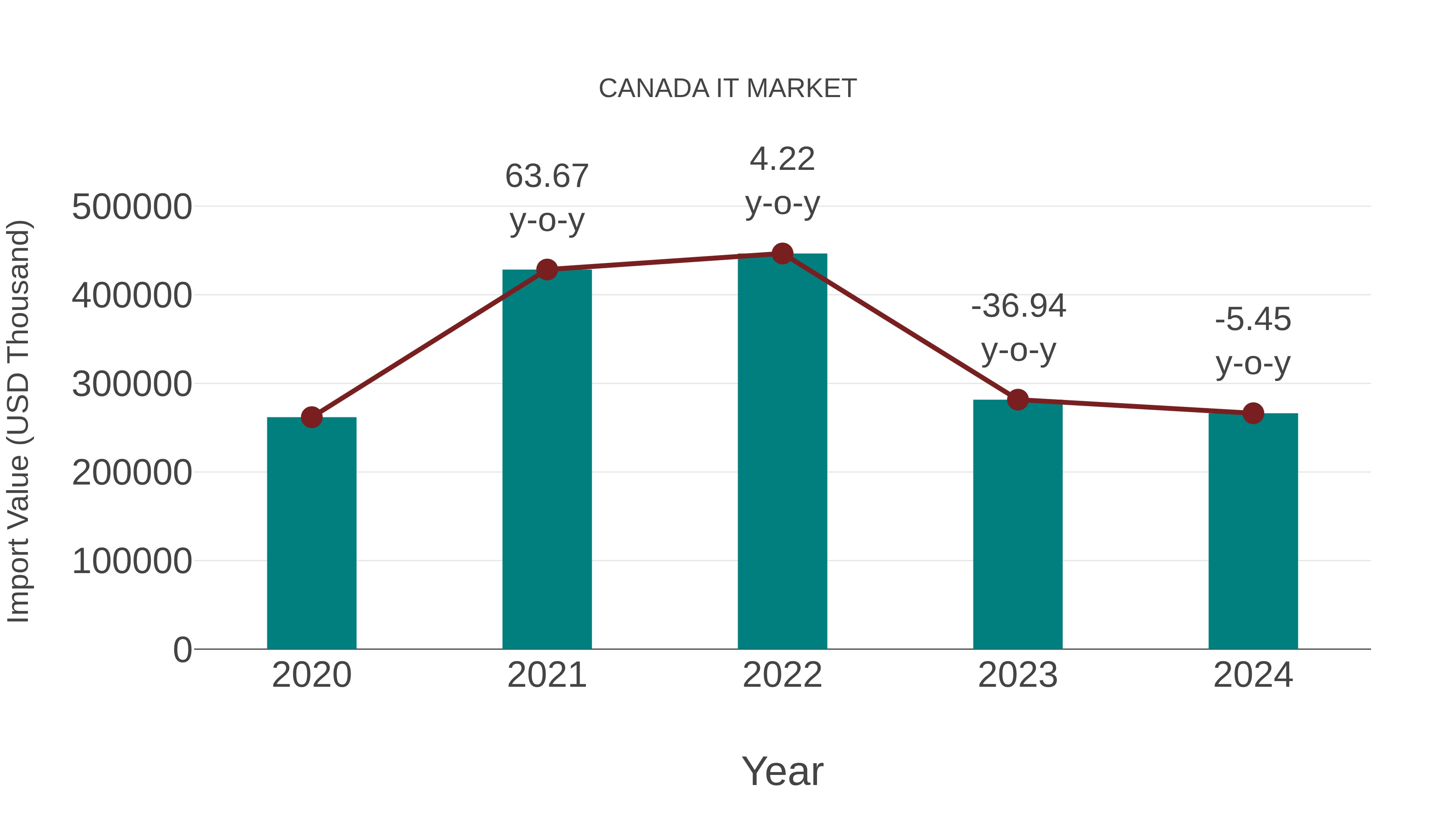
Canada IT Market Growth Rate
According to 6Wresearch internal database and industry insights, the Canada IT Market is anticipated to rise at a compound annual growth rate (CAGR) of 7.2% during the forecast period 2026-2032.
Five-Year Growth Trajectory of the Canada IT Market with Core Drivers
Below mentioned are the evaluation of years-wise growth rate along with key growth drivers:
| Year | Est. Annual Growth (%) | Growth Drivers |
| 2021 | 3.1% | Prevalent adoption of cloud computing and digital transformation strategies across various sectors boosted IT spending. |
| 2022 | 390% | Strong growth in demand for cybersecurity solutions due to rising security threats and data breaches. |
| 2023 | 4.6% | The rise in AI and machine learning applications drove investments in IT infrastructure and services. |
| 2024 | 5.5% | Expansion in the 5G network and IoT deployment spurred IT hardware and software demand. |
| 2025 | 6.2% | The ongoing digital transformation and e-commerce growth continued to drive IT investments, especially in cloud and enterprise solutions. |
Topics Covered in the Canada IT Market Report
The Canada IT Market report thoroughly covers the market by enterprise size and by end-user. The report provides an unbiased and detailed analysis of ongoing market trends, opportunities/high growth areas, and market drivers, which would help stakeholders to devise and align their market strategies according to the current and future market dynamics.
Canada IT Market Highlights
| Market Name | Canada IT Market |
| Forecast Period | 2026–2032 |
| CAGR | 7.2% |
| Growing Sector | Cloud Computing and Cybersecurity |
Canada IT Market Synopsis
Canada IT Market is expected to rise in the years to come on account of significant shift towards cloud computing, data analytics, and increased cybersecurity investments. Generally, cloud technologies, especially SaaS solutions, continue to gain traction among businesses of all sizes, contributing significantly to the Canada IT Market Growth.
Furthermore, the rise in cybersecurity threats has led to increased demand for security solutions, fueling growth in that sector. Apart from this, the government’s push for digital infrastructure improvements and e-commerce growth further supports market growth, with IT services becoming critical for most businesses to remain competitive and secure.
Evaluation of Growth Drivers in the Canada IT Market
Below mentioned are some major growth factors and their impacts on the market dynamics:
| Drivers | Primary Segments Affected | Why it matters (evidence) |
| Cloud Computing Adoption | By Solution Type (Cloud Computing) | Surging demand for flexible, scalable solutions is driving cloud adoption. |
| Cybersecurity Investments | By Solution Type (Cybersecurity) | Increasing concerns over data breaches and privacy regulations accelerates the need for security solutions. |
| E-Commerce Growth | By End-User (Retail) | As e-commerce develops, retailers require more robust IT infrastructure and software to meet constant demand. |
| Government Digital Initiatives | By End-User (Government) | Government-funded digital infrastructure projects are increasing IT service demand across the public sector. |
| AI and Automation Trends | By Solution Type (AI Solutions) | AI is being rapidly adopted across various sectors to automate operations, augment efficiency, and improve decision-making. |
Canada IT Market is expected to gain traction, exhibiting a strong CAGR of 7.2% during the forecast period 2026-2032. There are several factors benefitting the industry such as the widespread adoption of cloud-based technologies and digital services across both private and public sectors. In addition to this, the surging demand for cybersecurity solutions to protect sensitive data and infrastructure continues to flourish the Canada IT Industry. As AI and automation technologies become more prevalent, businesses are further investing in IT solutions to stay competitive in the rapidly evolving market.
Evaluation of Restraints in the Canada IT Market
Below mentioned are some major restraints and their influence on the market dynamics:
| Restraints | Primary Segments Affected | What this means (evidence) |
| High Implementation Costs | By Solution Type (AI Solutions) | High costs of adopting AI and automation technologies can deter small businesses from upgrading. |
| Skill Shortages | By Solution Type (Cloud Computing) | Lack of skilled IT professionals, particularly in cloud and cybersecurity, can slow adoption. |
| Data Privacy Concerns | By End-User (Government) | Concerns around data privacy and compliance with local regulations may hinder adoption of new technologies. |
| Integration Challenges | By Enterprise Size (Small and Medium Enterprises) | Difficulty in integrating new IT systems with legacy infrastructure poses challenges. |
| Infrastructure Limitations | By End-User (IT and Telecom) | Lack of robust digital infrastructure may hinder the growth of IT adoption. |
Canada IT Market Challenges
The Canada IT Market faces several challenges that could hamper growth. These include high implementation and integration costs, especially for small and medium-sized enterprises (SMEs) trying to adopt new technologies. Additionally, the shortage of skilled IT professionals, particularly in cloud computing, AI, and cybersecurity, poses a significant hurdle. Data privacy and regulatory compliance concerns also remain significant barriers, especially for businesses handling sensitive information. The need for robust digital infrastructure and connectivity continues to challenge the growth of IT adoption in certain regions.
Canada IT Market Trends
The following are some of the major trends that have been observed in the Canada IT industry:
- Increased use of automation and AI: As businesses begin to adopt more efficient algorithms, companies will increasingly utilize automation and AI technology to reduce costs, improve productivity, accelerate information flow, and improve the quality of decision-making processes.
- Increasing migration to cloud-based services: The majority of businesses will be migrating to cloud-based services, for their ability to provide tremendous flexibility at a lower cost than traditional infrastructure.
- An increase in investment in cybersecurity technologies and services: With an increasing number of data breaches, cyberattacks and stringent regulations on data privacy, companies will be investing more heavily in the development of advanced cybersecurity technologies and services.
- An increase in the use of edge computing: With the proliferation of IoT devices, the increasing use of edge computing is enabling companies to collect, store and process data closer to its source, thereby reducing latency in the transfer of information.
Investment Opportunities in the Canada IT Industry
Here is the list of competitive opportunities in the Canada IT Industry:
- An expanding cloud computing market: As businesses begin to migrate to cloud computing services, this creates a need for IT service providers to develop, deliver and support solutions that can meet the scalability needs of their clients.
- Increased need for comprehensive cyber security solutions: The ever-increasing number of cyber threats has created a demand for more comprehensive cyber security solutions.
- Growth of artificial intelligence (AI): With the continued growth of AI in all areas of business, the demand for companies that provide AI-based services and solutions will only grow.
- The digital transformation of small and medium sized enterprises (SMEs): The development of affordable and scalable solutions for SMEs will be a growing market opportunity.
Top 5 Leading Players in the Canada IT Market
Some of the leading companies in the Canada IT Market include:
1. Shopify Inc.
| Company Name | Shopify Inc. |
| Established Year | 2006 |
| Headquarters | Ottawa, Canada |
| Official Website | Click Here |
Shopify is a leading e-commerce platform providing digital services to SMEs, helping them build and manage online stores.
2. Telus Communications
| Company Name | Telus Communications |
| Established Year | 1990 |
| Headquarters | Vancouver, Canada |
| Official Website | Click Here |
Telus is a prominent IT and telecom company offering cloud, cybersecurity, and network solutions for enterprises across Canada.
3. CGI Group
| Company Name | CGI Group |
| Established Year | 1976 |
| Headquarters | Montreal, Canada |
| Official Website | Click Here |
CGI provides IT consulting, systems integration, and software solutions, with a strong presence in cloud services and cybersecurity.
4. OpenText Corporation
| Company Name | OpenText Corporation |
| Established Year | 1991 |
| Headquarters | Waterloo, Canada |
| Official Website | Click Here |
OpenText is a global leader in enterprise information management, providing cloud-based solutions for businesses of all sizes.
5. Rogers Communications
| Company Name | Rogers Communications |
| Established Year | 1960 |
| Headquarters | Toronto, Canada |
| Official Website | Click Here |
Rogers is a major provider of telecom and IT solutions in Canada, offering cloud, cybersecurity, and broadband services.
Government Regulations Introduced in the Canada IT Market
According to Canadian government data, The Office of the Privacy Commissioner of Canada (OPC) state that businesses comply with data privacy laws and the Canadian Radio-television and Telecommunications Commission (CRTC) regulates telecommunications services. The Canadian government is also investing in digital infrastructure projects that will drive technological innovation. The government also provides funding for cyber security programs to protect the nation's critical infrastructure.
Future Insights of the Canada IT Market
In the years to come, it is expected that the Canada IT Market will continue to experience a rapid growth due to ongoing investment into cloud computing, cyber security, and artificial intelligence (AI) solutions. Additionally, as all levels of government continue to digitize their operating processes, digital transformation continues to influence how enterprises adopt IT solutions. Increased demand for robust data protection and cyber security continues to create opportunities for companies that provide advanced solutions. Furthermore, the growth of e-commerce and hybrid working conditions will provide further opportunities for long-term growth and investment in innovative IT solutions.
Market Segmentation Analysis
The report offers a comprehensive study of the following market segments and their leading categories:
Small and Medium Enterprises (SMEs) to Dominate the Market – By Enterprise Size
According to Shubham, Senior Research Analyst, 6Wresearch, SMEs are expected to lead the Canada IT Market Share due to their increasing adoption of cost-effective IT solutions, such as cloud computing and cybersecurity, to streamline operations and enhance efficiency. Larger enterprises also show growth, but SMEs are leading the way in digital adoption.
Retail Sector to Dominate the Market – By End-user
The retail sector is projected to hold the largest share in the Canada IT Market as retailers increasingly adopt digital platforms, e-commerce solutions, and IT infrastructure to meet consumer demand. Other sectors like BFSI and manufacturing will also grow but will not surpass retail in market share during the forecast period.
Key Attractiveness of the Report
- 10 Years of Market Numbers
- Historical Data Starting from 2022 to 2025
- Base Year: 2025
- Forecast Data until 2032
- Key Performance Indicators Impacting the Market
- Major Upcoming Developments and Projects
Key Highlights of the Report:
- Canada IT Market Outlook
- Market Size of Canada IT Market, 2025
- Forecast of Canada IT Market, 2032
- Historical Data and Forecast of Canada IT Revenues & Volume for the Period 2022- 2032F
- Canada IT Market Trend Evolution
- Canada IT Market Drivers and Challenges
- Canada IT Price Trends
- Canada IT Porter's Five Forces
- Canada IT Industry Life Cycle
- Historical Data and Forecast of Canada IT Market Revenues & Volume By Enterprise Size for the Period 2022- 2032F
- Historical Data and Forecast of Canada IT Market Revenues & Volume By Small and Medium Enterprises for the Period 2022- 2032F
- Historical Data and Forecast of Canada IT Market Revenues & Volume By Large Enterprises for the Period 2022- 2032F
- Historical Data and Forecast of Canada IT Market Revenues & Volume By End-user for the Period 2022- 2032F
- Historical Data and Forecast of Canada IT Market Revenues & Volume By Retail for the Period 2022- 2032F
- Historical Data and Forecast of Canada IT Market Revenues & Volume By Manufacturing for the Period 2022- 2032F
- Historical Data and Forecast of Canada IT Market Revenues & Volume By BFSI for the Period 2022- 2032F
- Historical Data and Forecast of Canada IT Market Revenues & Volume By Government for the Period 2022- 2032F
- Historical Data and Forecast of Canada IT Market Revenues & Volume By IT and Telecom for the Period 2022- 2032F
- Historical Data and Forecast of Canada IT Market Revenues & Volume By Other for the Period 2022- 2032F
- Canada IT Import Export Trade Statistics
- Market Opportunity Assessment By Enterprise Size
- Market Opportunity Assessment By End-user
- Canada IT Top Companies Market Share
- Canada IT Competitive Benchmarking By Technical and Operational Parameters
- Canada IT Company Profiles
- Canada IT Key Strategic Recommendations
Market Covered
The market report provides a detailed analysis of the following market segments:
By Enterprise Size
- Small and Medium Enterprises
- Large Enterprises
By End-user
- Retail
- Manufacturing
- BFSI
- Government
- IT and Telecom
- Other






































