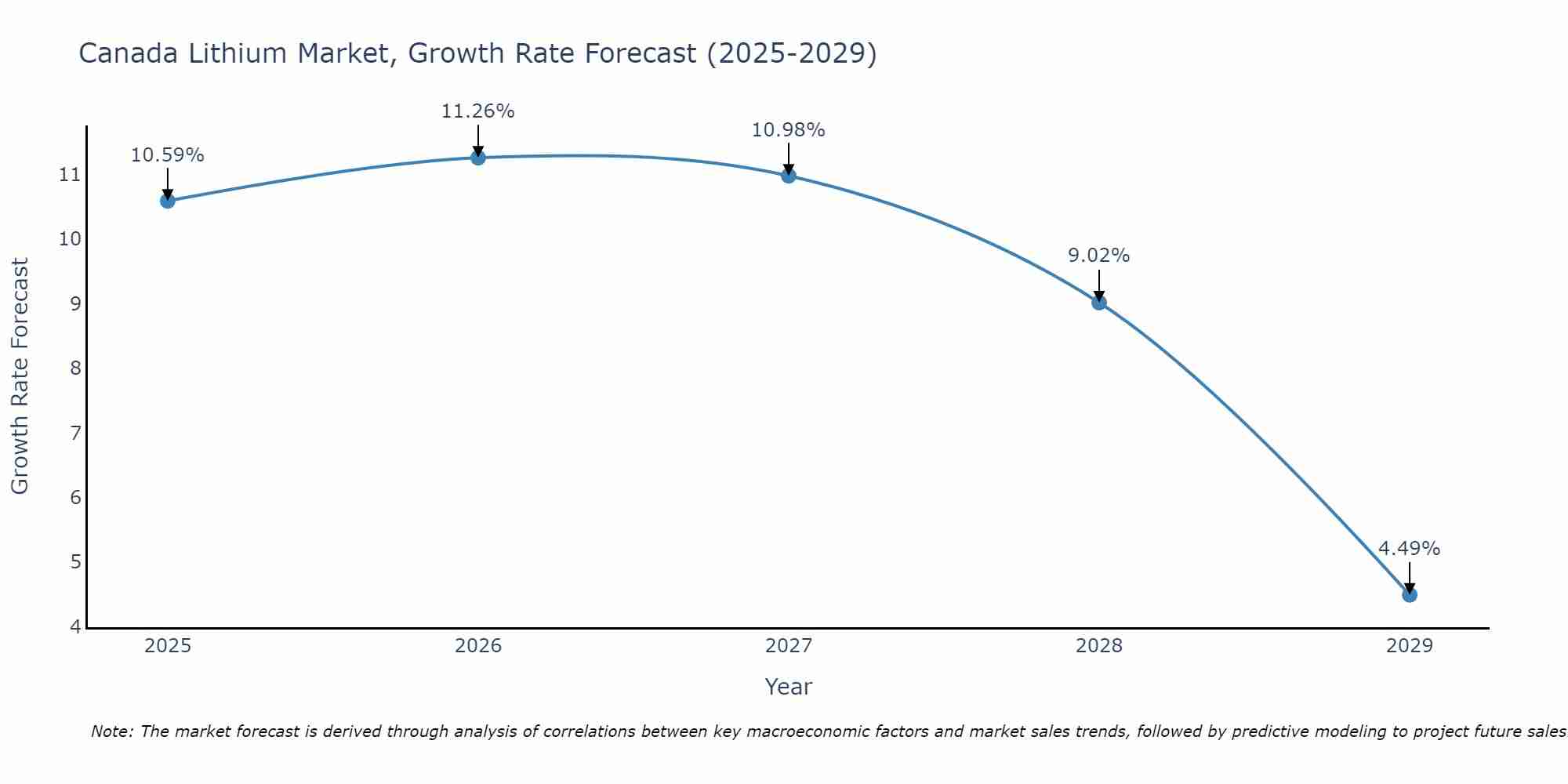
Canada Lithium Market Size Growth Rate
The Canada Lithium Market is projected to witness mixed growth rate patterns during 2025 to 2029. Starting at 10.59% in 2025, the market peaks at 11.26% in 2026, and settles at 4.49% by 2029.
Canada Lithium Market Overview
The overall lithium market in Canada is booming, primarily due to its critical role in battery production for electric vehicles and energy storage solutions, aligning with Canada`s focus on green energy.
Drivers of the market
The lithium market in Canada is driven by the increasing demand for lithium-based materials used in batteries, ceramics, and other industrial applications. Lithium is a critical component in energy storage technologies, including lithium-ion batteries for electric vehicles and renewable energy systems. The market is influenced by advancements in lithium extraction and processing technologies, the growth of the electric vehicle market, and trends towards sustainable and high-performance materials. Innovations in lithium applications and production are shaping market dynamics and contributing to growth.
Challenges of the market
The broader lithium market in Canada is challenged by fluctuating raw material prices, high production costs, and the environmental impact of lithium extraction. As lithium is critical for various applications, including batteries for electric vehicles and energy storage systems, the market must adapt to growing demand while addressing sustainability and regulatory issues. Additionally, competition from alternative technologies and the need for continuous innovation in lithium processing and applications add to the complexity of the market.
Government Policy of the market
Canadas policies regarding the lithium market focus on sustainable resource management and technological innovation. The government regulates lithium extraction and production to ensure environmental protection and safety. Policies also support research into new applications and advancements in lithium technologies, including incentives for innovation and industry growth.
Key Highlights of the Report:
- Canada Lithium Market Outlook
- Market Size of Canada Lithium Market, 2024
- Forecast of Canada Lithium Market, 2031
- Historical Data and Forecast of Canada Lithium Revenues & Volume for the Period 2021-2031
- Canada Lithium Market Trend Evolution
- Canada Lithium Market Drivers and Challenges
- Canada Lithium Price Trends
- Canada Lithium Porter`s Five Forces
- Canada Lithium Industry Life Cycle
- Historical Data and Forecast of Canada Lithium Market Revenues & Volume By Product for the Period 2021-2031
- Historical Data and Forecast of Canada Lithium Market Revenues & Volume By Carbonates for the Period 2021-2031
- Historical Data and Forecast of Canada Lithium Market Revenues & Volume By Hydroxide for the Period 2021-2031
- Historical Data and Forecast of Canada Lithium Market Revenues & Volume By Others for the Period 2021-2031
- Historical Data and Forecast of Canada Lithium Market Revenues & Volume By Application for the Period 2021-2031
- Historical Data and Forecast of Canada Lithium Market Revenues & Volume By Automotive for the Period 2021-2031
- Historical Data and Forecast of Canada Lithium Market Revenues & Volume By Consumer Electronics for the Period 2021-2031
- Historical Data and Forecast of Canada Lithium Market Revenues & Volume By Grid Storage for the Period 2021-2031
- Historical Data and Forecast of Canada Lithium Market Revenues & Volume By Glass & Ceramics for the Period 2021-2031
- Historical Data and Forecast of Canada Lithium Market Revenues & Volume By Others for the Period 2021-2031
- Canada Lithium Import Export Trade Statistics
- Market Opportunity Assessment By Product
- Market Opportunity Assessment By Application
- Canada Lithium Top Companies Market Share
- Canada Lithium Competitive Benchmarking By Technical and Operational Parameters
- Canada Lithium Company Profiles
- Canada Lithium Key Strategic Recommendations






































