Canada Oil Free Air Compressor Market: Import Trend Analysis
In the Canada oil-free air compressor market, the import trend showed a notable growth rate of 12.61% from 2023 to 2024, with a compound annual growth rate (CAGR) of 10.7% for the period of 2020 to 2024. This import momentum can be attributed to the increasing demand for energy-efficient and environmentally friendly air compressors in various industries, reflecting a positive market stability and a shift towards sustainable practices in the Canadian market.
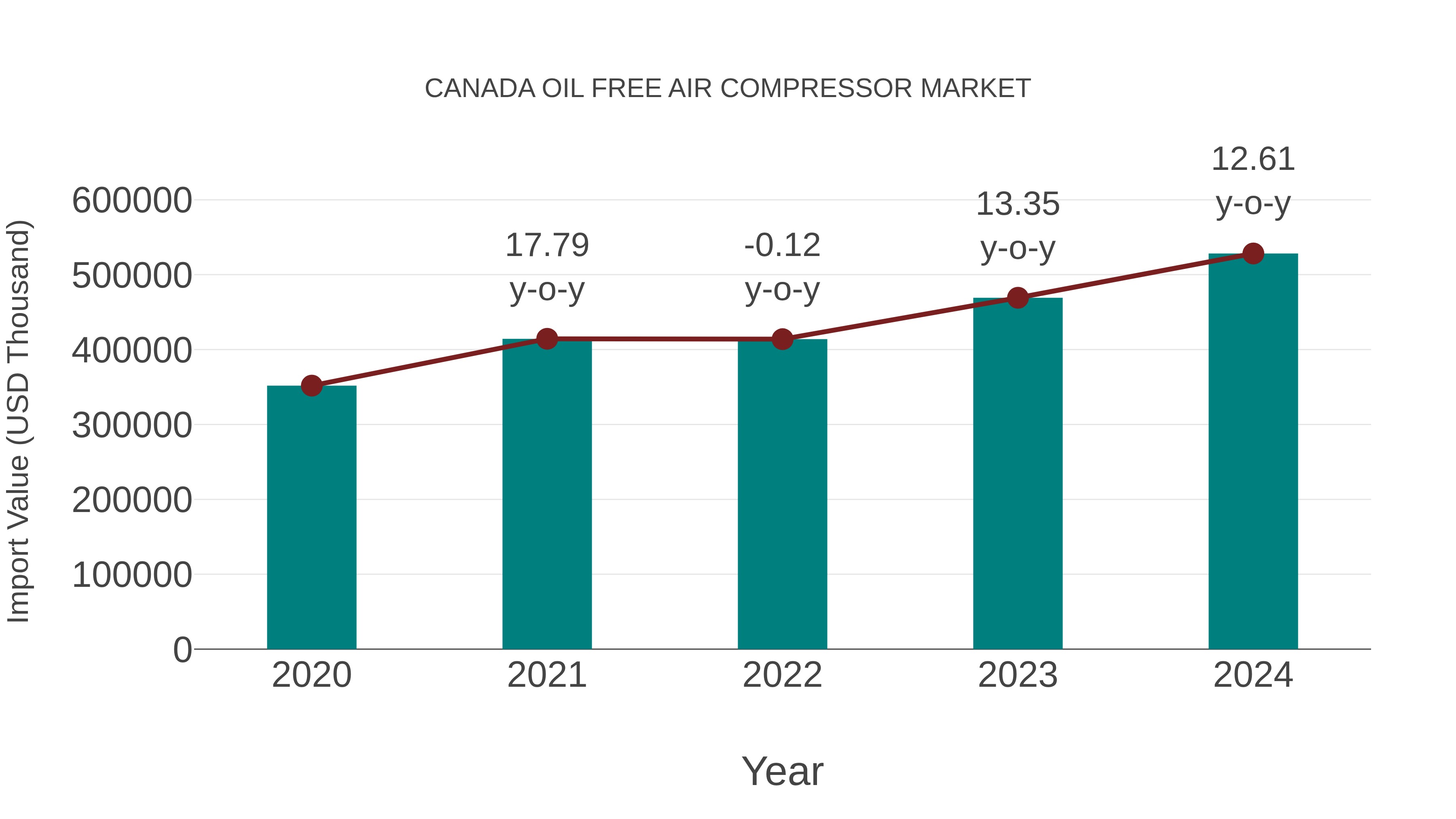
Canada Oil Free Air Compressor Market Overview
The Canada oil-free air compressor market is a growing segment within the broader industrial equipment industry. With increasing awareness and emphasis on environmental sustainability, the demand for oil-free air compressors has been on the rise. These compressors are favored for their ability to deliver clean, high-quality compressed air without the risk of oil contamination, making them ideal for applications in sensitive industries such as food and beverage, pharmaceuticals, and electronics manufacturing. Key players in the Canadian market include Atlas Copco, Ingersoll Rand, and Sullair, offering a range of oil-free compressor options to cater to diverse customer needs. The market is also witnessing technological advancements such as the integration of smart features for improved efficiency and performance, further driving the adoption of oil-free air compressors in Canada.
Canada Oil Free Air Compressor Market Trends
The Canada oil free air compressor market is experiencing a notable trend towards increased environmental consciousness and sustainability. Companies are increasingly opting for oil-free compressors due to their eco-friendly operation, reduced maintenance requirements, and lower risk of oil contamination in compressed air systems. This trend is driven by stringent environmental regulations, as well as a growing awareness of the importance of reducing carbon footprint in industrial operations. Additionally, advancements in technology have improved the efficiency and performance of oil free air compressors, making them a more attractive option for businesses looking to enhance their sustainability credentials. Overall, the market is seeing a shift towards oil-free solutions as companies prioritize environmental responsibility and seek reliable, energy-efficient compressed air solutions.
Canada Oil Free Air Compressor Market Challenges
In the Canada oil free air compressor market, challenges arise primarily from the increasing pressure to meet stringent environmental regulations and sustainability goals. The demand for oil free air compressors is driven by the need to minimize air contamination and reduce carbon emissions. However, the high initial cost of oil free compressors compared to traditional oil lubricated compressors can be a barrier for some buyers. Additionally, maintaining the performance and efficiency of oil free compressors requires specialized knowledge and regular maintenance, which can be challenging for operators. Ensuring consistent product quality and reliability while keeping up with technological advancements and market competition are also key challenges faced by companies operating in the Canada oil free air compressor market.
Canada Oil Free Air Compressor Market Investment Opportunities
The Canada oil-free air compressor market presents promising investment opportunities due to the increasing emphasis on environmental sustainability and energy efficiency. As the demand for oil-free air compressors rises in various industries such as healthcare, food and beverage, and electronics manufacturing, investors can capitalize on this trend by investing in companies that specialize in the production and distribution of oil-free air compressors. Additionally, the Canadian government`s focus on reducing greenhouse gas emissions and promoting clean energy initiatives further supports the growth of the oil-free air compressor market. Investing in innovative technologies and solutions that enhance the performance and sustainability of oil-free air compressors can provide attractive returns for investors seeking opportunities in the Canadian market.
Canada Oil Free Air Compressor Market Government Policy
In Canada, government policies related to the oil-free air compressor market primarily focus on environmental regulations and energy efficiency standards. The government has implemented measures to reduce greenhouse gas emissions and promote the use of energy-efficient equipment, including air compressors. This includes initiatives such as the Energy Efficiency Regulations, which establish minimum energy performance standards for various products, including air compressors. Additionally, the Canadian government has set targets to reduce emissions and transition to cleaner energy sources, which may impact the demand for oil-free air compressors in industries such as manufacturing, construction, and healthcare. Companies operating in the oil-free air compressor market in Canada need to adhere to these regulations and standards to ensure compliance and contribute to environmental sustainability efforts.
Canada Oil Free Air Compressor Market Future Outlook
The future outlook for the Canada oil-free air compressor market appears promising, driven by increasing emphasis on environmental sustainability and stringent regulations on emissions. The growing awareness about the adverse impact of oil-based compressors on air quality and health is expected to fuel the demand for oil-free alternatives. Additionally, the expanding industrial sector, particularly in construction, automotive, and manufacturing industries, is likely to contribute to market growth. Technological advancements in oil-free compressor designs, such as improved efficiency and reduced maintenance costs, are anticipated to attract more consumers. Overall, with a shift towards cleaner and more energy-efficient solutions, the Canada oil-free air compressor market is projected to witness steady growth in the coming years.
Key Highlights of the Report:
- Canada Oil Free Air Compressor Market Outlook
- Market Size of Canada Oil Free Air Compressor Market,2025
- Forecast of Canada Oil Free Air Compressor Market, 2032
- Historical Data and Forecast of Canada Oil Free Air Compressor Revenues & Volume for the Period 2022-2032F
- Canada Oil Free Air Compressor Market Trend Evolution
- Canada Oil Free Air Compressor Market Drivers and Challenges
- Canada Oil Free Air Compressor Price Trends
- Canada Oil Free Air Compressor Porter's Five Forces
- Canada Oil Free Air Compressor Industry Life Cycle
- Historical Data and Forecast of Canada Oil Free Air Compressor Market Revenues & Volume By Type for the Period 2022-2032F
- Historical Data and Forecast of Canada Oil Free Air Compressor Market Revenues & Volume By Rotary Screw for the Period 2022-2032F
- Historical Data and Forecast of Canada Oil Free Air Compressor Market Revenues & Volume By Piston for the Period 2022-2032F
- Historical Data and Forecast of Canada Oil Free Air Compressor Market Revenues & Volume By Centrifugal for the Period 2022-2032F
- Historical Data and Forecast of Canada Oil Free Air Compressor Market Revenues & Volume By Scroll for the Period 2022-2032F
- Historical Data and Forecast of Canada Oil Free Air Compressor Market Revenues & Volume By Application Area for the Period 2022-2032F
- Historical Data and Forecast of Canada Oil Free Air Compressor Market Revenues & Volume By Industrial Manufacturing for the Period 2022-2032F
- Historical Data and Forecast of Canada Oil Free Air Compressor Market Revenues & Volume By Food and Beverage Processing for the Period 2022-2032F
- Historical Data and Forecast of Canada Oil Free Air Compressor Market Revenues & Volume By Pharmaceutical Industry for the Period 2022-2032F
- Historical Data and Forecast of Canada Oil Free Air Compressor Market Revenues & Volume By Electronics and Semiconductor for the Period 2022-2032F
- Historical Data and Forecast of Canada Oil Free Air Compressor Market Revenues & Volume By End User for the Period 2022-2032F
- Historical Data and Forecast of Canada Oil Free Air Compressor Market Revenues & Volume By Automotive Sector for the Period 2022-2032F
- Historical Data and Forecast of Canada Oil Free Air Compressor Market Revenues & Volume By Chemical Industry for the Period 2022-2032F
- Historical Data and Forecast of Canada Oil Free Air Compressor Market Revenues & Volume By Healthcare Sector for the Period 2022-2032F
- Historical Data and Forecast of Canada Oil Free Air Compressor Market Revenues & Volume By Power Plants for the Period 2022-2032F
- Historical Data and Forecast of Canada Oil Free Air Compressor Market Revenues & Volume By Product Type for the Period 2022-2032F
- Historical Data and Forecast of Canada Oil Free Air Compressor Market Revenues & Volume By Energy-Efficient Compressors for the Period 2022-2032F
- Historical Data and Forecast of Canada Oil Free Air Compressor Market Revenues & Volume By Corrosion-Resistant Compressors for the Period 2022-2032F
- Historical Data and Forecast of Canada Oil Free Air Compressor Market Revenues & Volume By High-Pressure Systems for the Period 2022-2032F
- Historical Data and Forecast of Canada Oil Free Air Compressor Market Revenues & Volume By Compact Low-Noise Models for the Period 2022-2032F
- Canada Oil Free Air Compressor Import Export Trade Statistics
- Market Opportunity Assessment By Type
- Market Opportunity Assessment By Application Area
- Market Opportunity Assessment By End User
- Market Opportunity Assessment By Product Type
- Canada Oil Free Air Compressor Top Companies Market Share
- Canada Oil Free Air Compressor Competitive Benchmarking By Technical and Operational Parameters
- Canada Oil Free Air Compressor Company Profiles
- Canada Oil Free Air Compressor Key Strategic Recommendations






































