Canada Table Olives Market Year-wise Growth Rate (2021-2031F)
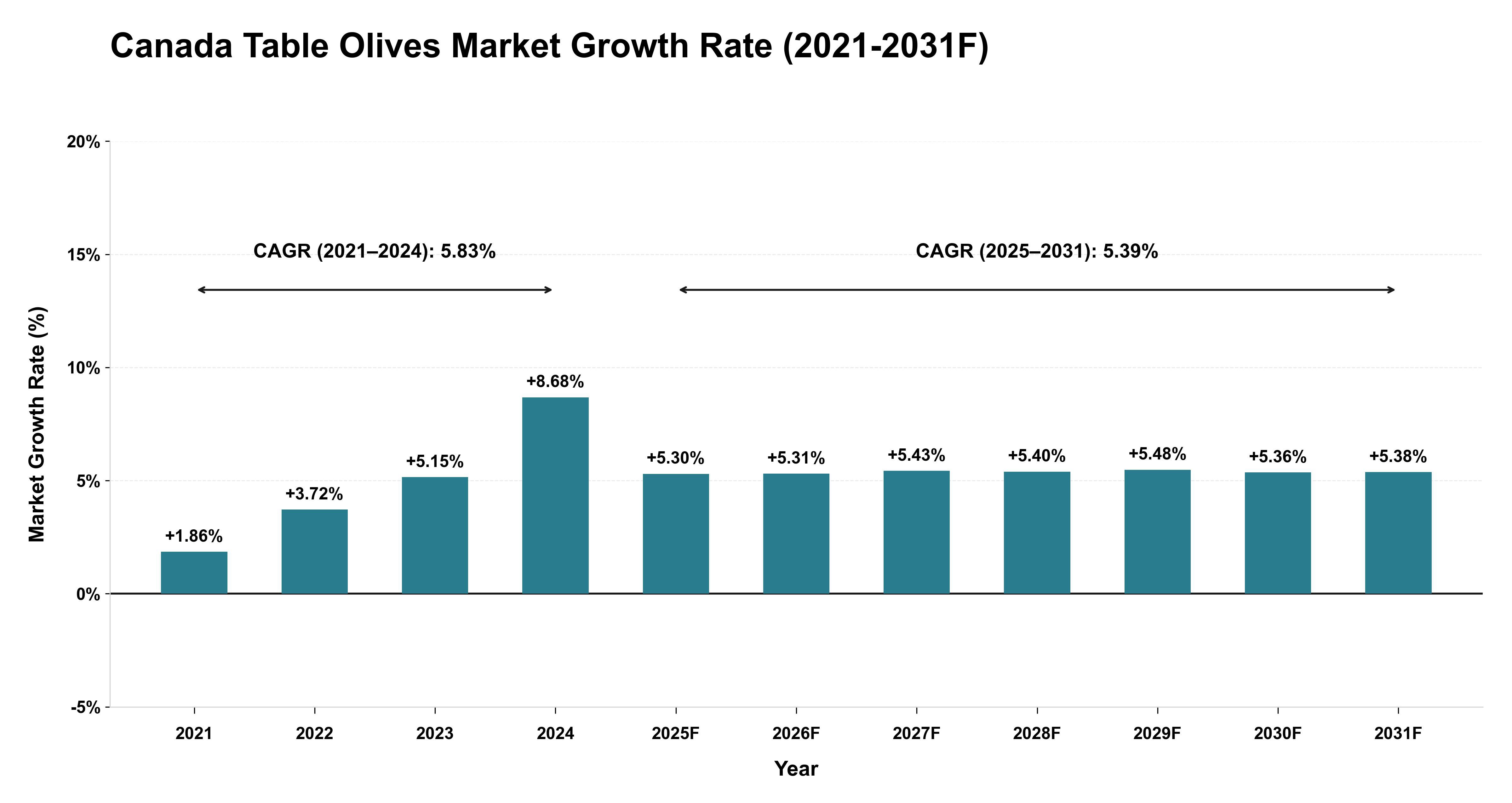
The Canada Table Olives Market witnessed a gradual acceleration in growth from 2021 to 2024, with the CAGR at 5.83%. The increasing consumer preference for healthier snack options and the rising popularity of Mediterranean cuisine were key demand drivers during this period. Additionally, advancements in processing technologies improved product quality and shelf life, further fueling market expansion. Looking ahead to 2025-2031, the market is expected to maintain a steady growth trajectory with a forecasted CAGR of 5.39%. This stability can be attributed to continued consumer demand for diverse culinary experiences and the industry's focus on sustainable sourcing practices. The consistent growth rates indicate a resilient market adapting well to changing consumer preferences and technological advancements in the food sector.
Canada Table Olives Market Synopsis
The Canada Table Olives Market is characterized by a steady demand for a variety of olives for consumption as snacks, appetizers, and cooking ingredients. The market offers a range of olive types such as green, black, Kalamata, and specialty stuffed olives, catering to diverse consumer preferences. The growing trend towards healthy eating habits and the popularity of Mediterranean cuisine have contributed to the increasing consumption of table olives in Canada. Key market players include both domestic producers and international suppliers offering high-quality and flavorful olives to meet the demand. Additionally, the rising awareness of the health benefits of olives, such as being rich in antioxidants and healthy fats, further drives the market growth. Overall, the Canada Table Olives Market presents opportunities for expansion and innovation to cater to evolving consumer tastes and preferences.
Canada Table Olives Market Trends
The Canada Table Olives Market is experiencing a growing demand for healthy and flavorful food options, driving the trend towards increased consumption of table olives as a versatile and nutritious snack or ingredient. Consumers are increasingly seeking out unique varieties and flavors of table olives, creating opportunities for producers to innovate and expand their product offerings. The market is also seeing a rise in demand for organic and locally sourced table olives, catering to the growing interest in sustainable and ethical food choices. Additionally, the increasing awareness of the health benefits of table olives, such as their high antioxidant content and potential to reduce inflammation, is further driving market growth. Overall, the Canada Table Olives Market presents promising opportunities for companies to capitalize on consumer preferences for healthy, flavorful, and sustainable food options.
Canada Table Olives Market Challenges
In the Canada Table Olives Market, some of the key challenges include competition from imported olives, limited domestic production, and variations in consumer preferences. Imported olives from countries with lower production costs can often be sold at lower prices, posing a challenge for domestic producers. Additionally, the climate in Canada is not conducive to large-scale olive cultivation, leading to limited domestic production and a reliance on imports. Furthermore, consumer preferences in Canada can vary widely, with some consumers favoring traditional Mediterranean varieties while others prefer new and innovative flavors, creating a need for producers to adapt and diversify their product offerings. Overall, navigating these challenges requires strategic marketing, product innovation, and a focus on quality to remain competitive in the Canada Table Olives Market.
Canada Table Olives Market Investment Opportunities
The Canada Table Olives Market is primarily driven by increasing consumer awareness of the health benefits associated with olives, such as their high content of antioxidants and healthy fats. Growing interest in Mediterranean cuisine and the rising popularity of olive-based products, such as olive oil and tapenades, are also contributing to the market growth. Additionally, the trend towards healthier snacking options and a shift towards plant-based diets are driving the demand for table olives in Canada. The expanding retail sector and the availability of a wide variety of flavored and stuffed olives are further fueling the market growth. Overall, factors such as health consciousness, changing dietary preferences, and culinary trends are key drivers propelling the Canada Table Olives Market forward.
Canada Table Olives Market Government Polices
Government policies related to the Canada Table Olives Market include regulations on food safety and quality standards enforced by the Canadian Food Inspection Agency (CFIA). The CFIA ensures that table olives meet the necessary requirements for packaging, labeling, and transportation to maintain consumer safety and confidence. Import regulations also play a significant role in the market, with the Canadian government monitoring and regulating the importation of table olives to protect local producers and consumers. Additionally, trade agreements such as the Canada-United States-Mexico Agreement (CUSMA) impact the market by influencing tariffs and quotas on imported table olives. Overall, government policies in Canada`s Table Olives Market focus on ensuring product quality, safety, and fair competition within the industry.
Canada Table Olives Market Future Outlook
The Canada Table Olives Market is expected to see steady growth in the coming years, driven by increasing consumer awareness of the health benefits associated with olives and the growing popularity of Mediterranean cuisine. Factors such as the rise in demand for natural and organic products, as well as the expanding food industry, are also contributing to the market`s positive outlook. Additionally, the trend towards healthier eating habits and the growing influence of global culinary trends are expected to further boost the consumption of table olives in Canada. Manufacturers focusing on product innovation and diversification, along with effective marketing strategies, will likely play a key role in driving market growth and catering to evolving consumer preferences.
Key Highlights of the Report:
- Canada Table Olives Market Outlook
- Market Size of Canada Table Olives Market, 2025
- Forecast of Canada Table Olives Market, 2032
- Historical Data and Forecast of Canada Table Olives Revenues & Volume for the Period 2022 - 2032F
- Canada Table Olives Market Trend Evolution
- Canada Table Olives Market Drivers and Challenges
- Canada Table Olives Price Trends
- Canada Table Olives Porter's Five Forces
- Canada Table Olives Industry Life Cycle
- Historical Data and Forecast of Canada Table Olives Market Revenues & Volume By Type for the Period 2022 - 2032F
- Historical Data and Forecast of Canada Table Olives Market Revenues & Volume By Black Olive for the Period 2022 - 2032F
- Historical Data and Forecast of Canada Table Olives Market Revenues & Volume By Green Olive for the Period 2022 - 2032F
- Historical Data and Forecast of Canada Table Olives Market Revenues & Volume By Application for the Period 2022 - 2032F
- Historical Data and Forecast of Canada Table Olives Market Revenues & Volume By Online Store for the Period 2022 - 2032F
- Historical Data and Forecast of Canada Table Olives Market Revenues & Volume By Supermarket for the Period 2022 - 2032F
- Historical Data and Forecast of Canada Table Olives Market Revenues & Volume By Convenience Store for the Period 2022 - 2032F
- Historical Data and Forecast of Canada Table Olives Market Revenues & Volume By Other for the Period 2022 - 2032F
- Canada Table Olives Import Export Trade Statistics
- Market Opportunity Assessment By Type
- Market Opportunity Assessment By Application
- Canada Table Olives Top Companies Market Share
- Canada Table Olives Competitive Benchmarking By Technical and Operational Parameters
- Canada Table Olives Company Profiles
- Canada Table Olives Key Strategic Recommendations






































