Chile Artificial Organs Market Size, Share & Growth Rate
The Chile Artificial Organs Market was estimated at USD 219 Million in 2025 and is projected to reach USD 309 Million by 2032, growing at a CAGR of 5.0% from 2026 to 2032. This growth trajectory is primarily driven by the rising incidence of chronic diseases and organ failures, which in turn escalates the demand for artificial organs. Additionally, advancements in medical technology and increased government focus on healthcare infrastructure are further fueling market expansion.
Chile Artificial Organs Market Year-wise Growth Rate and Key Drivers
This graph highlights how the Chile Artificial Organs Market has steadily grown over the years, supported by major growth factors.
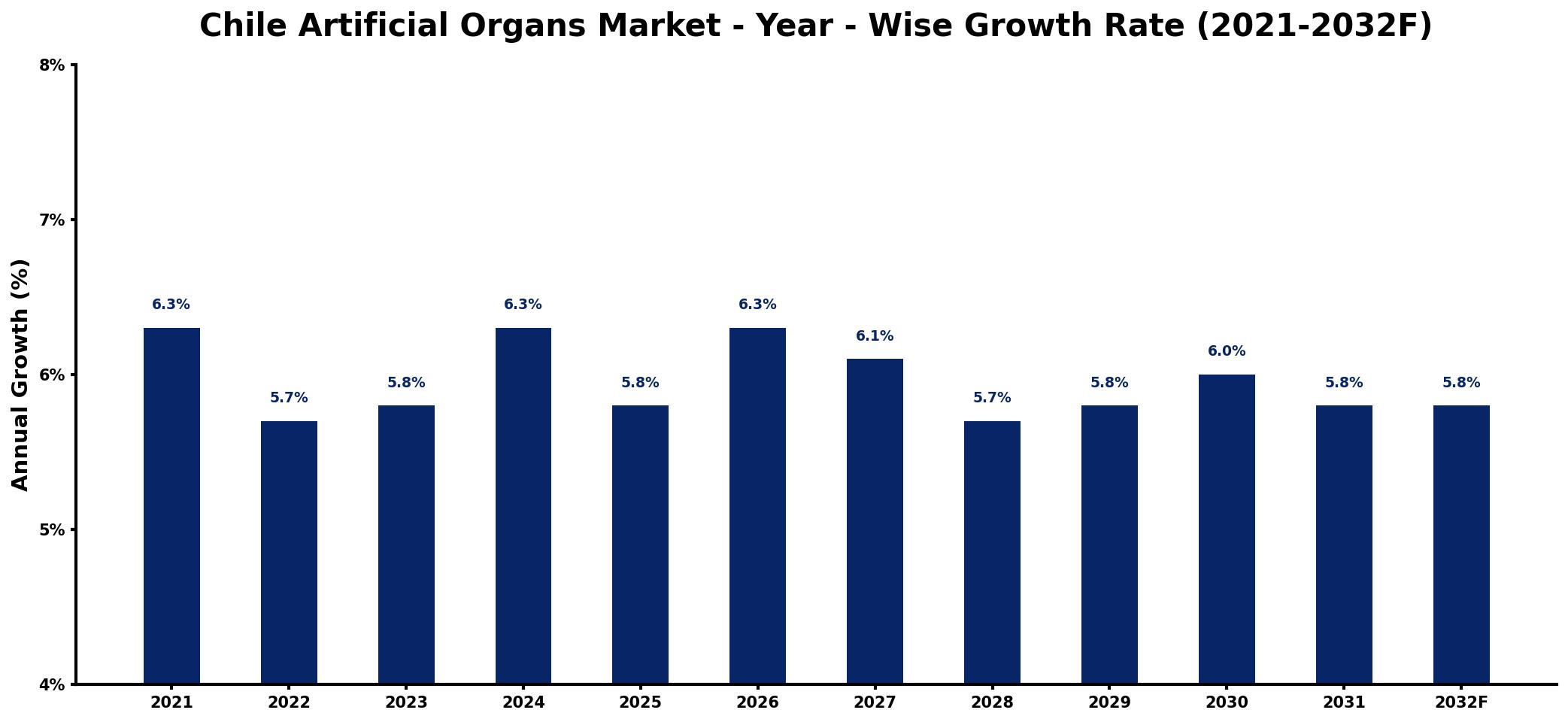
The table below presents the year‑wise growth rates along with the key drivers influencing the market
| Year | Growth Rate | Major Drivers |
| 2021 | 6.3% | Rising healthcare investment levels |
| 2022 | 5.7% | Increasing aging population prevalence |
| 2023 | 5.8% | Advancements in medical technologies |
| 2024 | 6.3% | Growing prevalence of chronic diseases |
| 2025 | 5.8% | Expansion of healthcare infrastructure |
| 2026 | 6.3% | Increased government funding initiatives |
| 2027 | 6.1% | Surge in medical tourism activities |
| 2028 | 5.7% | Enhanced patient awareness programs |
| 2029 | 5.8% | Rising demand for personalized treatments |
| 2030 | 6.0% | Growth in biotechnology collaborations |
| 2031 | 5.8% | Emerging markets attracting investments |
| 2032 | 5.8% | Strengthening regulatory frameworks supporting |
Note: Market size estimations and growth projections presented in this report are based on 6Wresearch's proprietary forecasting methodology, utilizing the latest available industry data, government publications, and primary research inputs.
Chile Artificial Organs Market Synopsis
The increasing demand for organ transplants, coupled with a shortage of donor organs, is the strongest force shaping the Chile Artificial Organs Market today. This need has led to a heightened focus on the development of innovative artificial organs, which aim to fulfill the gaps left by natural organ deficiencies.
Moreover, growing awareness regarding organ donation and the benefits of artificial organs is influencing public perception positively. Government initiatives aimed at improving the healthcare system and promoting research into artificial organ technologies are also playing a significant role in market growth.
Chile Artificial Organs Market Key Takeaways
- The market is seeing significant growth driven by chronic diseases and an aging population.
- Investment in biocompatibility and longevity of artificial organs is critical for enhancing patient outcomes.
- Technological advancements such as 3D printing are enabling the production of customized artificial organs.
- Government support and initiatives are bolstering research and development in the sector.
- High costs and limited access to advanced technologies remain challenges for market players.
Evaluation of Restraints in Chile Artificial Organs Market
Despite promising growth prospects, the Chile Artificial Organs Market faces several restraints. A significant barrier is the high cost associated with the development and implementation of advanced artificial organ technologies, which can limit accessibility for many patients. Furthermore, the reliance on imported technologies due to a lack of local expertise hampers the ability to innovate cost-effectively. Regulatory hurdles also slow down the approval processes for new devices, making it challenging for market entrants to navigate the landscape efficiently. These factors underscore the need for targeted strategies to enhance local production capabilities and improve patient access.
Chile Artificial Organs Market Trends
A prominent trend in the Chile Artificial Organs Market is the incorporation of cutting-edge technologies like bioengineering and 3D printing in organ development. These innovations are paving the way for highly customized solutions that closely mimic the functions of natural organs, thereby improving patient outcomes. Additionally, there is a growing emphasis on enhancing biocompatibility and minimizing rejection risks associated with artificial organs. The increasing prevalence of chronic diseases, particularly among the aging population, is also driving demand for artificial organ solutions, which are now being recognized as viable long-term treatments.
Chile Artificial Organs Market Opportunities
The Chile Artificial Organs Market presents several lucrative investment opportunities, especially in sectors such as artificial heart valves, prosthetic limbs, and bioartificial organs. As the population ages and the prevalence of chronic diseases rises, the demand for innovative organ replacement solutions continues to escalate. Partnerships with local healthcare providers and research institutions can provide strategic advantages for investors aiming to capitalize on the growing market. Additionally, leveraging advancements in technology, such as 3D printing, could help in lowering costs and improving product offerings, ultimately enhancing market positioning.
Government Initiatives in the Chile Artificial Organs Market
The Chilean government has actively implemented policies to promote the development and use of artificial organs. These initiatives focus on establishing stringent regulatory frameworks that ensure safety and efficacy. In addition, the government offers various incentives, including tax breaks and funding opportunities, to stimulate research and development in this sector. By collaborating with healthcare providers and stakeholders, the Ministry of Health aims to foster an environment conducive to innovation and improved accessibility of artificial organs for patients.
Future Insights of the Chile Artificial Organs Market
Looking ahead to 2026-2032, the Chile Artificial Organs Market is poised for steady expansion. Factors such as the increasing burden of chronic diseases and a growing geriatric population are expected to drive demand. As healthcare expenditure continues to rise and the acceptance of artificial organs as viable treatment alternatives increases, the market outlook remains positive. However, addressing cost barriers and ensuring a skilled workforce will be essential to sustain this growth trajectory.
Chile Artificial Organs Market Latest Developments (2025 - 2026)
Recent developments in the Chile Artificial Organs Market indicate a trend toward greater collaboration between research institutions and healthcare providers, aimed at accelerating the development of innovative artificial organ technologies. Additionally, an increase in public awareness campaigns about the benefits and availability of artificial organs is fostering a more positive perception among potential patients. Innovations in materials science are also contributing to enhancements in the design and functionality of artificial organs, aligning with patient needs and regulatory requirements.
Chile Artificial Organs Market - Key Attractiveness of the Report
- 10 Years of Market Numbers
- Historical Data Starting from 2022 to 2025
- Base Year: 2025
- Forecast Data until 2032
- Key Performance Indicators Impacting the Market
- Major Upcoming Developments and Projects
Key Highlights of the Report:
- Chile Artificial Organs Market Outlook
- Market Size of Chile Artificial Organs Market, 2025
- Forecast of Chile Artificial Organs Market, 2032
- Historical Data and Forecast of Chile Artificial Organs Revenues & Volume for the Period 2022-2032F
- Chile Artificial Organs Market Trend Evolution
- Chile Artificial Organs Market Drivers and Challenges
- Chile Artificial Organs Price Trends
- Chile Artificial Organs Porter's Five Forces
- Chile Artificial Organs Industry Life Cycle
- Historical Data and Forecast of Chile Artificial Organs Market Revenues & Volume By Product Type for the Period 2022-2032F
- Historical Data and Forecast of Chile Artificial Organs Market Revenues & Volume By Artificial Kidney for the Period 2022-2032F
- Historical Data and Forecast of Chile Artificial Organs Market Revenues & Volume By Artificial Heart for the Period 2022-2032F
- Historical Data and Forecast of Chile Artificial Organs Market Revenues & Volume By Artificial Pancreas for the Period 2022-2032F
- Historical Data and Forecast of Chile Artificial Organs Market Revenues & Volume By Cochlear Implants for the Period 2022-2032F
- Historical Data and Forecast of Chile Artificial Organs Market Revenues & Volume By Others for the Period 2022-2032F
- Chile Artificial Organs Import Export Trade Statistics
- Market Opportunity Assessment By Product Type
- Chile Artificial Organs Top Companies Market Share
- Chile Artificial Organs Competitive Benchmarking By Technical and Operational Parameters
- Chile Artificial Organs Company Profiles
- Chile Artificial Organs Key Strategic Recommendations






































