Chile Bathroom Products Market Summary
The chile bathroom products market was estimated at USD 366 Million in 2025 and is projected to reach USD 513 Million by 2032, growing at a CAGR of 6.0% from 2026 to 2032.
Chile Bathroom Products Market Year-wise Growth Rate and Key Drivers
This graph highlights how the Chile Bathroom Products Market has steadily grown over the past five years, supported by major growth factors.
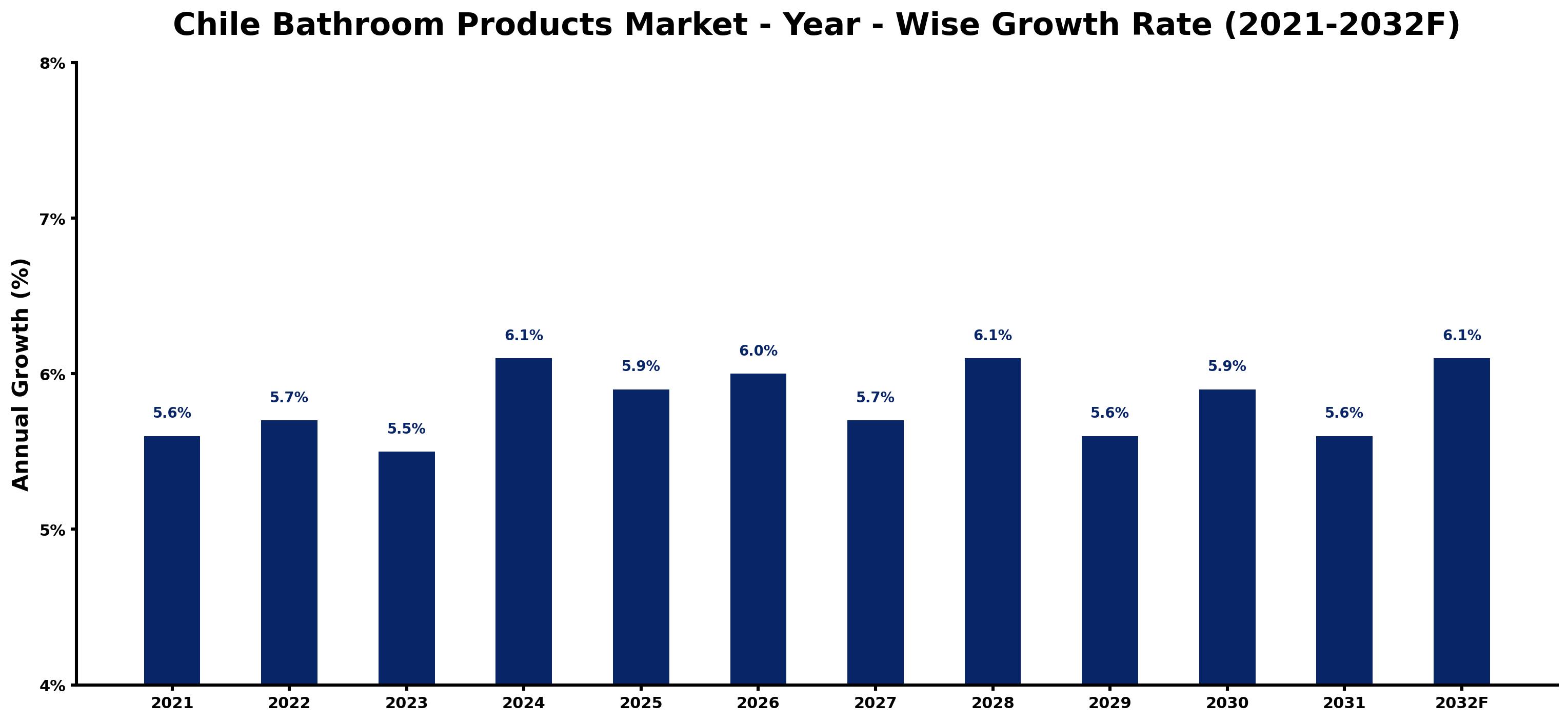
The table below presents the year wise growth rates along with the key drivers influencing the market
| Year | Growth Rate | Major Drivers |
| 2021 | 5.6% | Post-pandemic renovation projects inspire increased spending on bathroom aesthetics and functionality. |
| 2022 | 5.7% | Consumer interest shifts towards eco-friendly products, enhancing market competition and innovation. |
| 2023 | 5.5% | Urbanization trends elevate demand for compact and multifunctional bathroom solutions in cities. |
| 2024 | 6.1% | Luxury bathroom brands gain traction, catering to affluent consumer preferences for premium materials. |
| 2025 | 5.9% | Smart home technologies redefine bathroom experiences, integrating IoT for modern households. |
| 2026 | 6.0% | Sustainable materials emerge as a priority, influencing purchasing decisions in bathroom renovations. |
| 2027 | 5.7% | Growth in e-commerce platforms enables easier access to diverse bathroom product offerings. |
| 2028 | 6.1% | Increased disposable income supports higher spending on home improvement and wellness products. |
| 2029 | 5.6% | Shift towards minimalist designs drives demand for sleek, space-saving bathroom fixtures. |
| 2030 | 5.9% | Rising interest in health and wellness promotes the integration of spa-like features at home. |
| 2031 | 5.6% | Home automation trends signal a preference for technology-rich bathroom environments and experiences. |
| 2032 | 6.1% | Cultural emphasis on self-care drives continuous investment in luxurious bathroom spaces. |
Note - Market size estimations and growth projections presented in this report are based on 6Wresearch's advanced forecasting approach, validated with industry datasets as of June 2026.
Chile Bathroom Products Market Synopsis
The Chile Bathroom Products Market is projected to reach 6.0% and witness significant growth during the forecast period (2026-2032). This growth is primarily driven by factors such as increasing urbanization, a rise in disposable incomes, and evolving consumer lifestyles. The market encompasses a comprehensive spectrum of bathroom products, including fixtures, faucets, showers, toilets, and various accessories, reflecting a diverse set of consumer needs.
Chile Bathroom Products Market Growth Drivers
One of the principal drivers of the Chile Bathroom Products Market is the rapid urbanization occurring across the country. As more individuals and families move into urban areas, there is an increasing requirement for modern and efficient bathroom solutions. Additionally, growing disposable incomes among the population enable consumers to invest in higher-quality and technologically advanced bathroom fixtures.
The shift in consumer preferences towards stylish and functional bathroom aesthetics encourages manufacturers to innovate and adapt their product offerings. Furthermore, a heightened awareness of environmental issues is prompting consumers to seek out eco-friendly and water-saving bathroom products, which, in turn, stimulates market growth.
Moreover, the trend towards home renovations, amplified by the COVID-19 pandemic, has led consumers to enhance their living spaces, including bathrooms. This renovation wave supports the demand for diverse bathroom products designed to improve functionality and aesthetics.
The increase in real estate development also contributes to market growth, as new residential and commercial constructions require comprehensive bathroom installations. This combination of factors positions the Chile Bathroom Products Market for robust expansion over the coming years.
Chile Bathroom Products Market Trends and Opportunities
Sustainability continues to shape the trends in the Chile Bathroom Products Market, with an increasing demand for water-saving fixtures and eco-friendly materials. Manufacturers are increasingly focusing on creating products that minimize water usage and reduce environmental footprints, aligning with consumer expectations for sustainable living.
- Integration of smart technology within bathroom products is becoming a defining trend. Touchless faucets, digital shower controls, and advanced toilet systems are being incorporated to enhance user experience and convenience.
- The preference for minimalist and modern designs is also prevalent, as consumers gravitate toward stylish solutions that provide functionality without compromising on aesthetics.
- There is a marked shift towards luxury and premium products, with affluent consumers willing to invest in high-end bathroom fixtures that provide a spa-like experience at home.
- In addition, the rise of online retail channels has transformed purchasing behaviors, making it easier for consumers to access a wider variety of bathroom products.
- Finally, collaborations between designers and manufacturers to create exclusive product lines are being observed, providing unique options that cater to niche consumer segments.
Chile Bathroom Products Market Challenges and Restraints
Despite the promising outlook, the Chile Bathroom Products Market faces various challenges. Intense competition among both domestic and international brands often leads to price wars and pressures on profit margins, making it challenging for companies to maintain profitability while innovating.
Economic fluctuations and currency volatility can impact consumer purchasing power, leading to shifts in demand for bathroom products. As these economic factors evolve, companies may need to adjust their strategies accordingly.
Regulatory challenges also play a significant role, with industries required to comply with environmental standards and safety regulations that can raise production costs and limit product offerings.
Geographical challenges posed by Chile's diverse landscape can complicate distribution logistics, particularly in remote regions. Companies must develop efficient distribution methods to ensure product availability across the country.
Lastly, the rapidly evolving consumer preferences demand that companies remain agile and invest continuously in research and development, keeping pace with market expectations.
Chile Bathroom Products Market Government Investment and Initiatives
Government initiatives significantly influence the Chile Bathroom Products Market. Policies promoting sustainability, particularly in manufacturing processes and product design, are being implemented. These regulations encourage the adoption of eco-friendly materials and technologies aimed at conserving water and minimizing environmental impact.
Investment in sustainable urban development by the government also supports the bathroom products market as new housing projects incorporate modern bathroom solutions that meet contemporary standards.
Additionally, consumer protection laws ensure that products meet strict quality standards, thus promoting safety and reliability within the market. Transparency in labeling and pricing also fosters trust among consumers.
Public spending initiatives aimed at enhancing infrastructure may lead to increased demand for commercial bathroom products in public facilities, schools, and hospitals. The overall governmental direction emphasizes sustainability, quality, and consumer rights, which are expected to shape the market landscape positively.
Chile Bathroom Products Market Latest Developments (May 2025 - June 2026)
Recent developments in the Chile Bathroom Products Market highlight a growing inclination towards sustainable practices and technology integration. The period has seen a rise in innovative products that utilize smart technologies, catering to the demand for convenience and efficiency among consumers.
Furthermore, collaborations between manufacturers and designers have increased, leading to exclusive product lines that fulfill specific consumer desires for luxury and uniqueness.
The government's continued focus on environmental sustainability has catalyzed innovations in water-saving technologies and eco-friendly materials in bathroom products. Regulatory updates have also encouraged manufacturers to adopt practices that align with these goals.
Moreover, the online retail sector has expanded, with an increasing number of consumers preferring digital platforms for their purchases, further transforming the retail landscape for bathroom products.
Overall, these developments indicate a dynamic market that is responding to consumer demands for modernity, sustainability, and convenience.
Chile Bathroom Products Market - Key Attractiveness of the Report
- 10 Years of Market Numbers
- Historical Data Starting from 2022 to 2025
- Base Year: 2025
- Forecast Data until 2032
- Key Performance Indicators Impacting the Market
- Major Upcoming Developments and Projects
Key Highlights of the Report:
- Chile Bathroom Products Market Outlook
- Market Size of Chile Bathroom Products Market, 2025
- Forecast of Chile Bathroom Products Market, 2032F
- Historical Data and Forecast of Chile Bathroom Products Revenues & Volume for the Period 2022-2032F
- Chile Bathroom Products Market Trend Evolution
- Chile Bathroom Products Market Drivers and Challenges
- Chile Bathroom Products Price Trends
- Chile Bathroom Products Porter's Five Forces
- Chile Bathroom Products Industry Life Cycle
- Historical Data and Forecast of Chile Bathroom Products Market Revenues & Volume By Product Type for the Period 2022-2032F
- Historical Data and Forecast of Chile Bathroom Products Market Revenues & Volume By Towel Rack for the Period 2022-2032F
- Historical Data and Forecast of Chile Bathroom Products Market Revenues & Volume By Shower for the Period 2022-2032F
- Historical Data and Forecast of Chile Bathroom Products Market Revenues & Volume By Soap Holder for the Period 2022-2032F
- Historical Data and Forecast of Chile Bathroom Products Market Revenues & Volume By Toilet Brushes and Holder for the Period 2022-2032F
- Historical Data and Forecast of Chile Bathroom Products Market Revenues & Volume By Others for the Period 2022-2032F
- Historical Data and Forecast of Chile Bathroom Products Market Revenues & Volume By Applications for the Period 2022-2032F
- Historical Data and Forecast of Chile Bathroom Products Market Revenues & Volume By Residential for the Period 2022-2032F
- Historical Data and Forecast of Chile Bathroom Products Market Revenues & Volume By Hotels for the Period 2022-2032F
- Historical Data and Forecast of Chile Bathroom Products Market Revenues & Volume By Others for the Period 2022-2032F
- Historical Data and Forecast of Chile Bathroom Products Market Revenues & Volume By Distribution Channel for the Period 2022-2032F
- Historical Data and Forecast of Chile Bathroom Products Market Revenues & Volume By Online for the Period 2022-2032F
- Historical Data and Forecast of Chile Bathroom Products Market Revenues & Volume By Offline for the Period 2022-2032F
- Chile Bathroom Products Import Export Trade Statistics
- Market Opportunity Assessment By Product Type
- Market Opportunity Assessment By Applications
- Market Opportunity Assessment By Distribution Channel
- Chile Bathroom Products Top Companies Market Share
- Chile Bathroom Products Competitive Benchmarking By Technical and Operational Parameters
- Chile Bathroom Products Company Profiles
- Chile Bathroom Products Key Strategic Recommendations






































