Chile Desiccated Coconut Market Top 5 Importing Countries and Market Competition (HHI) Analysis
Chile continues to be a key destination for desiccated coconut imports, with top exporters in 2024 being the Philippines, Indonesia, Sri Lanka, Vietnam, and the USA. Despite a negative compound annual growth rate (CAGR) from 2020 to 2024, the industry saw a significant growth rate of 36.93% from 2023 to 2024. The market remains concentrated, as indicated by the high Herfindahl-Hirschman Index (HHI) in 2024. This data suggests that while there have been fluctuations, there is potential for growth and competition within the Chilean desiccated coconut import market.
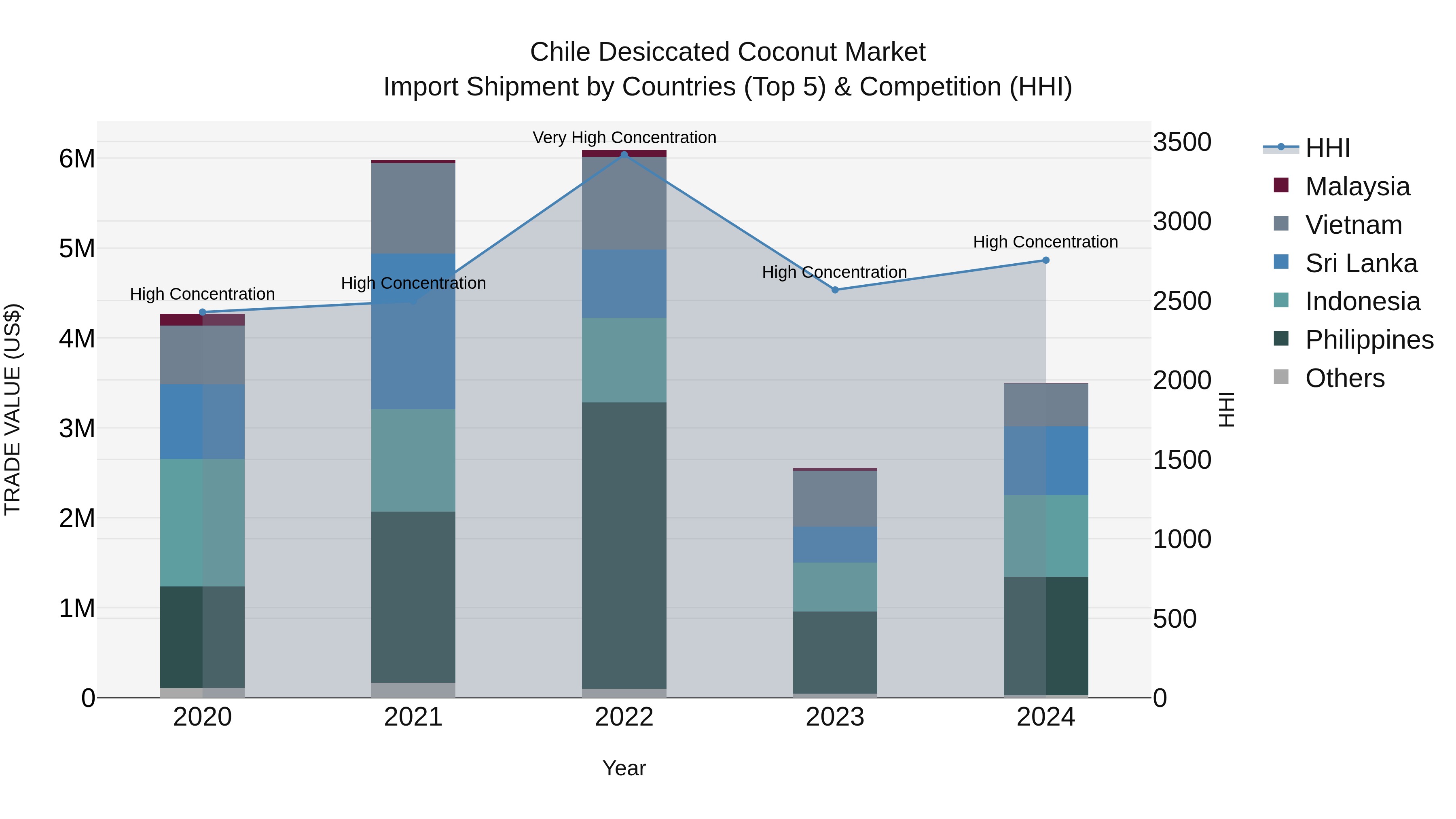
Chile Desiccated Coconut Market Overview
The Chile Desiccated Coconut market is experiencing steady growth driven by factors such as the increasing popularity of coconut-based products among health-conscious consumers and the rising demand for natural ingredients in food and beverages. The market is characterized by a diverse product range, including various grades of desiccated coconut such as fine, medium, and flaked, catering to different consumer preferences and industrial applications. Key players in the Chilean market are focusing on product innovation, quality assurance, and sustainable sourcing practices to gain a competitive edge. The growing trend of plant-based diets and the versatility of desiccated coconut as an ingredient in both sweet and savory dishes are further fueling market growth. Overall, the Chile Desiccated Coconut market presents opportunities for expansion and development in the coming years.
Chile Desiccated Coconut Market Trends
The Chile desiccated coconut market is experiencing growth driven by increasing consumer demand for healthy and natural ingredients in food products. The trend towards plant-based and vegan diets has also contributed to the rising popularity of desiccated coconut as a versatile and nutritious ingredient. Consumers are increasingly seeking out products with clean labels and minimal processing, which has boosted the demand for organic and non-GMO desiccated coconut options. Additionally, the use of desiccated coconut in a wide range of applications such as baked goods, confectionery, and savory dishes has further fueled market growth. As a result, manufacturers in Chile are focusing on product innovation, sustainable sourcing practices, and expanding distribution channels to capitalize on these trends and meet the evolving needs of consumers in the desiccated coconut market.
Chile Desiccated Coconut Market Challenges
In the Chile Desiccated Coconut Market, challenges such as fluctuating raw material prices due to external factors like weather conditions affecting coconut production, limited domestic supply leading to dependency on imports, and competition from other substitute products like dried fruits and nuts pose significant obstacles. Additionally, maintaining product quality standards, ensuring consistent supply chain efficiency, and managing transportation costs due to Chile`s geographical location can also be challenging. Furthermore, consumer preferences and trends towards healthier and organic food options require market players to adapt and innovate to meet changing demands, adding another layer of complexity to the market landscape. Overcoming these challenges requires strategic planning, market intelligence, and a deep understanding of consumer behavior in the Chilean market.
Chile Desiccated Coconut Market Investment Opportunities
The Chile Desiccated Coconut Market presents promising investment opportunities due to the increasing demand for healthy and natural food products globally. With the growing preference for plant-based and gluten-free ingredients, desiccated coconut is gaining popularity as a versatile ingredient in various food and beverage applications. Investors can capitalize on this trend by investing in desiccated coconut production facilities, processing technology upgrades, and market expansion strategies. Additionally, exploring partnerships with food manufacturers, retailers, and distributors to supply desiccated coconut products can provide a competitive edge in the market. Overall, the Chile Desiccated Coconut Market offers a lucrative investment landscape driven by consumer preferences for clean-label, sustainable, and nutritious food options.
Chile Desiccated Coconut Market Government Policy
In Chile, government policies related to the Desiccated Coconut Market primarily focus on promoting agricultural sustainability and export competitiveness. The Ministry of Agriculture provides support to coconut farmers through various programs aimed at improving production techniques, quality standards, and market access. Additionally, the government has implemented measures to ensure food safety and compliance with international regulations, enhancing the country`s reputation as a reliable supplier of desiccated coconut products. Policies also aim to stimulate innovation and technology adoption in the sector to enhance productivity and competitiveness in the global market. Overall, the government`s initiatives underscore its commitment to fostering a thriving desiccated coconut industry in Chile while meeting domestic and international market demands.
Chile Desiccated Coconut Market Future Outlook
The Chile Desiccated Coconut Market is expected to witness steady growth in the coming years due to increasing consumer demand for healthy and natural food products. The market is likely to be driven by factors such as the rising awareness of the health benefits of coconut-based products, the growing popularity of plant-based diets, and the expanding application of desiccated coconut in various food and beverage products. Additionally, the trend towards clean label and organic products is expected to further boost market growth. Manufacturers in the Chile Desiccated Coconut Market are likely to focus on product innovation, sustainable sourcing practices, and expanding distribution channels to capitalize on these opportunities and meet the evolving consumer preferences.
Key Highlights of the Report:
- Chile Desiccated Coconut Market Outlook
- Market Size of Chile Desiccated Coconut Market, 2024
- Forecast of Chile Desiccated Coconut Market, 2031
- Historical Data and Forecast of Chile Desiccated Coconut Revenues & Volume for the Period 2021 - 2031
- Chile Desiccated Coconut Market Trend Evolution
- Chile Desiccated Coconut Market Drivers and Challenges
- Chile Desiccated Coconut Price Trends
- Chile Desiccated Coconut Porter's Five Forces
- Chile Desiccated Coconut Industry Life Cycle
- Historical Data and Forecast of Chile Desiccated Coconut Market Revenues & Volume By Cut Type for the Period 2021 - 2031
- Historical Data and Forecast of Chile Desiccated Coconut Market Revenues & Volume By Regular cut for the Period 2021 - 2031
- Historical Data and Forecast of Chile Desiccated Coconut Market Revenues & Volume By Fancy cut for the Period 2021 - 2031
- Historical Data and Forecast of Chile Desiccated Coconut Market Revenues & Volume By Fat Content for the Period 2021 - 2031
- Historical Data and Forecast of Chile Desiccated Coconut Market Revenues & Volume By High fat content for the Period 2021 - 2031
- Historical Data and Forecast of Chile Desiccated Coconut Market Revenues & Volume By Low fat content for the Period 2021 - 2031
- Historical Data and Forecast of Chile Desiccated Coconut Market Revenues & Volume By Distribution Channel for the Period 2021 - 2031
- Historical Data and Forecast of Chile Desiccated Coconut Market Revenues & Volume By Supermarket for the Period 2021 - 2031
- Historical Data and Forecast of Chile Desiccated Coconut Market Revenues & Volume By Specialty stores for the Period 2021 - 2031
- Historical Data and Forecast of Chile Desiccated Coconut Market Revenues & Volume By Online sales for the Period 2021 - 2031
- Historical Data and Forecast of Chile Desiccated Coconut Market Revenues & Volume By Retail stores for the Period 2021 - 2031
- Chile Desiccated Coconut Import Export Trade Statistics
- Market Opportunity Assessment By Cut Type
- Market Opportunity Assessment By Fat Content
- Market Opportunity Assessment By Distribution Channel
- Chile Desiccated Coconut Top Companies Market Share
- Chile Desiccated Coconut Competitive Benchmarking By Technical and Operational Parameters
- Chile Desiccated Coconut Company Profiles
- Chile Desiccated Coconut Key Strategic Recommendations






































