Chile Digital Lending Market Size & Growth Rate (2026-2032)
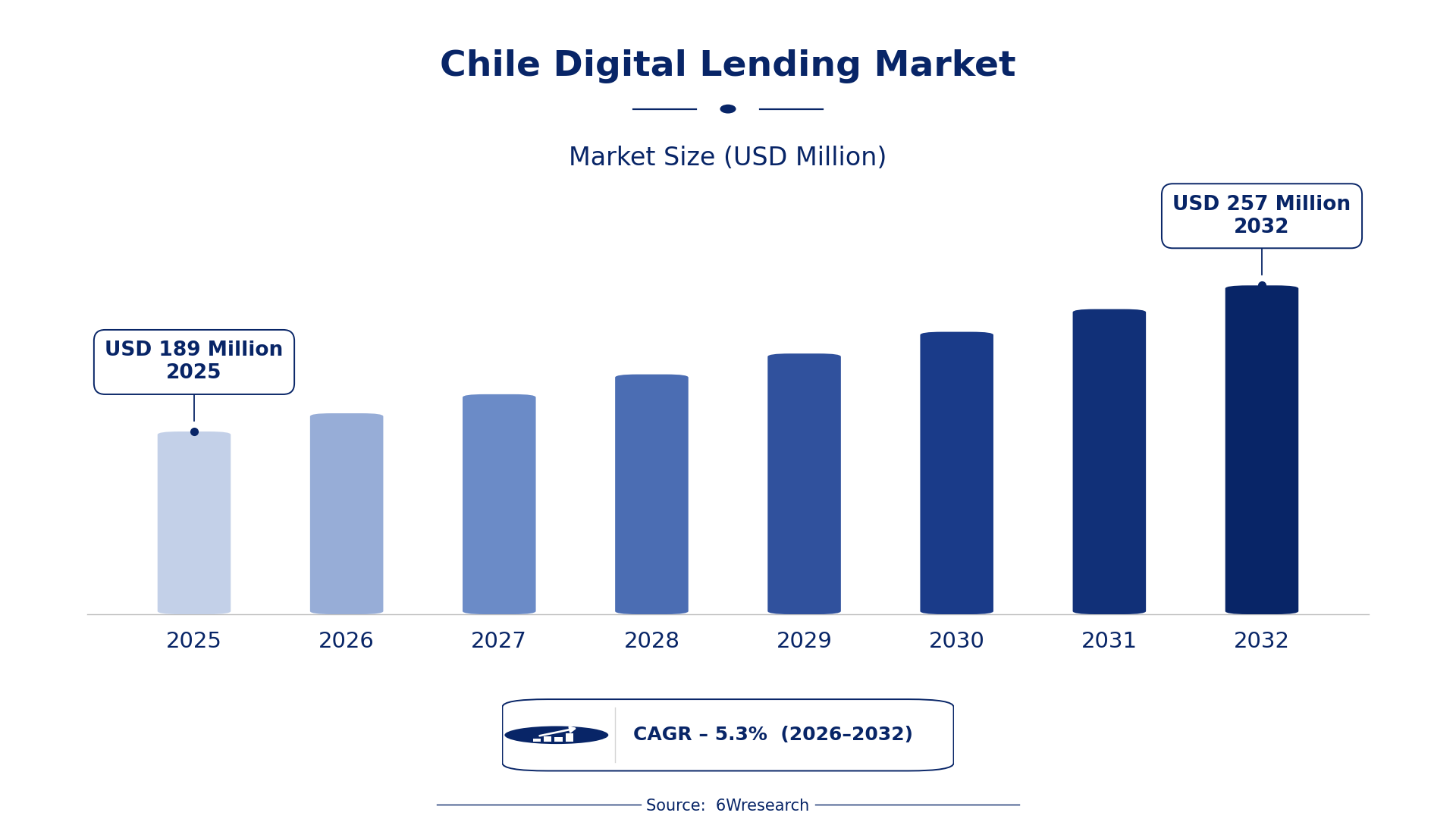
The Chile Digital Lending Market was estimated at USD 189 Million in 2025 and is projected to reach USD 257 Million by 2032, growing at a CAGR of 5.3% from 2026 to 2032.
Chile Digital Lending Market Synopsis
In Chile, the digital lending sector is witnessing a surge in demand, fueled by the increasing smartphone penetration and a tech-savvy population. This shift has prompted both traditional banks and innovative fintech companies to offer user-friendly loan products that cater to the evolving preferences of consumers.
The competitive environment is heating up as companies employ advanced technologies like AI and machine learning to streamline processes. Enhanced credit assessment mechanisms allow for quicker loan approvals, making digital lending a viable option for many Chileans who previously lacked access to conventional banking services.
Chile Digital Lending Market Year-wise Growth Rate and Key Drivers
This graph illustrates the annual growth rates of the Chile Digital Lending Market from 2021 to 2032, highlighting a steady upward trajectory and projected expansion over the forecast period.
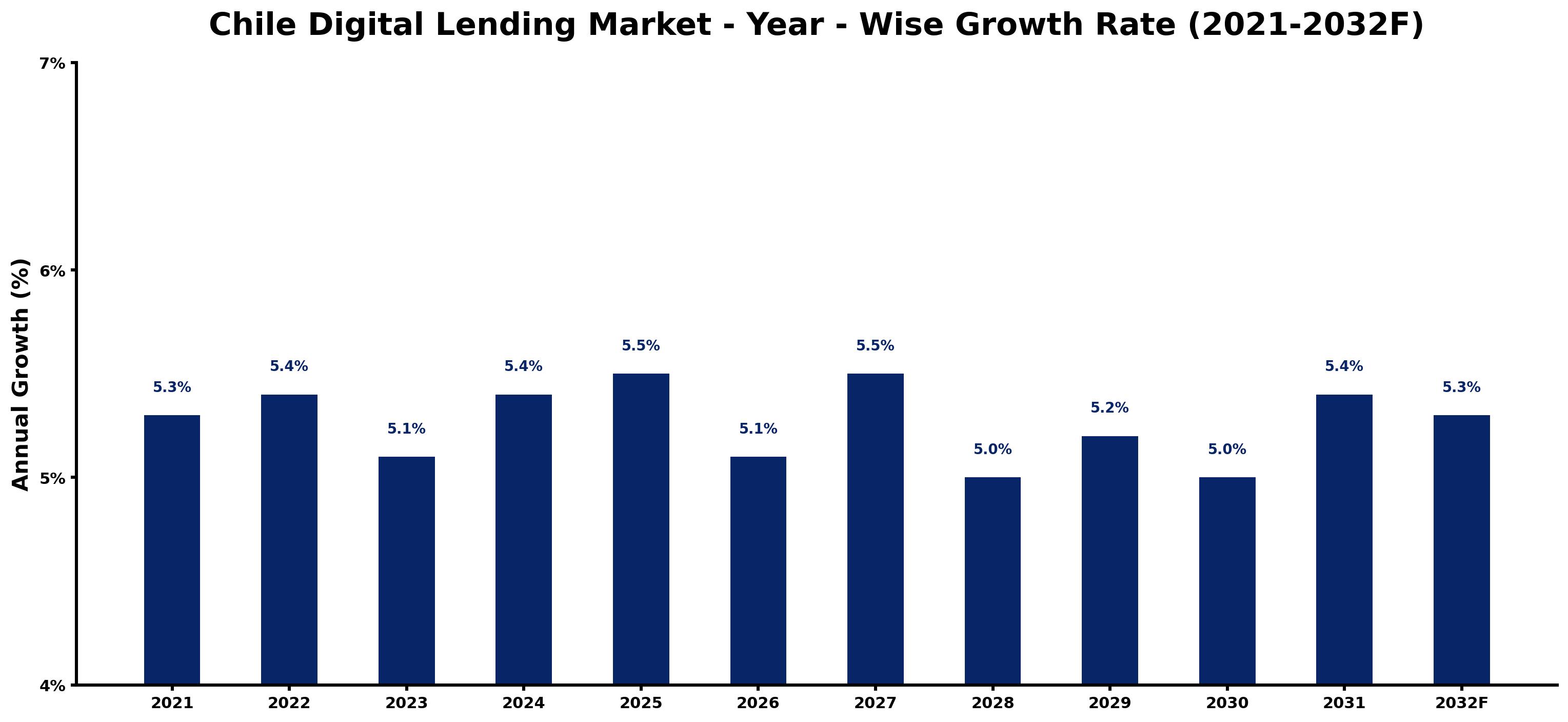
The table below presents the year‑wise growth rates along with the key drivers influencing the market
| Year | Growth Rate | Major Drivers |
| 2021 | 5.3% | Rising smartphone penetration boosting digital service adoption |
| 2022 | 5.4% | Regulatory support from CMF for digital banking solutions |
| 2023 | 5.1% | Increased consumer appetite for quick loan approvals |
| 2024 | 5.4% | E-commerce growth driving demand for flexible financing options |
| 2025 | 5.5% | Emergence of fintech startups enhancing market competitiveness |
| 2026 | 5.1% | Rising youth population favoring digital lending platforms |
| 2027 | 5.5% | Enhanced cybersecurity measures increasing consumer trust in lenders |
| 2028 | 5.0% | Government incentives promoting digital financial inclusion programs |
| 2029 | 5.2% | Accelerated digitization post-pandemic expanding loan accessibility |
| 2030 | 5.0% | Growing middle-class affluence enabling higher borrowing potential |
| 2031 | 5.4% | Improved internet connectivity facilitating online lending processes |
| 2032 | 5.3% | Public awareness campaigns educating consumers on digital loans |
Note: Market size estimations and growth projections presented in this report are based on 6Wresearch's proprietary forecasting methodology, utilizing the latest available industry data, government publications, and primary research inputs.
Chile Digital Lending Market Key Takeaways
Below are some of the specific key takeaways from the market, including:
- The market is rapidly growing due to increased smartphone usage and digital platform adoption.
- AI and machine learning technologies are transforming credit scoring and loan processing.
- There’s a noticeable shift towards peer-to-peer lending platforms, enhancing financial inclusion.
- Regulatory measures are evolving to support the digital lending ecosystem while protecting consumers.
- Partnerships between fintech firms and traditional banks are emerging, broadening market access.
Evaluation of Restraints in Chile Digital Lending Market
Despite its rapid growth, the Chile Digital Lending Market faces several restraints. Regulatory challenges are significant, particularly with evolving laws around data privacy and consumer protection. These regulations can complicate operations for digital lenders, who must adapt swiftly to maintain compliance. Additionally, the digital lending environment is vulnerable to fraud and credit risk, requiring robust identity verification methods. With increasing competition, market players also feel pressure on interest rates and profit margins, making it crucial to establish customer trust in this evolving sector.
Chile Digital Lending Market Trends
Current trends indicate a marked increase in the adoption of mobile lending applications. These apps not only cater to underserved populations but also enhance user experience through streamlined interfaces. The rise of alternative credit scoring models is enabling lenders to assess risk more accurately, ultimately resulting in more personalized loan offers. Additionally, the expansion of peer-to-peer lending platforms reflects a growing appetite for alternative finance solutions among consumers.
Chile Digital Lending Market Opportunities
Opportunities abound in the Chile Digital Lending Market, particularly for firms that harness big data analytics to refine lending decisions. Collaborations with traditional financial institutions can further enhance market reach, allowing digital lenders to tap into established customer bases. on top of that, initiatives aimed at financial inclusion present fertile ground for investment, as addressing the needs of the unbanked population can foster loyalty and drive growth in this sector.
Government Initiatives in the Chile Digital Lending Market
The Chilean government plays a crucial role in shaping the digital lending market through a framework that promotes innovation while ensuring consumer protection. Recent policy measures have focused on fostering a competitive environment, which is essential for both fintech startups and established financial institutions to thrive. These initiatives not only enhance transparency but also promote financial inclusion across various demographics.
- A regulatory sandbox introduced in 2023 allows fintech companies to test new lending solutions under the supervision of the Financial Market Commission.
- Current initiatives focus on enhancing data protection laws to safeguard consumer information in online lending transactions.
- Ongoing efforts are directed towards promoting financial literacy among underserved populations to foster responsible borrowing.
- A planned public-private partnership is expected to launch in 2026, aimed at expanding digital infrastructure and improving access to financial services.
Future Insights of the Chile Digital Lending Market
Looking ahead, the Chile Digital Lending Market is on a trajectory of substantial growth. With the anticipated rise in internet penetration and a continued shift towards digital solutions, more consumers are likely to embrace online lending platforms. The ongoing evolution of regulatory frameworks and technological advancements will further shape the market dynamics, presenting ample opportunities for innovation and expansion. As competition intensifies, companies that prioritize customer experience and regulatory adherence will stand out in this bustling landscape.
Chile Digital Lending Market Latest Developments
In the last 12 months, the Chile Digital Lending Market has seen dynamic changes, particularly in technology adoption and regulatory updates. Companies are actively enhancing their platforms to improve user experience and expedite loan processing times. The regulatory environment is also adapting to support new innovations in financial technology.
- A major technology vendor launched an upgraded AI-driven credit scoring system in Q1 2025, enhancing the accuracy of loan approvals.
- An initiative that began in early 2025 aims to integrate blockchain technology into the digital lending process for increased transparency.
- A fintech company is currently expanding its services to rural areas, focusing on underserved populations, with a rollout expected by mid-2026.
- In Q3 2025, a leading regional operator entered into a strategic partnership with a local bank to broaden its lending portfolio and improve customer outreach.
Chile Digital Lending Market - Key Attractiveness of the Report
- 10 Years of Market Numbers
- Historical Data Starting from 2022 to 2025
- Base Year: 2025
- Forecast Data until 2032
- Key Performance Indicators Impacting the Market
- Major Upcoming Developments and Projects
Key Highlights of the Report:
- Chile Digital Lending Market Outlook
- Market Size of Chile Digital Lending Market, 2025
- Forecast of Chile Digital Lending Market, 2032
- Historical Data and Forecast of Chile Digital Lending Revenues & Volume for the Period 2022-2032F
- Chile Digital Lending Market Trend Evolution
- Chile Digital Lending Market Drivers and Challenges
- Chile Digital Lending Price Trends
- Chile Digital Lending Porter's Five Forces
- Chile Digital Lending Industry Life Cycle
- Historical Data and Forecast of Chile Digital Lending Market Revenues & Volume By Offering for the Period 2022-2032F
- Historical Data and Forecast of Chile Digital Lending Market Revenues & Volume By Solutions for the Period 2022-2032F
- Historical Data and Forecast of Chile Digital Lending Market Revenues & Volume By Services for the Period 2022-2032F
- Historical Data and Forecast of Chile Digital Lending Market Revenues & Volume By Deployment Mode for the Period 2022-2032F
- Historical Data and Forecast of Chile Digital Lending Market Revenues & Volume By Cloud for the Period 2022-2032F
- Historical Data and Forecast of Chile Digital Lending Market Revenues & Volume By On-premises for the Period 2022-2032F
- Historical Data and Forecast of Chile Digital Lending Market Revenues & Volume By End User for the Period 2022-2032F
- Historical Data and Forecast of Chile Digital Lending Market Revenues & Volume By Banks for the Period 2022-2032F
- Historical Data and Forecast of Chile Digital Lending Market Revenues & Volume By Credit Unions for the Period 2022-2032F
- Historical Data and Forecast of Chile Digital Lending Market Revenues & Volume By NBFCs for the Period 2022-2032F
- Chile Digital Lending Import Export Trade Statistics
- Market Opportunity Assessment By Offering
- Market Opportunity Assessment By Deployment Mode
- Market Opportunity Assessment By End User
- Chile Digital Lending Top Companies Market Share
- Chile Digital Lending Competitive Benchmarking By Technical and Operational Parameters
- Chile Digital Lending Company Profiles
- Chile Digital Lending Key Strategic Recommendations






































