Chile Edible Oil Market Size Growth Rate
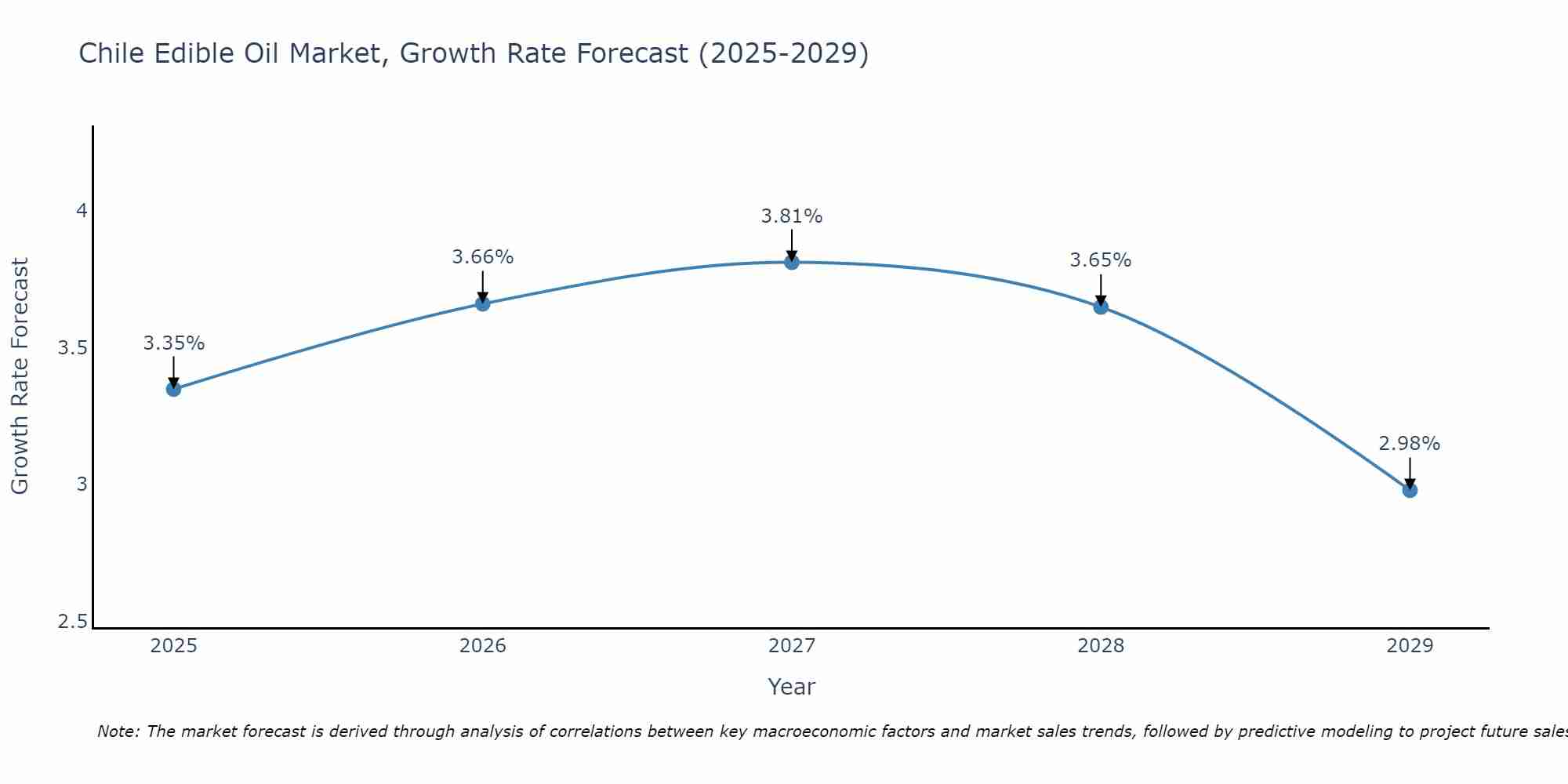
The Chile Edible Oil Market is projected to witness mixed growth rate patterns during 2025 to 2029. The growth rate begins at 3.35% in 2025, climbs to a high of 3.81% in 2027, and moderates to 2.98% by 2029.
Chile Edible Oil Market Overview
The Chile edible oil market is characterized by a diverse range of oils, including soybean, sunflower, canola, and olive oil, among others. The market is driven by factors such as increasing health awareness leading to a shift towards healthier cooking oils, rising disposable incomes, and a growing food industry. Olive oil holds a significant market share due to its perceived health benefits and culinary versatility. The market is also witnessing a trend towards organic and locally sourced oils, driven by consumer preferences for sustainable and environmentally friendly products. Key players in the market include national and international brands, competing on factors such as product quality, pricing, and marketing strategies. Overall, the Chile edible oil market is expected to continue growing, driven by changing consumer preferences and increasing demand for healthier cooking alternatives.
Chile Edible Oil Market Trends
The Chile Edible Oil Market is experiencing a shift towards healthier and more sustainable options, with a growing preference for oils such as olive oil and avocado oil due to their perceived health benefits and superior flavor profiles. Consumers are increasingly seeking out products that are non-GMO, organic, and have high levels of antioxidants. Additionally, there is a rising awareness of the environmental impact of palm oil production, leading to a greater demand for sustainable and ethically sourced oils. Manufacturers are responding to these trends by introducing new product lines that cater to the health-conscious and environmentally conscious consumer segments. Overall, the Chile Edible Oil Market is witnessing a transformation towards premium, high-quality oils that align with changing consumer preferences.
Chile Edible Oil Market Challenges
In the Chilean edible oil market, challenges primarily revolve around changing consumer preferences towards healthier and more sustainable options. There is a growing demand for oils perceived as healthier, such as olive oil and avocado oil, which poses a challenge for traditional vegetable oils like sunflower and soybean oil. Additionally, consumer awareness about sustainability and environmental impact is increasing, leading to a preference for oils with eco-friendly production practices. Economic factors, including fluctuating raw material prices and currency exchange rates, also impact the market. Regulatory changes and trade policies can further complicate the market landscape. Overall, companies operating in the Chilean edible oil market need to adapt to evolving consumer preferences, sustainability concerns, and economic uncertainties to remain competitive.
Chile Edible Oil Market Investment Opportunities
The Chilean Edible Oil Market offers attractive investment opportunities due to growing consumer demand for healthier cooking oils and increasing awareness of the health benefits associated with oils such as olive oil and avocado oil. These oils are seen as more natural and nutritious options compared to traditional oils like soybean and sunflower oil. Additionally, Chile`s reputation for producing high-quality olive oil and avocado oil presents opportunities for investors looking to capitalize on the country`s strong agricultural sector. Investing in production facilities, distribution networks, and marketing efforts for premium edible oils in Chile could prove to be a lucrative venture as consumer preferences continue to shift towards healthier and more sustainable food choices.
Chile Edible Oil Market Government Policy
Government policies related to the Chile Edible Oil Market focus on promoting domestic production and ensuring food safety. The government provides support to local producers through subsidies, incentives, and regulations to increase production capacity and improve product quality. Additionally, there are strict regulations in place to monitor the quality and safety standards of edible oils in the market, ensuring that consumers have access to safe and healthy products. The government also encourages sustainable practices in the production and distribution of edible oils to protect the environment and promote long-term industry growth. Overall, the government`s policies aim to foster a competitive and sustainable edible oil market in Chile while prioritizing consumer health and safety.
Chile Edible Oil Market Future Outlook
The Chile Edible Oil Market is expected to witness steady growth in the coming years due to increasing consumer awareness regarding health benefits associated with consuming healthy oils. The market is likely to be driven by factors such as rising disposable incomes, shifting dietary preferences towards healthier options, and a growing demand for convenience foods. Additionally, the focus on sustainable sourcing practices and the introduction of innovative oil variants are anticipated to further propel market growth. With the increasing adoption of healthier cooking oils and the presence of key players expanding their product portfolios, the Chile Edible Oil Market is poised for sustained growth and development in the foreseeable future.
Key Highlights of the Report:
- Chile Edible Oil Market Outlook
- Market Size of Chile Edible Oil Market, 2021
- Forecast of Chile Edible Oil Market, 2031
- Historical Data and Forecast of Chile Edible Oil Revenues & Volume for the Period 2018 - 2031
- Chile Edible Oil Market Trend Evolution
- Chile Edible Oil Market Drivers and Challenges
- Chile Edible Oil Price Trends
- Chile Edible Oil Porter's Five Forces
- Chile Edible Oil Industry Life Cycle
- Historical Data and Forecast of Chile Edible Oil Market Revenues & Volume By Type for the Period 2018 - 2031
- Historical Data and Forecast of Chile Edible Oil Market Revenues & Volume By Palm Oil for the Period 2018 - 2031
- Historical Data and Forecast of Chile Edible Oil Market Revenues & Volume By Soybean Oil for the Period 2018 - 2031
- Historical Data and Forecast of Chile Edible Oil Market Revenues & Volume By Mustard Oil for the Period 2018 - 2031
- Historical Data and Forecast of Chile Edible Oil Market Revenues & Volume By Sunflower Oil for the Period 2018 - 2031
- Historical Data and Forecast of Chile Edible Oil Market Revenues & Volume By Others for the Period 2018 - 2031
- Historical Data and Forecast of Chile Edible Oil Market Revenues & Volume By for the Period 2018 - 2031
- Historical Data and Forecast of Chile Edible Oil Market Revenues & Volume By Packaging Type for the Period 2018 - 2031
- Historical Data and Forecast of Chile Edible Oil Market Revenues & Volume By Pouches for the Period 2018 - 2031
- Historical Data and Forecast of Chile Edible Oil Market Revenues & Volume By Jars for the Period 2018 - 2031
- Historical Data and Forecast of Chile Edible Oil Market Revenues & Volume By Cans for the Period 2018 - 2031
- Historical Data and Forecast of Chile Edible Oil Market Revenues & Volume By Bottles for the Period 2018 - 2031
- Historical Data and Forecast of Chile Edible Oil Market Revenues & Volume By for the Period 2018 - 2031
- Historical Data and Forecast of Chile Edible Oil Market Revenues & Volume By Pack Size for the Period 2018 - 2031
- Historical Data and Forecast of Chile Edible Oil Market Revenues & Volume By Less than 1 Litres for the Period 2018 - 2031
- Historical Data and Forecast of Chile Edible Oil Market Revenues & Volume By 1 Litres for the Period 2018 - 2031
- Historical Data and Forecast of Chile Edible Oil Market Revenues & Volume By 1 Litres - 5 litres for the Period 2018 - 2031
- Historical Data and Forecast of Chile Edible Oil Market Revenues & Volume By 5 Litres - 10 Litres for the Period 2018 - 2031
- Historical Data and Forecast of Chile Edible Oil Market Revenues & Volume By 10 Litres and Above for the Period 2018 - 2031
- Historical Data and Forecast of Chile Edible Oil Market Revenues & Volume By for the Period 2018 - 2031
- Historical Data and Forecast of Chile Edible Oil Market Revenues & Volume By Packaging Material for the Period 2018 - 2031
- Historical Data and Forecast of Chile Edible Oil Market Revenues & Volume By Metal for the Period 2018 - 2031
- Historical Data and Forecast of Chile Edible Oil Market Revenues & Volume By Plastic for the Period 2018 - 2031
- Historical Data and Forecast of Chile Edible Oil Market Revenues & Volume By Paper for the Period 2018 - 2031
- Historical Data and Forecast of Chile Edible Oil Market Revenues & Volume By Others for the Period 2018 - 2031
- Historical Data and Forecast of Chile Edible Oil Market Revenues & Volume By Application for the Period 2018 - 2031
- Historical Data and Forecast of Chile Edible Oil Market Revenues & Volume By HoReCa for the Period 2018 - 2031
- Historical Data and Forecast of Chile Edible Oil Market Revenues & Volume By Home Users for the Period 2018 - 2031
- Historical Data and Forecast of Chile Edible Oil Market Revenues & Volume By Food Processing Industry for the Period 2018 - 2031
- Historical Data and Forecast of Chile Edible Oil Market Revenues & Volume By for the Period 2018 - 2031
- Historical Data and Forecast of Chile Edible Oil Market Revenues & Volume By Distribution Channel for the Period 2018 - 2031
- Historical Data and Forecast of Chile Edible Oil Market Revenues & Volume By Direct/Institutional Sales for the Period 2018 - 2031
- Historical Data and Forecast of Chile Edible Oil Market Revenues & Volume By Supermarkets and Hypermarkets for the Period 2018 - 2031
- Historical Data and Forecast of Chile Edible Oil Market Revenues & Volume By Convenience Stores for the Period 2018 - 2031
- Historical Data and Forecast of Chile Edible Oil Market Revenues & Volume By Online for the Period 2018 - 2031
- Historical Data and Forecast of Chile Edible Oil Market Revenues & Volume By Others for the Period 2018 - 2031
- Chile Edible Oil Import Export Trade Statistics
- Market Opportunity Assessment By Type
- Market Opportunity Assessment By Packaging Type
- Market Opportunity Assessment By Pack Size
- Market Opportunity Assessment By Packaging Material
- Market Opportunity Assessment By Application
- Market Opportunity Assessment By Distribution Channel
- Chile Edible Oil Top Companies Market Share
- Chile Edible Oil Competitive Benchmarking By Technical and Operational Parameters
- Chile Edible Oil Company Profiles
- Chile Edible Oil Key Strategic Recommendations






































