Chile Ethyl Alcohol Market Top 5 Importing Countries and Market Competition (HHI) Analysis
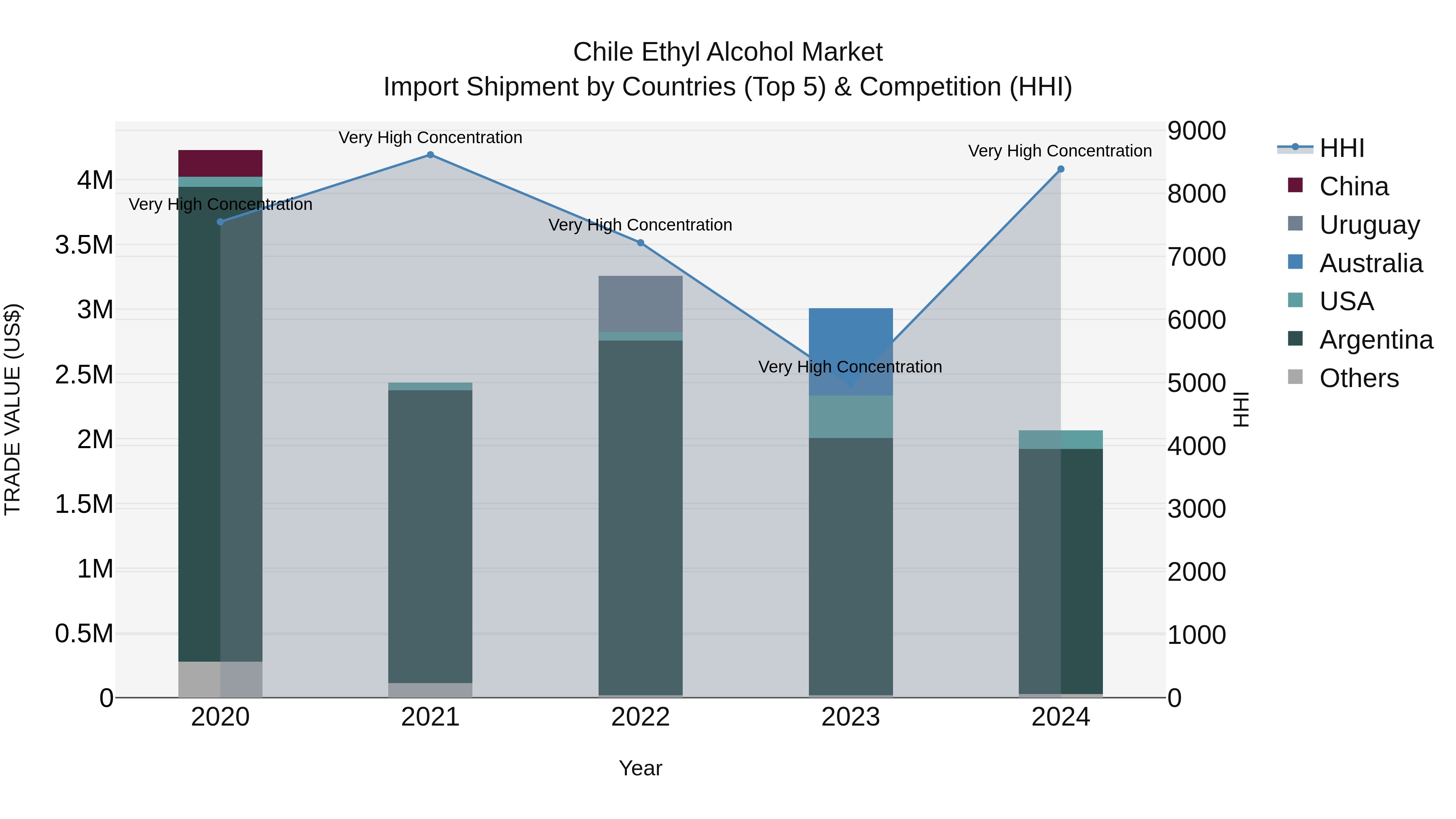
Chile`s ethyl alcohol import market in 2024 saw a significant decline with a CAGR of -16.41% from 2020 to 2024, and a sharp growth rate decrease of -31.39% from 2023 to 2024. Despite the challenging market conditions, the top countries exporting to Chile remained consistent, with Argentina, USA, Belgium, UK, and Japan leading the way. The high concentration levels, as indicated by the HHI, suggest a competitive landscape with a few dominant players shaping the market dynamics. Continued monitoring of these trends will be crucial for stakeholders in the industry.
Chile Ethyl Alcohol Market Overview
The Chile ethyl alcohol market is experiencing steady growth driven by diverse factors such as increasing demand for biofuels, expanding applications in the pharmaceutical and personal care industries, and rising consumption of alcoholic beverages. The market is primarily dominated by industrial-grade ethyl alcohol used in various sectors, while there is also a growing trend towards the production and consumption of premium spirits and alcoholic beverages. Government initiatives promoting renewable energy sources further support the market growth, as ethanol production from sugarcane and other feedstocks gains traction. Key players in the Chilean ethyl alcohol market include agricultural producers, ethanol manufacturers, and beverage companies. The market is expected to continue growing, driven by the increasing focus on sustainability and renewable energy sources.
Chile Ethyl Alcohol Market Trends
The Chile Ethyl Alcohol Market is experiencing a growth trend driven by increasing demand for ethanol as a fuel additive, disinfectant, and ingredient in the pharmaceutical and beverage industries. The market is witnessing a shift towards bioethanol production due to growing environmental concerns and government initiatives promoting renewable energy sources. Additionally, the COVID-19 pandemic has led to a surge in demand for ethyl alcohol-based sanitizers and disinfectants, further boosting market growth. Key players in the market are focusing on expanding their production capacities and investing in research and development to enhance product quality and meet the evolving consumer preferences. Overall, the Chile Ethyl Alcohol Market is poised for continued growth in the foreseeable future.
Chile Ethyl Alcohol Market Challenges
In the Chile Ethyl Alcohol Market, there are several challenges faced by industry players. One significant challenge is the fluctuating raw material prices, particularly for sugarcane or corn used in ethanol production, which can impact profit margins and pricing strategies. Additionally, regulatory hurdles and government policies related to ethanol production and consumption can create uncertainty for market participants. Competition from imported ethyl alcohol products and the need for continuous innovation to meet sustainability goals and consumer preferences are other key challenges. Moreover, economic fluctuations and global market trends can also influence the demand and supply dynamics in the Chile Ethyl Alcohol Market, requiring companies to stay agile and adaptable to remain competitive in the industry.
Chile Ethyl Alcohol Market Investment Opportunities
The Chile Ethyl Alcohol Market presents promising investment opportunities, driven by the increasing demand for ethanol as a fuel additive and in beverage production. With Chile being a key player in the Latin American ethanol market, investors can consider opportunities in ethanol production facilities, distribution networks, and technology advancements to enhance production efficiency and quality. Additionally, the growing trend towards sustainable and eco-friendly practices presents opportunities for investments in ethanol made from renewable sources such as sugarcane or corn. As the global focus on reducing carbon emissions intensifies, investing in the Chile Ethyl Alcohol Market can offer long-term growth potential and contribute to the country`s sustainable development goals.
Chile Ethyl Alcohol Market Government Policy
The Chilean government regulates the ethyl alcohol market through various policies aimed at ensuring quality and safety standards. The Ministry of Health oversees the production, importation, and distribution of ethyl alcohol, setting requirements for labeling, packaging, and advertising to protect consumers. Additionally, the Ministry of Agriculture monitors the cultivation and production of raw materials used in alcohol production to maintain sustainability and prevent environmental harm. The government also imposes taxes on alcohol products to control consumption and generate revenue. Overall, these policies create a regulatory framework that promotes responsible production and consumption practices in the Chilean ethyl alcohol market.
Chile Ethyl Alcohol Market Future Outlook
The future outlook for the Chile Ethyl Alcohol Market appears promising due to the increasing demand for ethanol as a biofuel and the growing application of ethyl alcohol in the pharmaceutical and cosmetic industries. Additionally, the government`s initiatives to promote the use of ethanol as a renewable energy source are expected to drive market growth. However, factors such as fluctuating raw material prices, regulatory challenges, and competition from other biofuels could pose challenges to market expansion. Overall, with the increasing focus on sustainability and the shift towards renewable energy sources, the Chile Ethyl Alcohol Market is likely to experience steady growth in the coming years, presenting opportunities for market players to innovate and expand their offerings to meet the evolving needs of various industries.
Key Highlights of the Report:
- Chile Ethyl Alcohol Market Outlook
- Market Size of Chile Ethyl Alcohol Market, 2021
- Forecast of Chile Ethyl Alcohol Market, 2031
- Historical Data and Forecast of Chile Ethyl Alcohol Revenues & Volume for the Period 2018 - 2031
- Chile Ethyl Alcohol Market Trend Evolution
- Chile Ethyl Alcohol Market Drivers and Challenges
- Chile Ethyl Alcohol Price Trends
- Chile Ethyl Alcohol Porter's Five Forces
- Chile Ethyl Alcohol Industry Life Cycle
- Historical Data and Forecast of Chile Ethyl Alcohol Market Revenues & Volume By Grade for the Period 2018 - 2031
- Historical Data and Forecast of Chile Ethyl Alcohol Market Revenues & Volume By Food Grade for the Period 2018 - 2031
- Historical Data and Forecast of Chile Ethyl Alcohol Market Revenues & Volume By Industrial Grade for the Period 2018 - 2031
- Historical Data and Forecast of Chile Ethyl Alcohol Market Revenues & Volume By Pharmaceutical Grade for the Period 2018 - 2031
- Historical Data and Forecast of Chile Ethyl Alcohol Market Revenues & Volume By Lab Grade for the Period 2018 - 2031
- Historical Data and Forecast of Chile Ethyl Alcohol Market Revenues & Volume By End-user Industry for the Period 2018 - 2031
- Historical Data and Forecast of Chile Ethyl Alcohol Market Revenues & Volume By Automotive and Transportation for the Period 2018 - 2031
- Historical Data and Forecast of Chile Ethyl Alcohol Market Revenues & Volume By Food and Beverage for the Period 2018 - 2031
- Historical Data and Forecast of Chile Ethyl Alcohol Market Revenues & Volume By Pharmaceutical for the Period 2018 - 2031
- Historical Data and Forecast of Chile Ethyl Alcohol Market Revenues & Volume By Cosmetics and Personal Care (Includes hand-Sanitizer) for the Period 2018 - 2031
- Historical Data and Forecast of Chile Ethyl Alcohol Market Revenues & Volume By Other End-user Industries for the Period 2018 - 2031
- Chile Ethyl Alcohol Import Export Trade Statistics
- Market Opportunity Assessment By Grade
- Market Opportunity Assessment By End-user Industry
- Chile Ethyl Alcohol Top Companies Market Share
- Chile Ethyl Alcohol Competitive Benchmarking By Technical and Operational Parameters
- Chile Ethyl Alcohol Company Profiles
- Chile Ethyl Alcohol Key Strategic Recommendations






































