Chile Football Market Top 5 Importing Countries and Market Competition (HHI) Analysis
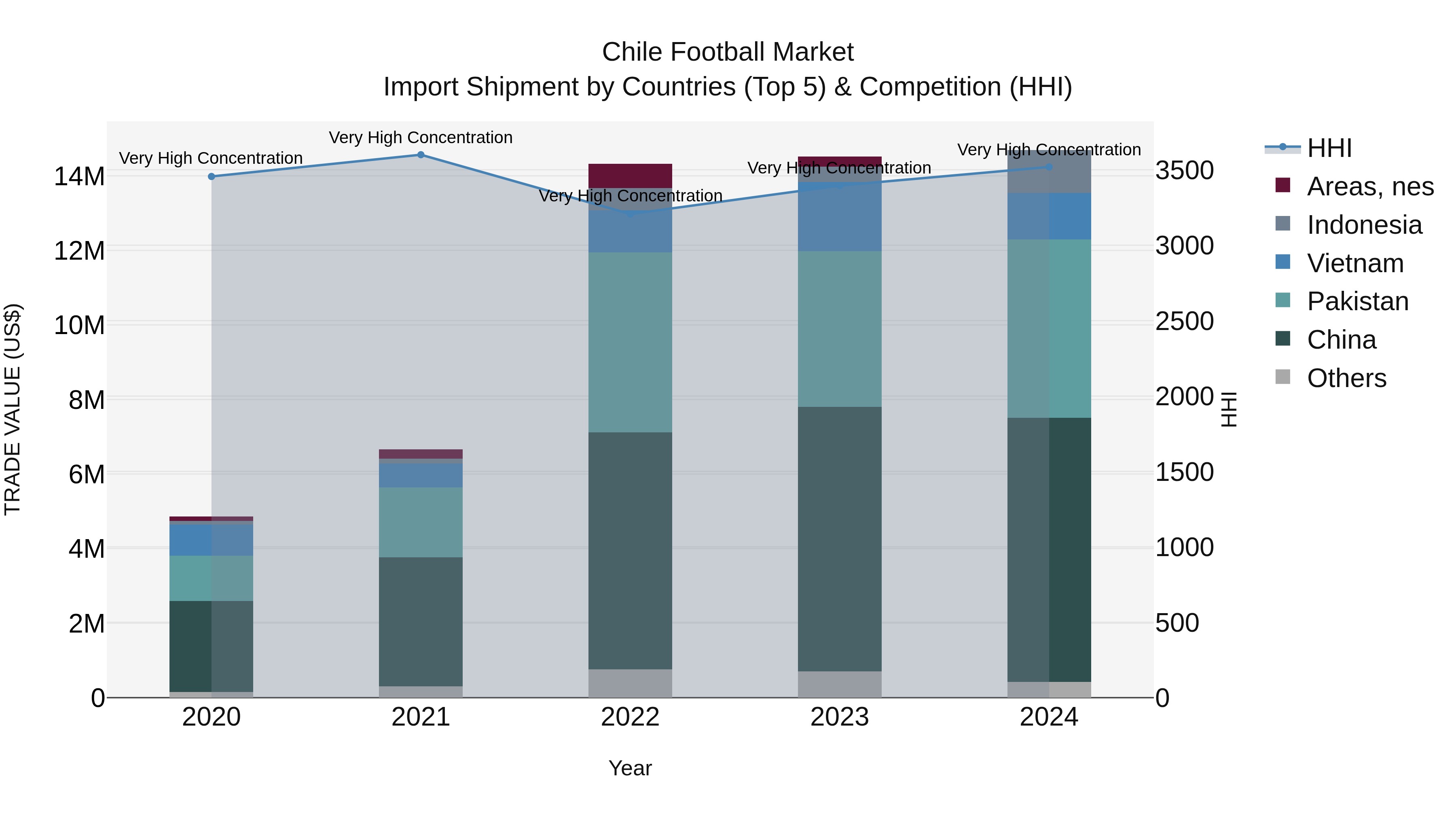
Chile continues to see a significant influx of football imports, with key exporting countries in 2024 including China, Pakistan, Vietnam, Indonesia, and Thailand. The high Herfindahl-Hirschman Index (HHI) concentration indicates a competitive market. With a notable compound annual growth rate (CAGR) of 31.88% from 2020 to 2024, the industry is showing strong expansion. Although the growth rate slightly decreased to 1.21% in 2024 compared to the previous year, the overall trend suggests a thriving market for football imports in Chile.
Chile Football Market Overview
The Chile football market is characterized by a passionate fan base, with football being the most popular sport in the country. The top-tier league, known as the Chilean Primera División, features prominent clubs such as Colo-Colo, Universidad de Chile, and Universidad Católica, which enjoy strong fan following and rivalry. The market is also influenced by successful national teams, with Chile having a rich footballing history that includes two Copa America titles in recent years. Sponsorship deals, broadcasting rights, and merchandise sales play a significant role in the market, with clubs competing for financial resources to strengthen their squads and infrastructure. The market`s growth potential is evident, with increasing investment in youth development and infrastructure aimed at further boosting the sport`s popularity and competitiveness in Chile.
Chile Football Market Trends
In the Chile Football Market, there is a growing emphasis on youth development and talent identification. Clubs are investing more resources in their youth academies to nurture and develop homegrown talents. Additionally, there is a trend towards data-driven decision-making in player recruitment and performance analysis, with clubs utilizing advanced analytics to identify promising players and optimize team strategies. The market is also witnessing an increased focus on sustainability and social responsibility, with clubs engaging in community outreach programs and environmental initiatives. Furthermore, there is a growing interest in women`s football, with investments being made to develop the women`s game and increase its visibility and popularity in Chile. Overall, the Chile Football Market is evolving towards a more modern and inclusive approach that prioritizes talent development, data analytics, sustainability, and diversity.
Chile Football Market Challenges
In the Chilean football market, one of the key challenges faced is the lack of financial resources and investment in clubs, leading to difficulties in maintaining and attracting top talent. The unequal distribution of wealth among clubs also creates an imbalance in competition, with a few dominant teams overshadowing smaller clubs. Additionally, issues such as inadequate infrastructure, low attendance at matches, and limited commercial opportunities hinder the overall growth and sustainability of the football industry in Chile. Furthermore, the lack of a strong domestic league and international exposure compared to other Latin American countries poses a challenge in attracting global attention and investment. Addressing these challenges will be crucial in developing a more competitive and prosperous football market in Chile.
Chile Football Market Investment Opportunities
The Chilean football market presents various investment opportunities for those looking to tap into the growing sports industry. Potential investments include acquiring stakes in top-tier clubs like Colo-Colo or Universidad de Chile, which have strong fan bases and revenue streams from ticket sales, merchandise, and broadcasting rights. Additionally, there is room for investment in youth development programs to nurture talent and potentially sell players to international clubs for a profit. Sponsorship deals with clubs or individual players can also be lucrative, given the popularity of football in Chile. Overall, the Chilean football market offers avenues for investment in clubs, player development, and sponsorship opportunities that can provide returns through the country`s passion for the sport and its potential for growth.
Chile Football Market Government Policy
The Chilean government has implemented various policies to support and regulate the football market in the country. One key policy is the Sports Law, which aims to promote transparency, good governance, and financial sustainability in sports clubs, including football teams. This law requires clubs to adhere to strict financial regulations, such as maintaining balanced budgets and transparent financial reporting. Additionally, the government provides financial support to clubs through grants and subsidies to promote the development of football at the grassroots level. Furthermore, the National Sports Institute (IND) oversees the implementation of these policies and works to ensure fair competition and integrity within the football market. Overall, these government policies play a crucial role in shaping the football landscape in Chile and fostering a sustainable and competitive environment for clubs and players.
Chile Football Market Future Outlook
The Chile Football Market is poised for a positive future outlook with growing interest and investment in the sport. The country`s successful national team performances, participation in international competitions, and the development of top-quality players are expected to drive continued growth in the market. Additionally, the increasing popularity of football among the younger generation, coupled with the expansion of grassroots programs and infrastructure improvement initiatives, will further contribute to the market`s expansion. Sponsorship deals, broadcasting rights, and merchandise sales are expected to increase, offering lucrative opportunities for stakeholders in the Chilean football industry. Overall, with a strong foundation and a growing fan base, the Chile Football Market is likely to thrive in the coming years.
Key Highlights of the Report:
- Chile Football Market Outlook
- Market Size of Chile Football Market, 2021
- Forecast of Chile Football Market, 2031
- Historical Data and Forecast of Chile Football Revenues & Volume for the Period 2018 - 2031
- Chile Football Market Trend Evolution
- Chile Football Market Drivers and Challenges
- Chile Football Price Trends
- Chile Football Porter's Five Forces
- Chile Football Industry Life Cycle
- Historical Data and Forecast of Chile Football Market Revenues & Volume By Type for the Period 2018 - 2031
- Historical Data and Forecast of Chile Football Market Revenues & Volume By Training Ball for the Period 2018 - 2031
- Historical Data and Forecast of Chile Football Market Revenues & Volume By Match Ball for the Period 2018 - 2031
- Historical Data and Forecast of Chile Football Market Revenues & Volume By Others for the Period 2018 - 2031
- Historical Data and Forecast of Chile Football Market Revenues & Volume By Manufacturing Process for the Period 2018 - 2031
- Historical Data and Forecast of Chile Football Market Revenues & Volume By Hand Stitched for the Period 2018 - 2031
- Historical Data and Forecast of Chile Football Market Revenues & Volume By Machine Stitched for the Period 2018 - 2031
- Historical Data and Forecast of Chile Football Market Revenues & Volume By Thermally Bonded for the Period 2018 - 2031
- Historical Data and Forecast of Chile Football Market Revenues & Volume By Distribution Channel for the Period 2018 - 2031
- Historical Data and Forecast of Chile Football Market Revenues & Volume By Online for the Period 2018 - 2031
- Historical Data and Forecast of Chile Football Market Revenues & Volume By Offline for the Period 2018 - 2031
- Chile Football Import Export Trade Statistics
- Market Opportunity Assessment By Type
- Market Opportunity Assessment By Manufacturing Process
- Market Opportunity Assessment By Distribution Channel
- Chile Football Top Companies Market Share
- Chile Football Competitive Benchmarking By Technical and Operational Parameters
- Chile Football Company Profiles
- Chile Football Key Strategic Recommendations






































