Chile Fruit Pulp Market Size, Share & Growth Rate
The Chile Fruit Pulp Market was estimated at USD 1184 Million in 2025 and is projected to reach USD 1723 Million by 2032, growing at a CAGR of 5.5% from 2026 to 2032. This growth trajectory is primarily fueled by the increasing consumer preference for natural and healthy food products. Additionally, the surging popularity of fruit-based beverages and desserts, coupled with substantial investments in the country's fruit processing infrastructure, underscores the optimism surrounding this market.
Chile Fruit Pulp Market Year-wise Growth Rate and Key Drivers
This graph highlights how the Chile Fruit Pulp Market has steadily grown over the years, supported by major growth factors.
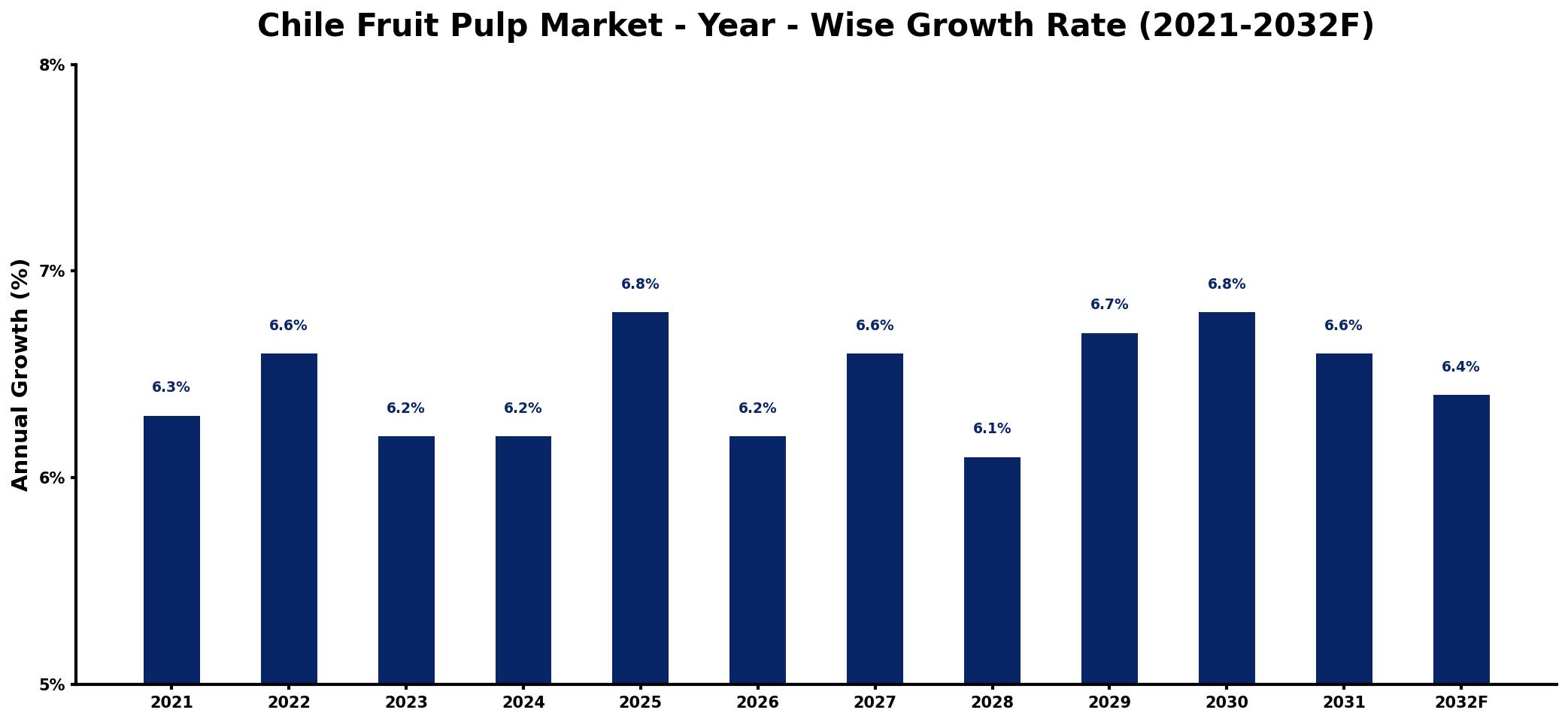
The table below presents the year‑wise growth rates along with the key drivers influencing the market
| Year | Growth Rate | Major Drivers |
| 2021 | 6.3% | Rising consumer health consciousness |
| 2022 | 6.6% | Increased demand for natural ingredients |
| 2023 | 6.2% | Growth in beverage industry applications |
| 2024 | 6.2% | Expansion of export markets |
| 2025 | 6.8% | Investment in processing technologies |
| 2026 | 6.2% | Emerging trends in vegan diets |
| 2027 | 6.6% | Surge in online retail channels |
| 2028 | 6.1% | Higher demand for organic options |
| 2029 | 6.7% | Increased focus on sustainability practices |
| 2030 | 6.8% | growing emerging market penetration |
| 2031 | 6.6% | Enhanced product innovation initiatives |
| 2032 | 6.4% | Rising popularity of functional foods |
Note: Market size estimations and growth projections presented in this report are based on 6Wresearch's proprietary forecasting methodology, utilizing the latest available industry data, government publications, and primary research inputs.
Chile Fruit Pulp Market Synopsis
The demand for natural flavors and health-oriented products is the most significant force currently shaping the Chile Fruit Pulp market. With consumers increasingly turning to fruit-based options for a healthier lifestyle, the market has responded by diversifying its offerings to include organic and non-GMO fruit pulps.
Moreover, the development of value-added products such as frozen fruit purees and smoothie blends has further catalyzed market growth. As fruit processing technologies advance, the industry is poised to meet the burgeoning needs of both domestic and international markets, ensuring a steady expansion trajectory.
Chile Fruit Pulp Market Key Takeaways
- The market is driven by a strong consumer shift towards healthy and natural food products.
- Chile's diverse fruit production underpins the country's competitive advantage in the fruit pulp sector.
- Organic and non-GMO certifications are increasingly important to consumers.
- Investment in advanced processing technologies enhances product quality and supply chain efficiency.
- The government supports the industry through policies aimed at promoting fruit pulp exports and processing facilities.
Evaluation of Restraints in Chile Fruit Pulp Market
Despite the positive growth indicators, the Chile Fruit Pulp market faces significant challenges, particularly concerning the consistency of fruit quality. The perishable nature of fruits makes it essential for producers to maintain efficient supply chains, which can be a struggle given varying climatic conditions and market fluctuations. Furthermore, competition from other fruit pulp-exporting countries may create price pressures, making it crucial for Chilean producers to innovate and differentiate their products to maintain market share.
Chile Fruit Pulp Market Trends
Current trends in the Chile Fruit Pulp market reflect a strong move towards sustainability and health consciousness among consumers. The rise of organic fruit pulps, driven by both domestic preferences and export demands, is significant. Additionally, innovations in packaging, such as eco-friendly options, are becoming more prevalent, aligning with global trends toward sustainability.
The popularity of convenience foods is also shaping demand for frozen fruit purees and smoothie blends. As more consumers seek quick, nutritious options, these products are gaining traction in various food and beverage applications. This trend is bolstered by advancements in processing technology that ensure freshness and quality, further attracting health-conscious consumers.
Chile Fruit Pulp Market Opportunities
Significant growth opportunities exist in the premium product segment, particularly with organic fruit pulps that cater to health-oriented consumers. With an increasing number of health-focused brands entering the market, there is a pronounced demand for high-quality, value-added fruit products. Additionally, as international markets expand, Chilean fruit pulp producers are well-positioned to tap into emerging economies that are beginning to embrace Western-style diets rich in natural flavors.
Government Initiatives in the Chile Fruit Pulp Market
The Chilean government recognizes the potential of the fruit pulp market and actively supports its development through various initiatives. Policies aimed at enhancing agricultural productivity, including funding for research and development in processing technologies, are becoming increasingly prevalent. There are also incentives for fruit processing facilities aimed at encouraging domestic production and improving export capabilities, making it an opportune time for market participants.
Future Insights of the Chile Fruit Pulp Market
Looking ahead to the period from 2026 to 2032, the Chile Fruit Pulp market is set to experience robust growth, underpinned by evolving consumer preferences that increasingly favor natural and health-conscious options. As processing technologies advance and distribution channels expand, market players are likely to leverage these developments to introduce innovative products. Furthermore, enhanced international trade agreements could open new avenues for exports, solidifying Chile's position as a leading player in the global fruit pulp market.
Chile Fruit Pulp Market Latest Developments (2025 - 2026)
Recently, the Chile Fruit Pulp market has witnessed notable shifts toward value-added product offerings, with an increasing number of processors investing in organic certifications. Developments in processing technologies are also becoming more prevalent, enhancing the quality and shelf-life of products. Furthermore, market players are actively exploring new international partnerships to expand their distribution networks, responding to a growing global demand for natural fruit ingredients.
Chile Fruit Pulp Market - Key Attractiveness of the Report
- 10 Years of Market Numbers
- Historical Data Starting from 2022 to 2025
- Base Year: 2025
- Forecast Data until 2032
- Key Performance Indicators Impacting the Market
- Major Upcoming Developments and Projects
Key Highlights of the Report:
- Chile Fruit Pulp Market Outlook
- Market Size of Chile Fruit Pulp Market, 2025
- Forecast of Chile Fruit Pulp Market, 2032
- Historical Data and Forecast of Chile Fruit Pulp Revenues & Volume for the Period 2022-2032F
- Chile Fruit Pulp Market Trend Evolution
- Chile Fruit Pulp Market Drivers and Challenges
- Chile Fruit Pulp Price Trends
- Chile Fruit Pulp Porter's Five Forces
- Chile Fruit Pulp Industry Life Cycle
- Historical Data and Forecast of Chile Fruit Pulp Market Revenues & Volume By Fruit Type for the Period 2022-2032F
- Historical Data and Forecast of Chile Fruit Pulp Market Revenues & Volume By Mango for the Period 2022-2032F
- Historical Data and Forecast of Chile Fruit Pulp Market Revenues & Volume By Strawberry for the Period 2022-2032F
- Historical Data and Forecast of Chile Fruit Pulp Market Revenues & Volume By Apple for the Period 2022-2032F
- Historical Data and Forecast of Chile Fruit Pulp Market Revenues & Volume By Guava for the Period 2022-2032F
- Historical Data and Forecast of Chile Fruit Pulp Market Revenues & Volume By Berries for the Period 2022-2032F
- Historical Data and Forecast of Chile Fruit Pulp Market Revenues & Volume By Citrus Fruits for the Period 2022-2032F
- Historical Data and Forecast of Chile Fruit Pulp Market Revenues & Volume By Others for the Period 2022-2032F
- Historical Data and Forecast of Chile Fruit Pulp Market Revenues & Volume By Form for the Period 2022-2032F
- Historical Data and Forecast of Chile Fruit Pulp Market Revenues & Volume By Liquid for the Period 2022-2032F
- Historical Data and Forecast of Chile Fruit Pulp Market Revenues & Volume By Powder for the Period 2022-2032F
- Historical Data and Forecast of Chile Fruit Pulp Market Revenues & Volume By Application for the Period 2022-2032F
- Historical Data and Forecast of Chile Fruit Pulp Market Revenues & Volume By Food and Beverages for the Period 2022-2032F
- Historical Data and Forecast of Chile Fruit Pulp Market Revenues & Volume By Distribution for the Period 2022-2032F
- Historical Data and Forecast of Chile Fruit Pulp Market Revenues & Volume By E-Commerce for the Period 2022-2032F
- Historical Data and Forecast of Chile Fruit Pulp Market Revenues & Volume By Convenience Stores for the Period 2022-2032F
- Historical Data and Forecast of Chile Fruit Pulp Market Revenues & Volume By Supermarkets/Hypermarkets for the Period 2022-2032F
- Historical Data and Forecast of Chile Fruit Pulp Market Revenues & Volume By Specialty Stores for the Period 2022-2032F
- Historical Data and Forecast of Chile Fruit Pulp Market Revenues & Volume By Others for the Period 2022-2032F
- Chile Fruit Pulp Import Export Trade Statistics
- Market Opportunity Assessment By Fruit Type
- Market Opportunity Assessment By Form
- Market Opportunity Assessment By Application
- Market Opportunity Assessment By Distribution
- Chile Fruit Pulp Top Companies Market Share
- Chile Fruit Pulp Competitive Benchmarking By Technical and Operational Parameters
- Chile Fruit Pulp Company Profiles
- Chile Fruit Pulp Key Strategic Recommendations






































