Chile Household furniture Market Summary
The chile household furniture market was estimated at USD 185 Million in 2025 and is projected to reach USD 203 Million by 2032, growing at a CAGR of 1.3% from 2026 to 2032.
Chile Household furniture Market Year-wise Growth Rate and Key Drivers
This graph highlights how the Chile Household furniture Market has steadily grown over the past five years, supported by major growth factors.
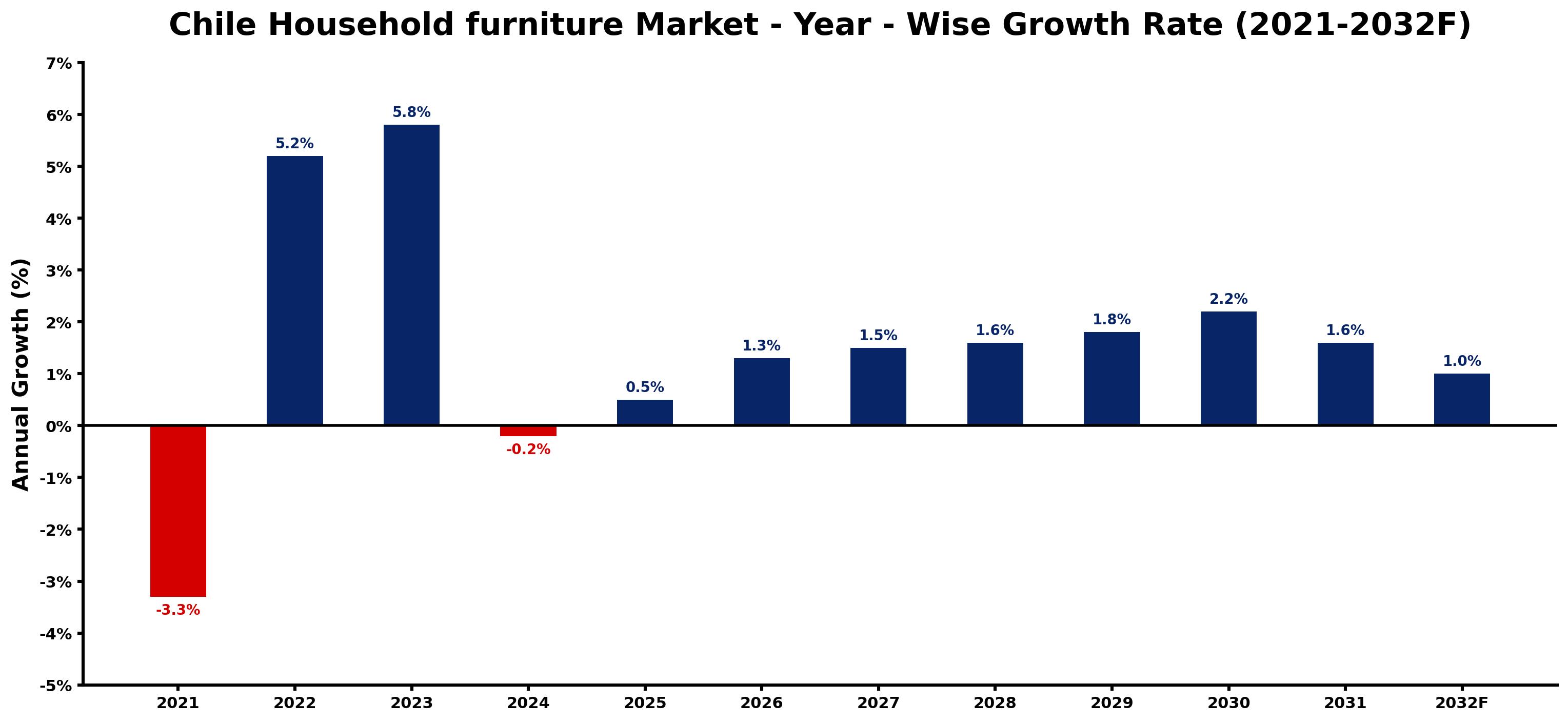
The table below presents the year wise growth rates along with the key drivers influencing the market
| Year | Growth Rate | Major Drivers |
| 2021 | -3.3% | Heightened economic uncertainty led consumers to delay major purchases, reducing demand for household furniture significantly. |
| 2022 | 5.2% | Urbanization trends prompted families to upgrade living spaces with multifunctional furniture solutions. |
| 2023 | 5.8% | Consumer preferences shifted towards sustainable materials, impacting purchasing decisions significantly. |
| 2024 | -0.2% | Increased competition from lowcost international brands eroded local market share and contributed to declining sales. |
| 2025 | 0.5% | E-commerce expansion enabled easier access to diverse furniture styles for Chilean households. |
| 2026 | 1.3% | Increased disposable income allowed families to invest more in quality furniture items. |
| 2027 | 1.5% | Shifts in remote work trends encouraged the creation of dedicated home office spaces. |
| 2028 | 1.6% | Collaborations with international brands introduced new design concepts to the Chilean market. |
| 2029 | 1.8% | Technological integration in manufacturing improved production efficiency and reduced costs. |
| 2030 | 2.2% | Consumer education about ergonomic furniture enhanced focus on health and comfort. |
| 2031 | 1.6% | Market consolidation led to stronger brands offering wider product ranges and selections. |
| 2032 | 1.0% | Growing interest in interior design inspired consumers to frequently update their furniture choices. |
Note - Market size estimations and growth projections presented in this report are based on 6Wresearch's advanced forecasting approach, validated with industry datasets as of June 2026.
Chile Household furniture Market Synopsis
The Chile Household furniture Market is projected to reach 1.3% and witness significant growth during the forecast period (2026-2032). This growth is primarily driven by factors such as increasing urbanization, rising disposable incomes among middle-class families, and a growing consumer awareness regarding home decor and interior design. In recent years, there has been a marked increase in the demand for essential furniture products, which include sofas, chairs, tables, beds, and dressing tables. As urbanization accelerates, the lifestyle trends among consumers are shifting towards greater convenience and comfort, alongside an enhanced aesthetic appeal, ultimately spurring demand for modern furniture across various demographics.
Chile Household furniture Market Growth Drivers
The growth trajectory of the Chile Household furniture Market is influenced by multiple factors:
- Urbanization is a prominent driver, as more individuals migrate to cities seeking better opportunities, thereby increasing the need for modern furniture that accommodates smaller living spaces.
- The rising disposable incomes among middle-class families empower consumers to invest in higher-quality furniture, reflective of their evolving lifestyles and aesthetic preferences.
- Consumer awareness surrounding home decor and interior design has led to a greater demand for stylish and practical furniture options that enhance living environments.
- Technological advancements in manufacturing, including the use of automation and artificial intelligence, are streamlining production processes, minimizing costs, and optimizing output, which in turn boosts market supply.
- The growing trend of online shopping for household furnishings offers consumers a wider array of choices and competitive pricing, positively impacting market expansion.
Chile Household furniture Market Government Investment and Initiatives
The government of Chile has implemented various initiatives aimed at stimulating growth within the household furniture sector. These initiatives include policies designed to support local manufacturers and promote exports of Chilean-made products. Key efforts by organizations such as ProChile aim to enhance the visibility of local furniture brands in international markets, thus providing small and medium enterprises (SMEs) with resources and training to improve their export competitiveness.
In addition, public spending on urban development projects is expected to include provisions for home improvements and construction, thereby increasing the demand for household furniture. Government subsidies for sustainable practices also encourage manufacturers to adopt environmentally friendly materials and processes, aligning with global sustainability trends. Such supportive policies and investments are pivotal in enhancing the resilience and growth potential of the Chile Household furniture Market.
Chile Household furniture Market Latest Developments (May 2025 - June 2026)
The Chile Household furniture Market has witnessed significant developments from May 2025 to June 2026. During this period, industry stakeholders have increasingly focused on sustainability and eco-friendly practices, responding to consumer demand for environmentally responsible products. Manufacturers have made strides in incorporating reclaimed materials and sustainable sourcing into their product lines, which aligns with global shifts towards sustainable living.
Moreover, advancements in technology have led to enhanced customer experiences, with several companies investing in augmented reality (AR) tools that allow consumers to visualize furniture in their homes before making a purchase. This technological innovation has not only improved customer satisfaction but has also reduced return rates. Furthermore, amid evolving market dynamics, collaboration among local furniture designers and artisans has surged, fostering a sense of community and promoting unique product offerings that reflect Chile's cultural heritage.
Chile Household furniture Market - Key Attractiveness of the Report
- 10 Years of Market Numbers
- Historical Data Starting from 2022 to 2025
- Base Year: 2025
- Forecast Data until 2032
- Key Performance Indicators Impacting the Market
- Major Upcoming Developments and Projects
Key Highlights of the Report:
- Chile Household furniture Market Outlook
- Market Size of Chile Household furniture Market, 2025
- Forecast of Chile Household furniture Market, 2032F
- Historical Data and Forecast of Chile Household furniture Revenues & Volume for the Period 2022-2032F
- Chile Household furniture Market Trend Evolution
- Chile Household furniture Market Drivers and Challenges
- Chile Household furniture Price Trends
- Chile Household furniture Porter's Five Forces
- Chile Household furniture Industry Life Cycle
- Historical Data and Forecast of Chile Household furniture Market Revenues & Volume By Types for the Period 2022-2032F
- Historical Data and Forecast of Chile Household furniture Market Revenues & Volume By Wood Furniture for the Period 2022-2032F
- Historical Data and Forecast of Chile Household furniture Market Revenues & Volume By Metal Furniture for the Period 2022-2032F
- Historical Data and Forecast of Chile Household furniture Market Revenues & Volume By Plastic Furniture for the Period 2022-2032F
- Historical Data and Forecast of Chile Household furniture Market Revenues & Volume By Others for the Period 2022-2032F
- Historical Data and Forecast of Chile Household furniture Market Revenues & Volume By Area of Use for the Period 2022-2032F
- Historical Data and Forecast of Chile Household furniture Market Revenues & Volume By ?Bedroom Furniture for the Period 2022-2032F
- Historical Data and Forecast of Chile Household furniture Market Revenues & Volume By Living Room Furniture for the Period 2022-2032F
- Historical Data and Forecast of Chile Household furniture Market Revenues & Volume By Dining Room Furniture for the Period 2022-2032F
- Historical Data and Forecast of Chile Household furniture Market Revenues & Volume By Household Furniture for the Period 2022-2032F
- Historical Data and Forecast of Chile Household furniture Market Revenues & Volume By Others for the Period 2022-2032F
- Chile Household furniture Import Export Trade Statistics
- Market Opportunity Assessment By Types
- Market Opportunity Assessment By Area of Use
- Chile Household furniture Top Companies Market Share
- Chile Household furniture Competitive Benchmarking By Technical and Operational Parameters
- Chile Household furniture Company Profiles
- Chile Household furniture Key Strategic Recommendations






































