Chile IoT Data Management Market Size & Growth Rate (2026-2032)
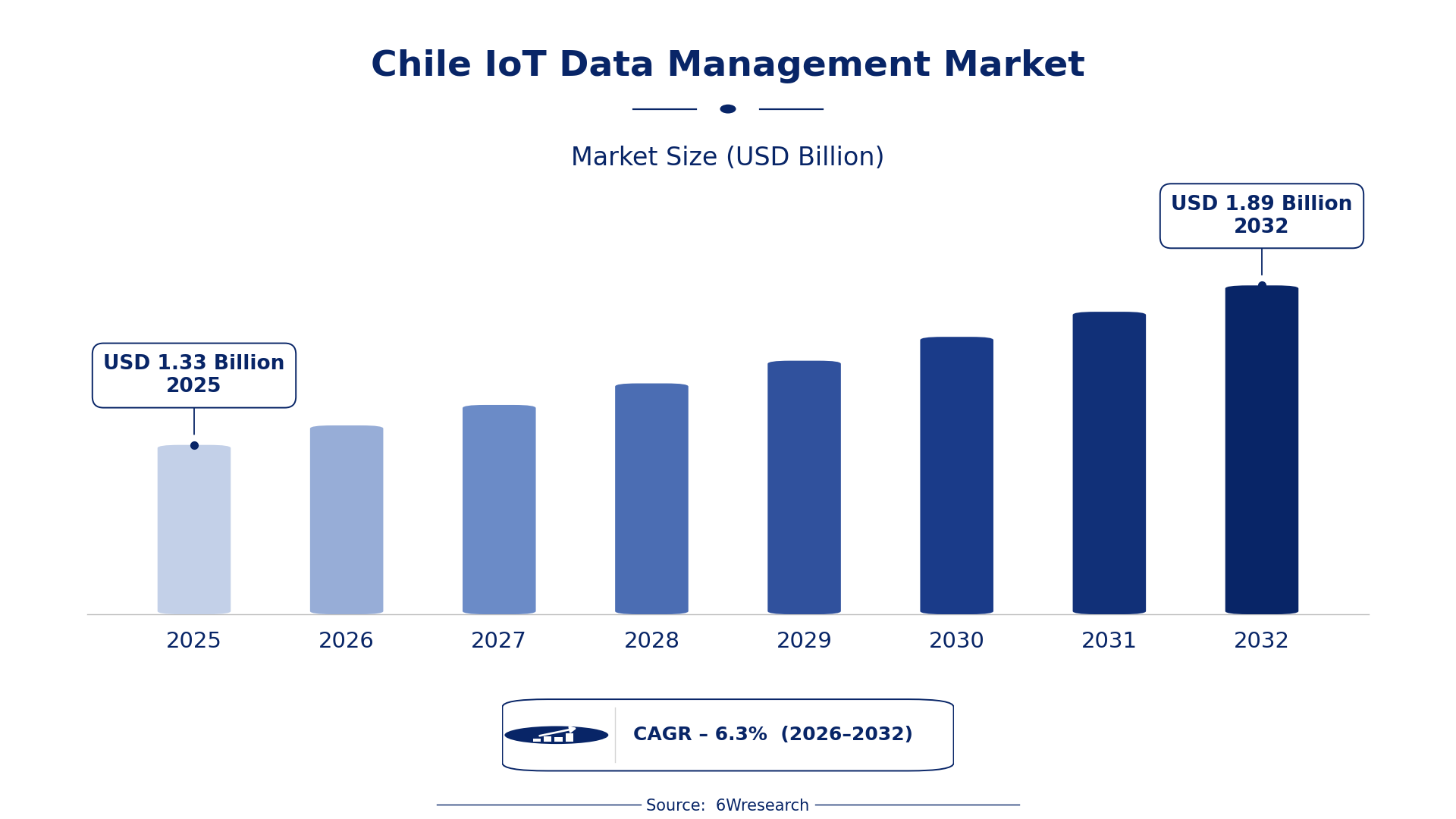
The Chile IoT Data Management Market was estimated at USD 1326 Million in 2025 and is projected to reach USD 1888 Million by 2032, growing at a CAGR of 6.3% from 2026 to 2032.
Chile IoT Data Management Market Synopsis
The Chile IoT Data Management Market is on an upward trajectory, propelled by a surge in IoT device adoption across key sectors. While this momentum is palpable, the market is poised for a more transformative phase as organizations increasingly recognize the critical importance of efficient data management strategies.
As companies seek to harness real-time data analytics and improve operational efficiency, the demand for sophisticated data management solutions will continue to escalate. The intersection of IoT and advanced analytics is set to redefine the operational fabric of industries, making it imperative for businesses to adapt quickly to this evolving environment.
Chile IoT Data Management Market Year-wise Growth Rate and Key Drivers
This graph illustrates the annual growth rates of the Chile IoT Data Management Market from 2021 to 2032, highlighting a steady upward trajectory and projected expansion over the forecast period.
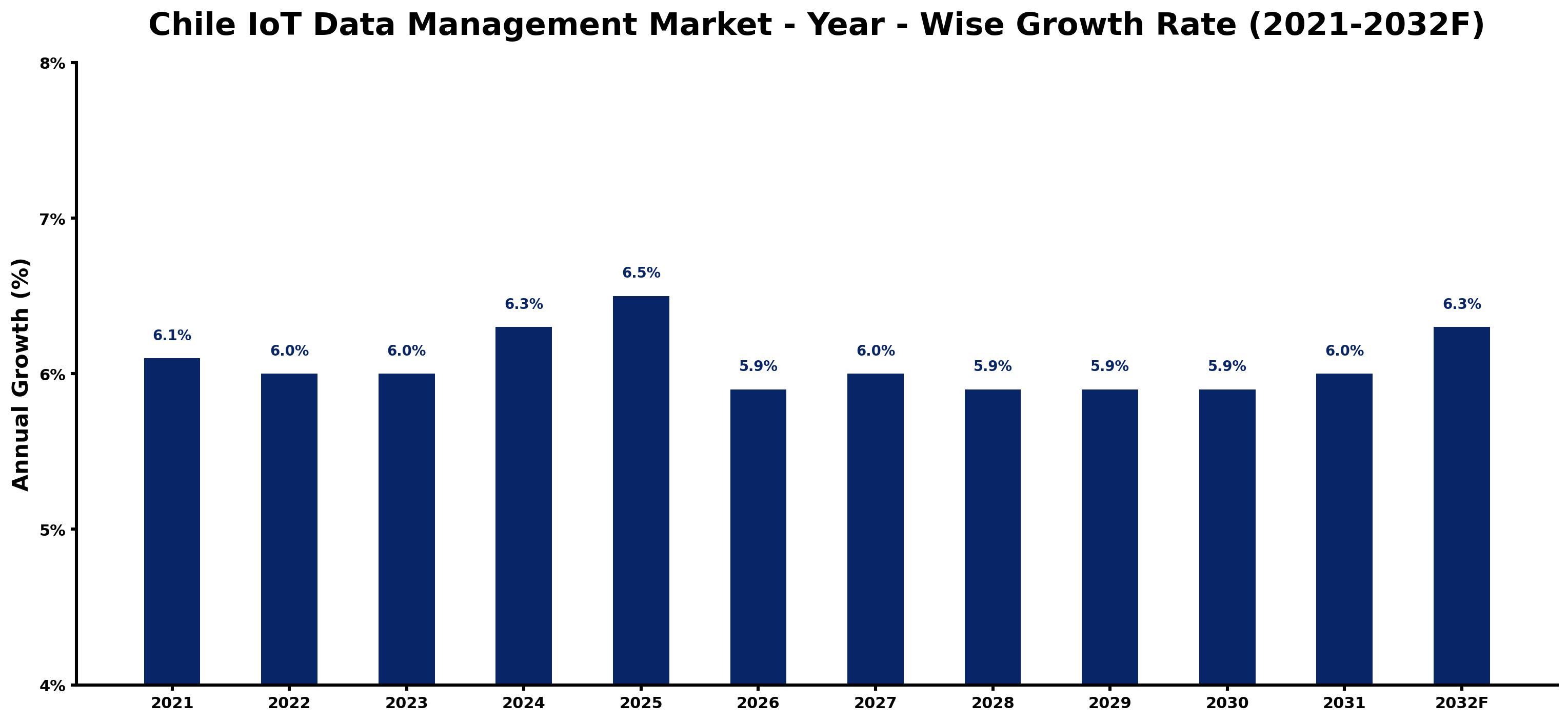
The table below presents the year‑wise growth rates along with the key drivers influencing the market
| Year | Growth Rate | Major Drivers |
| 2021 | 6.1% | Government's National IoT Strategy promotes data management solutions. |
| 2022 | 6.0% | Emergence of local startups enhancing IoT data capabilities. |
| 2023 | 6.0% | Increased mining sector adoption of IoT data analytics. |
| 2024 | 6.3% | Regulatory push for agricultural data transparency and management. |
| 2025 | 6.5% | Growing telemedicine applications require robust data handling systems. |
| 2026 | 5.9% | Sustainable energy projects utilizing IoT for data insights. |
| 2027 | 6.0% | Tourism sector leveraging IoT for customer experience data. |
| 2028 | 5.9% | Public transportation enhancements relying on IoT data integration. |
| 2029 | 5.9% | Telecommunications operators investing in IoT data applications. |
| 2030 | 5.9% | Healthcare reforms prompting better IoT data utilization. |
| 2031 | 6.0% | Increased smart agriculture initiatives driving IoT data usage. |
| 2032 | 6.3% | Civic engagement platforms using IoT for community data management. |
Note: Market size estimations and growth projections presented in this report are based on 6Wresearch's proprietary forecasting methodology, utilizing the latest available industry data, government publications, and primary research inputs.
Chile IoT Data Management Market Key Takeaways
Below are some of the specific key takeaways from the market, including:
- The increasing integration of IoT devices is driving the demand for enhanced data management solutions.
- Real-time data analytics are becoming essential for improving decision-making processes.
- Data security and privacy measures are increasingly prioritized by organizations handling IoT data.
- Government initiatives are fostering a supportive environment for IoT technology adoption.
- Investment in advanced data platforms is crucial for managing the growing volume of IoT-generated data.
Evaluation of Restraints in Chile IoT Data Management Market
Despite its promising growth, the Chile IoT Data Management Market faces several restraints that could impede progress. Chief among these is the challenge of ensuring data security and privacy. As IoT devices proliferate, the amount of sensitive information collected increases, raising concerns about potential breaches and regulatory compliance.
Interoperability issues present another hurdle. Various IoT systems and devices often struggle to communicate effectively, which can create inefficiencies in data management processes. Additionally, the market must contend with scalability challenges, as the rapid growth in data volume necessitates substantial infrastructure investments. Lastly, a shortage of skilled professionals adept in data analytics and management compounds these challenges, underscoring the need for comprehensive training and development strategies.
Chile IoT Data Management Market Trends
Current trends in the Chile IoT Data Management Market highlight a growing demand for real-time analytics and actionable insights. Companies are increasingly focusing on harnessing the power of big data to enhance operational efficiency and inform strategic decisions. This shift is prompting the integration of artificial intelligence and machine learning technologies into data management platforms, allowing organizations to extract valuable insights with greater efficiency.
on top of that, there's a marked emphasis on data security, with companies proactively investing in solutions that comply with stringent regulations. As industries continue to evolve, the ability to manage and protect data effectively will remain a pivotal concern, shaping the technological advancements in this space.
Chile IoT Data Management Market Opportunities
Opportunities abound in the Chile IoT Data Management Market, particularly for vendors capable of delivering advanced data management platforms. The increasing complexity of data generated by IoT devices necessitates solutions that can efficiently handle large volumes while providing real-time analytics.
Additionally, the integration of AI and machine learning into these platforms offers a pathway to enhanced data interpretation, paving the way for more informed decision-making. As organizations strive to capitalize on their data assets, the demand for innovative and flexible data management solutions will only intensify.
Government Initiatives in the Chile IoT Data Management Market
Government initiatives are playing a crucial role in shaping the trajectory of the Chile IoT Data Management Market. Recent regulatory measures emphasize data protection and privacy, fostering a more secure environment for IoT technology. With an eye on digital transformation, public-sector priorities are geared towards enhancing infrastructure and supporting innovation across various industries.
- A regulatory framework established under the General Data Protection Law (LGPD) mandates strict compliance regarding the handling of IoT data.
- The National IoT Policy, currently underway, aims to stimulate growth in the IoT industry by promoting collaboration among stakeholders.
- A recently completed initiative focused on upgrading digital infrastructure, enhancing connectivity for IoT devices across urban areas.
- Ongoing public-private partnerships are designed to expand IoT infrastructure accessibility in remote regions.
- A planned initiative expected to launch in 2026 will focus on developing training programs for professionals in data analytics and management.
Future Insights of the Chile IoT Data Management Market
Looking ahead to 2026-2032, the Chile IoT Data Management Market is set for sustained growth. The adoption of IoT devices across diverse industries will continue to drive demand for data management solutions. Companies will increasingly seek ways to leverage data for operational efficiency and competitive advantage, spurring further technological advancements.
As regulatory frameworks evolve, organizations will need to adapt to stricter data security measures, which will in turn fuel investments in advanced data management platforms. With the ongoing expansion of the IoT ecosystem, Chile is well-positioned to emerge as a leader in this sector within Latin America.
Chile IoT Data Management Market Latest Developments
Recent developments in the Chile IoT Data Management Market indicate a vigorous pace of innovation and investment. Over the past year, industry players have been keenly focused on enhancing their offerings to meet the growing demand for efficient data management solutions.
- A major technology vendor initiated a rollout of an advanced data management platform in early 2025, designed to support real-time analytics for manufacturing sectors.
- A partnership announced in Q3 2025 aims to integrate AI-driven analytics into existing IoT frameworks, enhancing data interpretation capabilities.
- An ongoing initiative focused on upgrading cloud storage solutions is expected to complete by mid-2026, improving data accessibility for businesses.
- A planned product launch in late 2026 will introduce a comprehensive security suite tailored specifically for IoT data management.
- A recent collaboration between private firms and governmental bodies seeks to enhance digital infrastructure in rural areas, currently underway.
Chile IoT Data Management Market - Key Attractiveness of the Report
- 10 Years of Market Numbers
- Historical Data Starting from 2022 to 2025
- Base Year: 2025
- Forecast Data until 2032
- Key Performance Indicators Impacting the Market
- Major Upcoming Developments and Projects
Key Highlights of the Report:
- Chile IoT Data Management Market Outlook
- Market Size of Chile IoT Data Management Market, 2025
- Forecast of Chile IoT Data Management Market, 2032
- Historical Data and Forecast of Chile IoT Data Management Revenues & Volume for the Period 2022-2032F
- Chile IoT Data Management Market Trend Evolution
- Chile IoT Data Management Market Drivers and Challenges
- Chile IoT Data Management Price Trends
- Chile IoT Data Management Porter's Five Forces
- Chile IoT Data Management Industry Life Cycle
- Historical Data and Forecast of Chile IoT Data Management Market Revenues & Volume By Solution for the Period 2022-2032F
- Historical Data and Forecast of Chile IoT Data Management Market Revenues & Volume By Data integration for the Period 2022-2032F
- Historical Data and Forecast of Chile IoT Data Management Market Revenues & Volume By Data analytics and visualization for the Period 2022-2032F
- Historical Data and Forecast of Chile IoT Data Management Market Revenues & Volume By Metadata management for the Period 2022-2032F
- Historical Data and Forecast of Chile IoT Data Management Market Revenues & Volume By Data security for the Period 2022-2032F
- Historical Data and Forecast of Chile IoT Data Management Market Revenues & Volume By Data migration for the Period 2022-2032F
- Historical Data and Forecast of Chile IoT Data Management Market Revenues & Volume By Others (data governance, data quality, and data orchestration) for the Period 2022-2032F
- Historical Data and Forecast of Chile IoT Data Management Market Revenues & Volume By Component for the Period 2022-2032F
- Historical Data and Forecast of Chile IoT Data Management Market Revenues & Volume By Solutions for the Period 2022-2032F
- Historical Data and Forecast of Chile IoT Data Management Market Revenues & Volume By Services for the Period 2022-2032F
- Historical Data and Forecast of Chile IoT Data Management Market Revenues & Volume By Service for the Period 2022-2032F
- Historical Data and Forecast of Chile IoT Data Management Market Revenues & Volume By Managed services for the Period 2022-2032F
- Historical Data and Forecast of Chile IoT Data Management Market Revenues & Volume By Consulting services for the Period 2022-2032F
- Historical Data and Forecast of Chile IoT Data Management Market Revenues & Volume By Support and maintenance services for the Period 2022-2032F
- Historical Data and Forecast of Chile IoT Data Management Market Revenues & Volume By Deployment Type for the Period 2022-2032F
- Historical Data and Forecast of Chile IoT Data Management Market Revenues & Volume By Public cloud for the Period 2022-2032F
- Historical Data and Forecast of Chile IoT Data Management Market Revenues & Volume By Private cloud for the Period 2022-2032F
- Historical Data and Forecast of Chile IoT Data Management Market Revenues & Volume By Hybrid cloud for the Period 2022-2032F
- Historical Data and Forecast of Chile IoT Data Management Market Revenues & Volume By Organization Size for the Period 2022-2032F
- Historical Data and Forecast of Chile IoT Data Management Market Revenues & Volume By Small and Medium-sized Enterprises (SMEs) for the Period 2022-2032F
- Historical Data and Forecast of Chile IoT Data Management Market Revenues & Volume By Large enterprises for the Period 2022-2032F
- Historical Data and Forecast of Chile IoT Data Management Market Revenues & Volume By Application Area for the Period 2022-2032F
- Historical Data and Forecast of Chile IoT Data Management Market Revenues & Volume By Smart energy and utilities for the Period 2022-2032F
- Historical Data and Forecast of Chile IoT Data Management Market Revenues & Volume By Smart manufacturing for the Period 2022-2032F
- Historical Data and Forecast of Chile IoT Data Management Market Revenues & Volume By Building and home automation for the Period 2022-2032F
- Historical Data and Forecast of Chile IoT Data Management Market Revenues & Volume By Smart healthcare for the Period 2022-2032F
- Historical Data and Forecast of Chile IoT Data Management Market Revenues & Volume By Smart retail for the Period 2022-2032F
- Historical Data and Forecast of Chile IoT Data Management Market Revenues & Volume By Smart mobility and transportation for the Period 2022-2032F
- Historical Data and Forecast of Chile IoT Data Management Market Revenues & Volume By Connected logistics for the Period 2022-2032F
- Historical Data and Forecast of Chile IoT Data Management Market Revenues & Volume By Others for the Period 2022-2032F
- Chile IoT Data Management Import Export Trade Statistics
- Market Opportunity Assessment By Solution
- Market Opportunity Assessment By Component
- Market Opportunity Assessment By Service
- Market Opportunity Assessment By Deployment Type
- Market Opportunity Assessment By Organization Size
- Market Opportunity Assessment By Application Area
- Chile IoT Data Management Top Companies Market Share
- Chile IoT Data Management Competitive Benchmarking By Technical and Operational Parameters
- Chile IoT Data Management Company Profiles
- Chile IoT Data Management Key Strategic Recommendations






































