Chile Marble Market Growth Rate Analysis (2025 - 2031)
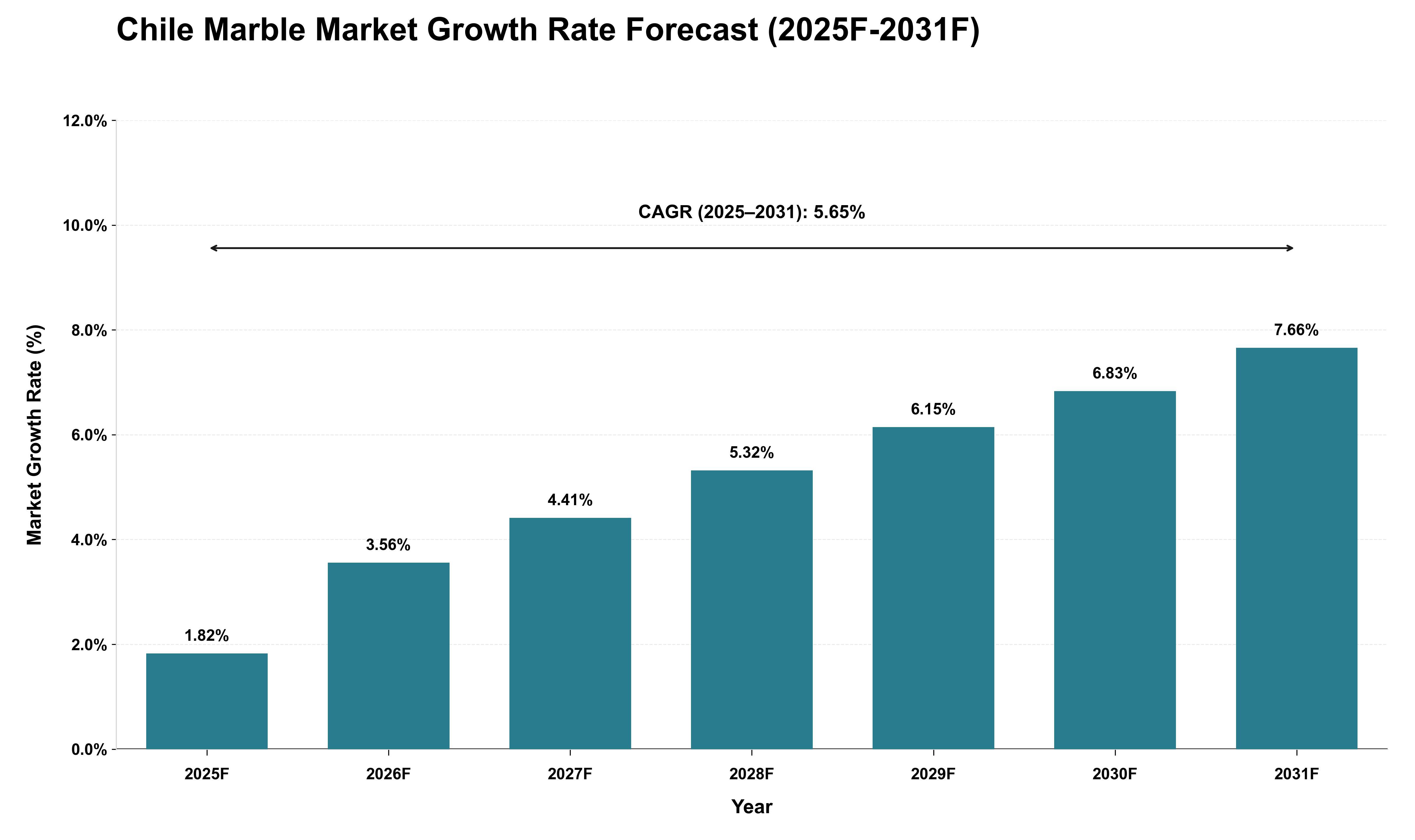
From 2025 onward, the Chile marble market will experience a robust growth trajectory, driven by increasing demand for high-quality natural stone in construction and design sectors. The projected CAGR of 5.65% reflects a gradual acceleration in annual growth rates, peaking at 7.66% in 2031. This upward trend will likely be supported by technological advancements in extraction and processing methods, enhancing product quality and reducing costs. Additionally, as global construction activities rebound post-pandemic, Chile's marble exports may benefit from heightened international demand, particularly from emerging markets seeking premium materials for infrastructure projects. Import dependencies on raw materials could also influence pricing dynamics; however, local production capabilities are expected to adapt through innovation and efficiency improvements. Overall, the interplay of these macroeconomic factors will position the Chile marble market favorably within the broader context of evolving consumer preferences for sustainable and aesthetically appealing building materials.
Key Highlights of the Report:
- Chile Marble Market Outlook
- Market Size of Chile Marble Market, 2024
- Forecast of Chile Marble Market, 2031
- Historical Data and Forecast of Chile Marble Revenues & Volume for the Period 2021 - 2031
- Chile Marble Market Trend Evolution
- Chile Marble Market Drivers and Challenges
- Chile Marble Price Trends
- Chile Marble Porter's Five Forces
- Chile Marble Industry Life Cycle
- Historical Data and Forecast of Chile Marble Market Revenues & Volume By Colour Type for the Period 2021 - 2031
- Historical Data and Forecast of Chile Marble Market Revenues & Volume By White for the Period 2021 - 2031
- Historical Data and Forecast of Chile Marble Market Revenues & Volume By Black for the Period 2021 - 2031
- Historical Data and Forecast of Chile Marble Market Revenues & Volume By Yellow for the Period 2021 - 2031
- Historical Data and Forecast of Chile Marble Market Revenues & Volume By Red for the Period 2021 - 2031
- Historical Data and Forecast of Chile Marble Market Revenues & Volume By Others for the Period 2021 - 2031
- Historical Data and Forecast of Chile Marble Market Revenues & Volume By Application for the Period 2021 - 2031
- Historical Data and Forecast of Chile Marble Market Revenues & Volume By Building & Construction for the Period 2021 - 2031
- Historical Data and Forecast of Chile Marble Market Revenues & Volume By Statues and Monuments for the Period 2021 - 2031
- Historical Data and Forecast of Chile Marble Market Revenues & Volume By Furniture for the Period 2021 - 2031
- Historical Data and Forecast of Chile Marble Market Revenues & Volume By Others for the Period 2021 - 2031
- Chile Marble Import Export Trade Statistics
- Market Opportunity Assessment By Colour Type
- Market Opportunity Assessment By Application
- Chile Marble Top Companies Market Share
- Chile Marble Competitive Benchmarking By Technical and Operational Parameters
- Chile Marble Company Profiles
- Chile Marble Key Strategic Recommendations






































