Chile Phenol Market Growth Rate Analysis (2021-2031)
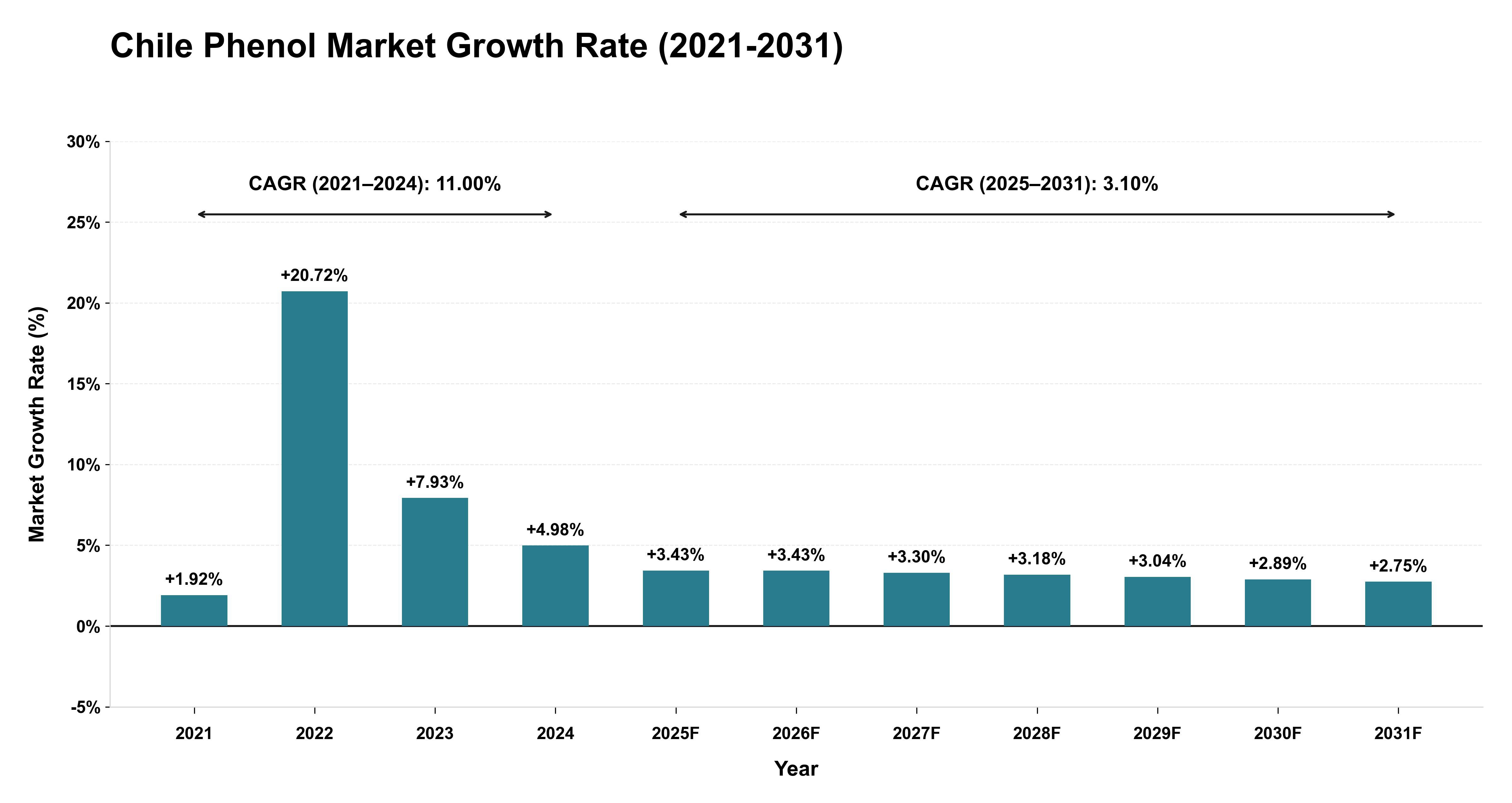
The Chile Phenol Market experienced robust growth from 2021 to 2024, with a CAGR of 11.00%, driven by a significant spike in 2022 at 20.72%, followed by steady expansions in the subsequent years. However, from 2025 to 2031, the market is expected to undergo a phase of stabilization, with a forecasted CAGR of 3.10%. This deceleration reflects a structural consolidation after the volatile growth period, as seen in the consistent but slower growth rates post-2024. The market is anticipated to adjust to more sustainable levels of expansion, hovering around the forecasted CAGR, indicating a maturing phase and equilibrium in demand-supply dynamics within the Chilean Phenol Market.
Chile Phenol Market Overview
The Chile Phenol Market is witnessing steady growth driven by increasing demand from various end-use industries such as automotive, construction, and electronics. Phenol is primarily used in the production of resins, polycarbonates, and pharmaceuticals, among other applications. The market is also benefiting from the rising adoption of phenol derivatives in the agricultural sector for pesticide production. Key market players in Chile include companies like Enap Refinerias S.A. and Empresa Nacional del Petroleo, among others. The market is expected to continue its growth trajectory, supported by the expanding industrial sector and ongoing research and development activities aimed at enhancing the applications of phenol and its derivatives in various industries.
Chile Phenol Market Trends
The Chile Phenol market is experiencing steady growth, driven by increasing demand from industries such as pharmaceuticals, cosmetics, and agriculture. One prominent trend in the market is the rising preference for eco-friendly and sustainable phenol production methods, in line with global environmental concerns. Manufacturers are increasingly focusing on developing bio-based phenol derived from renewable sources, such as plants and biomass, to reduce carbon footprint and meet regulatory requirements. Additionally, there is a growing emphasis on product innovation and research to enhance the properties and applications of phenol in various end-use industries. Overall, the Chile Phenol market is expected to continue its growth trajectory, propelled by evolving consumer preferences and technological advancements in production processes.
Chile Phenol Market Challenges
In the Chile Phenol market, challenges include increasing competition from low-cost producers in other regions, fluctuating raw material prices, and stringent environmental regulations. The market is also impacted by the global economic conditions and trade dynamics, which can affect demand and pricing. Additionally, the industry faces the challenge of developing sustainable production methods to meet growing consumer demand for environmentally friendly products. Keeping up with technological advancements and maintaining high-quality standards while remaining cost-effective are ongoing challenges for players in the Chile Phenol market. Overall, companies operating in this market need to adapt quickly to changing market conditions and regulatory requirements to stay competitive and sustain growth.
Chile Phenol Market Investment Opportunities
Investment opportunities in the Chile Phenol Market include the growing demand for phenol in various industries such as pharmaceuticals, agriculture, and construction. With Chile`s stable economy and favorable business environment, investing in phenol production or distribution could be lucrative. Additionally, the government`s initiatives to promote industrial growth and innovation further support the potential for investment in the phenol market. As the country continues to attract foreign investments and expand its industrial sector, there is a strong opportunity for investors to capitalize on the increasing demand for phenol in Chile and potentially benefit from the market`s growth and development. Conducting thorough market research and understanding the regulatory landscape will be crucial for successful investment in the Chile Phenol Market.
Chile Phenol Market Government Policy
In Chile, government policies related to the phenol market primarily focus on regulating the production, importation, and use of phenol to ensure environmental sustainability and public health protection. The government has implemented measures to monitor and control the emissions of phenol into the environment, as well as to promote the responsible handling and disposal of phenol-containing products. Additionally, there are regulations in place regarding the importation of phenol to guarantee its quality and safety for industrial and consumer applications. Overall, the government`s policies aim to strike a balance between supporting the growth of the phenol market in Chile while safeguarding the well-being of its citizens and the environment.
Chile Phenol Market Future Outlook
The Chile Phenol Market is expected to experience steady growth in the coming years due to increasing demand from various end-use industries such as automotive, construction, and electronics. The market is likely to be driven by the growing use of phenol in the production of Bisphenol A (BPA), which is extensively used in the manufacturing of polycarbonate plastics and epoxy resins. Additionally, the rising awareness about the benefits of phenol derivatives in the healthcare and pharmaceutical sectors is anticipated to further fuel market growth. However, factors such as fluctuating raw material prices and environmental regulations may pose challenges to market expansion. Overall, with the evolving industrial landscape and technological advancements, the Chile Phenol Market is poised for a positive outlook in the foreseeable future.
Key Highlights of the Report:
- Chile Phenol Market Outlook
- Market Size of Chile Phenol Market, 2021
- Forecast of Chile Phenol Market, 2031
- Historical Data and Forecast of Chile Phenol Revenues & Volume for the Period 2021 - 2031
- Chile Phenol Market Trend Evolution
- Chile Phenol Market Drivers and Challenges
- Chile Phenol Price Trends
- Chile Phenol Porter's Five Forces
- Chile Phenol Industry Life Cycle
- Historical Data and Forecast of Chile Phenol Market Revenues & Volume By End-users for the Period 2021 - 2031
- Historical Data and Forecast of Chile Phenol Market Revenues & Volume By Bisphenol A for the Period 2021 - 2031
- Historical Data and Forecast of Chile Phenol Market Revenues & Volume By Phenolic Resins for the Period 2021 - 2031
- Historical Data and Forecast of Chile Phenol Market Revenues & Volume By Caprolactam for the Period 2021 - 2031
- Historical Data and Forecast of Chile Phenol Market Revenues & Volume By Alkyl Phenyls for the Period 2021 - 2031
- Historical Data and Forecast of Chile Phenol Market Revenues & Volume By Others for the Period 2021 - 2031
- Chile Phenol Import Export Trade Statistics
- Market Opportunity Assessment By End-users
- Chile Phenol Top Companies Market Share
- Chile Phenol Competitive Benchmarking By Technical and Operational Parameters
- Chile Phenol Company Profiles
- Chile Phenol Key Strategic Recommendations






































