Global Phenol Market Highlights
| Market Size (2025) | USD 19.8 Billion |
| Forecast Size (2032) | USD 26.5 Billion |
| CAGR | 4.20% |
| Base Year | 2025 |
| Forecast Period | 2026-2032 |
| Largest Region | Asia Pacific |
| Fastest Growing Region | North America |
| Largest Segment | Bisphenol A |
| Fastest Growing Segment | Phenolic Resins |
| Leading Companies | BASF, Dow Chemical, Eastman Chemical, Shell, Ineos |
Global Phenol Market Size & Growth Rate (2026-2032)
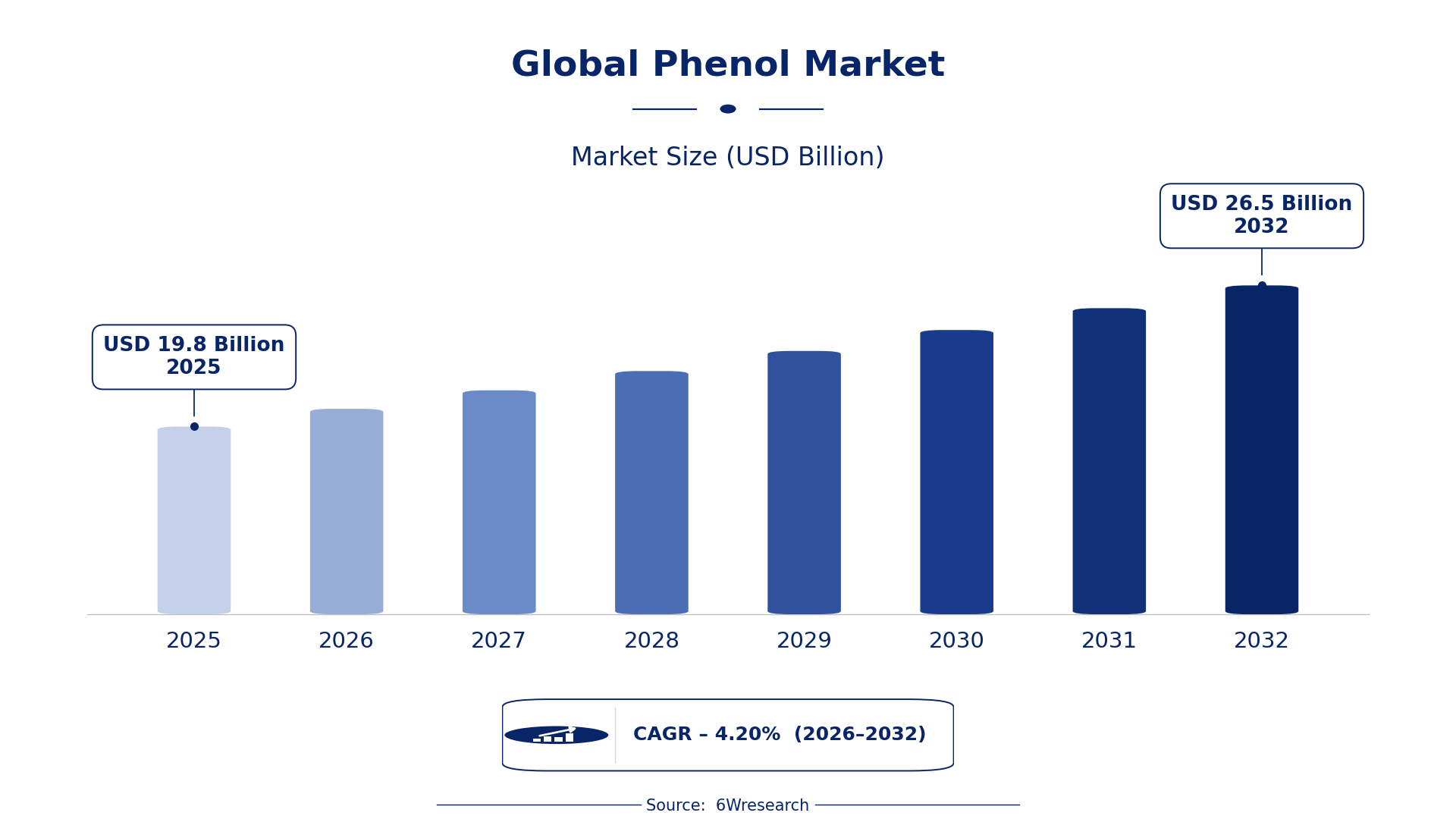
The Global Phenol Market was estimated at USD 19.8 Billion in 2025 and is projected to reach USD 26.5 Billion by 2032, growing at a CAGR of 4.20% from 2026 to 2032.
Global Phenol Market Synopsis
The Global Phenol Market is integral to the petrochemical sector, serving as a primary feedstock for Bisphenol A (BPA) and phenolic resins, which are pivotal in manufacturing polycarbonates and epoxy resins. This market underpins numerous industries, including automotive, electronics, and construction, reflecting its crucial role in supporting modern infrastructure and consumer products.
As urbanization accelerates and industrial capacities expand, particularly in developing regions, demand for phenol-based applications is intensifying. Factors such as rising environmental regulations and fluctuating raw material costs are shaping industry practices, compelling producers to innovate and adopt more efficient production processes.
Global Phenol Market Year-wise Growth Rate and Key Drivers
This graph illustrates the annual growth rates of the Global Phenol Market from 2022 to 2032, highlighting a steady upward trajectory and projected expansion over the forecast period.
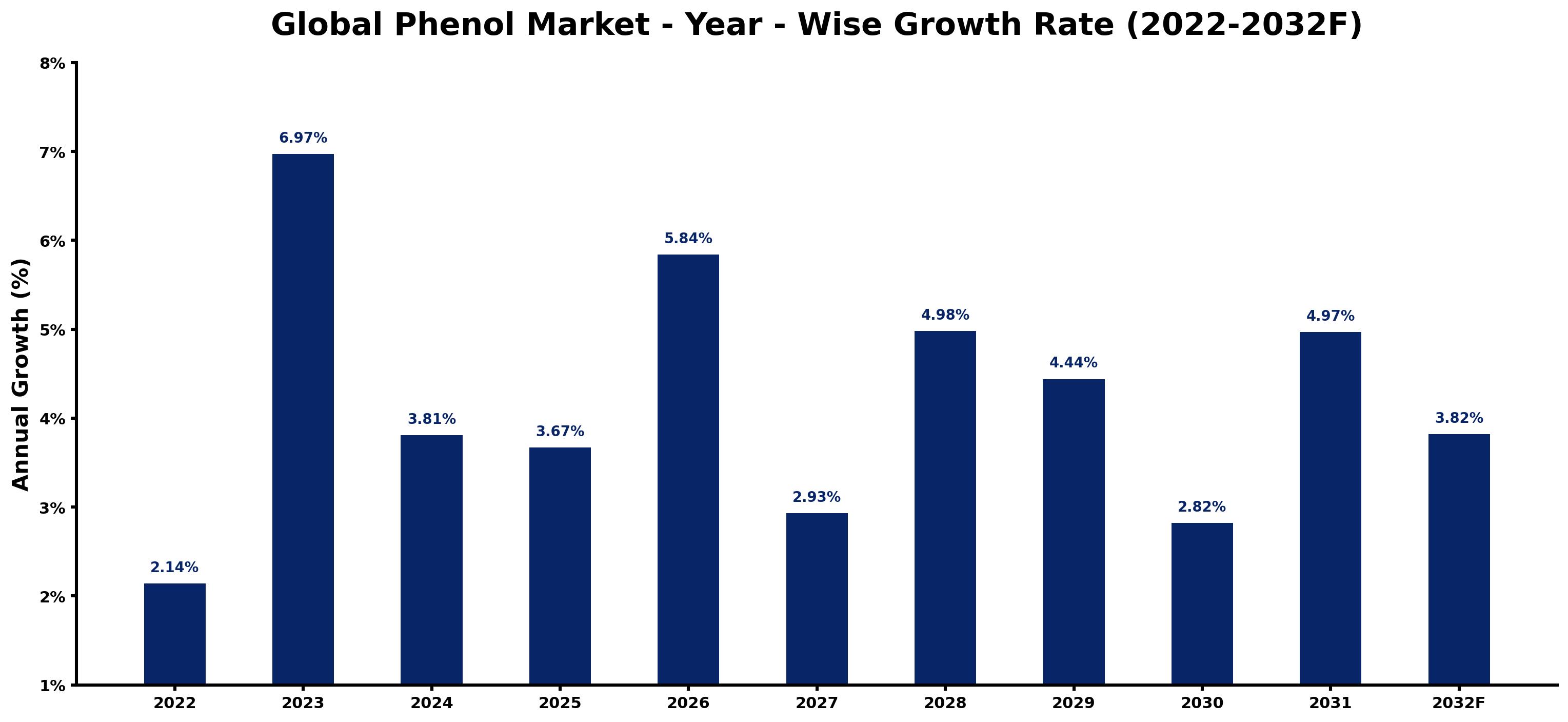
The table below presents the year‑wise growth rates along with the key drivers influencing the market
| Year | Growth Rate (%) | Major Drivers |
| 2022 | 2.14 | A shift toward stricter REACH compliance impacts phenol manufacturing processes significantly. |
| 2023 | 6.97 | In the automotive sector, increasing demand for specialty polymers drives phenol consumption. |
| 2024 | 3.81 | Chemical distributors are adjusting strategies to accommodate changing resin formulation preferences. |
| 2025 | 3.67 | Rising feedstock pricing influences phenol production economics and market dynamics substantially. |
| 2026 | 5.84 | Innovative catalysts in phenol production attract considerable investment from key chemical firms. |
| 2027 | 2.93 | The increasing focus on sustainability encourages bio-based phenol solutions among manufacturers. |
| 2028 | 4.98 | Heightened competition among petrochemical players accelerates advancements in phenol applications. |
| 2029 | 4.44 | Manufacturers are deploying advanced additive manufacturing materials to enhance phenol product offerings. |
| 2030 | 2.82 | End-users in the coatings industry demand improved performance from phenol-based resins. |
| 2031 | 4.97 | While supply chain adjustments persist, phenol availability stabilizes amidst fluctuating market conditions. |
| 2032 | 3.82 | Adoption of innovative petrochemical cracking methods expands phenol production capabilities regionally. |
Note - Market size estimations and growth projections presented in this report are based on 6Wresearch's proprietary research methodology, combining internal industry data, secondary research, and primary validation, updated periodically to reflect current market conditions. As markets evolve rapidly, figures for certain industries may vary slightly and are intended as informed estimates rather than absolute figures. For the most current market sizing, we recommend validating figures with a 6Wresearch analyst.
Global Phenol Market Key Takeaways
Below are some of the specific key takeaways from the market, including:
- As of 2025, the Asia Pacific region accounted for approximately 48% of the global phenol consumption, highlighting its dominance in industrial applications.
- Phenolic resins are projected to grow at a CAGR of 6.5% from 2026 to 2032, driven by their critical use across diverse industries, including automotive and construction.
- BASF invested USD 300 million in new production facilities aimed at increasing phenol output in response to surging market demands.
- The infrastructural growth plans in emerging economies are expected to shift around USD 25 billion into the phenol sector by 2030.
Evaluation of Restraints in Global Phenol Market
The Global Phenol Market faces significant restraints, particularly from volatile raw material prices. For instance, fluctuations in crude oil prices can directly affect benzene costs, a fundamental component in phenol production. As of late 2022, benzene prices surged by approximately 30%, raising production costs and impacting profitability. Additionally, stringent environmental regulations around the handling of phenolic compounds necessitate costly compliance measures, hindering market growth. For example, compliance with the European Union's REACH legislation has increasingly become a concern, demanding extensive testing and registration processes for manufacturers.
Global Phenol Market Trends
Current trends in the Global Phenol Market are markedly influenced by advancements in production technology and evolving regulatory frameworks. Companies like Dow Chemical are actively investing in innovative production methods that utilize renewable feedstocks, helping to alleviate some environmental concerns associated with conventional petrochemicals. This technology shift is crucial as it aligns production with stringent regulations aimed at reducing carbon footprints. For instance, Dow Chemical's pilot plant in Texas, launched in 2023, is projected to enhance production efficiency by 20% while reducing emissions significantly.
Another trend involves the increasing adoption of phenolic resins in high-performance applications such as automotive lightweighting and electronics, driven by the demand for energy-efficient solutions. The automotive sector, specifically, is expected to leverage phenolic materials that reduce vehicle weight, thus improving fuel efficiency. This shift indicates a robust market evolution in response to sustainability challenges.
Global Phenol Market Opportunities
Future revenue opportunities in the Global Phenol Market are firmly rooted in expanding applications in sectors like automotive manufacturing and electronics. For instance, in 2024, a major automotive manufacturer plans to incorporate phenolic resins in up to 40% of its new electric vehicle models. This shift underscores significant demand potential as companies adapt to cleaner technologies and materials. Furthermore, the rise in battery manufacturing necessitates robust chemical components, with phenol derivatives being explored for use in battery production, expected to generate USD 1 billion in revenues by 2025.
Global Phenol Market by End-users
In the Global Phenol Market, Bisphenol A commands a leading market share, accounting for approximately 42% in 2025, thanks to its extensive use in producing polycarbonate plastics and epoxy resins critical for electronics and automotive applications. Conversely, phenolic resins demonstrate the fastest growth, predicted to achieve a CAGR of 6.5% from 2026 to 2032, owing to their increasing use in construction and industrial applications, where their durability and heat resistance offer significant performance advantages.
Global Phenol Market by Region
Asia Pacific is the largest region in the Global Phenol Market, with a share estimated at 48% as of 2025, primarily driven by strong industrial growth across China and India. The North America region, meanwhile, is projected to be the fastest-growing, with a CAGR of 5.5% from 2026 to 2032, buoyed by investments in renewable energy and technology advancements that enhance domestic production capabilities. This regional dynamism reflects an optimal combination of industrial demand and supportive government policies driving market development.
Government Initiatives in the Global Phenol Market
Government initiatives play a vital role in shaping the regulatory landscape for the Global Phenol Market, influencing production practices, environmental compliance, and investment flows. Numerous national policies are tailored to promote sustainability and innovation across the industry.
- U.S. Environmental Protection Agency - Chemical Facility Anti-Terrorism Standards (CFATS), enacted in 2021, enhances security for chemical production facilities, impacting operational standards for phenol producers.
- The European Commission - REACH (Registration, Evaluation, Authorisation and Restriction of Chemicals) compliance measures, ongoing since 2007, enforce stringent safety and environmental standards that phenol manufacturers must meet.
- China National Chemical Corporation - Green Chemical Initiative, scheduled for 2025, aims to reduce the environmental footprint of chemical products, including phenol, through advanced cleaner production technologies.
- Indian Ministry of Chemicals and Fertilizers - National Chemicals Policy, proposed in 2022, is set to support sustainable practices in chemical manufacturing, with potential financial aid to phenol producers meeting green criteria.
Future Insights of the Global Phenol Market
The evolving dynamics in the Global Phenol Market are expected to center around enhanced production efficiencies and sustainability measures. Companies are likely to shift towards circular economy models, with a focus on bio-based phenols and recycling strategies. For instance, by 2025, BASF plans to increase its investment in cutting-edge biotechnological methods to produce phenol, aiming to reduce greenhouse gas emissions significantly. This trend is anticipated to attract further regulatory support, driving innovation and potentially opening new application avenues in high-performance sectors.
Global Phenol Market Latest Developments
Several recent developments highlight the competitive landscape of the Global Phenol Market.
- In late 2023, Dow Chemical completed the expansion of its phenol production facility in Texas, which is set to enhance capacity by 15%, positioning the company as a major player in meeting rising global demand.
- As part of its green initiative, Shell announced in early 2024 its plans to integrate renewable feedstocks into its phenol production process, aiming for a 30% reduction in carbon emissions by 2026.
- In mid-2023, Ineos established strategic partnerships with leading automotive manufacturers to develop phenol-based composites, aligning with increasing industry trends for lightweight materials.
- During 2024, Eastman Chemical is set to launch a new phenolic resin product tailored for high-temperature applications, demonstrating its commitment to innovation in specialty chemicals.
Global Phenol Market Key Players and Industry Positioning
The Global Phenol Market exhibits a moderately consolidated structure, dominated by key industry players whose competitive advantages stem from advanced technology, extensive regional networks, and robust production capabilities.
| Leading Company | Core Strength | Strategic Focus |
|---|---|---|
| BASF | Strong R&D capabilities in sustainable chemicals | Investment in bio-based phenol technologies |
| Dow Chemical | Robust supply chain integration | Expansion in renewable feedstock applications |
| Eastman Chemical | Diverse product portfolio of specialty chemicals | Focus on high-performance resin innovation |
| Shell | Strong position in energy transition initiatives | Incorporating renewables into chemical production |
| Ineos | Wide operational footprint in Europe and North America | Partnerships for automotive industry applications |
As the Global Phenol Market evolves, the emphasis on sustainability and innovation will likely drive competition and encourage new collaborations, shaping the future of the industry.
Key Attractiveness of the Report
- 10 Years of Market Numbers
- Historical Data Starting from 2022 to 2025
- Base Year: 2025
- Forecast Data until 2032
- Key Performance Indicators Impacting the Market
- Major Upcoming Developments and Projects
Key Highlights of the Report:
- Global Phenol Market Outlook
- Market Size of Global Phenol Market, 2025
- Forecast of Global Phenol Market, 2032
- Historical Data and Forecast of Global Phenol Revenues & Volume for the Period 2022-2032
- Global Phenol Market Trend Evolution
- Global Phenol Market Drivers and Challenges
- Global Phenol Price Trends
- Global Phenol Porter's Five Forces
- Global Phenol Industry Life Cycle
- Historical Data and Forecast of Global Phenol Market Revenues & Volume
- Historical Data and Forecast of Global Phenol Market Revenues & Volume By End-users for the Period 2022-2032
- Historical Data and Forecast of Global Phenol Market Revenues & Volume By Bisphenol A for the Period 2022-2032
- Historical Data and Forecast of Global Phenol Market Revenues & Volume By Phenolic Resins for the Period 2022-2032
- Historical Data and Forecast of Global Phenol Market Revenues & Volume By Caprolactam for the Period 2022-2032
- Historical Data and Forecast of Global Phenol Market Revenues & Volume By Alkyl Phenyls for the Period 2022-2032
- Historical Data and Forecast of Global Phenol Market Revenues & Volume By Others for the Period 2022-2032
- Historical Data and Forecast of North America Phenol Market Revenues & Volume By End-users for the Period 2022-2032
- Historical Data and Forecast of North America Phenol Market Revenues & Volume By Bisphenol A for the Period 2022-2032
- Historical Data and Forecast of North America Phenol Market Revenues & Volume By Phenolic Resins for the Period 2022-2032
- Historical Data and Forecast of North America Phenol Market Revenues & Volume By Caprolactam for the Period 2022-2032
- Historical Data and Forecast of North America Phenol Market Revenues & Volume By Alkyl Phenyls for the Period 2022-2032
- Historical Data and Forecast of North America Phenol Market Revenues & Volume By Others for the Period 2022-2032
- Historical Data and Forecast of United States of America Phenol Market Revenues & Volume for the Period 2022-2032
- Historical Data and Forecast of Canada Phenol Market Revenues & Volume for the Period 2022-2032
- Historical Data and Forecast of Rest of North America Phenol Market Revenues & Volume for the Period 2022-2032
- Historical Data and Forecast of Latin America (LATAM) Phenol Market Revenues & Volume By End-users for the Period 2022-2032
- Historical Data and Forecast of Latin America (LATAM) Phenol Market Revenues & Volume By Bisphenol A for the Period 2022-2032
- Historical Data and Forecast of Latin America (LATAM) Phenol Market Revenues & Volume By Phenolic Resins for the Period 2022-2032
- Historical Data and Forecast of Latin America (LATAM) Phenol Market Revenues & Volume By Caprolactam for the Period 2022-2032
- Historical Data and Forecast of Latin America (LATAM) Phenol Market Revenues & Volume By Alkyl Phenyls for the Period 2022-2032
- Historical Data and Forecast of Latin America (LATAM) Phenol Market Revenues & Volume By Others for the Period 2022-2032
- Historical Data and Forecast of Brazil Phenol Market Revenues & Volume for the Period 2022-2032
- Historical Data and Forecast of Mexico Phenol Market Revenues & Volume for the Period 2022-2032
- Historical Data and Forecast of Argentina Phenol Market Revenues & Volume for the Period 2022-2032
- Historical Data and Forecast of Rest of LATAM Phenol Market Revenues & Volume for the Period 2022-2032
- Historical Data and Forecast of Asia Pacific Phenol Market Revenues & Volume By End-users for the Period 2022-2032
- Historical Data and Forecast of Asia Pacific Phenol Market Revenues & Volume By Bisphenol A for the Period 2022-2032
- Historical Data and Forecast of Asia Pacific Phenol Market Revenues & Volume By Phenolic Resins for the Period 2022-2032
- Historical Data and Forecast of Asia Pacific Phenol Market Revenues & Volume By Caprolactam for the Period 2022-2032
- Historical Data and Forecast of Asia Pacific Phenol Market Revenues & Volume By Alkyl Phenyls for the Period 2022-2032
- Historical Data and Forecast of Asia Pacific Phenol Market Revenues & Volume By Others for the Period 2022-2032
- Historical Data and Forecast of China Phenol Market Revenues & Volume for the Period 2022-2032
- Historical Data and Forecast of India Phenol Market Revenues & Volume for the Period 2022-2032
- Historical Data and Forecast of Japan Phenol Market Revenues & Volume for the Period 2022-2032
- Historical Data and Forecast of Rest of Asia Pacific Phenol Market Revenues & Volume for the Period 2022-2032
- Historical Data and Forecast of Africa Phenol Market Revenues & Volume By End-users for the Period 2022-2032
- Historical Data and Forecast of Africa Phenol Market Revenues & Volume By Bisphenol A for the Period 2022-2032
- Historical Data and Forecast of Africa Phenol Market Revenues & Volume By Phenolic Resins for the Period 2022-2032
- Historical Data and Forecast of Africa Phenol Market Revenues & Volume By Caprolactam for the Period 2022-2032
- Historical Data and Forecast of Africa Phenol Market Revenues & Volume By Alkyl Phenyls for the Period 2022-2032
- Historical Data and Forecast of Africa Phenol Market Revenues & Volume By Others for the Period 2022-2032
- Historical Data and Forecast of South Africa Phenol Market Revenues & Volume for the Period 2022-2032
- Historical Data and Forecast of Nigeria Phenol Market Revenues & Volume for the Period 2022-2032
- Historical Data and Forecast of Egypt Phenol Market Revenues & Volume for the Period 2022-2032
- Historical Data and Forecast of Rest of Africa Phenol Market Revenues & Volume for the Period 2022-2032
- Historical Data and Forecast of Europe Phenol Market Revenues & Volume By End-users for the Period 2022-2032
- Historical Data and Forecast of Europe Phenol Market Revenues & Volume By Bisphenol A for the Period 2022-2032
- Historical Data and Forecast of Europe Phenol Market Revenues & Volume By Phenolic Resins for the Period 2022-2032
- Historical Data and Forecast of Europe Phenol Market Revenues & Volume By Caprolactam for the Period 2022-2032
- Historical Data and Forecast of Europe Phenol Market Revenues & Volume By Alkyl Phenyls for the Period 2022-2032
- Historical Data and Forecast of Europe Phenol Market Revenues & Volume By Others for the Period 2022-2032
- Historical Data and Forecast of United Kingdom Phenol Market Revenues & Volume for the Period 2022-2032
- Historical Data and Forecast of France Phenol Market Revenues & Volume for the Period 2022-2032
- Historical Data and Forecast of Germany Phenol Market Revenues & Volume for the Period 2022-2032
- Historical Data and Forecast of Rest of Europe Phenol Market Revenues & Volume for the Period 2022-2032
- Historical Data and Forecast of Middle East Phenol Market Revenues & Volume By End-users for the Period 2022-2032
- Historical Data and Forecast of Middle East Phenol Market Revenues & Volume By Bisphenol A for the Period 2022-2032
- Historical Data and Forecast of Middle East Phenol Market Revenues & Volume By Phenolic Resins for the Period 2022-2032
- Historical Data and Forecast of Middle East Phenol Market Revenues & Volume By Caprolactam for the Period 2022-2032
- Historical Data and Forecast of Middle East Phenol Market Revenues & Volume By Alkyl Phenyls for the Period 2022-2032
- Historical Data and Forecast of Middle East Phenol Market Revenues & Volume By Others for the Period 2022-2032
- Historical Data and Forecast of Saudi Arabia Phenol Market Revenues & Volume for the Period 2022-2032
- Historical Data and Forecast of UAE Phenol Market Revenues & Volume for the Period 2022-2032
- Historical Data and Forecast of Turkey Phenol Market Revenues & Volume for the Period 2022-2032
- Historical Data and Forecast of Rest of Middle East Phenol Market Revenues & Volume for the Period 2022-2032
- Global Phenol Market - Key Performance Indicators
- Global Phenol Market - Import Export Trade Statistics
- Global Phenol Market - Opportunity Assessment By Countries
- Global Phenol Market - Opportunity Assessment By End-users
- 0
- Global Phenol Market - Top Companies Market Share
- Global Phenol Market - Top Companies Profiles
- Global Phenol Market - Comparison of Players in Technical and Operating Parameters
- Global Phenol Market - Strategic Recommendations
Markets Covered
The Global Phenol Market report provides a detailed analysis of the following market segments:
By Regions and Countries:
- North America
- Europe
- LATAM
- Middle East
- Asia Pacific
- Africa
By End-users:
- Bisphenol A
- Phenolic Resins
- Caprolactam
- Alkyl Phenyls
- Others






































