Nigeria Phenol Market Top 5 Importing Countries and Market Competition (HHI) Analysis
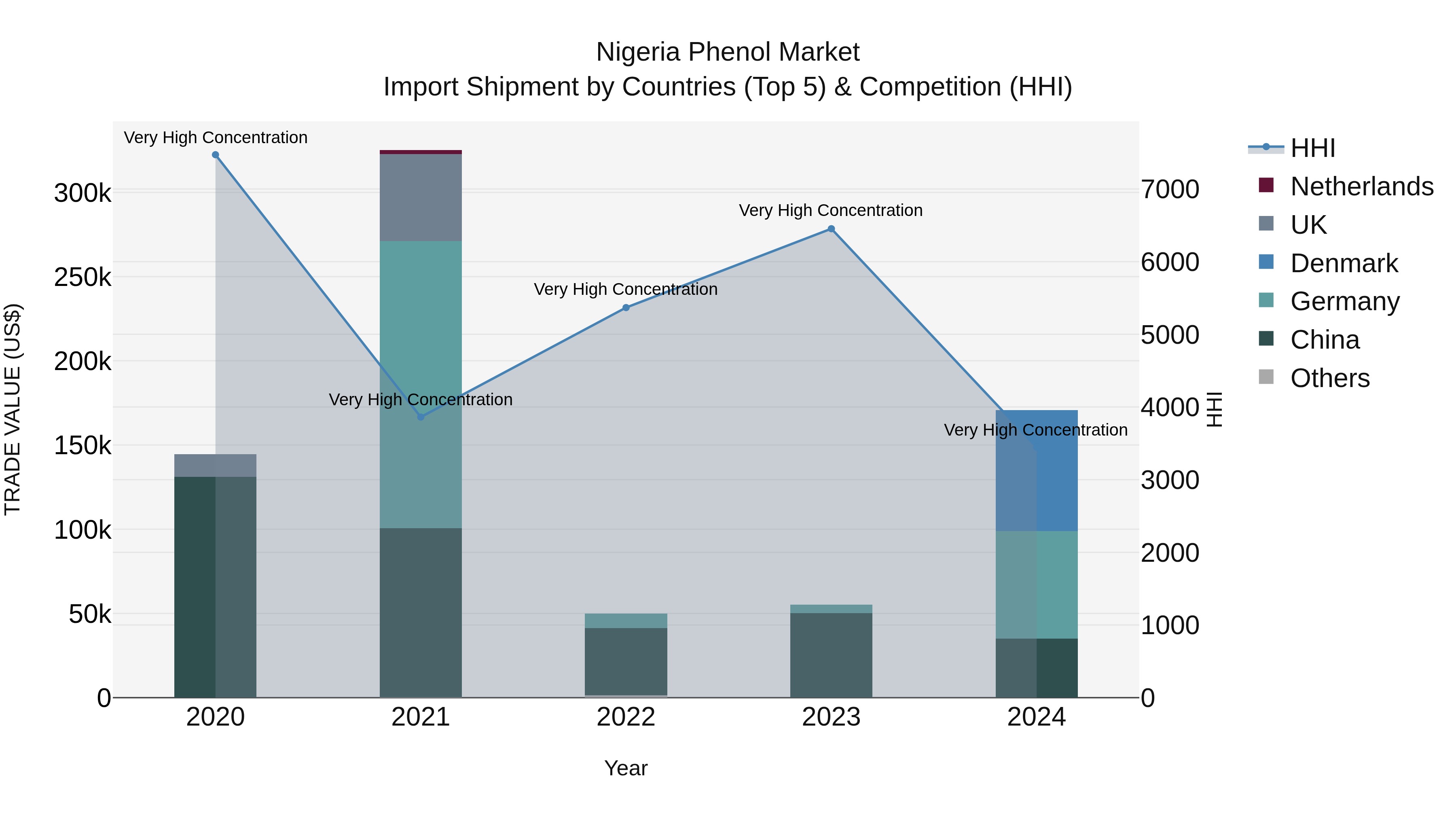
In 2024, Nigeria continued to import phenol primarily from Denmark, Germany, China, India, and the Netherlands. The market exhibited high concentration, as indicated by the high Herfindahl-Hirschman Index (HHI). The compound annual growth rate (CAGR) from 2020 to 2024 stood at a steady 4.24%, with a notable surge in the growth rate from 2023 to 2024 at 208.55%. These trends suggest a strong demand for phenol in Nigeria, with key suppliers maintaining a dominant presence in the market.
Nigeria Phenol Market Overview
The Nigeria Phenol Market is experiencing steady growth due to increasing demand from various industries such as pharmaceuticals, paints and coatings, and automotive sectors. Phenol, a key chemical compound used in the production of various consumer goods, is witnessing rising consumption in Nigeria driven by the expanding industrial sector and growing population. The market is also influenced by factors such as technological advancements in production processes, government regulations, and fluctuating raw material prices. Key players in the Nigeria Phenol Market are focusing on strategic collaborations, product innovations, and expansion of production capacities to gain a competitive edge in the market. Overall, the market is expected to continue its growth trajectory in the coming years, driven by the increasing application of phenol in diverse industries.
Nigeria Phenol Market Trends
Currently, the Nigeria Phenol Market is experiencing growth driven by various factors. One significant trend is the increasing demand for phenol as a key ingredient in the production of resins, adhesives, and pharmaceuticals. The rise in construction and infrastructure projects in Nigeria has also fueled the demand for phenol-based products. Additionally, the growing awareness about the benefits of phenol in industries such as healthcare, automotive, and electronics is contributing to market expansion. However, challenges such as fluctuating raw material prices and environmental concerns regarding phenol production processes are also influencing market dynamics. Overall, the Nigeria Phenol Market is poised for steady growth in the coming years with opportunities for innovation and sustainability driving the market forward.
Nigeria Phenol Market Challenges
In the Nigeria Phenol Market, some key challenges include fluctuating prices of raw materials, such as benzene, which impact the cost of production and ultimately the selling price of phenol. Additionally, inconsistent supply chain logistics and infrastructural limitations can lead to delays in product delivery and increased operational costs. Regulatory hurdles and compliance issues also pose challenges for phenol manufacturers in Nigeria, potentially affecting market growth and expansion. Furthermore, competition from imported phenol products and the need for continuous innovation to meet changing consumer demands add complexity to the market landscape. Overall, navigating these challenges requires strategic planning, efficient resource management, and a deep understanding of both domestic and global market dynamics.
Nigeria Phenol Market Investment Opportunities
Investment opportunities in the Nigeria Phenol Market include the growing demand for phenol in various industries such as pharmaceuticals, plastics, and chemicals. With Nigeria`s expanding economy and increasing industrialization, there is a rising need for phenol as a key raw material in the production of products like bisphenol-A, phenolic resins, and caprolactam. Investing in phenol production facilities or partnering with existing manufacturers can be lucrative, especially with the potential for export opportunities to neighboring countries in West Africa. Additionally, focusing on sustainable and environmentally friendly production methods can attract investors and consumers alike, as the global trend towards eco-friendly products continues to gain traction. Understanding the market dynamics, regulatory environment, and consumer preferences will be essential for successful investment in the Nigeria Phenol Market.
Nigeria Phenol Market Government Policy
Government policies related to the Nigeria Phenol Market include regulations on production, importation, and distribution of phenol. The Nigerian government imposes tariffs on imported phenol to protect local industries, while also promoting domestic production through incentives and subsidies. Environmental regulations are also in place to ensure safe handling and disposal of phenol, as it is considered a hazardous chemical. Additionally, there may be regulations on pricing and quality standards to maintain market stability and protect consumer interests. Overall, the government plays a significant role in shaping the Nigeria Phenol Market through various policies aimed at balancing economic growth with environmental protection and consumer safety.
Nigeria Phenol Market Future Outlook
The Nigeria Phenol market is poised for significant growth in the coming years due to increasing demand from various end-use industries such as construction, automotive, electronics, and pharmaceuticals. Factors driving this growth include rising population, urbanization, and industrialization in the country. Additionally, government initiatives to promote local manufacturing and investments in infrastructure development are expected to further boost the market. However, challenges such as fluctuating raw material prices, environmental regulations, and competition from imports may impact market growth. Overall, with increasing industrial activities and a growing economy, the Nigeria Phenol market is likely to see sustained growth in the future, presenting opportunities for both domestic producers and international players looking to enter the market.
Key Highlights of the Report:
- Nigeria Phenol Market Outlook
- Market Size of Nigeria Phenol Market, 2021
- Forecast of Nigeria Phenol Market, 2031
- Historical Data and Forecast of Nigeria Phenol Revenues & Volume for the Period 2021 - 2031
- Nigeria Phenol Market Trend Evolution
- Nigeria Phenol Market Drivers and Challenges
- Nigeria Phenol Price Trends
- Nigeria Phenol Porter's Five Forces
- Nigeria Phenol Industry Life Cycle
- Historical Data and Forecast of Nigeria Phenol Market Revenues & Volume By End-users for the Period 2021 - 2031
- Historical Data and Forecast of Nigeria Phenol Market Revenues & Volume By Bisphenol A for the Period 2021 - 2031
- Historical Data and Forecast of Nigeria Phenol Market Revenues & Volume By Phenolic Resins for the Period 2021 - 2031
- Historical Data and Forecast of Nigeria Phenol Market Revenues & Volume By Caprolactam for the Period 2021 - 2031
- Historical Data and Forecast of Nigeria Phenol Market Revenues & Volume By Alkyl Phenyls for the Period 2021 - 2031
- Historical Data and Forecast of Nigeria Phenol Market Revenues & Volume By Others for the Period 2021 - 2031
- Nigeria Phenol Import Export Trade Statistics
- Market Opportunity Assessment By End-users
- Nigeria Phenol Top Companies Market Share
- Nigeria Phenol Competitive Benchmarking By Technical and Operational Parameters
- Nigeria Phenol Company Profiles
- Nigeria Phenol Key Strategic Recommendations






































