Chile Predictive Maintenance Market Size & Growth Rate (2026-2032)
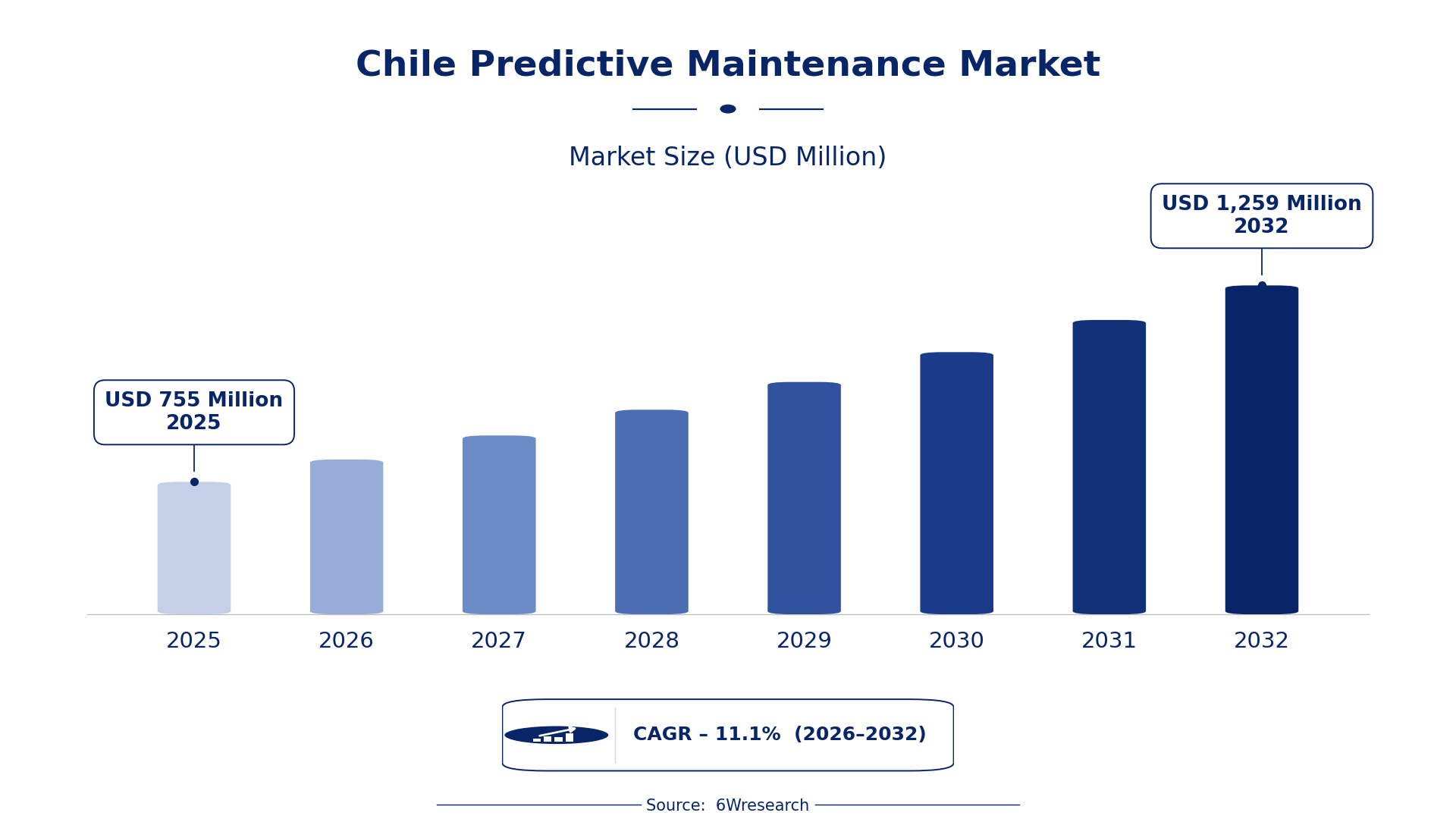
The Chile Predictive Maintenance Market was estimated at USD 755 Million in 2025 and is projected to reach USD 1259 Million by 2032, growing at a CAGR of 11.1% from 2026 to 2032.
Chile Predictive Maintenance Market Synopsis
The Chile Predictive Maintenance Market is currently on an upward trajectory, driven by the rapid integration of advanced technologies across sectors such as manufacturing, energy, and transportation. Businesses are increasingly adopting predictive maintenance solutions to enhance operational efficiency and prevent unplanned downtimes.
As organizations recognize the tangible benefits of predictive maintenance, including reduced costs and optimized asset performance, the market's growth is expected to accelerate. Government initiatives promoting digital transformation further bolster this trend, creating an environment ripe for innovation and investment.
Chile Predictive Maintenance Market Year-wise Growth Rate and Key Drivers
This graph illustrates the annual growth rates of the Chile Predictive Maintenance Market from 2021 to 2032, highlighting a steady upward trajectory and projected expansion over the forecast period.
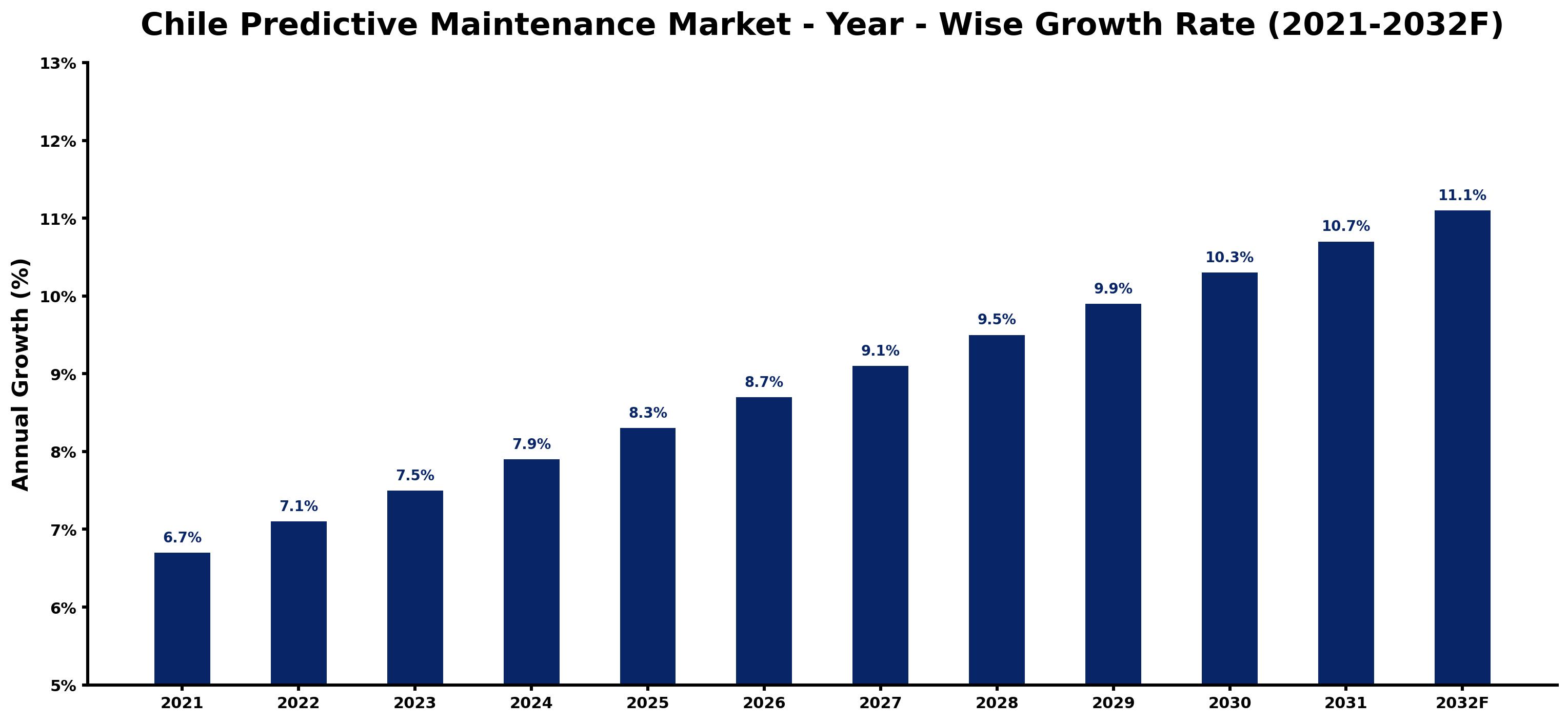
The table below presents the year‑wise growth rates along with the key drivers influencing the market
| Year | Growth Rate | Major Drivers |
| 2021 | 6.7% | Adoption of Industry 4.0 standards in mining sector. |
| 2022 | 7.1% | Increased investment in smart grid technologies nationwide. |
| 2023 | 7.5% | National strategy promoting predictive analytics in utilities. |
| 2024 | 7.9% | Growth in IoT technology adoption among local manufacturers. |
| 2025 | 8.3% | Regulatory incentives for implementing maintenance automation. |
| 2026 | 8.7% | Emerging focus on data-driven decision making in industries. |
| 2027 | 9.1% | Support from Chilean government for technology startups. |
| 2028 | 9.5% | Rising labor costs push firms toward predictive solutions. |
| 2029 | 9.9% | Improvements in connectivity enabling remote monitoring systems. |
| 2030 | 10.3% | Collaborative initiatives between universities and industry leaders. |
| 2031 | 10.7% | Increased cyber risk awareness demanding robust maintenance tech. |
| 2032 | 11.1% | Strong focus on sustainability driving predictive maintenance adoption. |
Note: Market size estimations and growth projections presented in this report are based on 6Wresearch's proprietary forecasting methodology, utilizing the latest available industry data, government publications, and primary research inputs.
Chile Predictive Maintenance Market Key Takeaways
Below are some of the specific key takeaways from the market, including:
- The market is increasingly driven by the adoption of IoT and AI technologies.
- Government support is vital for digital transformation initiatives across industries.
- Investment in predictive maintenance technologies is essential for companies aiming to remain competitive.
- There is a growing demand for tailored solutions in sectors like mining and energy.
- Challenges related to workforce skills and standardization remain significant hurdles.
Evaluation of Restraints in Chile Predictive Maintenance Market
Despite the promising outlook, the Chile Predictive Maintenance Market faces notable restraints that hinder its full potential. One major issue is the absence of standardized practices and regulations, which creates inconsistency in implementation across various industries. This leads to uncertainty in the effectiveness of predictive maintenance programs.
on top of that, the shortage of skilled professionals adept in data analytics and condition monitoring technologies presents a significant barrier to entry for companies looking to adopt predictive maintenance solutions. Without the right expertise, organizations may struggle to realize the benefits of these technologies, limiting the overall market growth.
Chile Predictive Maintenance Market Trends
Current trends indicate a heightened focus on real-time monitoring and data-driven decision-making. Companies are increasingly leveraging machine learning algorithms to predict equipment failures and optimize maintenance schedules. The integration of IoT devices is also becoming more common, providing valuable insights into equipment conditions.
on top of that, there is a noticeable shift toward preventive maintenance strategies that emphasize long-term asset reliability and safety. As businesses in Chile embrace these trends, the demand for innovative predictive maintenance solutions is expected to grow significantly.
Chile Predictive Maintenance Market Opportunities
The market presents several lucrative opportunities for solution providers. Companies that can develop customized predictive maintenance solutions tailored to the unique needs of industries such as mining, manufacturing, and energy will find a growing customer base. Additionally, firms that integrate advanced analytics and real-time monitoring capabilities are particularly well-positioned to meet the rising demand.
As awareness of the advantages of predictive maintenance continues to expand, organizations are likely to allocate more resources to implement these solutions. This shift will create fertile ground for innovation and investment in the predictive maintenance sector.
Government Initiatives in the Chile Predictive Maintenance Market
Government policy is playing a crucial role in shaping the future of the Chile Predictive Maintenance Market. With a focus on fostering innovation and technology adoption, public initiatives are designed to support the integration of predictive maintenance solutions across various industries. The regulatory framework encourages collaboration between businesses and research institutions to advance predictive maintenance technologies.
- A recently launched initiative aims to provide funding for tech startups focusing on predictive maintenance solutions.
- Current efforts include promoting public-private partnerships to enhance digital infrastructure for predictive maintenance applications.
- A planned regulatory framework is expected to establish best practices for predictive maintenance implementation by 2027.
- The government is currently rolling out incentives for companies investing in research and development activities related to predictive maintenance.
- Upcoming initiatives will focus on enhancing workforce training programs to address the skills gap in predictive maintenance technologies.
Future Insights of the Chile Predictive Maintenance Market
Looking ahead to 2026-2032, the Chile Predictive Maintenance Market is set to expand as businesses increasingly recognize the strategic value of predictive maintenance. The integration of emerging technologies such as AI and machine learning will continue to drive innovation and efficiency in maintenance processes.
As companies prioritize operational excellence and sustainability, the demand for predictive maintenance solutions will likely surge. This growth will create ample opportunities for market players to innovate and differentiate their offerings.
Chile Predictive Maintenance Market Latest Developments
In the past year, the Chile Predictive Maintenance Market has witnessed dynamic changes, with numerous advancements in technology and business practices. Companies are rapidly adopting predictive maintenance tools to enhance their operational efficiencies, driven by the need to remain competitive in a challenging economic environment.
- A major technology vendor announced a rollout of an advanced predictive maintenance software solution in Q1 2025.
- A regional operator is currently upgrading its maintenance systems to incorporate real-time data analytics, enhancing operational transparency.
- An industry consortium launched a collaborative project in mid-2025 focused on developing standardized metrics for predictive maintenance success.
- Plans are underway for a comprehensive workforce training program set to begin in late 2025, aimed at closing the skills gap in predictive maintenance.
Chile Predictive Maintenance Market - Key Attractiveness of the Report
- 10 Years of Market Numbers
- Historical Data Starting from 2022 to 2025
- Base Year: 2025
- Forecast Data until 2032
- Key Performance Indicators Impacting the Market
- Major Upcoming Developments and Projects
The government is promoting innovation through initiatives like Start-Up Chile and providing incentives for R&D in predictive maintenance technologies, which fosters a supportive environment for market growth.
Key Highlights of the Report:
- Chile Predictive Maintenance Market Outlook
- Market Size of Chile Predictive Maintenance Market, 2025
- Forecast of Chile Predictive Maintenance Market, 2032
- Historical Data and Forecast of Chile Predictive Maintenance Revenues & Volume for the Period 2022-2032F
- Chile Predictive Maintenance Market Trend Evolution
- Chile Predictive Maintenance Market Drivers and Challenges
- Chile Predictive Maintenance Price Trends
- Chile Predictive Maintenance Porter's Five Forces
- Chile Predictive Maintenance Industry Life Cycle
- Historical Data and Forecast of Chile Predictive Maintenance Market Revenues & Volume By Component for the Period 2022-2032F
- Historical Data and Forecast of Chile Predictive Maintenance Market Revenues & Volume By Solutions for the Period 2022-2032F
- Historical Data and Forecast of Chile Predictive Maintenance Market Revenues & Volume By Services for the Period 2022-2032F
- Historical Data and Forecast of Chile Predictive Maintenance Market Revenues & Volume By Organization Size for the Period 2022-2032F
- Historical Data and Forecast of Chile Predictive Maintenance Market Revenues & Volume By Large Enterprises for the Period 2022-2032F
- Historical Data and Forecast of Chile Predictive Maintenance Market Revenues & Volume By SME for the Period 2022-2032F
- Historical Data and Forecast of Chile Predictive Maintenance Market Revenues & Volume By Deployment Mode for the Period 2022-2032F
- Historical Data and Forecast of Chile Predictive Maintenance Market Revenues & Volume By On-premises for the Period 2022-2032F
- Historical Data and Forecast of Chile Predictive Maintenance Market Revenues & Volume By Cloud for the Period 2022-2032F
- Historical Data and Forecast of Chile Predictive Maintenance Market Revenues & Volume By Vertical for the Period 2022-2032F
- Historical Data and Forecast of Chile Predictive Maintenance Market Revenues & Volume By Government and Defense for the Period 2022-2032F
- Historical Data and Forecast of Chile Predictive Maintenance Market Revenues & Volume By Manufacturing for the Period 2022-2032F
- Historical Data and Forecast of Chile Predictive Maintenance Market Revenues & Volume By Energy and Utilities for the Period 2022-2032F
- Historical Data and Forecast of Chile Predictive Maintenance Market Revenues & Volume By Transportation and Logistics for the Period 2022-2032F
- Historical Data and Forecast of Chile Predictive Maintenance Market Revenues & Volume By Healthcare and Life Sciences for the Period 2022-2032F
- Chile Predictive Maintenance Import Export Trade Statistics
- Market Opportunity Assessment By Component
- Market Opportunity Assessment By Organization Size
- Market Opportunity Assessment By Deployment Mode
- Market Opportunity Assessment By Vertical
- Chile Predictive Maintenance Top Companies Market Share
- Chile Predictive Maintenance Competitive Benchmarking By Technical and Operational Parameters
- Chile Predictive Maintenance Company Profiles
- Chile Predictive Maintenance Key Strategic Recommendations






































